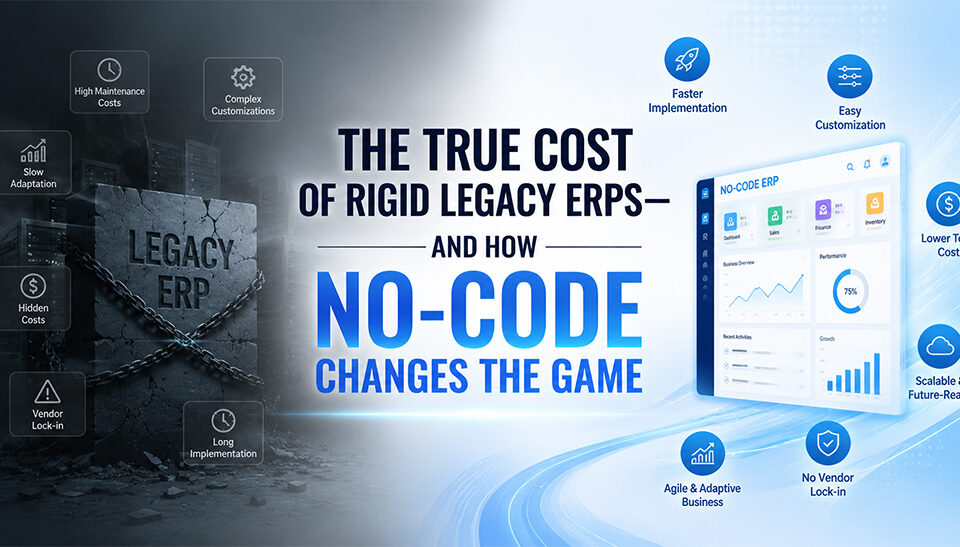

A legacy ERP rarely becomes expensive because of its original purchase price. Instead, the real cost appears years later through customization, maintenance, integrations, workarounds, slow reporting, upgrade difficulties, and the growing dependence on technical specialists.
For many businesses, replacing an ERP also feels risky. Employees have learned existing processes, historical data is already inside the system, and critical operations depend on workflows that may have been customized over several years. Consequently, companies often continue paying for an ERP that no longer fits the way they operate.
That is where the conversation around no-code ERP becomes important. Rather than forcing every business process into rigid software structures, a modern no-code ERP can allow organizations to configure workflows, forms, reports, approvals, and applications with significantly less dependence on conventional software development.
The objective, therefore, is not simply to replace an old ERP. It is to reduce the cost of changing the business.
What Is the True Cost of a Legacy ERP?
The visible ERP cost usually includes licensing, implementation, infrastructure, support, and maintenance. However, the hidden cost is often much larger. Consider a manufacturing company that needs a new approval workflow. With a rigid ERP, the request may require requirement analysis, technical design, coding, testing, deployment, documentation, and ongoing support. Meanwhile, employees may continue using spreadsheets or emails because the required change is taking too long.
As a result, the organization pays twice: once for the ERP and again for the manual process surrounding it. Research into ERP environments continues to show that customization, integration, long system lifecycles, and mixed technology environments remain significant modernization considerations. PMMI’s 2025 ERP survey, for example, found continued reliance on long-lived ERP systems alongside increasing cloud adoption and widespread use of supplemental software and custom integrations.
Therefore, the real cost of legacy ERP should be measured by the cost of ownership plus the cost of business change.
Why Rigid ERP Customization Becomes Expensive
Customization is not automatically bad. In fact, businesses often need customization because standard ERP workflows cannot accommodate every operational requirement. The problem begins when every change becomes a development project. Suppose a company wants to modify a purchase approval process. Later, it wants another approval level for high-value purchases. Then it needs a different workflow for a particular branch. Eventually, it requires additional fields, reports, alerts, and integrations.
Individually, each request may appear small. Collectively, however, they can create a highly customized ERP that becomes difficult to understand and maintain. This creates what can be called ERP technical debt: the accumulated complexity created when yesterday’s custom solutions become tomorrow’s maintenance burden. The business consequently becomes afraid to change its own software.
Legacy ERP Integration Creates Another Hidden Cost
Modern businesses rarely operate with ERP alone. CRM platforms, e-commerce applications, payroll systems, banking platforms, production systems, logistics applications, supplier portals, analytics tools, and customer-facing applications frequently need to exchange information with ERP.
However, rigid legacy platforms can make integration difficult, especially when older architectures, proprietary interfaces, limited APIs, or heavily customized databases are involved. That creates another familiar situation: employees manually export data from one system and import it into another. Although this appears to be a simple workaround, it creates duplicate data entry, reconciliation work, reporting delays, and greater opportunities for human error.
Recent ERP research also highlights the continued use of supplemental applications and custom integrations around ERP environments, reinforcing the importance of integration when organizations modernize their systems.
The Cost of Slow ERP Changes Is Often Ignored
One of the most underestimated ERP costs is the cost of waiting. A business may identify an operational problem today but receive a software change weeks or months later. During that period, employees create spreadsheets, maintain parallel processes, send emails, or manually verify information.
Consequently, the organization loses more than development time. It loses operational efficiency. For example, imagine a sales team that needs a new quotation approval process. If the ERP cannot be changed quickly, salespeople may continue seeking approvals through email. Management then loses centralized visibility, while employees spend additional time following up. Therefore, ERP agility directly influences operational productivity.
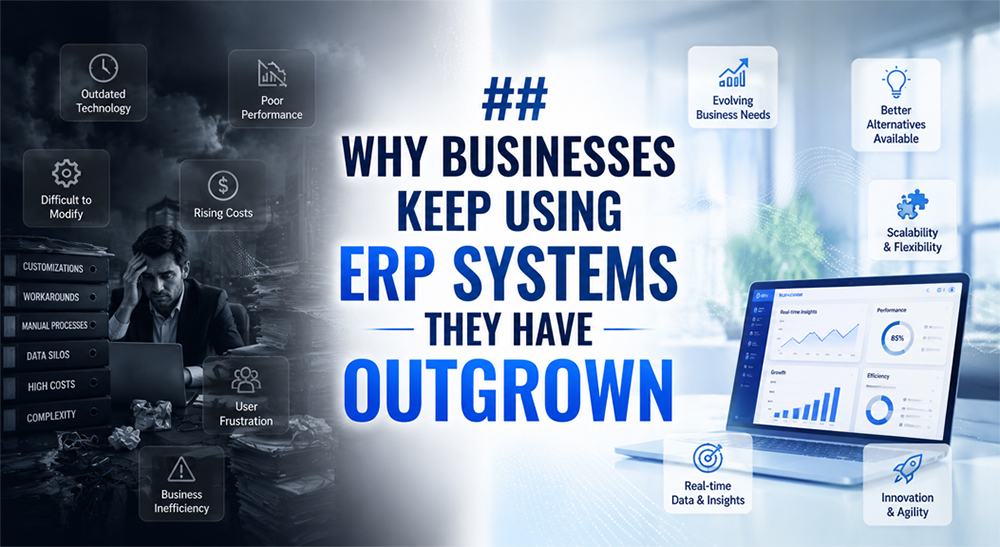
Why Businesses Keep Using ERP Systems They Have Outgrown
The biggest reason is not always satisfaction. It is risk. ERP replacement can involve data migration, employee training, process redesign, integrations, testing, reporting, and organizational change. Consequently, management may decide that continuing with the existing platform is safer than replacing it.
This creates a dangerous cycle. The company postpones modernization because migration appears expensive. Meanwhile, maintenance costs increase, integrations become harder, employees develop workarounds, and the technology becomes increasingly difficult to change.
Eventually, modernization becomes more urgent—and potentially more disruptive. A better strategy is to evaluate ERP modernization according to business impact rather than treating replacement as an all-or-nothing technology project.
How No-Code ERP Changes the Economics of ERP Customization
No-code ERP changes the model by moving more business application development toward visual configuration rather than traditional programming. Instead of asking, “How much will it cost developers to change this feature?” businesses can increasingly ask, “How quickly can we configure this process?”
That distinction matters. A no-code approach can allow authorized users or implementation teams to configure forms, workflows, approvals, dashboards, reports, and business rules without writing conventional application code for every requirement.
As a result, smaller business changes can potentially move from long development cycles toward shorter configuration cycles. The benefit is not simply faster development. It is lower change friction.
No-Code ERP Reduces Dependence on Hard-Coded Workflows
Rigid ERP systems typically define business processes through software logic. Changing that logic may require development expertise. No-code platforms approach the problem differently by representing more business requirements through configurable components. For example, a company may need an approval workflow where purchase requests above a particular value require finance approval, while requests below that threshold follow a simpler route.
Instead of building a new application from scratch, a no-code ERP can represent the workflow through configurable rules. Consequently, business teams can spend more time improving the process and less time explaining every small change to developers.
However, this does not mean that developers disappear. Complex integrations, architecture, security, performance, and advanced extensions still require technical expertise. The difference is that developers can focus on higher-value technical work instead of repeatedly rebuilding routine business workflows.
No-Code ERP Can Help Control ERP Technical Debt
Technical debt grows when every change adds another layer of complexity. No-code platforms can reduce this problem when they provide standardized configuration, reusable components, centralized business rules, controlled workflows, and maintainable application structures. That makes future changes easier to manage.
For instance, if a business opens a new branch, it may need additional approval rules, users, forms, reports, and operational workflows. A configurable ERP can potentially adapt these elements without duplicating an entire custom application.
Therefore, the long-term advantage of no-code ERP is not merely implementation speed. It is the ability to keep the ERP aligned with the business as the business changes.
What About AI and No-Code ERP?
AI is adding another layer to ERP modernization. Businesses increasingly expect ERP platforms to support intelligent search, document processing, forecasting, anomaly detection, automated workflows, decision support, and natural-language interaction.
However, AI should not simply be added as a marketing feature. AI outputs need governance, validation, security, transparency, and human oversight. NIST’s AI Risk Management Framework emphasizes trustworthy AI characteristics such as validity, reliability, security, transparency, explainability, privacy, and fairness.
For that reason, a practical no-code ERP strategy should combine automation with appropriate human review rather than attempting to automate every decision. The stronger approach is AI-assisted business automation with configurable human control.
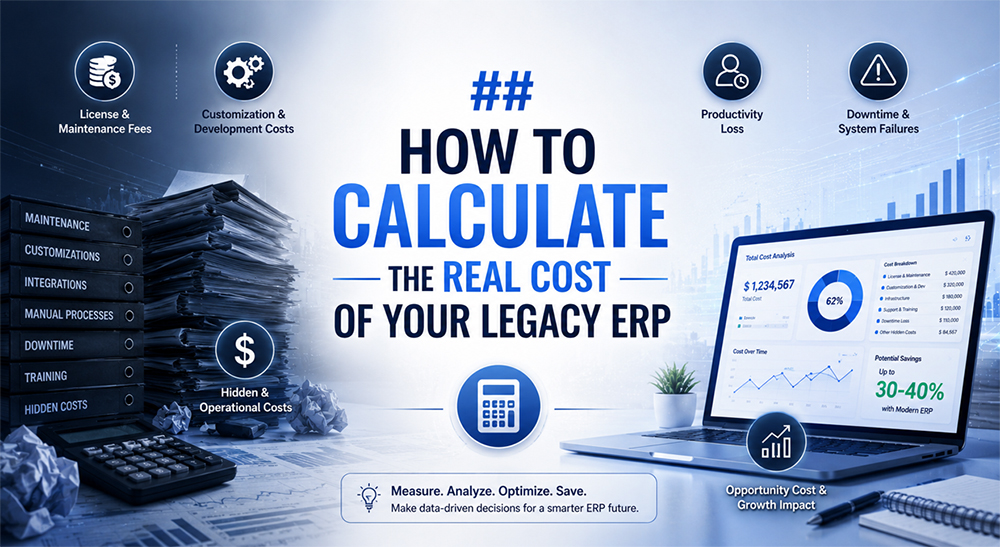
How to Calculate the Real Cost of Your Legacy ERP
A useful ERP modernization assessment should go beyond annual license fees. Start with the amount spent on ERP support and maintenance. Then consider the cost of custom development, third-party integrations, manual data entry, spreadsheet-based processes, reporting delays, employee workarounds, infrastructure, upgrade projects, and specialist dependency.
Next, calculate the cost of delayed business changes. If a new workflow takes three months to implement, ask what those three months cost the organization in lost productivity, delayed revenue, additional administration, or customer experience.
This creates a much more realistic picture of ERP total cost of ownership. The important question is therefore not simply, “How much does our ERP cost?”
It is:
“How much does it cost our business every time we need to change it?”
When Should a Business Consider No-Code ERP?
A business should seriously evaluate ERP modernization when routine changes require excessive development effort, employees increasingly depend on spreadsheets, integrations are becoming difficult to maintain, reporting requires manual consolidation, or the organization has become dependent on a small number of technical specialists.
The same applies when business teams regularly say, “The ERP cannot do that.” That statement is often a signal that the software has become a constraint rather than an enabler. A no-code ERP can be particularly valuable for growing businesses because requirements naturally change as the company adds products, branches, employees, customers, suppliers, compliance requirements, and new operating models.
The Future of ERP Is Not Just Cloud—It Is Adaptability
Moving a legacy ERP to the cloud can solve infrastructure and accessibility challenges. However, cloud deployment alone does not automatically eliminate rigid workflows or expensive customization. A cloud-based legacy ERP can still be difficult to modify.
Therefore, the next generation of ERP modernization needs to focus on adaptability, integration, automation, configurability, and responsible AI. That is why no-code ERP is gaining attention as an alternative approach to traditional ERP customization. The value is not simply that users can build applications without writing code. The deeper value is that the organization can respond to operational change with less software friction.
Frequently Asked Questions About Legacy ERP and No-Code ERP
What is a legacy ERP system?
A legacy ERP system is an older enterprise resource planning platform that may still support critical business operations but can become difficult to maintain, integrate, upgrade, or customize as business requirements evolve.
Why are legacy ERP systems expensive?
Legacy ERP costs extend beyond licensing. Maintenance, customization, integrations, manual workarounds, infrastructure, upgrades, technical expertise, and delayed business changes can significantly increase the total cost of ownership.
Can no-code ERP replace a legacy ERP?
Yes, depending on the organization’s requirements, a no-code ERP can replace or modernize processes handled by a legacy ERP. However, businesses should evaluate data migration, integrations, security, scalability, compliance, reporting, and implementation requirements before making the transition.
Is no-code ERP suitable for manufacturing businesses?
Yes. Manufacturing organizations can use configurable ERP workflows for areas such as production, inventory, purchasing, sales, quality, approvals, costing, and reporting. The exact suitability depends on the complexity of the manufacturing environment and required integrations.
Does no-code ERP eliminate developers?
No. Instead, it can reduce the amount of conventional development required for routine business changes. Developers can consequently focus on architecture, integrations, advanced functionality, security, and other technically complex requirements.
How does no-code ERP reduce ERP implementation costs?
No-code ERP can reduce implementation effort by allowing more application components and business workflows to be configured rather than custom-coded. The actual savings depend on the platform, project scope, integrations, data migration, and complexity of the business processes.
The Bottom Line: Your ERP Should Adapt to Your Business
A rigid ERP becomes expensive when every business change turns into a software project. That is the true cost many organizations overlook. The solution is not necessarily to abandon ERP altogether. Instead, businesses need an ERP architecture that can evolve with their processes, people, customers, and growth.
No-code ERP offers a different approach: configure more, code less, integrate intelligently, automate responsibly, and make future changes easier. For organizations evaluating modernization, the right question is therefore not simply, “Should we replace our legacy ERP?”
A better question is:
“Can our ERP change as quickly as our business needs to change?”
If the answer is no, the cost of staying with the legacy system may already be higher than the cost of modernization.
Ready to find out where your ERP is creating hidden costs? Start with an ERP modernization assessment. Identify your customization burden, manual processes, integration gaps, reporting delays, and change costs before committing to a replacement.
Book a free ERP consultation with BlueChip Solutions to explore how a configurable, no-code ERP approach can help modernize business processes while reducing unnecessary development dependency.
Suggested Lead Magnet
Free Legacy ERP Cost & Modernization Assessment
Enter your current ERP maintenance cost, customization effort, manual processes, integration challenges, reporting workload, and upgrade frequency to estimate your hidden ERP change cost and identify where no-code automation could deliver the greatest operational impact.
Editorial note: ERP modernization data and AI governance references in this article have been aligned with current publicly available 2025–2026 research and guidance. Specific implementation savings should be validated against an organization’s actual ERP architecture, processes, integrations, and migration scope rather than assumed as universal percentages.