
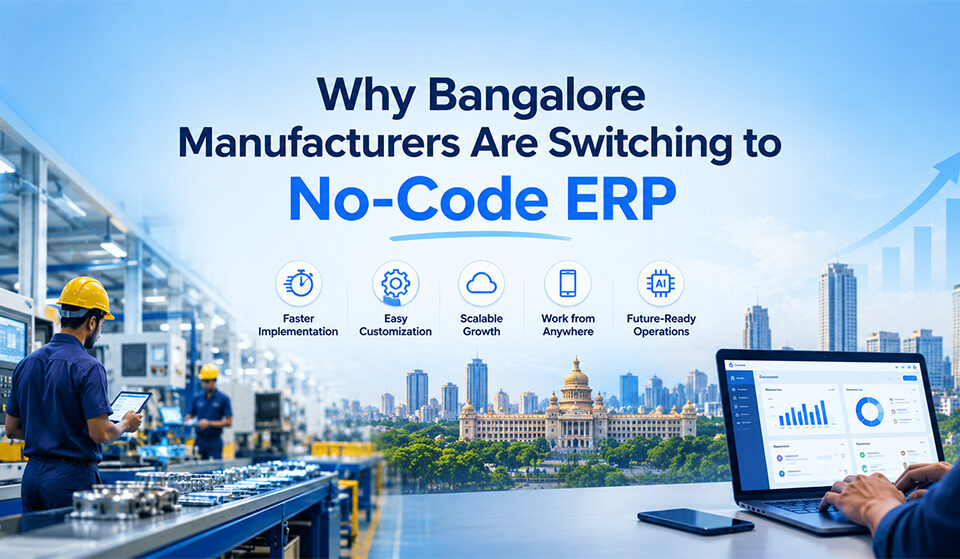

Bangalore’s manufacturing sector is expanding across electronics, engineering, automotive components, machinery, aerospace, food processing, garments, pharmaceuticals, and other industrial segments. However, growth is also exposing a problem that many manufacturing CEOs and operations leaders already know: the business is changing faster than the ERP system supporting it.
A new product may require a different production workflow. A customer may demand tighter delivery schedules. Management may need real-time production visibility. Finance may need faster reporting. Meanwhile, shop-floor teams may still depend on Excel, WhatsApp, paper records, and disconnected applications.
That is where No-Code ERP for manufacturing is gaining attention.
Instead of replacing the ERP every time the business process changes, a no-code or highly configurable ERP approach allows organisations to adapt workflows, screens, approvals, reports, dashboards and business processes with significantly less dependence on traditional software development.
For Bangalore manufacturers, the attraction is therefore not simply “ERP without coding.” The bigger question is how quickly the ERP can adapt when the manufacturing business itself changes.
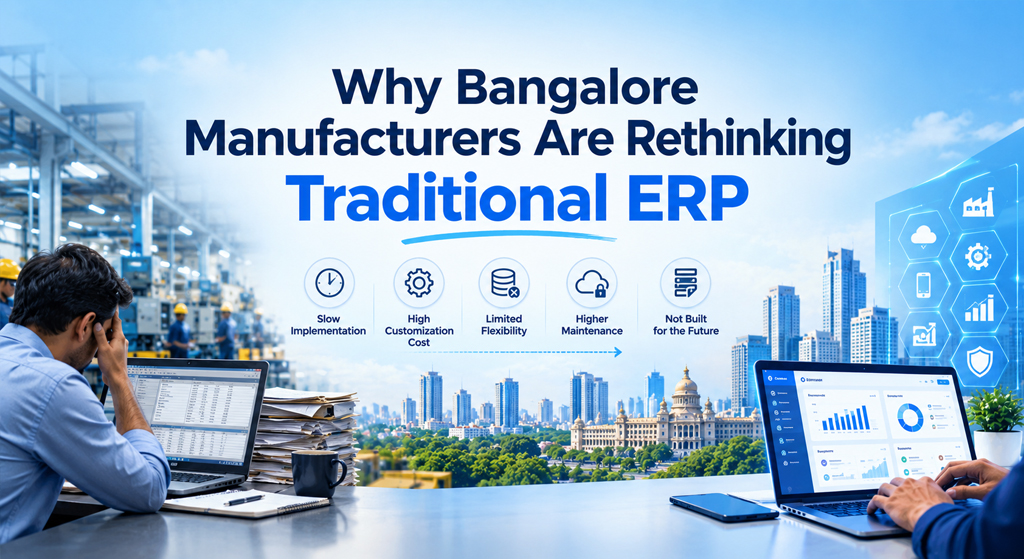
Why Bangalore Manufacturers Are Rethinking Traditional ERP
Bangalore has a highly diverse manufacturing ecosystem. A growing manufacturer may begin with basic accounting, inventory and production management. However, as orders, plants, suppliers, SKUs and compliance requirements increase, operational complexity increases as well.
Consequently, the ERP that worked for a smaller operation can become difficult to adapt. A manufacturing company might need a customised approval before releasing a production order. Another may need a different quality inspection process for every product category. A third may require subcontracting, batch tracking, serial-number control or customer-specific documentation.
Traditional ERP systems can support many of these processes. The problem often appears when the business wants to change how those processes work. A seemingly simple modification may require a vendor, developer, implementation partner or lengthy change-request cycle. For a growing manufacturer, that creates a hidden cost: business agility becomes dependent on software modification.
The Biggest Pain Point: Manufacturing Processes Keep Changing
Manufacturing is rarely static. A Bangalore manufacturer may add a new production line, introduce a new SKU, change its bill of materials, onboard a new supplier, modify approval levels or start serving a new industry. However, rigid ERP configurations can make these changes difficult. Suppose a company currently operates one approval process for purchase orders. Six months later, management wants separate approval levels based on purchase value, department and material category.
If the ERP cannot accommodate the change easily, employees may create manual workarounds. That can result in spreadsheets, emails, unofficial approval messages and duplicate data entry. Over time, these workarounds become part of the operational process.
No-code ERP addresses this problem by making configurability a central part of the system rather than treating every change as a major development exercise.
What Is No-Code ERP for Manufacturing?
No-code ERP is an ERP approach that allows business processes and application behaviour to be configured with minimal traditional programming. For manufacturers, this can include configuring workflows, forms, approval processes, business rules, dashboards, reports, notifications and data capture according to organisational requirements.
The important distinction is that no-code does not mean “no technology.” A serious manufacturing ERP still needs a strong underlying architecture, security controls, database management, APIs, reporting capabilities, access controls and integration capabilities.
The no-code layer should make the business-facing configuration easier without compromising the underlying enterprise system. That distinction is particularly important for CEOs evaluating ERP platforms. The question should not simply be, “Does this ERP require coding?”
Instead, ask:
“How much of our changing business process can we configure without depending on custom development every time?”
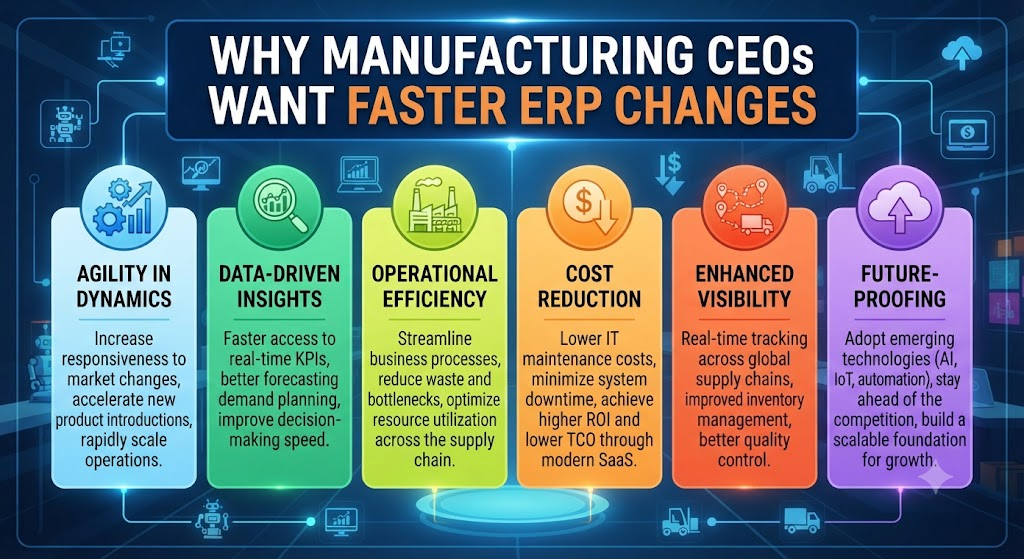
Why Manufacturing CEOs Want Faster ERP Changes
For a manufacturing CEO, ERP flexibility has a direct relationship with operational speed. Imagine a company introducing a new product family. The production team needs a new workflow. Procurement needs additional material controls. Quality needs inspection checkpoints. Finance needs new cost tracking. Management wants a dashboard showing production performance.
With a rigid ERP, these requirements may become separate IT requests. With a configurable ERP, many of these requirements can potentially be incorporated into the existing business framework. Therefore, the ERP becomes less of a fixed software package and more of an adaptable digital operating system for the business.
This is one of the reasons no-code ERP is becoming increasingly relevant to manufacturers that cannot afford long software-change cycles.
The Excel Problem Is Bigger Than It Looks
Many manufacturers do not completely lack software. Instead, they have too many disconnected tools. Production may be managed in one system. Inventory may be tracked in another. Accounts may operate through accounting software. Quality teams may maintain spreadsheets. Sales teams may use CRM tools. Shop-floor updates may arrive through WhatsApp.
Initially, this seems manageable. However, as the organisation grows, the gaps between these systems become expensive. A production manager may not know the latest inventory position. Procurement may not immediately see future material requirements. Finance may struggle to connect production costs with actual output. Management may receive reports after the situation has already changed.
Consequently, the real ERP problem is not always the absence of information. It is the absence of connected, timely and trustworthy information.
How No-Code ERP Can Connect Manufacturing Operations
A well-designed ERP can bring manufacturing processes into a common operational framework. Sales orders can influence production planning. Production requirements can influence material planning. Procurement can be connected with inventory. Quality checkpoints can be integrated into operational workflows. Production information can flow into management dashboards and financial reporting.
This creates a connected information flow. For example, when production quantities change, the organisation can have better visibility into material requirements, production schedules and expected completion. As a result, decision-makers spend less time asking different departments for separate spreadsheets. They can instead work from a common operational data environment.
Real-Time Production Visibility Is Becoming a Management Requirement
One of the biggest frustrations for manufacturing leadership is discovering operational problems after they have already affected delivery. A delayed production order may remain unnoticed until the promised dispatch date approaches. A material shortage may be discovered only when production is ready to start.
A quality issue may become visible after a significant quantity has already been produced. A real-time ERP environment can reduce this information delay. Dashboards can bring together production status, inventory movement, pending approvals, order progress, quality information and other operational indicators. The purpose is not to create more dashboards. The purpose is to help management identify exceptions early enough to act. That difference matters.
AI Makes ERP Data More Valuable — But Data Quality Comes First
Artificial intelligence is becoming an important part of enterprise software. However, manufacturers should be cautious about choosing an ERP simply because it advertises “AI.” AI becomes useful when the underlying ERP contains reliable, structured and connected operational data.
For example, an AI-assisted manufacturing environment could analyse historical production information, inventory movements, purchasing patterns, order behaviour and operational exceptions to identify potential risks. A machine-learning model can be trained on historical data to identify patterns associated with stock shortages, abnormal consumption, delays or other business events.
However, the quality of the prediction depends heavily on the quality of the underlying data. Therefore, AI-ready ERP starts with connected ERP data.
This is another reason configurable ERP architecture matters. As businesses introduce AI-driven analytics, forecasting and decision-support capabilities, the ERP must provide consistent and accessible operational data. AI should support decision-making rather than blindly replace managerial judgement.
No-Code ERP Can Reduce the Gap Between IT and Business Teams
Another challenge faced by growing manufacturers is the communication gap between business users and technical teams. A production manager understands the manufacturing process. An IT developer understands the software architecture. However, explaining every operational change through technical requirements can take time.
No-code and low-code approaches can reduce this gap by allowing authorised business or implementation teams to configure certain processes using more visual and business-oriented mechanisms. As a result, the organisation can potentially respond faster to process changes. This does not eliminate the need for IT governance.
Instead, it can allow technical teams to concentrate on architecture, integrations, security and complex requirements while business teams gain more flexibility over configurable processes.
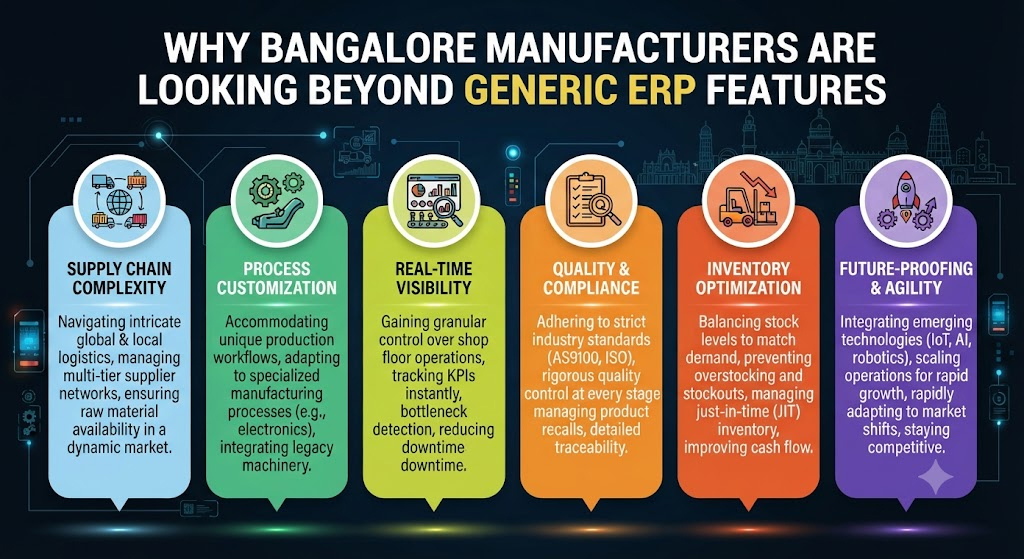
Why Bangalore Manufacturers Are Looking Beyond Generic ERP Features
ERP comparison is often reduced to a feature checklist. Does the system have inventory? Does it have accounting? it have production? Does it have purchasing? Does it have HR? Almost every established ERP can answer “yes” to many of these questions.
The more important question is what happens after implementation. Can the ERP adapt when the company introduces a new business process? and management change workflows without rebuilding the application? Can different departments work with connected information? the system support web and mobile users? Can dashboards evolve with management requirements?
Can integrations be added as the organisation grows? ERP become more intelligent as the company’s data grows? These questions provide a much better framework for evaluating ERP flexibility.
What Bangalore Manufacturing CEOs Should Check Before Choosing a No-Code ERP
A no-code claim alone should never be enough to select an ERP. Manufacturing leaders should examine how the platform actually handles configuration. They should understand whether workflows can be modified, how approvals are managed, how reports are created, how dashboards are configured and how integrations are supported.
They should also examine security. A flexible ERP must still provide appropriate access controls, auditability, data protection and governance. Implementation capability matters as well. Even the most flexible platform can fail if the implementation team does not understand the company’s manufacturing processes.
Therefore, the evaluation should include actual business scenarios rather than a generic product demonstration. Ask the vendor to demonstrate how the system would handle a real process from your organisation. For example, demonstrate a purchase approval, production workflow, quality checkpoint, subcontracting process or management dashboard using your actual business requirement. That is much more revealing than a standard sales presentation.
Where Auvit No-Code ERP Fits Into the Manufacturing Conversation
Bluechip Solutions offers Auvit No-Code ERP as a configurable ERP and business process automation platform designed to support changing business requirements. For manufacturers, the value proposition is centred around connecting business processes while providing flexibility for workflows, dashboards, document management, scheduling, notifications, reporting and other operational requirements.
Auvit’s web and mobile capabilities can also support users who need access to business information beyond a traditional desktop environment. More importantly, the platform is positioned around the idea that manufacturing companies should not have to treat every process change as a completely new software project. For a growing Bangalore manufacturer, that flexibility can become strategically important.
The Real ROI of No-Code ERP Is Not Just the Software Cost
ERP ROI is frequently calculated by comparing licence prices. However, manufacturing leaders should also consider the cost of waiting. If a process change takes months to implement, what does that delay cost the organisation? and employees spend hours reconciling spreadsheets, what is the annual productivity cost?
If management receives production information late, how much does that affect decision-making? If inventory information is inaccurate, how much working capital can become unnecessarily locked into stock? Therefore, the ROI of a flexible ERP should include time-to-change, operational visibility, productivity, data accuracy and decision speed. This provides a more realistic assessment of the technology investment.
The Future of Manufacturing ERP Is Flexible, Connected and AI-Ready
Bangalore manufacturers do not necessarily need another ERP filled with hundreds of features. They need an ERP that can keep up with the business. Manufacturing requirements will continue to change. New products will be introduced. Customers will demand faster fulfilment. Compliance requirements will evolve. AI will become increasingly integrated into planning and decision support.
Consequently, ERP flexibility will become increasingly important. The strongest ERP strategy is therefore not simply to purchase software that solves today’s problems. It is to choose a platform capable of evolving with tomorrow’s manufacturing requirements. That is the fundamental reason more manufacturers are evaluating no-code ERP.
Frequently Asked Questions About No-Code ERP for Manufacturing
Is no-code ERP suitable for manufacturing companies?
Yes. No-code ERP can be particularly useful for manufacturers that frequently change workflows, approval processes, reports, dashboards or operational requirements. However, the platform should still provide enterprise-grade security, data management, integration and governance capabilities.
Can no-code ERP replace traditional ERP?
No-code ERP is still ERP. The difference is primarily in how much of the business application can be configured and adapted without conventional software development. Businesses should evaluate the underlying architecture, manufacturing capabilities and implementation approach before making a decision.
Does no-code ERP mean there is no IT involvement?
Not necessarily. IT remains important for security, integrations, architecture, governance and complex technical requirements. No-code capabilities can instead reduce unnecessary dependence on development for certain business-level changes.
Is no-code ERP useful for small and medium manufacturers?
It can be particularly valuable for growing manufacturers because business processes often change rapidly as the company adds products, customers, employees, suppliers and locations. A flexible ERP can help the technology evolve alongside the organisation.
Can AI work with a no-code ERP?
Yes, provided the ERP creates reliable and structured operational data and offers suitable integration or analytics capabilities. AI should be viewed as a decision-support layer rather than a substitute for sound business processes and management judgement.
Ready to See How a Flexible ERP Could Work for Your Manufacturing Business?
The best way to evaluate ERP is not by watching another generic product demo. Instead, take one real manufacturing problem from your business and see how the ERP handles it. Bring your production workflow, approval structure, inventory challenge or reporting requirement.
Then evaluate how much configuration is possible, how quickly the process can be adapted and what visibility management receives.
Book a Free ERP Consultation with Bluechip Solutions and explore how Auvit No-Code ERP can support your manufacturing operations, workflows and future growth.