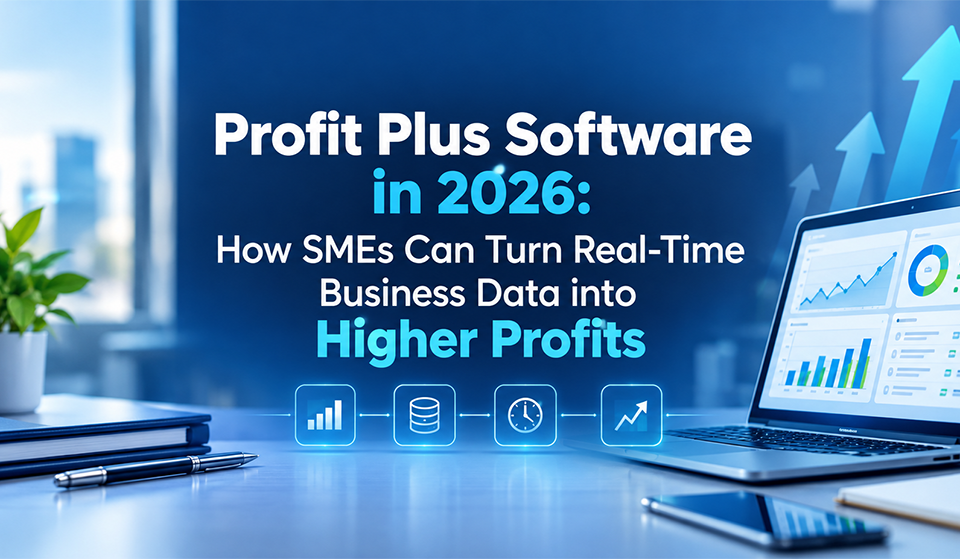
Profit Plus Software in 2026: How SMEs Can Turn Real-Time Business Data into Higher Profits

Growing sales do not always translate into higher profits. Many SMEs continue to face shrinking margins, rising inventory costs, delayed customer payments and unexpected operating expenses because they lack a clear, real-time view of business performance. By the time these issues appear in monthly reports, valuable time and money may already be lost.
Profit Plus Software in 2026 offers businesses an opportunity to improve financial visibility by connecting essential operations, from sales and inventory to purchasing and financial reporting. Instead of relying on scattered spreadsheets and outdated reports, decision-makers can use integrated business data to identify inefficiencies, control costs and make informed decisions faster. Furthermore, AI-driven analytics, where available, can help businesses identify unusual trends and anticipate potential risks.
In this article, discover how Profit Plus Software can help SMEs turn real-time business data into actionable insights, strengthen cost control and build a more profitable, sustainable business.
Why Growing SMEs Need Better Profit Visibility in 2026
A company can report rising sales every month and still struggle to maintain healthy profits. For many small and medium-sized enterprises (SMEs), the problem is not a lack of business activity. Instead, it is the inability to identify where money is being earned, spent, delayed or lost while operations are running.
For example, a manufacturing business may receive more orders but experience increasing raw material costs, production wastage and delayed customer payments. Similarly, a distribution company may increase its sales volume while tying up more working capital in slow-moving inventory. Although revenue appears healthy, the actual profit margin may continue to shrink.
This is where Profit Plus Software becomes relevant to business decision-makers. By connecting financial information with sales, purchasing, inventory and operational activities, an integrated ERP system can help management understand business performance beyond basic accounting figures.
More importantly, when information is updated consistently across departments, managers can identify problems earlier rather than discovering them after the month-end closing process. Consequently, they can make better-informed decisions about purchasing, pricing, production, collections and resource allocation.
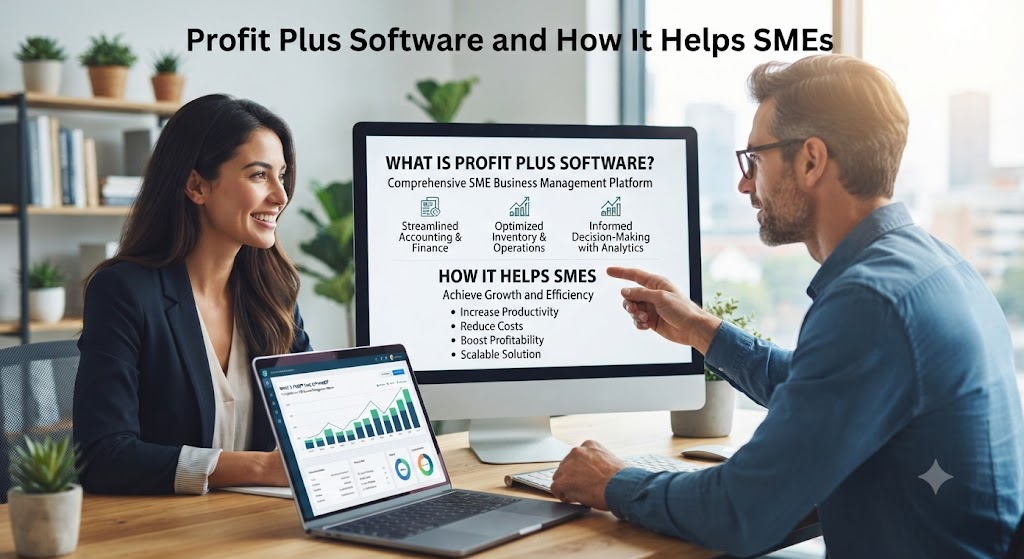
What Is Profit Plus Software and How Does It Help SMEs?
Profit Plus Software can be understood as a business management solution that helps organisations coordinate essential business processes and monitor their financial performance. Depending on the selected product and its configuration, an ERP platform can bring together accounting, sales, procurement, inventory, production and reporting within a connected business environment.
Traditionally, many SMEs manage these activities through separate spreadsheets, accounting applications and department-specific tools. Although this approach may work when transaction volumes are low, it becomes increasingly difficult as the business expands.
For instance, the sales team may confirm an order without knowing the latest inventory position. Meanwhile, purchasing may reorder materials that are already available, and finance may struggle to determine the actual cost of fulfilling that order. As a result, disconnected information creates unnecessary expenses and delays.
With an integrated ERP system, these processes can be connected through shared records, transaction updates and configured workflows. Therefore, management gains a more consistent view of sales, stock, outstanding payments and operating expenses.
However, software alone does not guarantee higher profits. The real value comes from accurate data, well-defined business processes and the ability to turn reports into timely action.
How Real-Time Business Data Helps SMEs Identify Hidden Profit Losses
Monitor Profit Margins Before They Deteriorate
A common mistake is to evaluate business performance only through total sales and overall revenue. However, higher sales do not automatically translate into higher profits. Consider a manufacturer that sells a product for ₹1,000. If its material, labour, production and other attributable costs increase from ₹700 to ₹850, the gross contribution from that sale falls from ₹300 to ₹150, assuming the same selling price and cost basis. Even if the company sells more units, the declining margin can place pressure on its overall profitability.
An ERP system can help management compare selling prices with relevant product costs, review margin variations and identify products that are becoming less profitable. Furthermore, management reports can reveal whether the pressure comes from material prices, discounts, production inefficiencies or other expenses. Consequently, business owners can review pricing, supplier terms and production methods before margin erosion becomes a larger financial problem.
Control Inventory Costs and Working Capital
Inventory is one of the most significant areas where growing SMEs can lose financial control. Excess stock consumes working capital, increases storage expenses and creates risks of damage, expiry or obsolescence. Conversely, insufficient stock can delay deliveries and cause lost sales.
For example, a distributor may continue purchasing a product because its spreadsheet shows previous demand, even though recent sales have slowed. Without a clear view of stock levels, purchase commitments and sales movement, the business may accumulate inventory that takes months to sell.
Profit Plus Software, when configured with appropriate inventory and purchasing capabilities, can help businesses monitor stock availability, stock ageing, reorder requirements and inventory valuation. Additionally, management can compare stock movement against demand to identify items that require purchasing changes or clearance strategies.
For manufacturing businesses, batch tracking, material consumption and production-related inventory records can provide further visibility into where materials are being used and where losses occur. As a result, companies can make purchasing decisions based on operational requirements instead of assumptions, helping release working capital for more productive business activities.
Improve Cash Flow and Receivables Management
Profitability and cash flow are related, but they are not the same. A company may record a profitable sale while waiting several weeks or months to receive payment. During that period, it still needs to pay employees, suppliers, transport providers and other operating expenses.
When receivables are managed through manual follow-ups, overdue invoices can remain unnoticed until cash shortages begin affecting daily operations. An integrated ERP solution can help finance teams track customer invoices, due dates, outstanding balances and payment histories. Where configured, automated reminders and escalation workflows can also support timely collection follow-ups.
Furthermore, managers can review overdue receivables alongside upcoming payment obligations to anticipate potential cash flow pressure. This visibility supports better decisions about credit limits, collection priorities and supplier payment schedules. Therefore, businesses can strengthen financial discipline without relying entirely on manual reporting or individual employees’ follow-up records.

How AI-Driven Analytics Can Support Smarter Profit Decisions
Traditional reports explain what has already happened. AI-assisted analytics and predictive models can potentially help businesses identify patterns, estimate likely outcomes and investigate unusual changes. Nevertheless, these capabilities depend on the ERP platform, available integrations, data quality and the specific analytical tools implemented. They should not be assumed to exist in every Profit Plus Software configuration.
Use Predictive Insights to Anticipate Business Risks
For example, a forecasting model may analyse historical sales, seasonal demand and recent order patterns to estimate future inventory requirements. Similarly, financial forecasting tools can use historical collections and payment behaviour to estimate potential cash flow gaps.
Anomaly detection can also flag unusual transactions, unexpected expense increases or significant deviations from normal inventory consumption. Management can then investigate whether the variation results from a genuine business change, a process issue or an incorrect entry.
However, AI-generated predictions are estimates rather than guarantees. Businesses should validate recommendations against current market conditions, operational constraints and human expertise. When used appropriately, these models help managers move from reactive reporting towards earlier risk identification and better planning.
Turn Business Dashboards into Actionable Decisions
A dashboard becomes useful when it answers a specific management question. For instance, a CFO may need to understand why operating costs increased, while a plant head may want to identify production lines with rising material consumption.
A well-configured ERP dashboard can bring relevant indicators together, such as sales performance, gross margins, inventory movement, overdue receivables and expense variations. With suitable permissions and drill-down reports, users can investigate the transactions behind a reported change.
Moreover, managers can establish thresholds and workflow notifications for selected exceptions. Consequently, the right person can review a problem while there is still time to respond. The objective is not to create more reports. Instead, it is to reduce the time between identifying a problem, understanding its cause and taking corrective action.
Why Disconnected Business Systems Reduce SME Profitability
As organisations grow, their processes often become more complicated than the systems supporting them. Sales data may sit in one application, accounts in another, inventory in spreadsheets and operational approvals in email conversations. This fragmentation creates several challenges. Employees spend time reconciling records, managers receive conflicting figures, and financial reports take longer to prepare. In addition, important decisions may be based on information that was accurate when recorded but is no longer current.
An integrated ERP environment helps reduce these gaps by establishing shared data, standardised transactions and controlled workflows. For example, a confirmed sales order can connect with stock availability, dispatch activities and invoicing, depending on the system configuration.
Likewise, purchasing records can be linked with goods receipts, supplier invoices and payments, allowing finance teams to reconcile business transactions more consistently. Nevertheless, successful implementation requires more than transferring existing spreadsheets into new software. Companies must review their workflows, assign responsibility for data accuracy, establish access controls and train employees to follow consistent processes.
This preparation is essential because unreliable source data can produce misleading reports, regardless of how advanced the software appears.
How SMEs Can Measure the Business Value of Profit Plus Software
Before investing in ERP software, management should establish a baseline against which improvements can be measured. Otherwise, it becomes difficult to determine whether the implementation is delivering meaningful business value. For example, a company can measure how long it takes to close monthly accounts, how frequently inventory records require correction, how much stock remains unsold beyond the target period and how many customer invoices become overdue.
Similarly, manufacturers can track material wastage, production yield and the difference between estimated and actual batch costs. Distributors can review inventory turnover, order fulfilment performance and gross margins across products or customers. After implementation, these measures can be reviewed at regular intervals to identify improvements and remaining gaps.
Importantly, the targets should reflect the company’s industry, transaction volume and operating model. A manufacturer with batch-based production requires different performance indicators from a service business managing project costs and billable hours.
By linking ERP usage to measurable business outcomes, management can evaluate software as an operational investment rather than simply another technology expense.

Why Bluechip Solutions for ERP-Led Business Visibility?
For SMEs evaluating Profit Plus Software, the right solution should support the way their business actually operates rather than forcing every department into disconnected workarounds. Bluechip Solutions offers ProfitPlus ERP and Auvit™ No-Code ERP capabilities to support business process integration, reporting and operational visibility. Auvit combines ERP functionality with a business process automation approach, helping organisations configure workflows and adapt processes as requirements evolve.
For growing businesses, this approach can be relevant when approval structures, reporting requirements and operating procedures change over time. Depending on the selected solution and implementation scope, businesses can connect core processes, improve access to operational information and reduce dependence on repetitive manual coordination.
However, the appropriate configuration depends on the organisation’s industry, existing systems, reporting requirements and integration needs. Therefore, a practical evaluation should establish which modules, workflows and dashboards are required before implementation begins.
Want to understand where your business is losing profit? Request an ERP consultation with Bluechip Solutions to discuss your current processes, reporting gaps and opportunities for better operational visibility.
Explore: https://bluechipsolutions.in/
Book Your Free ERP Demo or Request a Free ERP Consultation.
Frequently Asked Questions About Profit Plus Software
What is Profit Plus Software used for?
Profit Plus Software is a search term used for business software products and solutions associated with managing business operations and financial information. The exact capabilities depend on the specific product. An integrated ERP solution can support accounting, inventory, purchasing, sales, reporting and related workflows.
How can Profit Plus Software help SMEs increase profits?
It can help SMEs improve visibility into costs, inventory, sales margins, receivables and operational performance. By identifying inefficiencies and providing more consistent information, an ERP system can support better decisions. Actual profit improvements depend on implementation quality and management action.
Can ERP software provide real-time business data?
Yes, an ERP system can provide frequently updated or near-real-time information when transactions are recorded promptly and the relevant modules are integrated. However, update frequency depends on the system architecture, configuration, integrations and data-entry practices.
Can AI help SMEs predict costs and cash flow?
AI-assisted forecasting can analyse historical transactions and business patterns to estimate future demand, expenses or cash flow risks. The reliability of these estimates depends on data quality, model design and changing business conditions. Forecasts should support, rather than replace, management judgement.
Is Profit Plus Software suitable for growing manufacturing companies?
An ERP solution may suit a growing manufacturer if it supports the company’s requirements for material planning, inventory control, production tracking, costing, quality processes and financial reporting. Businesses should evaluate these capabilities against their actual manufacturing workflows before selecting a product.
How do SMEs choose the right ERP software?
SMEs should assess their industry requirements, existing processes, integration needs, reporting expectations, scalability, implementation support and total cost of ownership. A product demonstration based on real business scenarios is more useful than selecting software solely by the number of features advertised.
Final Thoughts: Turn Business Data into Better Profit Decisions
Higher profitability does not always require more sales, additional staff or greater investment. In many cases, businesses can improve financial performance by controlling costs, reducing avoidable inventory, accelerating collections and identifying operational inefficiencies earlier.
Profit Plus Software and integrated ERP capabilities can support these objectives by connecting business transactions with financial and operational reporting. When reliable data is combined with suitable workflows, clear performance indicators and timely management decisions, SMEs gain a stronger foundation for sustainable growth.
Take the next step: Contact Bluechip Solutions to explore how ProfitPlus ERP or Auvit™ No-Code ERP can support your business visibility, process automation and profitability goals.