
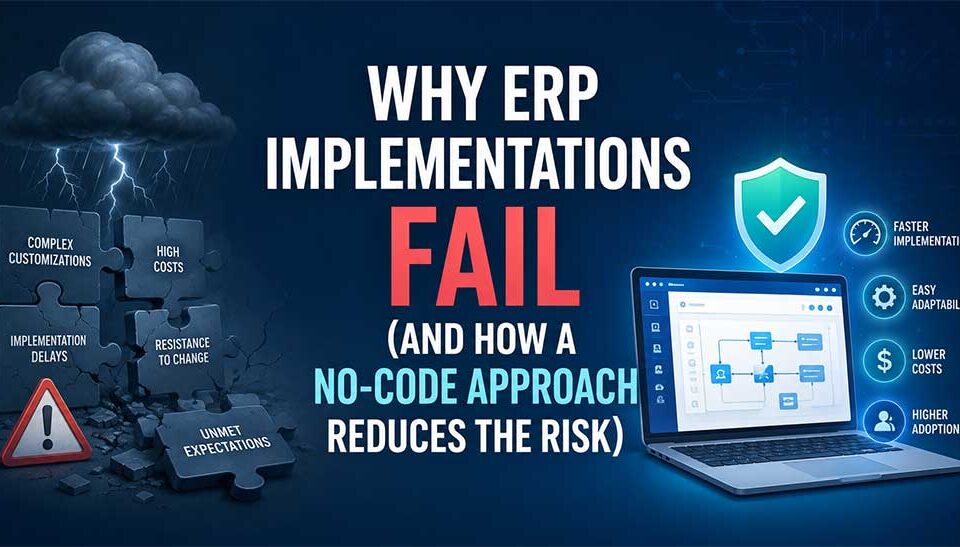

ERP implementation is supposed to bring finance, operations, inventory, sales, purchasing, production, and reporting together. Yet many businesses discover that buying an ERP is easier than making it work. ERP implementation failure can occur when projects run over budget, deadlines slip, employees return to spreadsheets, and management still struggles to access reliable real-time information. In some cases, the ERP technically goes live but fails to deliver the business outcomes it was purchased for.
Recent research shows why this deserves serious attention. Gartner states that more than 70% of recently implemented ERP initiatives fail to fully meet their original business-use-case goals, while Prosci’s 2025 research defines ERP failure more narrowly and found that implementations fell below 70% of expected benefits between 11% and 31% of the time. The difference comes from how “failure” is defined, but both sources point to the same conclusion: ERP implementation risk is real.
The good news is that ERP failure is not inevitable. A carefully designed implementation, strong process ownership, effective user adoption, clean data, and a flexible ERP architecture can significantly reduce the risks. This is where a no-code ERP approach can make a meaningful difference.
What Does ERP Implementation Failure Actually Mean?
ERP implementation failure does not necessarily mean the software crashes or the project is completely abandoned. Instead, failure can appear in much quieter ways. The system may technically go live, but employees continue maintaining Excel files because the ERP workflow does not match how they actually work. Managers may still depend on manually prepared reports. Finance teams may spend hours reconciling information. Production teams may create workarounds because the standard workflow does not support their process.
Therefore, an ERP project should not be judged simply by whether it went live. A successful ERP implementation should improve measurable business outcomes such as process efficiency, data accuracy, reporting visibility, user adoption, operational control, and decision-making speed. Gartner similarly emphasizes that ERP success depends on business adaptation and user training rather than configuration alone.
Why ERP Implementations Fail
Poor Understanding of Business Requirements
One of the earliest ERP mistakes happens before implementation even begins. Companies often evaluate ERP software based on demonstrations, feature lists, pricing, and brand reputation. However, a demonstration rarely shows whether the system can handle the company’s actual workflows.
For example, a manufacturing business may have different approval levels for purchasing, material planning, subcontracting, production, quality control, and dispatch. A distribution company may require different pricing, credit limits, warehouse rules, and sales processes. When these requirements are not documented properly, the implementation team starts making assumptions.
Consequently, the project moves forward with an ERP that may be powerful but does not fit the business. A better approach is to map the current process, identify bottlenecks, define the desired process, and convert those requirements into measurable ERP acceptance criteria before implementation begins.
Excessive Customization Creates an Expensive ERP
Customization is another major reason ERP projects become difficult to control. A company selects an ERP and then discovers that several important workflows do not fit. Instead of reconsidering the platform, the implementation team begins adding custom code, modifications, extensions, and workarounds.
Initially, each customization appears reasonable. However, as the number of customizations grows, the ERP becomes harder to test, maintain, upgrade, and support. ERP Research identifies excessive customization as one of the recurring causes of ERP project failure.
The solution is not to eliminate customization completely. Businesses are different, and genuine differentiation sometimes requires flexibility. The better solution is controlled adaptability. A no-code ERP allows business workflows, forms, fields, validations, approvals, reports, and other application behavior to be adapted without turning every business requirement into a traditional software-development project.
Poor Data Migration Can Destroy Trust in the New ERP
Data migration is frequently treated as a technical activity that happens near the end of the project. That is a mistake. Legacy ERP systems, spreadsheets, accounting applications, and departmental databases often contain duplicate customers, outdated products, inconsistent supplier records, incorrect opening balances, and incomplete transaction histories.
Moving bad data into a new ERP does not solve the problem. It simply creates bad data in a newer system. Workday identifies data quality, mapping, reconciliation, integration, and testing as important ERP migration risks. A stronger approach begins data preparation early. Businesses should determine which historical data is genuinely required, cleanse master data, establish ownership, define mapping rules, conduct trial migrations, and reconcile results before final cutover.
Employee Resistance Can Make a Good ERP Look Like a Bad One
An ERP changes how people perform their daily work. That means implementation is not only a technology project. It is also a people and process transformation. Employees who have spent years using spreadsheets or legacy applications may resist a new workflow, particularly when they do not understand why the change is necessary.
Prosci’s recent ERP research highlights the human side of transformation and identifies training, stakeholder engagement, and change management as important factors in ERP outcomes. Therefore, training should not begin a few days before go-live.
Users should participate in process discussions, demonstrations, testing, feedback sessions, and role-specific training. When employees see that the new ERP actually removes repetitive work instead of simply adding another system to their responsibilities, adoption becomes much easier.
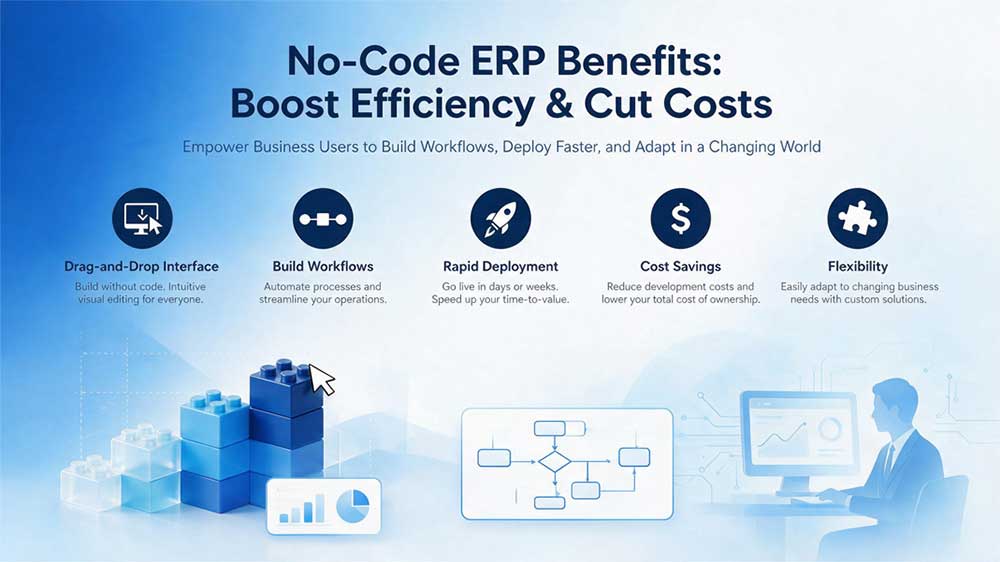
How a No-Code ERP Approach Addresses These Problems
No-code does not mean “no planning.” In fact, successful no-code ERP implementation still requires proper requirements analysis, data governance, testing, user training, and management ownership. The difference is the flexibility of the technology underneath the implementation. Traditional ERP customization can require developers to modify source code or build separate extensions whenever a business requires a change. A no-code approach shifts more of that adaptability into configurable business applications and workflows.
Faster Adaptation to Real Business Processes
Business requirements rarely remain completely static during an ERP project. A finance team may identify a new approval requirement. Operations may need an additional validation. Management may request a new dashboard. A production department may require a different workflow.
With a rigid ERP architecture, each change can become a development request. With a no-code platform, many of these changes can be handled through configuration and visual application development rather than extensive traditional coding. As a result, the ERP can evolve with the organization instead of forcing the organization to permanently adapt to the limitations of the original implementation.
Lower Dependence on Custom Code
Reducing unnecessary custom code can also make an ERP easier to maintain. Instead of creating a separate technical solution for every process exception, organizations can configure workflows around actual business requirements. This matters particularly for growing businesses. As processes change, the ability to modify applications quickly can prevent small operational requirements from becoming large IT projects.
Gartner’s research on product-based ERP also points toward continuously evolving ERP capabilities rather than treating ERP as a one-time project.
Faster Feedback During Implementation
A major advantage of a no-code approach is the ability to show working processes earlier. Instead of waiting until a development cycle is completed, teams can review workflows, forms, approvals, dashboards, and reports during implementation. That creates a valuable feedback loop.
Users can say, “This approval should happen before that step,” or “We need this information on the purchase screen,” while the process is still being designed. Therefore, errors can be identified earlier, when changing them is less expensive and less disruptive.
No-Code Does Not Guarantee ERP Success — Governance Does
The phrase “guarantees success” sounds attractive, but no technology can honestly guarantee that an ERP project will succeed. A no-code platform can reduce technical rigidity and make adaptation easier. However, it cannot compensate for unclear leadership, poor requirements, inaccurate data, weak testing, or employees who are never trained. ERP success comes from combining flexible technology with disciplined implementation.
The strongest model is therefore simple: understand the business first, configure or build around validated requirements, test continuously, involve users, measure outcomes, and improve the system after go-live. That approach turns ERP from a one-time software installation into a continuously improving business platform.
How to Choose a No-Code ERP Without Making Another Costly Mistake
Not every product marketed as “no-code ERP” provides the same level of flexibility. Before selecting a platform, businesses should demonstrate their actual workflows rather than relying on generic sales demonstrations. Ask the vendor to show how a new approval workflow can be created, how a business form can be modified, how reports can be changed, how roles and permissions are managed, and how integrations are handled.
Most importantly, test the platform with real business scenarios. If the vendor can demonstrate these changes without requiring extensive custom programming for every small requirement, the platform may be a stronger fit for a rapidly changing business. The goal should not simply be to find the ERP with the longest feature list. The goal should be to find an ERP that can continue fitting the business as the business changes.
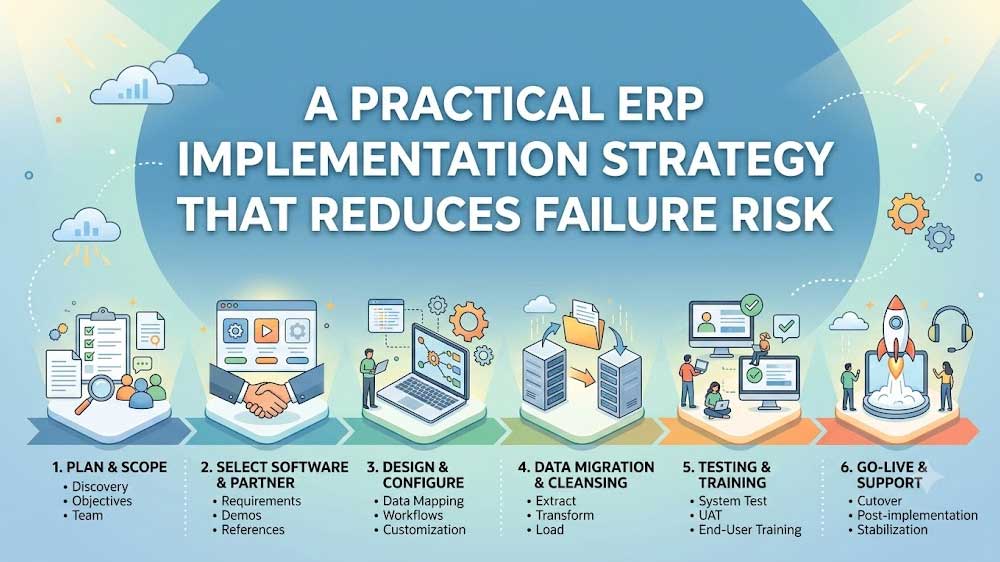
A Practical ERP Implementation Strategy That Reduces Failure Risk
The most reliable approach starts with business objectives rather than software screens. First, define what the company expects to improve. That could include reducing order-processing time, improving inventory accuracy, shortening month-end closing, increasing production visibility, or eliminating duplicate data entry.
Next, map the critical workflows and identify where the existing process is creating cost or delays. Then, prioritize requirements and validate them with the people who actually perform the work. After that, configure or build the ERP around those validated processes. Use real data samples during testing rather than relying only on theoretical scenarios.
Finally, measure the results after go-live. If order processing was expected to become 30% faster, measure it and management expected faster reporting, measure report preparation time. If the objective was higher inventory accuracy, track the variance. This creates a measurable connection between ERP investment and business value.
The Future of ERP Is Flexible, Connected and AI-Ready
ERP systems are increasingly moving beyond basic transaction processing. AI, automation, analytics, workflow orchestration, and connected applications are becoming important parts of the ERP landscape. Gartner reported in 2025 that 73% of ERP leaders planned to update their ERP strategies with emerging technologies. However, AI cannot fix a fundamentally rigid process architecture.
If data is fragmented, workflows are inconsistent, and business rules are buried inside difficult-to-maintain custom code, adding AI does not automatically create business intelligence. A flexible no-code foundation can provide a more adaptable environment in which automation, analytics, and AI capabilities can evolve alongside business requirements.
Frequently Asked Questions About ERP Implementation Failure
Why do ERP implementations fail?
ERP implementations commonly fail because of unclear requirements, poor data migration, excessive customization, weak change management, inadequate testing, scope creep, poor vendor fit, and lack of executive ownership. In many cases, the underlying problem is not the ERP software itself but the way the project is planned and managed.
Can no-code ERP prevent implementation failure?
No-code ERP cannot guarantee success. However, it can reduce several technical risks by making workflows and applications easier to adapt, reducing dependence on traditional custom development, and allowing users to validate changes earlier.
Is no-code ERP suitable for manufacturing and complex businesses?
Yes, provided the platform supports the organization’s required workflows, permissions, integrations, reporting, data structures, and business rules. Complex businesses should validate the platform using real operational scenarios before making a purchasing decision.
Is no-code ERP better than traditional ERP?
Neither approach is automatically better for every organization. Traditional ERP can be appropriate where standardized processes are sufficient. No-code ERP becomes particularly valuable when a business needs frequent workflow changes, industry-specific processes, rapid customization, and greater control over application evolution.
What is the biggest ERP implementation mistake?
Treating ERP as an IT installation instead of a business transformation is one of the biggest mistakes. Successful ERP implementation requires business ownership, clear objectives, user participation, process redesign, data preparation, testing, training, and continuous improvement.
Turn ERP Implementation Risk Into a Competitive Advantage
An ERP should not become another system employees have to work around. It should become the system that helps them work better. That requires more than selecting a recognized ERP brand. Businesses need an implementation strategy that understands their processes, protects data quality, involves users, controls customization, and leaves enough flexibility for future change.
A no-code ERP approach can help reduce the rigidity that makes traditional ERP customization expensive and slow. However, the real advantage comes when flexible technology is combined with disciplined business analysis, continuous testing, strong change management, and measurable outcomes.
Before committing to your next ERP implementation, evaluate your current processes, identify your highest-cost bottlenecks, and test whether your shortlisted ERP can adapt to them without turning every change into a development project.
Ready to evaluate whether your ERP can adapt to your business? Book a free ERP consultation and explore how a flexible no-code approach can help you simplify processes, accelerate customization, and build an ERP environment that can evolve with your organization.
Suggested Lead Magnet: Download the “ERP Implementation Risk Assessment Checklist” to evaluate requirements, data migration, customization, user adoption, testing, governance, and ROI before signing an ERP contract.