

For a growing SMB, choosing an ERP is only half the decision. The bigger question is how quickly the business can start using it without disrupting sales, finance, inventory, production, purchasing, or customer operations.
Traditional ERP implementations can take months because businesses often move through lengthy requirement studies, technical development, customization, integrations, testing, data migration, and repeated change requests. In contrast, a well-designed no-code ERP can reduce much of the development dependency by allowing business processes, forms, workflows, reports, and applications to be configured with significantly less conventional programming.
However, saying that a no-code ERP is “50% faster” should not mean promising every company a fixed timeline. The real opportunity is to reduce the activities that unnecessarily extend implementation.
Current 2026 ERP implementation guidance shows that SMB projects can range from rapid 6–12 week deployments for tightly scoped implementations to several months for broader projects involving multiple modules, integrations, customization, and complex data migration.
So, how does a no-code ERP potentially cut that timeline in half?
What Does 50% Faster ERP Implementation Actually Mean?
A 50% reduction means completing the same agreed implementation scope in approximately half the time.
For example, assume an SMB’s conventional ERP implementation requires 24 weeks from project kickoff to production go-live. If a comparable no-code ERP reaches the same functional scope, data readiness, integrations, testing, user acceptance, training, and go-live criteria in 12 weeks, the implementation time has been reduced by 50%.
The calculation is simple:
Implementation Time Reduction = (Traditional ERP Time − No-Code ERP Time) ÷ Traditional ERP Time × 100
Therefore, a 24-week implementation reduced to 12 weeks represents a 50% reduction. This distinction matters because implementation speed should never be measured by how quickly software is installed. It should be measured by how quickly the business becomes operational on the new ERP.
Why Traditional ERP Implementation Takes So Long for SMBs
The biggest problem for many SMBs is not the ERP software itself. Instead, the delay often comes from the implementation process surrounding it. A business may begin with a clear requirement. However, once implementation starts, every process that differs from the standard ERP workflow can create another requirement, customization request, development cycle, testing cycle, and approval.
For example, a manufacturing company may need a different approval process for purchase orders, a customized production workflow, industry-specific reports, special inventory rules, GST-related requirements, or customer-specific billing formats. With a conventional development-heavy ERP, these requirements can move through business analysis, technical design, coding, testing, correction, deployment, and user validation.
Consequently, a small change can consume days or weeks. Data migration can create another bottleneck. If customer masters, supplier masters, item codes, opening balances, inventory records, or transaction history are inconsistent, the implementation team must first clean and map the information before importing it.
Integration creates another layer of dependency. When an ERP has to communicate with accounting systems, payment platforms, e-commerce applications, CRM systems, biometric devices, logistics platforms, or external APIs, each integration can add development and testing time. That is why current ERP implementation research repeatedly identifies scope, customization, data quality, integrations, testing, and internal availability as major timeline drivers.
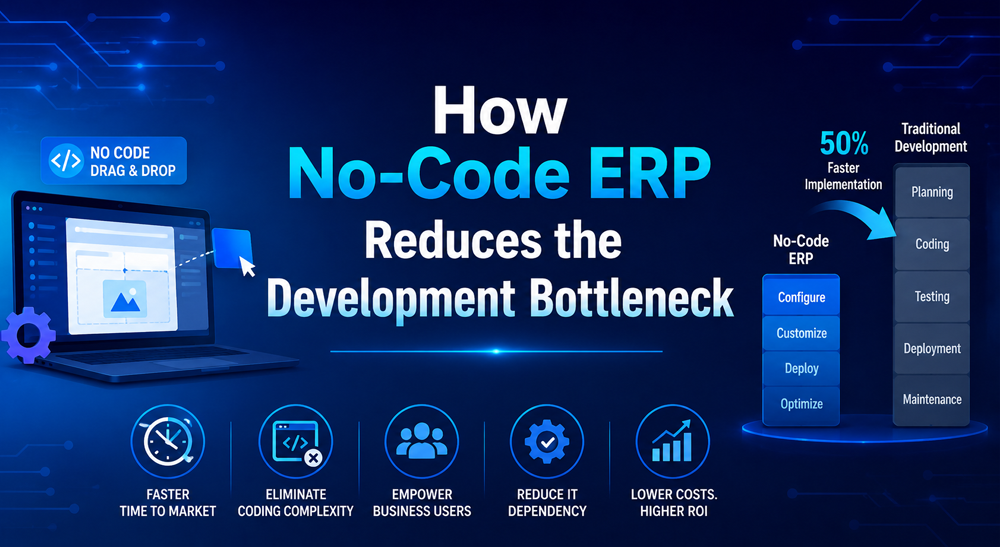
How No-Code ERP Reduces the Development Bottleneck
The fundamental difference with no-code ERP is that many business changes can be configured rather than traditionally coded. Instead of waiting for developers to build every form or workflow from scratch, authorized business or implementation teams can configure processes using visual tools and reusable components.
This becomes especially valuable for SMBs because their requirements frequently change during implementation. Suppose a distributor discovers during testing that its sales approval process needs three levels instead of two. In a development-heavy environment, that change may require a developer, a change request, testing, deployment, and approval.
With a capable no-code platform, the workflow can potentially be modified through configuration. Therefore, the implementation cycle becomes shorter because the gap between “business requirement” and “working functionality” becomes smaller. That is one of the strongest mechanisms through which no-code ERP can reduce implementation time.
Faster Customization Without Rebuilding the ERP
Customization is one of the most important areas to examine when evaluating ERP implementation speed. SMBs often need customization because they have developed their own operational processes over many years. A generic ERP may cover standard accounting, inventory, purchasing, sales, and production, yet the company may still need industry-specific workflows.
Traditional customization can become expensive and time-consuming because every modification can create additional development and testing requirements. No-code ERP changes this equation by allowing organizations to configure fields, screens, forms, workflows, validations, reports, dashboards, and business rules without relying on conventional application development for every change.
As a result, customization can become an implementation activity rather than a separate software-development project. However, this benefit depends on the platform. A product should not be called “no-code” merely because it provides a few configurable fields. A genuine no-code platform should provide meaningful control over business applications, workflows, data, forms, reports, and automation.
How No-Code ERP Speeds Up Data and Process Configuration
ERP implementation does not begin with software. It begins with understanding the business. During a traditional implementation, consultants may spend considerable time documenting processes and translating those requirements into technical specifications. No-code platforms can shorten this translation process because business workflows can often be represented directly within the platform.
For example, consider a purchase process involving purchase requisition, approval, purchase order, goods receipt, quality inspection, invoice matching, and payment. Instead of documenting the process and then waiting for developers to translate every stage into software, an implementation team can configure the workflow and demonstrate it to users much earlier.
Consequently, users can identify gaps earlier. That early feedback is important because discovering a problem during configuration is considerably better than discovering it immediately before go-live.
Reducing the Cost of Change Requests
Change requests are one of the hidden reasons ERP projects become longer than expected. At the beginning of implementation, management may approve one process. However, once employees start seeing the system, they may request additional fields, approvals, reports, dashboards, notifications, or workflow changes.
In a conventional ERP project, each change can create another development cycle. No-code ERP can reduce this dependency because many changes can be handled through configuration. This does not mean every change is free or instantaneous. Complex integrations, advanced calculations, large-scale data migration, and highly specialized functionality can still require technical work.
Nevertheless, reducing the number of changes that require conventional programming can significantly improve implementation velocity.
AI Can Make No-Code ERP Implementation Even Faster
The next opportunity is the combination of no-code ERP and AI-assisted implementation. AI can help implementation teams analyze business requirements, identify process patterns, classify data, detect inconsistencies, generate workflow suggestions, assist with report definitions, and support users during configuration. However, AI should not be treated as a replacement for ERP expertise.
A practical AI-assisted implementation model can evaluate factors such as process complexity, number of modules, number of users, data quality, integration count, customization requirements, approval layers, and testing effort. The result can be used to estimate implementation risk before the project begins.
For example, an AI-assisted readiness model could assign greater implementation risk to a company with poor master data, multiple legacy systems, and highly customized processes than to a single-location company with clean data and standardized workflows. This creates a more realistic implementation forecast rather than simply promising a fixed number of weeks.
Interestingly, 2026 research also shows that SMBs are increasingly using AI for sensitive business processes, while concerns remain about understanding and governing AI-generated decisions. Therefore, AI should accelerate implementation while keeping human validation, governance, and business ownership in place.
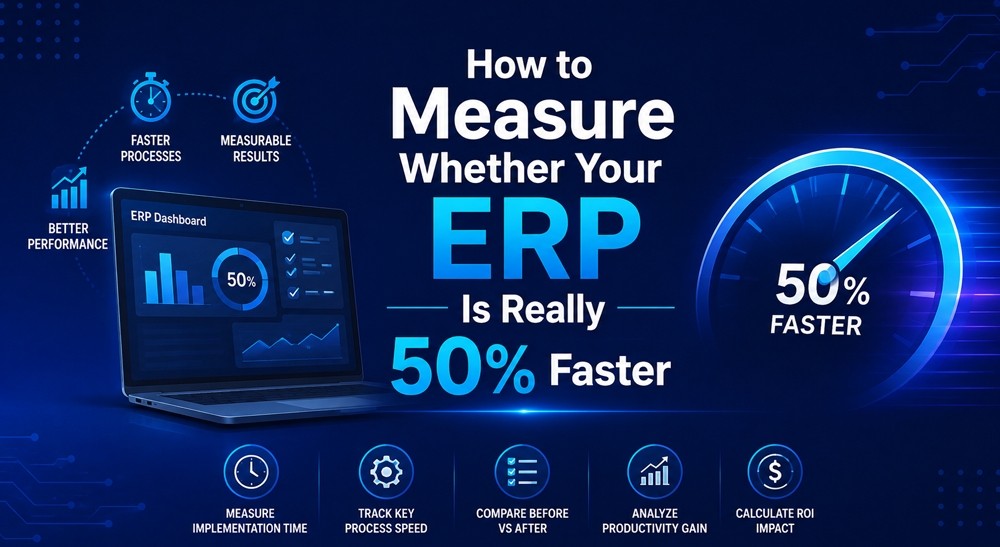
How to Measure Whether Your ERP Is Really 50% Faster
The best way to verify the claim is to measure the complete implementation lifecycle. Start by recording the baseline implementation time for a comparable traditional ERP project. Then measure the no-code ERP against the same scope.
The comparison should include requirements finalization, process configuration, customization, data migration, integration, testing, user acceptance testing, training, deployment, and stabilization. For example, if a traditional implementation takes 20 weeks and a no-code ERP takes 10 weeks for the same agreed scope, the reduction is 50%.
However, if the traditional project includes ten modules and five integrations while the no-code project includes three modules and one integration, the comparison is not valid. The scope must remain comparable. This is the most important point for businesses evaluating ERP vendors: measure time-to-business-value, not simply time-to-installation.
What SMBs Should Check Before Believing a Faster ERP Promise
A faster implementation sounds attractive, but speed should never come at the expense of data accuracy, testing, training, security, or operational reliability. Before selecting an ERP, ask the vendor how long similar businesses took to reach go-live.
Then ask what was included in that timeline.
Was data migration included?
Were integrations included?
Was user acceptance testing completed?
Was employee training completed?
Were custom workflows included?
Was post-go-live stabilization included?
These questions separate a genuine rapid ERP implementation from a marketing claim. Industry guidance also warns that aggressive timelines can become unrealistic when projects have complex integrations, poor data, heavy customization, or insufficient internal participation.
Why No-Code ERP Can Be a Strong Fit for Growing SMBs
An SMB does not necessarily need an ERP with the largest feature catalogue. It needs an ERP that can adapt as the business grows. A company may start with accounting and inventory. Later, it may need purchasing automation, manufacturing, CRM, HRMS, mobile applications, supplier portals, dashboards, or advanced workflow automation.
If every change requires software development, the ERP can become increasingly expensive and slow to adapt. A no-code architecture can provide a different path. The business can start with the most important processes, configure them, validate them with users, and expand the system as requirements evolve.
Consequently, the ERP becomes an evolving business platform rather than a one-time software installation.
The Real Business Benefit Is Not Just Faster Go-Live
Reducing implementation time by 50% is valuable, but the bigger advantage is reducing the period during which the business operates between old and new processes. Every additional month of implementation can mean continued spreadsheet work, duplicate data entry, manual approvals, disconnected reports, and delayed decision-making.
Therefore, faster implementation can accelerate the point at which the company begins receiving value from automation. For an SMB, that can mean earlier visibility into inventory, faster approvals, better financial reporting, reduced manual work, and more consistent processes.
The objective should not be “go live quickly at any cost.” The objective should be go live faster without compromising operational quality.
How to Build a 50% Faster ERP Implementation Strategy
A practical strategy begins with scope discipline. Instead of trying to automate every process on day one, identify the workflows creating the greatest operational pain. Next, clean the master data before implementation begins. Then, configure standard processes before requesting customization. After that, use no-code capabilities for workflows, forms, reports, validations, and business rules wherever possible.
At the same time, identify integrations early because integration dependencies can become critical-path activities. Finally, conduct user testing continuously rather than waiting until the end. This approach creates shorter feedback loops.
Instead of spending months building a system and then asking employees whether it works, the business continuously validates the system during implementation. That is where much of the potential time saving comes from.
Frequently Asked Questions About No-Code ERP Implementation
Can a no-code ERP really reduce implementation time by 50%?
Yes, it can in the right project, but 50% should be treated as a measurable project outcome rather than a universal guarantee. The reduction depends on scope, data quality, integrations, customization requirements, user availability, and the capabilities of the no-code platform.
How long does ERP implementation take for an SMB?
Current 2026 industry guidance places SMB implementations across a wide range. Highly standardized rapid deployments can take around 6–12 weeks, while broader SMB implementations commonly take several months. Complexity, integrations, data migration, and customization have a major influence on the final timeline.
Why is no-code ERP faster than traditional ERP?
No-code ERP can reduce the amount of conventional programming required to configure forms, workflows, reports, business rules, and applications. Therefore, fewer requirements need to pass through a lengthy development cycle.
Does no-code ERP eliminate customization?
No. Instead, it changes how customization is performed. Many business changes can be handled through configuration rather than traditional source-code development. Complex requirements may still require technical work.
What is the most important factor in speeding up ERP implementation?
There is no single factor. However, clear scope, clean data, standardized processes, rapid decision-making, limited unnecessary customization, early integration planning, and strong user participation can significantly reduce delays.
How can a company prove that its ERP implementation was 50% faster?
Use a comparable baseline. Measure the complete implementation duration for the same scope, then calculate the percentage reduction using the baseline and actual no-code implementation time. The comparison should include configuration, customization, migration, integrations, testing, training, and go-live.
Ready to Find Out How Much Faster Your ERP Implementation Could Be?
A faster ERP implementation starts with understanding where your current implementation process is losing time. If your business is spending weeks waiting for developers to modify forms, workflows, reports, approvals, or business applications, a no-code ERP approach may provide a faster path to automation.
Book a free ERP consultation with Bluechip Solutions and evaluate your current processes, customization requirements, data readiness, and implementation roadmap. You can also use an ERP Readiness Assessment to identify the processes that are most likely to delay implementation and determine where no-code automation can create the greatest time savings.
The goal is not simply to promise “50% faster.” The goal is to calculate it, measure it, and deliver it.
Explore No-Code ERP: https://bluechipsolutions.in/
Book a Free ERP Consultation: https://bluechipsolutions.in/contact.php