
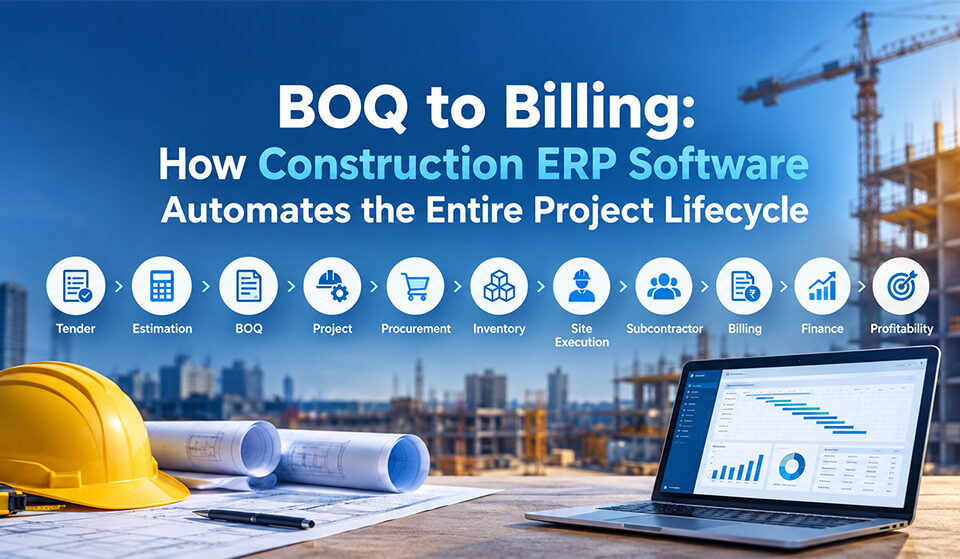
BOQ to Billing: How Construction ERP Software Automates the Entire Project Lifecycle

A construction project can look profitable on paper and still lose money before completion. The problem is rarely one major mistake. Instead, profitability often disappears through small gaps between estimation, BOQ, procurement, inventory, site execution, subcontractor work, billing and finance.
A quantity estimated during tendering may change after the project starts. Materials may be purchased without considering existing stock. Site teams may report consumption late. Subcontractor bills may reach the office without complete verification. Meanwhile, finance teams may see costs only after invoices are processed.
As a result, project managers and CFOs can struggle to answer a basic question: How much is this project actually costing right now, and how much profit is still available? This is where construction ERP software becomes more valuable than a collection of disconnected accounting, spreadsheet and project-management tools.
A well-designed construction ERP can connect the complete project lifecycle, from Tender → Estimation → BOQ → Project → Procurement → Inventory → Site Execution → Subcontractor → Billing → Finance → Profitability. More importantly, it can create a continuous flow of operational and financial data. Consequently, management does not have to wait until project closure to discover cost overruns.
Why the Gap Between BOQ and Billing Creates Construction Profit Leakage
The BOQ is one of the most important commercial documents in a construction project. However, a BOQ by itself does not control the project. The real challenge begins after the estimate is approved.
For example, a contractor may estimate 10,000 units of a particular material for a project. However, if procurement purchases 12,000 units because of poor coordination, the additional inventory immediately affects working capital. Likewise, if site consumption is not recorded accurately, management may not know whether the excess material is genuinely required, sitting unused at the site or being consumed faster than planned.
Similarly, labour, subcontractor expenses, equipment usage and site purchases can gradually move away from the original estimate. Therefore, the critical requirement is not simply creating a BOQ. It is maintaining a connected relationship between the BOQ, project activities, actual consumption, procurement, billing and financial results. That is precisely where construction ERP software can create measurable operational value.
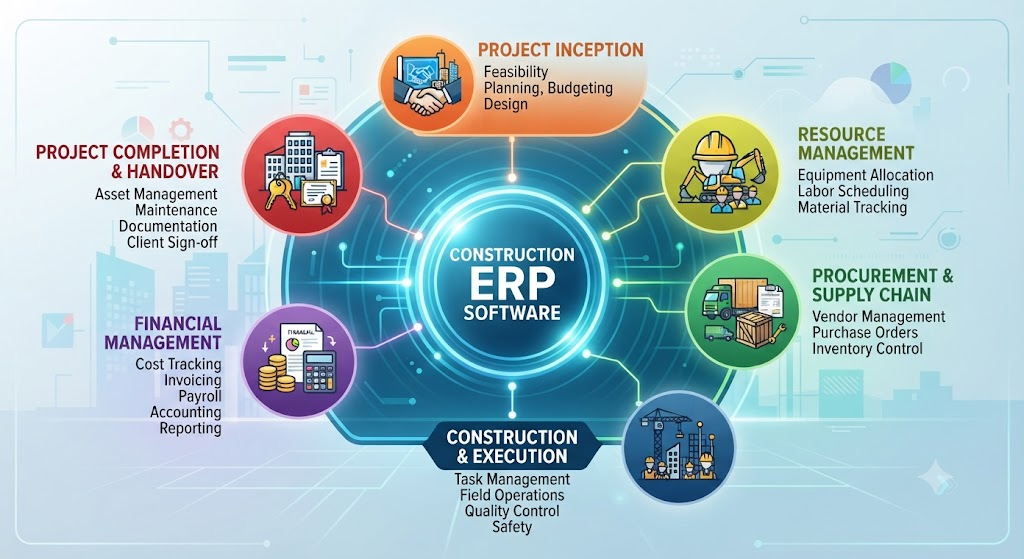
How Construction ERP Software Connects the Complete Project Lifecycle
Instead of maintaining separate information across Excel files, emails, accounting software and site-level records, an integrated construction ERP can establish a common project data structure. The objective is straightforward: every commercial and operational transaction should ultimately connect back to the project and its planned cost.
When this happens, a change made during estimation can influence procurement requirements. Procurement can affect inventory. Inventory consumption can affect project cost. Project progress can influence billing. Billing can feed finance. Finally, management can compare revenue against actual and committed costs. This creates a much stronger foundation for project profitability management.
Tender and Estimation: Establishing the Commercial Foundation
Every construction project begins with a commercial decision: should the company bid, and if so, at what price? However, tender estimation can become difficult when historical project data, material rates, labour costs and subcontractor quotations are stored separately.
A construction ERP can centralize estimation information so that project teams can build a more structured cost picture before submitting the tender. Material requirements, labour estimates, equipment costs, subcontractor components and other project expenses can be incorporated into the commercial calculation.
Consequently, management can evaluate expected project cost before committing to the contract. The benefit is not simply faster estimation. It is better visibility into expected margin and commercial risk before the project starts.
BOQ Management: Turning the Estimate Into a Controllable Project Baseline
Once the tender is awarded, the BOQ becomes the bridge between commercial planning and project execution. However, many companies continue to manage BOQs in spreadsheets. As revisions occur, multiple versions can circulate between estimation teams, project managers, procurement departments and finance.
That creates a serious control problem. Which BOQ is the latest version? Which quantity was originally approved? What has already been consumed? What remains? Has a variation been approved? Construction ERP software can provide a structured BOQ against which project transactions can be tracked.
Therefore, instead of treating the BOQ as a static document, businesses can use it as a project cost and quantity control baseline. This is particularly important when project quantities change because of approved variations, design changes or site conditions.
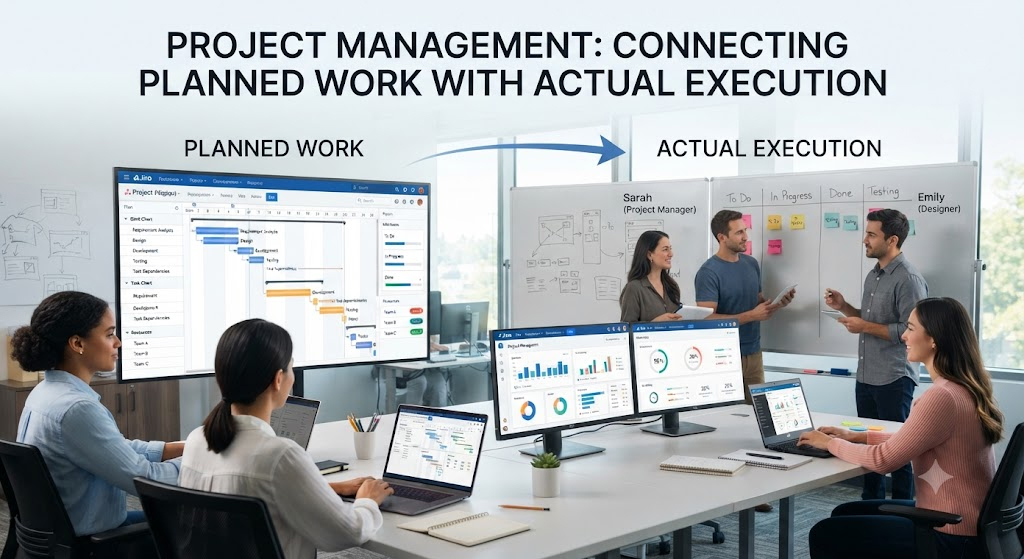
Project Management: Connecting Planned Work With Actual Execution
After the BOQ is established, the project needs continuous monitoring. Site teams need to know what has been planned, what has been completed and what resources have been consumed. Management, meanwhile, needs visibility into whether the project is moving according to the original commercial assumptions. Disconnected reporting makes this difficult.
A construction ERP can connect project activities with related procurement, inventory, labour, subcontractor and financial transactions. As a result, project managers can move beyond simply asking whether work is progressing. They can investigate whether progress is financially healthy. This distinction matters because a project can show strong physical progress while simultaneously experiencing cost overruns.
Procurement: Purchasing Against Project Requirements
Procurement is one of the biggest areas where construction companies can lose control over project costs. mergency purchases, duplicate orders, supplier price variations and purchases made without considering available inventory can increase project expenditure.
With an integrated ERP, procurement requirements can be linked to project estimates and material requirements. Consequently, purchase decisions can be evaluated against planned quantities and existing stock before an order is raised. This creates stronger purchasing discipline while also helping procurement teams respond faster to genuine site requirements. For management, the bigger advantage is visibility. Procurement is no longer an isolated purchasing activity; it becomes part of the project’s financial story.
Inventory: Knowing Where Project Materials Are Going
Material control becomes increasingly difficult when a business operates across multiple project sites. A material may be purchased centrally, transferred to a project, issued to a particular activity and consumed at the site. If these movements are recorded late or manually, the company’s inventory position can quickly become unreliable.
Construction ERP software can connect purchasing, stock receipts, transfers, issues and consumption with individual projects. Therefore, project teams can get a clearer picture of material availability and usage. This also supports tighter control over excess stock, material shortages and unexplained consumption. The real value is not merely knowing how much inventory exists. It is knowing which project is consuming it, why it was consumed and how that consumption compares with the planned requirement.
Site Execution: Bringing Field Data Into the Project Control System
The site is where the original estimate meets reality. Weather conditions, design changes, labour availability, material delays, rework and unexpected site requirements can all affect project performance. Unfortunately, site information often reaches management through phone calls, WhatsApp messages, spreadsheets or delayed reports.
By connecting site execution with the central ERP, companies can reduce this information gap. Site-related transactions and progress information can be associated with the relevant project, activity and cost category. As a result, management receives a more connected view of project execution instead of relying entirely on retrospective reporting. Mobile-enabled access can make this even more practical because project personnel do not need to wait until they return to the office to update relevant information.
Subcontractor Management: Controlling One of the Most Difficult Cost Areas
Subcontractors can represent a substantial portion of construction expenditure. However, controlling subcontractor costs is difficult when work orders, measurements, advances, deductions and bills are managed through separate records. A connected construction ERP can associate subcontractor commitments and transactions with the appropriate project and work scope.
Therefore, when a subcontractor submits a bill, the business has a stronger basis for checking it against the agreed commercial terms and recorded work. This helps reduce the risk of paying against incomplete or incorrectly recorded work. More importantly, management can understand not just the amount already paid but also the financial commitment created by outstanding subcontractor obligations.
Billing: Moving From Project Progress to Revenue
Billing is where project execution begins converting into recognized commercial value. Yet billing delays can create cash-flow pressure even when physical work is progressing well. When project progress, BOQ quantities and commercial information are connected, billing teams can work from a more reliable source of project data.
This can reduce the dependency on manually collecting information from project managers and site teams. Consequently, businesses can improve billing timeliness while maintaining better traceability between the work completed and the amount being billed. For contractors, this connection is especially important because revenue generation and cash flow depend on converting completed work into accurate, timely invoices.
Finance: Connecting Every Project Transaction to the Books
An accounting system can tell a company how much money has been spent. However, construction businesses need to know considerably more. They need to understand where the money was spent, which project consumed it, what activity generated the cost and whether that expenditure was expected.
When construction operations and finance operate on disconnected systems, reconciliation becomes time-consuming. An integrated ERP can connect procurement, inventory, project expenses, subcontractor transactions, billing and accounting. Therefore, finance teams gain a clearer project-level view without repeatedly collecting information from different departments.
This also improves management reporting because financial information is connected to operational activity.
Profitability: The Number Every Construction CEO Ultimately Wants to Know
Ultimately, every previous stage leads to one question:
Is the project making money? A construction ERP can help compare the original estimate with actual and committed costs while considering project revenue and billing. This creates the foundation for project profitability analysis.
For example, if material costs are increasing faster than planned, management can investigate the reason. If subcontractor expenses are exceeding the original estimate, the project team can review the relevant scope. If billing is lagging behind execution, finance can identify the commercial bottleneck.
Therefore, profitability becomes something management can monitor throughout the project rather than calculate only after completion.
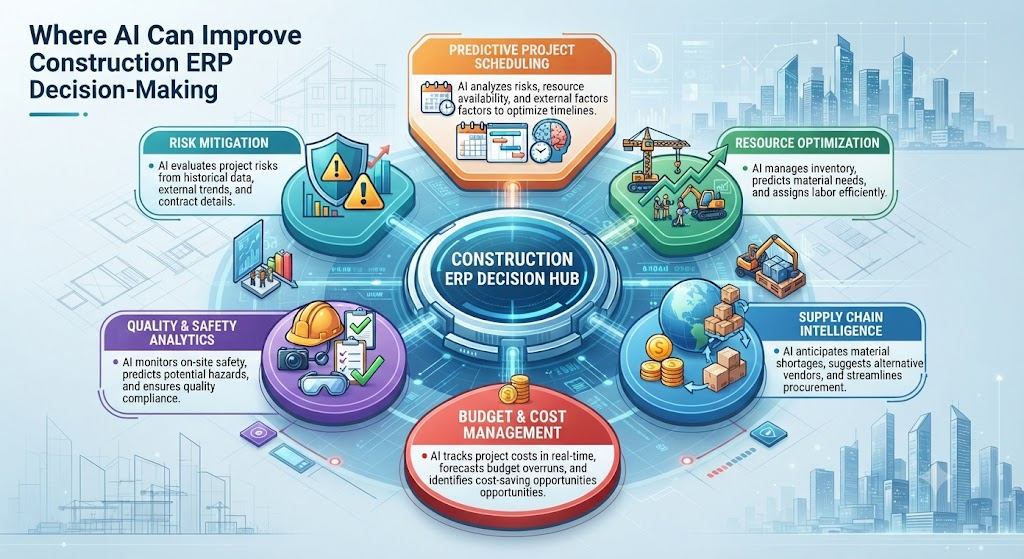
Where AI Can Improve Construction ERP Decision-Making
AI should not be treated as a marketing label added to an ERP dashboard. Its practical value comes from using business data to identify patterns, anomalies and potential risks. For construction companies, AI-assisted ERP capabilities can potentially support areas such as unusual material consumption, cost variance detection, procurement patterns, delayed billing signals and project performance forecasting.
For example, if actual material consumption consistently exceeds the planned quantity for a particular activity, an intelligent system could flag the variance for management review. Likewise, historical project data can support forecasting models that help identify potential cost or schedule risks earlier.
However, AI should support decision-making rather than replace project managers, engineers or finance professionals. The strongest approach is therefore ERP data + business rules + analytics + AI-assisted insights + human validation.
Why an Integrated Construction ERP Is More Valuable Than Multiple Disconnected Tools
Using separate applications for estimation, project management, inventory, procurement, accounting and billing can appear flexible at first. However, every integration gap creates another opportunity for information to become delayed, duplicated or inconsistent. An integrated construction ERP creates a common operational foundation.
The result is not simply fewer software systems. More importantly, it creates better continuity from the original estimate to the final project profitability calculation. That continuity is what allows construction businesses to move from reactive reporting toward proactive project control.
How Bluechip Solutions Approaches Construction ERP
Bluechip Solutions’ construction ERP approach is designed around the operational reality of project-based businesses. Instead of treating accounting, procurement, inventory, project execution and billing as completely separate functions, the objective is to connect them through a common ERP environment.
This approach can help construction businesses establish stronger visibility from estimation and BOQ management through procurement, site operations, subcontractor transactions, billing and finance. Furthermore, configurable business processes can be important because construction companies rarely operate in exactly the same way. Approval structures, project controls, reporting requirements and commercial workflows can differ from one organization to another.
That is where a configurable and automation-oriented ERP architecture can provide an advantage over rigid systems.
Frequently Asked Questions About Construction ERP Software
What is construction ERP software?
Construction ERP software is an integrated business management system designed to connect construction processes such as estimation, BOQ, project management, procurement, inventory, subcontractor management, billing, accounting and profitability analysis.
Can construction ERP software connect BOQ with billing?
Yes. When BOQ, project execution and billing are integrated, completed quantities and project transactions can provide a structured foundation for generating and monitoring project billing.
How does ERP reduce construction project cost overruns?
ERP can improve visibility by connecting planned costs with procurement, inventory consumption, project expenses, subcontractor costs and actual financial transactions. This allows management to identify variances earlier instead of discovering them only after project completion.
Can construction ERP software support multiple projects?
Yes. A properly designed ERP can maintain project-wise transactions, budgets, procurement, inventory, expenses, billing and profitability information across multiple projects.
Is AI useful in construction ERP?
AI can be useful when applied to real business data. It can support anomaly detection, variance analysis, forecasting and management alerts. However, AI should complement human decision-making rather than replace experienced construction professionals.
The Real Advantage: One Connected View From BOQ to Profit
Construction profitability does not disappear at one particular stage. It can disappear between stages. A quantity can be estimated incorrectly. A purchase can exceed the requirement. Material consumption can go unrecorded. A subcontractor bill can be delayed. Completed work can remain unbilled. Financial reporting can arrive after the commercial problem has already become expensive.
Therefore, the real value of construction ERP software is the connection between these stages.
Tender → Estimation → BOQ → Project → Procurement → Inventory → Site Execution → Subcontractor → Billing → Finance → Profitability.
When these processes operate as one connected lifecycle, construction companies gain something more valuable than another software dashboard: the ability to see where the project stands financially while there is still time to act. For construction CEOs, project directors, CFOs and operations leaders evaluating ERP, that should be one of the most important criteria.
Don’t ask only whether an ERP has construction modules. Ask whether it can connect the entire commercial lifecycle from BOQ to billing and finally to project profitability.
Ready to Connect Your Construction Project Lifecycle?
If your teams are still moving project information between Excel, email, accounting software and site-level records, it may be time to evaluate a more connected approach.
Explore Bluechip Solutions’ Construction ERP capabilities and request a personalized ERP consultation or demo to understand how your estimation, BOQ, procurement, inventory, project execution, billing and finance processes can be connected.
Get a Construction ERP Project Cost-Control Checklist and evaluate where your current project workflow is losing visibility—from estimation and BOQ through billing and profitability.