
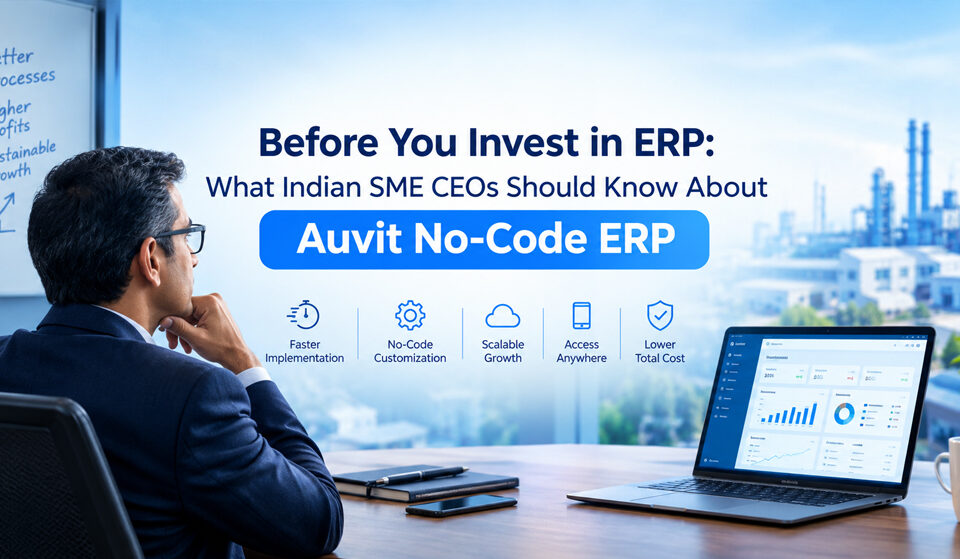

Choosing an ERP system is not simply a software purchase. For an Indian SME, it can affect how finance, sales, procurement, inventory, production, projects, HR, customer service, and management reporting work together for years. That is why the real question is not, “Which ERP has the most features?” Instead, CEOs need to ask, “Will this ERP solve our current operational problems without creating a new layer of complexity?”
For many growing SMEs, conventional ERP systems become difficult when business processes change faster than the software can adapt. Customization can require additional development, consulting costs, testing cycles, and long implementation timelines. Meanwhile, teams may continue using Excel, WhatsApp, email, and disconnected applications because the ERP does not fit the way the business actually operates.
This is where Auvit No-Code ERP from Bluechip Solutions takes a different approach. Auvit uses a no-code business process automation model to help businesses configure and adapt workflows without relying heavily on traditional software development.
For an SME CEO evaluating ERP investment, understanding that difference can make the decision significantly clearer.
Why Indian SMEs Need to Look Beyond ERP Feature Lists
ERP vendors often present long lists of modules and capabilities. However, having 15 or 20 modules does not automatically mean an ERP will deliver business value.
A manufacturing company may need production planning, inventory control, quality management, procurement, sales, finance, and shop-floor visibility. A distributor may require stronger stock management, order processing, purchasing, logistics, and financial control. Similarly, a construction company may need project costing, procurement, subcontractor management, billing, and project-level profitability.
Therefore, the right ERP should support the actual operating model of the business, not merely provide a large collection of features.
A common SME problem begins after implementation. The ERP handles the processes the company initially defined, but as the business evolves, the company introduces new requirements, such as additional approval processes. A customer requires a different quotation workflow. Management wants a new dashboard. A department needs another validation. Finance requires additional controls.
If every change requires substantial coding and vendor intervention, the ERP can gradually become expensive and difficult to maintain. Therefore, CEOs should evaluate the ERP’s flexibility before signing the contract.
The Biggest ERP Pain Point: Your Business Changes, But Your ERP Does Not
Indian SMEs rarely operate with completely static processes. A business may start with a simple purchase approval process. As procurement volume increases, management may introduce department-level approvals, purchase limits, vendor comparisons, quality checks, and escalation rules.
Likewise, a manufacturing company may initially manage production using basic work orders. Later, it may require material availability checks, production-stage approvals, quality inspections, machine-related information, rework tracking, and real-time production reporting. With a rigid ERP, these changes can become customization projects.
Consequently, the CEO faces an uncomfortable choice: either change the business process to match the ERP or pay for repeated customization.
Auvit approaches this problem through no-code business process automation. Instead of treating every process change as a traditional programming task, Auvit helps businesses adapt processes, workflows, validations, approvals, documents, and information flows more easily.
For an SME, this can mean greater control over how the system evolves as the business grows.
What Makes Auvit No-Code ERP Different for SME Businesses?
Auvit combines ERP capabilities with a Business Process Automation approach. This distinction matters because an ERP should not only record transactions; it should help control how those transactions move through the organization.
For example, a purchase request can move through defined approval stages. A sales process can trigger appropriate actions based on business rules. Documents can follow controlled workflows. Management can receive alerts or escalations when an activity requires attention.
As a result, the system becomes more than a digital replacement for spreadsheets. It becomes an operational framework connecting people, processes, data, and management decisions. For CEOs, that is particularly important because business visibility often becomes harder as the organization grows.
Can Auvit Reduce ERP Customization Time and Cost?
Customization is one of the areas where ERP projects can become financially unpredictable. A business may begin with an estimated implementation budget. However, additional requirements can emerge during implementation. Changes to reports, workflows, approvals, forms, integrations, and business rules can increase both cost and delivery time.
Auvit’s no-code approach reduces businesses’ dependence on traditional development for business process changes. Bluechip Solutions positions Auvit around faster customization compared with conventional ERP approaches, with the potential to significantly reduce the time and cost associated with adapting business processes.
However, CEOs should evaluate this claim against their own requirements rather than accepting any ERP promise at face value. The practical question is simple: How quickly can the system accommodate a genuine business change after implementation? That question should be part of every ERP demonstration.
Real-Time Business Visibility Is More Important Than More Reports
An SME CEO does not necessarily need hundreds of reports. What management needs is the right information at the right time. Suppose inventory appears healthy at the company level. However, one critical raw material is approaching its reorder level. At the same time, another SKU is moving slowly. Meanwhile, the production team delays the production order because they did not check material availability early enough.
A traditional reporting process may reveal these issues only after someone manually combines information from multiple systems. An integrated ERP can instead connect procurement, inventory, sales, production, finance, and management information.
Auvit supports dashboards and business intelligence integration to help management move from fragmented information toward a more connected view of operations. That visibility helps CEOs identify where the company has blocked cash.Which inventory is moving slowly? Which customers have overdue payments? Which projects are exceeding their budgets? Which production orders are running behind schedule? Which business processes need management intervention?
Ultimately, CEOs measure ERP value by how effectively it helps them answer those questions.
Why AI-Ready ERP Matters to Indian SMEs
AI is becoming increasingly relevant to ERP strategy. However, simply adding an “AI” label to an ERP does not make the system intelligent. Useful AI depends on reliable business data, structured processes, appropriate permissions, and connected operational information.
For example, an AI-enabled business environment can potentially help identify unusual purchasing patterns, forecast demand, highlight inventory risks, support management analysis, or identify process exceptions. However, these capabilities become far more useful when the underlying ERP already captures structured information across departments.
Auvit’s focus on integrated ERP, business process automation, dashboards, APIs, and connected data creates a foundation that can support an increasingly AI-driven operating environment. Therefore, CEOs should ask more than, “Does this ERP have AI?” They should ask, “Can this ERP become AI-ready as our business evolves?”
That distinction can prevent SMEs from investing in technology that sounds innovative but lacks operational depth.
ERP Implementation Should Not Disrupt Your Business
Companies often treat ERP implementation as an IT project. In reality, it is a business transformation project. Employees have to learn new workflows. Existing data has to be reviewed. Management processes may need clarification. Departments must agree on responsibilities. Historical information may need migration. Reports have to be validated.
If companies ignore these areas, even technically capable ERP software can face adoption problems. Therefore, Indian SME CEOs should evaluate the implementation methodology, not just the software demonstration. Bluechip Solutions brings ERP experience across business sectors and positions Auvit as a platform for organizations that need configurable processes rather than a completely rigid implementation model.
The objective should always be to establish a practical connection between the ERP and the company’s existing business reality.
Can Auvit Scale When an SME Becomes a Larger Enterprise?
Scalability is not only about handling more users. A growing company also develops more departments, locations, products, customers, suppliers, transactions, approvals, and management requirements. An ERP that works for a 30-person organization may become inadequate when the company reaches 200 employees. Likewise, an ERP designed around one location may require significant restructuring when operations expand across multiple locations.
A scalable ERP should therefore support increasing operational complexity while maintaining control and visibility. Auvit uses web and mobile capabilities, workflow-driven architecture, integrations, dashboards, and configurable business processes to help businesses adapt as their operational requirements evolve. That makes scalability a business question as much as a technical one.
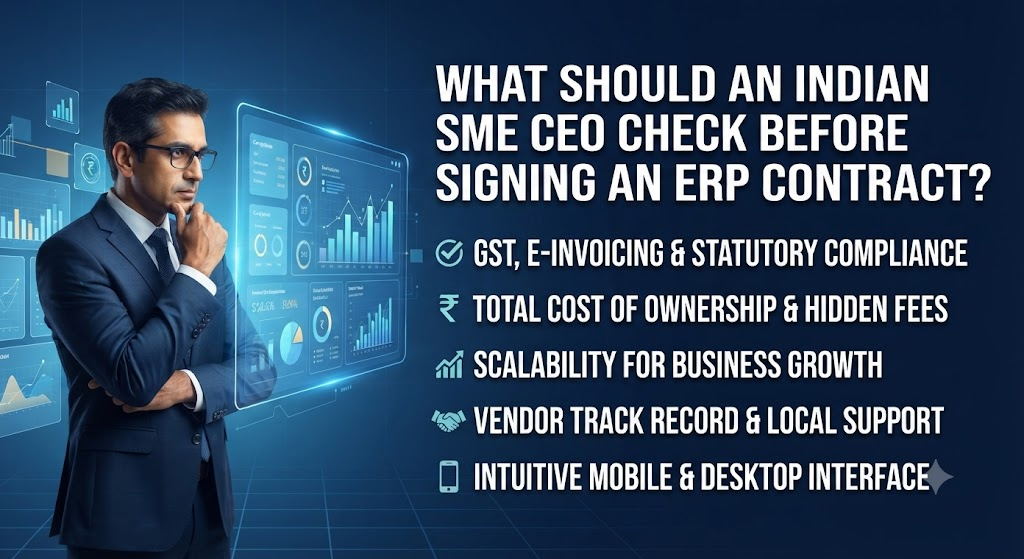
What Should an Indian SME CEO Check Before Signing an ERP Contract?
Before making an ERP investment, CEOs should look beyond the sales presentation. Ask how much of the system can be configured without traditional coding. Ask how long a typical business-process change takes. Ask what happens when a new approval workflow is required six months after implementation. Ask how data can be integrated with other systems. Ask how management dashboards are created. Ask how user permissions and access controls work.
Most importantly, demonstrate your real business process, not a generic vendor scenario. Take one complicated process from your company and ask the ERP provider to demonstrate it. For a manufacturer, that could be order-to-production-to-dispatch. For a distributor, it could be purchase-to-stock-to-sales. For a construction company, it could be project budgeting-to-procurement-to-cost tracking.
This approach gives CEOs a much better indication of whether the ERP can actually fit the organization.
Auvit No-Code ERP: A Better Fit for Businesses That Keep Evolving
The strongest reason to consider Auvit is not simply that it is a no-code ERP. The larger advantage is the combination of ERP + Business Process Automation + configurability + management visibility. For Indian SMEs, this can address several recurring challenges: disconnected departments, spreadsheet dependency, slow approvals, limited management visibility, rigid workflows, expensive customization, and difficulty adapting software as the company changes.
Instead of asking employees to continuously work around the ERP, the objective should be to create an ERP environment that can evolve with the business. That is particularly valuable for CEOs who expect their organization to add products, locations, customers, employees, processes, and new digital capabilities over time.
Frequently Asked Questions About Auvit No-Code ERP
What is Auvit No-Code ERP?
Auvit is a no-code ERP and Business Process Automation platform from Bluechip Solutions designed to help businesses manage core operations while adapting workflows and business processes with less dependence on conventional programming.
Is Auvit suitable for Indian SMEs?
Yes. Auvit is designed for businesses that require integrated ERP capabilities while also needing flexibility in workflows, approvals, dashboards, documents, and operational processes. Its suitability should ultimately be evaluated against the company’s specific industry and requirements.
How is no-code ERP different from traditional ERP?
Traditional ERP customization often depends heavily on software development. A no-code ERP aims to allow more business-process configuration through platform capabilities, potentially reducing the time and effort required for certain changes.
Can Auvit support manufacturing businesses?
Auvit can support manufacturing-related processes such as inventory, procurement, production, sales, finance, workflows, reporting, and business process automation. The exact implementation should be mapped to the manufacturer’s operational requirements.
Is Auvit an AI ERP?
Auvit is positioned as an AI-ready ERP platform. However, AI value depends on the quality and structure of business data, integrations, processes, and the specific AI capabilities implemented for a business.
How should a CEO evaluate ERP ROI?
ERP ROI should be evaluated through measurable business outcomes such as reduced manual work, improved inventory control, faster approvals, better data visibility, reduced process delays, improved financial control, and lower operational inefficiencies. The evaluation should compare these outcomes against the complete cost of implementation and ownership.
The Final ERP Decision Should Start With Your Business Problem
An ERP should not be selected because it has the longest feature list or the most impressive presentation. It should be selected because it can solve the problems that are currently costing the business time, money, visibility, and management attention.
For Indian SME CEOs, the most important ERP question is therefore not “Which ERP should we buy?” but “Which ERP can continue adapting as our business changes?” That is where Auvit No-Code ERP deserves consideration.
With its combination of ERP capabilities, business process automation, configurable workflows, dashboards, integration capabilities, web and mobile access, and AI-ready approach, Auvit is designed for businesses that do not want their growth limited by rigid software processes.
Before signing an ERP contract, see how your actual business process works inside the system.
Request an Auvit ERP consultation from Bluechip Solutions and evaluate the platform against your real operational requirements.
Get the ERP Evaluation Checklist
Not sure what to ask an ERP vendor before investing? Use a practical ERP evaluation approach covering customization, implementation, scalability, integrations, security, reporting, user adoption, and long-term ROI.
Book a Free ERP Consultation with Bluechip Solutions to discuss your business requirements and identify where Auvit No-Code ERP can create measurable operational value.