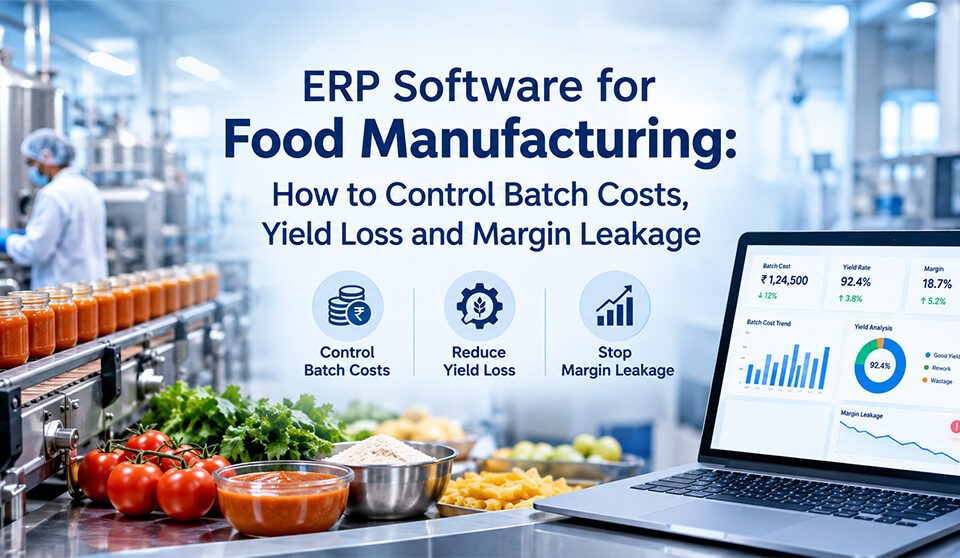
ERP Software for Food Manufacturing: How to Control Batch Costs, Yield Loss and Margin Leakage

For an experienced food manufacturer, profitability rarely disappears because of one major mistake. It usually leaks through hundreds of small production decisions: a raw-material price increase that is not reflected in the product cost, a batch that delivers lower-than-expected yield, excess process loss, an expired ingredient, an incorrect formulation revision, or a finished product that is sold without understanding its actual production margin.
That is why ERP Software for Food Manufacturing needs to do much more than manage accounting, inventory and sales. It needs to connect formulation, procurement, batch production, yield, wastage, inventory, quality, costing and finance so that management can see where money is being gained or lost while production is still happening.
The challenge becomes even greater when food manufacturers operate with multiple recipes, changing raw-material prices, different production lines, variable yields, expiry-sensitive inventory and frequent product variants. A spreadsheet may show what happened yesterday. A connected ERP system can help management understand what is happening now and why.
Why Food Manufacturers Lose Margin Even When Production Looks Efficient
A food manufacturing plant can achieve its planned production quantity and still lose money. Suppose a production order requires 1,000 kg of raw material to produce 800 kg of finished product. On paper, the batch may appear normal. However, if the actual output is 760 kg, the missing 40 kg is not simply a production statistic. It represents additional cost distributed across the finished quantity.
The same problem occurs when raw-material prices change but standard product costing remains unchanged. Procurement may buy at a higher rate, production may continue using an older cost assumption, and sales may continue quoting based on outdated margins. Consequently, finance sees the impact only after the month closes.
This is one of the biggest weaknesses of disconnected food manufacturing systems. Production measures output. Finance measures cost. Procurement measures purchasing price. Inventory measures stock. However, profitability depends on all four working together. An effective ERP system for food manufacturing closes that gap.
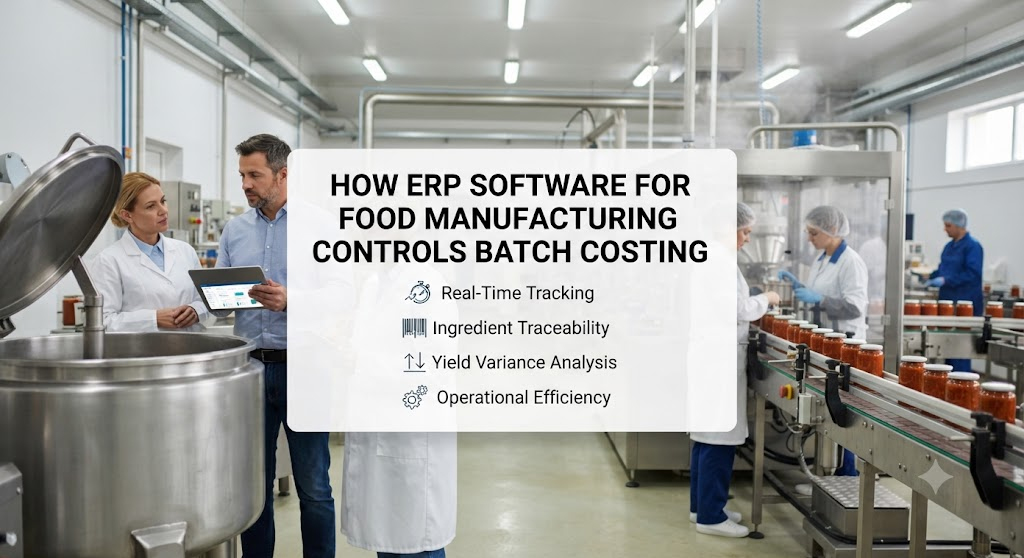
How ERP Software for Food Manufacturing Controls Batch Costing
Batch costing becomes complicated when the actual cost of a product changes from one production run to another. Raw-material prices fluctuate. Packaging costs change. Labour and energy costs vary. Process losses are different across batches. Furthermore, rework, rejected quantities and production deviations can influence the final cost.
A modern ERP system should therefore allow manufacturers to define the product formulation or BOM while simultaneously capturing the actual consumption and production output. For example, a manufacturer producing a packaged food product can define the expected quantity of flour, oil, additives, flavours, packaging materials and other ingredients. During production, the system records the actual consumption against the batch.
The management team can then compare planned consumption with actual consumption. That difference matters. If a formulation expects 100 kg of an ingredient but production consistently consumes 104 kg, the additional 4 kg becomes a measurable cost variance. When the same variance occurs across hundreds of batches, the financial impact can become significant.
Therefore, ERP Software for Food Manufacturing should turn batch costing from a month-end accounting exercise into a continuous operational control mechanism.
Formulation and BOM Control: Stop Cost Leakage at the Recipe Level
Food manufacturers rarely operate with one fixed product specification forever. Recipes evolve. Ingredient suppliers change. raw-material quality changes. Customers request variants. Packaging specifications are modified. Regulatory requirements can also influence formulations.
When these changes are managed through spreadsheets or manually circulated documents, production teams can accidentally work with outdated formulations.That creates two problems.First, the batch may not be produced according to the intended specification. Second, the calculated product cost may no longer represent the actual manufacturing cost.
An ERP system can establish controlled BOM and formulation versions so that production works against the approved recipe. Changes can be tracked rather than silently replacing previous values. This becomes particularly important when manufacturers need to understand why two batches of the same SKU have different costs. The answer should not require someone to search through multiple spreadsheets. The ERP should connect the formulation version, raw-material lots, production order, consumption, output and cost.
Yield Variance: The Number That Can Reveal Hidden Production Loss
Yield is one of the most important profitability indicators in food manufacturing. However, many plants monitor yield only as a production KPI rather than as a financial KPI. Consider a process where the expected yield is 92%. If the actual yield repeatedly falls to 88%, the four-percentage-point difference may appear small. Yet, at high production volumes, the financial effect can be substantial.
Yield variance can originate from several areas. Raw-material quality may differ. Moisture content may change. Processing conditions may not be consistent. Equipment performance may deteriorate. Operators may adjust processes manually. Excess trimming, spillage or evaporation may also contribute. With an integrated ERP system, expected yield can be compared against actual batch output.
Consequently, management can identify recurring deviations instead of treating every production loss as an isolated incident. The real value is not simply calculating yield. It is connecting yield variance to the cost of the lost material.

Wastage Management Should Become a Financial Control
Wastage is often recorded after the production process rather than being analysed as part of the production economics. That approach hides the real cause. For example, if a batch generates 250 kg of process waste, management needs to know whether that waste was normal, abnormal, recoverable, recyclable or caused by a production deviation.
An ERP platform can classify production losses and connect them to the relevant batch and production stage. Over time, this creates a historical picture of normal versus abnormal wastage. That information can then support decisions about machine settings, process parameters, operator practices, raw-material quality and production planning. More importantly, the cost of wastage can be incorporated into profitability analysis rather than remaining as an unexplained operational number.
Expiry and Slow-Moving Inventory Can Quietly Destroy Margins
Food inventory has a different risk profile from many other manufacturing industries. A raw material may have a limited shelf life. A finished product may need to be dispatched according to expiry dates. A slow-moving SKU can occupy warehouse space while its commercial value declines. Therefore, inventory control cannot stop at knowing how many kilograms or units are available.
The business needs to know which batch is available, when it was received, when it expires, where it is stored and where it should be consumed or dispatched. An ERP system with batch and expiry tracking can support FEFO-oriented inventory practices and provide better visibility into ageing stock.
That is particularly valuable when procurement, production and sales are planning independently. Instead of discovering expired or near-expiry inventory during a physical stock review, management can identify the exposure earlier and take corrective action.
Real-Time Margin Visibility Changes the Way Management Makes Decisions
A major advantage of integrated ERP is the ability to connect operational activity with financial impact. Imagine that the purchase price of a key ingredient increases by 12%. In a disconnected environment, procurement knows about the increase, inventory records the new stock value, production continues, and finance eventually sees the effect.
By then, the company may already have produced thousands of units at a lower expected margin. With connected ERP data, the increase can flow into material costing and profitability analysis much faster. Management can then evaluate whether the product price needs adjustment, whether an alternative supplier should be considered, whether the formulation needs review, or whether the product remains commercially viable.
This is where ERP becomes a management system rather than simply a transaction-processing system.
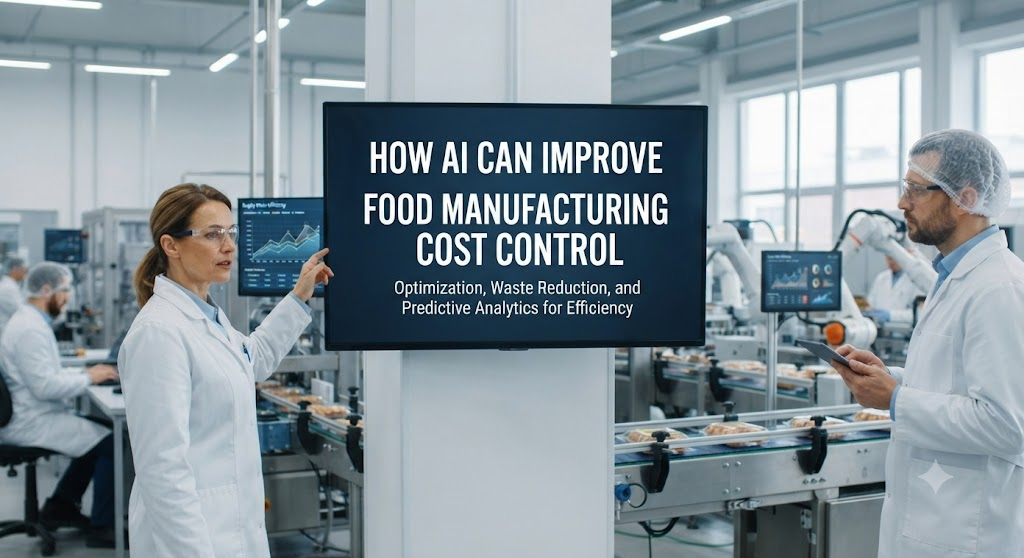
How AI Can Improve Food Manufacturing Cost Control
AI should not be treated as a replacement for production expertise. Instead, it can act as a decision-support layer over reliable ERP data. For example, historical batch information can be analysed to identify recurring yield deviations, unusual material consumption, abnormal wastage or changes in production performance. An AI-enabled analytical model can also help identify patterns that may be difficult to notice manually.
If a particular raw-material supplier, production line, shift or formulation version repeatedly correlates with higher variance, management can investigate the underlying cause. Similarly, historical consumption and production data can support more informed demand and procurement planning. However, AI recommendations are only as reliable as the operational data behind them. If batch numbers, consumption, production output and wastage are incomplete, the model will have limited value.
Therefore, the correct approach is ERP first, connected data second, AI intelligence third.
Food Traceability Makes Connected Batch Data Even More Important
Traceability is no longer simply a quality department responsibility. For food manufacturers selling into regulated or export markets, the ability to connect ingredients, batches, production events and finished products can become strategically important. Modern traceability requirements increasingly emphasise the ability to link lot-level information across critical points in the supply chain. Therefore, manufacturers need systems capable of retrieving accurate batch information without depending on manual searches.
An ERP system can provide the foundation by connecting supplier lots, receiving, production batches, finished products, inventory movements and dispatch records. That means that when a quality issue occurs, the organisation can investigate the affected batch and its upstream and downstream relationships much faster.
What CEOs and CFOs Should Expect From Food Manufacturing ERP
The right ERP investment should answer business questions, not simply provide more screens. A CEO should be able to understand where margin is being lost. A CFO should be able to compare expected and actual production costs. A Plant Head should be able to identify yield and wastage deviations.
A Production Manager should be able to work with controlled formulations and accurate batch information. A Procurement Head should be able to understand the cost impact of supplier pricing. Meanwhile, the quality team should be able to trace materials and production batches efficiently When all these requirements operate on the same data foundation, the ERP becomes a single operational view of the manufacturing business.
How to Know Whether Your Food Manufacturing ERP Is Actually Working
Buying ERP software does not automatically solve manufacturing problems. The real test is whether the system can answer critical questions quickly. Can management identify the actual cost of the latest batch? Can the plant explain why yield declined? Can finance see the financial effect of production wastage? Can procurement identify the impact of raw-material price changes? Can the quality team trace a finished batch back to its input lots? Can management identify products whose margins are declining? Can production work with the correct formulation version?
If these answers still require spreadsheets, phone calls and manual reconciliation, the organisation may have software without achieving true operational visibility.
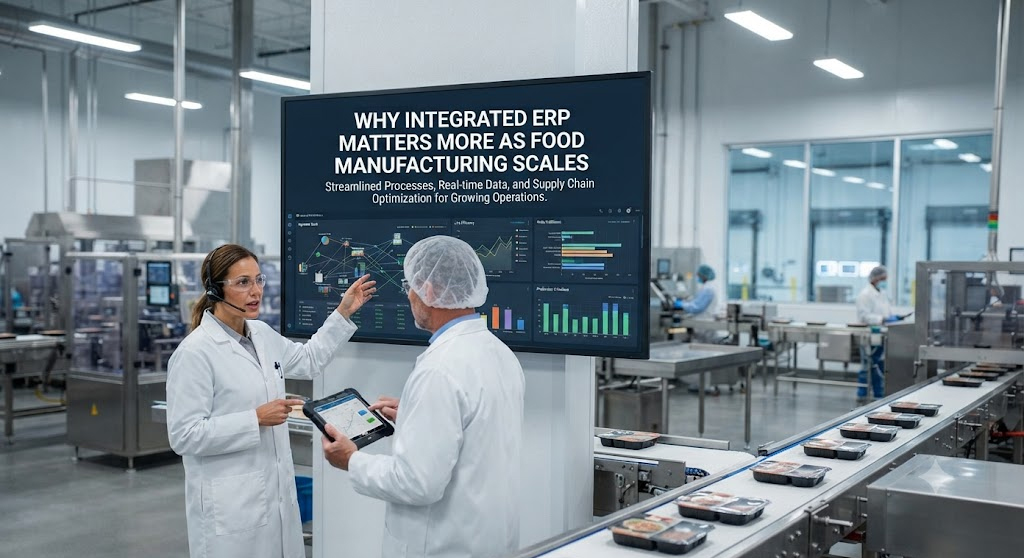
Why Integrated ERP Matters More as Food Manufacturing Scales
As production volume increases, small inefficiencies become expensive. A one-percent variance that is insignificant for a small batch can become a major annual cost when multiplied across hundreds or thousands of production orders. That is why experienced food manufacturers need to think beyond inventory digitisation. The objective should be to create a connected flow from procurement to formulation, formulation to production, production to inventory, inventory to sales and sales to profitability.
With that foundation, management can move from asking “What happened?” to “Why did it happen, what did it cost us, and what should we change?” That shift is where modern ERP Software for Food Manufacturing creates measurable business value.
How Bluechip Solutions Can Help Food Manufacturers Gain Better Cost and Production Control
Bluechip Solutions helps businesses evaluate ERP around their actual workflows rather than forcing manufacturing operations into a rigid template. For food manufacturers, the focus can extend across formulation and BOM management, procurement, batch production, inventory, wastage, costing, finance, workflow automation, dashboards and business process automation.
With a connected ERP environment, management can gain better visibility into production performance and financial outcomes while reducing dependency on disconnected spreadsheets and manual reconciliation. For manufacturers already operating at scale, the objective is not simply to install another ERP system.
The objective is to create better control over every batch, every material movement and every rupee contributing to product profitability. Want to identify where your food manufacturing operation is losing margin? Request a Free ERP Consultation with Bluechip Solutions and discuss your batch costing, yield, inventory and profitability workflows with an ERP specialist.
Get a Food Manufacturing ERP Assessment
Before investing in or replacing an ERP system, manufacturers can evaluate their current process across batch costing, formulation control, yield variance, wastage, expiry management, inventory visibility and real-time profitability.
Get the Food Manufacturing ERP Cost & Margin Control Checklist to evaluate whether your current system provides the operational visibility needed for modern food manufacturing.
Frequently Asked Questions About ERP Software for Food Manufacturing
What is ERP Software for Food Manufacturing?
ERP Software for Food Manufacturing is an integrated business system designed to connect food production processes such as formulation, BOM management, procurement, batch production, inventory, costing, quality, sales and finance. Its purpose is to provide a unified view of manufacturing operations and profitability.
How does ERP reduce food manufacturing cost?
ERP can reduce avoidable costs by connecting actual material consumption, production output, yield variance, wastage, inventory ageing and procurement costs. This allows manufacturers to identify cost deviations earlier and take corrective action before they accumulate.
Can ERP track batch costing and yield variance?
Yes. A manufacturing ERP can compare planned material consumption and expected yield against actual batch consumption and output. This allows production and finance teams to investigate recurring cost and yield deviations.
Can food manufacturing ERP manage expiry and batch inventory?
Yes. ERP systems designed for food manufacturing can maintain batch-level inventory information and expiry-related data. This can support FEFO-oriented inventory control, better stock rotation and earlier identification of ageing inventory.
Can AI be used with food manufacturing ERP?
Yes. AI can analyse historical ERP data to identify patterns in yield, material consumption, wastage, production performance and demand. However, AI works best when the underlying ERP data is accurate, consistent and connected.
Why is real-time margin visibility important for food manufacturers?
Because product profitability can change when raw-material prices, yield, wastage, packaging costs or production efficiency change. Real-time or near-real-time visibility allows management to investigate margin deterioration before it becomes a month-end surprise.
What should a CEO check before selecting food manufacturing ERP software?
A CEO should evaluate whether the ERP can connect formulation, procurement, production, batch costing, yield, wastage, inventory, quality and finance. The system should also provide management dashboards and the flexibility required as products, processes and business requirements evolve.