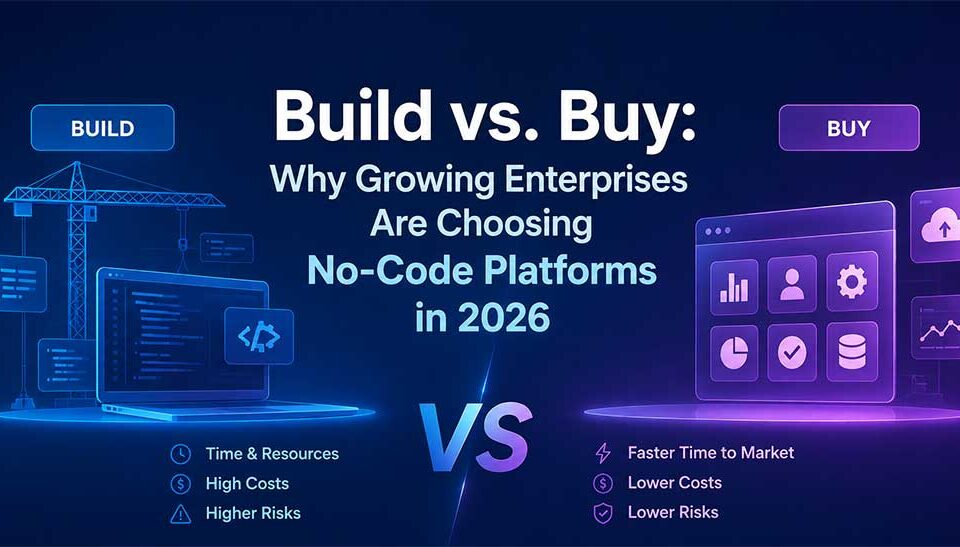

For a growing enterprise, the software decision is rarely as simple as “build or buy.” The real question is whether the business can keep adapting when processes change, customers expect faster service, regulations evolve, and technology teams are already overloaded.
Traditional custom development offers flexibility, but it can demand significant time, specialist skills, testing, maintenance, and ongoing investment. Off-the-shelf software, meanwhile, can be faster to deploy, yet businesses often discover that their processes must change to fit the software rather than the other way around.
That is why no-code platforms are becoming increasingly relevant to enterprise technology strategies in 2026. Instead of choosing between rigid packaged software and expensive custom development, enterprises can use no-code application platforms to create, customize, automate, and continuously improve business applications with far less dependency on traditional coding.
The market direction supports this shift. Gartner forecasts that the worldwide low-code development technologies market will reach $58.2 billion by 2029, growing at a 14.1% CAGR. Gartner also identifies agentic AI, citizen development, and operational excellence as important adoption drivers.
Why the Build vs. Buy Decision Is Becoming More Difficult
Historically, enterprises had two primary choices. They could build software internally or purchase an existing product. However, both approaches have limitations. When an organization builds a system traditionally, the initial requirements may appear straightforward. Over time, however, new approval rules, reports, integrations, mobile requirements, customer requests, compliance changes, and workflow modifications start accumulating. Consequently, the application becomes more expensive and difficult to maintain.
Buying software solves some of those problems. Nevertheless, packaged applications frequently come with predefined workflows. If the company’s procurement process, manufacturing workflow, distribution model, financial structure, or approval hierarchy differs from the software’s standard design, customization becomes necessary.
That is where the traditional build-versus-buy model starts to break down. Growing enterprises increasingly need a third option: buy a flexible technology platform and build the business-specific capabilities on top of it.
What Is a No-Code Platform?
A no-code platform enables organizations to create applications, workflows, forms, dashboards, reports, integrations, and automation using visual configuration rather than conventional programming for every change. More importantly, enterprise no-code is not simply about allowing non-technical employees to create small applications.
A mature no-code platform can provide a structured environment where business teams and professional developers work together. Instead of rebuilding an entire application whenever requirements change, teams can configure processes, data structures, screens, rules, approvals, and integrations according to changing business needs.
This distinction matters because enterprise software is rarely static. A growing organization may enter a new market, add a warehouse, introduce a new product line, change its approval hierarchy, integrate another financial system, or create a new customer portal. Therefore, the ability to modify software quickly becomes a strategic advantage.
The Biggest Pain Point: Traditional Development Takes Too Long to Change
One of the most common problems enterprises face is not creating the first version of an application. It is changing that application later.
A seemingly minor modification can move through requirement analysis, technical design, development, testing, deployment, documentation, and approval. As a result, a business request that could have created value immediately may take weeks or months to reach production. Meanwhile, the business continues operating with workarounds.
Employees return to spreadsheets. Managers request manual reports. Teams maintain parallel databases. Customers wait longer for responses. Eventually, the organization has multiple disconnected processes surrounding the original application. No-code platforms address this bottleneck by moving many application changes closer to the business process itself. Instead of treating every change as a new software project, organizations can treat applications as continuously configurable business systems.
Why Growing Enterprises Are Choosing No-Code in 2026
The shift toward no-code is also being accelerated by the broader evolution of enterprise software. Gartner’s 2025 research describes enterprise low-code application platforms as addressing delivery speed, legacy complexity, integration requirements, AI-assisted development, composable architecture, and governance.
Furthermore, Gartner reported that the worldwide high-productivity application platform market grew 16.6% to $10.8 billion in 2024, with growth supported by GenAI and agentic AI capabilities. Therefore, enterprises are no longer evaluating low-code and no-code purely as developer productivity tools. Increasingly, they are evaluating these platforms as part of their broader modernization and digital transformation strategies. The practical reason is simple: businesses need software that can evolve at approximately the same speed as the business.
No-Code Reduces the Gap Between Business Requirements and Technology
Consider a manufacturing company that changes its purchase approval process. With a traditional development approach, the business team may submit a requirement to IT. The IT team then analyzes the change, estimates the effort, schedules development, implements the logic, performs testing, and deploys the update.
By the time the change becomes available, the business requirement may have changed again. With a capable no-code platform, many of these changes can be configured through visual business rules, workflows, forms, and approval structures. Professional developers can still manage complex integrations and technical requirements, while business teams can participate much more directly in application evolution.
Consequently, the distance between “what the business needs” and “what the software does” becomes smaller.
Build vs. Buy vs. No-Code: Which Approach Makes More Sense?
Traditional custom development remains valuable when an organization needs highly specialized technology that cannot reasonably be delivered through a platform. Similarly, packaged software can be an excellent choice when a company’s processes closely match the product’s standard functionality and customization requirements are limited.
No-code becomes particularly attractive when the business needs both speed and flexibility. For example, an enterprise may require standard accounting, inventory, sales, purchasing, HR, manufacturing, or reporting capabilities while also needing industry-specific workflows and company-specific approvals.
Instead of repeatedly modifying source code, the organization can use a configurable platform to create the required business experience. The strongest strategy, therefore, is not automatically “replace everything with no-code.” Rather, enterprises should determine which systems should remain standard, which processes require customization, and where a no-code platform can eliminate development bottlenecks.
How No-Code Can Reduce the Total Cost of Software Ownership
Software cost is often misunderstood because companies focus heavily on the initial purchase or development price. However, the real cost includes implementation, customization, integrations, testing, upgrades, infrastructure, support, maintenance, training, and future changes. A system that appears inexpensive initially can become expensive when every modification requires specialist development.
No-code can reduce this long-term burden by making many changes configurable rather than code-intensive. Consequently, organizations may reduce their dependency on lengthy development cycles while allowing internal teams to participate more actively in application improvements. The financial benefit is therefore not simply lower development cost. It is the potential reduction in the cost of change. For growing enterprises, that distinction is critical.
AI Is Changing What Enterprises Expect From No-Code Platforms
No-code platforms are also evolving because of artificial intelligence. Modern application platforms increasingly combine visual development with AI-assisted design, automation, data analysis, application generation, and intelligent workflows. Gartner’s 2025 research highlights the increasing importance of GenAI and agentic capabilities within enterprise application platforms.
This creates a new development model. Instead of starting with a blank development environment, a business user may describe a process in natural language, while AI assists with creating application structures, workflows, rules, or automation. However, enterprises should not choose a platform simply because it includes an AI label.
The more important question is whether AI operates within a secure, governed, integrated application environment. AI-generated functionality still needs business validation, access controls, data governance, testing, and human oversight. Therefore, the winning combination in 2026 is not “AI instead of people.” It is AI-assisted development combined with human business expertise and enterprise governance.
What Enterprises Should Look for Before Choosing a No-Code Platform
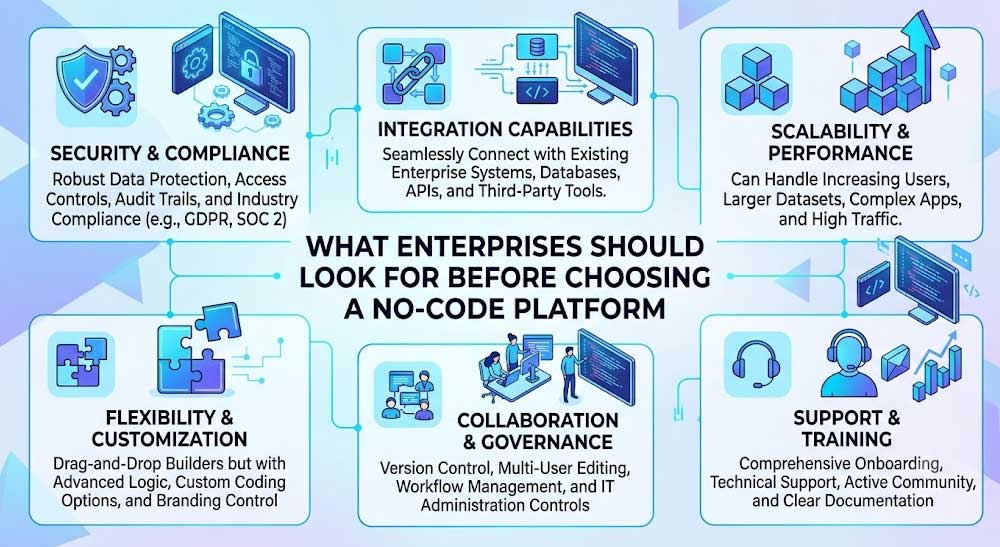
The biggest mistake is selecting a platform based only on how quickly someone can build a simple application. Enterprise requirements are considerably broader. A serious evaluation should examine scalability, security, role-based access, auditability, integrations, workflow management, reporting, mobile support, data management, deployment options, governance, extensibility, vendor support, and the ability to handle mission-critical processes.
Integration is especially important. An enterprise application rarely operates alone. It may need to communicate with accounting systems, CRM platforms, payment gateways, payroll systems, manufacturing equipment, customer portals, APIs, email services, messaging platforms, and external databases. Consequently, a no-code platform should be evaluated as an enterprise application foundation rather than merely a visual form builder.
The Human Factor: No-Code Does Not Mean No IT
Another misconception is that no-code eliminates the need for IT teams. In reality, successful enterprise adoption usually requires collaboration between business users, IT professionals, security teams, management, and implementation specialists.
Business teams understand the process. IT teams understand architecture and governance. Management understands strategic priorities. Implementation teams understand how to translate requirements into a sustainable solution. No-code simply changes how these groups collaborate.
Instead of IT becoming a permanent bottleneck for every small modification, teams can distribute application development responsibilities while retaining governance and technical oversight. This is particularly important as enterprises attempt to increase innovation without creating uncontrolled technology sprawl. Forrester’s 2026 research notes that the AppGen and low-code market is expanding development capacity while also creating challenges around fragmentation, complexity, platform maturity, and governance.
How to Decide Whether No-Code Is Right for Your Enterprise
The answer depends on the nature of the organization’s processes. If your business relies heavily on spreadsheets, manual approvals, duplicate data entry, disconnected applications, lengthy customization cycles, or frequent requests that remain in an IT backlog, a no-code approach may provide significant value. Likewise, if your enterprise needs to modernize legacy applications but cannot justify rebuilding everything from scratch, a no-code platform can provide a practical modernization layer.
The most useful starting point is therefore not “Which platform should we buy?” Instead, ask: “Which business processes are currently costing us the most time, money, and operational visibility?” Once those processes are identified, the organization can evaluate whether a configurable no-code solution can deliver measurable improvement.
Why the Future Is Moving Beyond the Traditional Build-or-Buy Model
The build-versus-buy debate assumed that enterprises had to choose between customization and convenience. No-code changes that equation. A modern no-code platform can provide a foundation that is purchased while allowing the business-specific application experience to be configured around it. Consequently, enterprises can achieve greater flexibility without assuming the full cost and complexity of traditional custom development.
At the same time, the emergence of AI and agentic capabilities is pushing application development toward a more collaborative model. Gartner forecasts continued strong growth in low-code technologies through 2029, while Forrester’s 2026 research highlights the rapid evolution of application generation and low-code platforms. For growing enterprises, the strategic advantage is clear: software should support business change instead of becoming another obstacle to it.
No-Code ERP Can Be the Next Step for Growing Businesses
For enterprises struggling with disconnected finance, inventory, sales, purchasing, manufacturing, HR, reporting, and operational processes, an enterprise no-code ERP approach can go further than simply replacing individual applications. A configurable ERP platform can bring core business data and workflows together while allowing organizations to adapt the system as their operations evolve.
That is particularly valuable for businesses that have outgrown spreadsheets or rigid legacy ERP systems but do not want to enter another lengthy, expensive customization project. BlueChip Solutions’ no-code approach is designed around this principle, combining enterprise business processes with configurable application development so organizations can adapt technology to their operational requirements.
If your current ERP requires weeks for simple changes, your teams depend on spreadsheets for critical processes, or your IT backlog is preventing business improvements, it may be time to evaluate a more flexible approach.
Ready to see whether a no-code ERP approach fits your business? Book a free ERP consultation with BlueChip Solutions and identify the processes where faster customization and automation can create the greatest business impact.
Frequently Asked Questions About No-Code Platforms
Is no-code suitable for large enterprises?
Yes. Modern enterprise no-code platforms can support complex applications when they provide appropriate security, governance, integration, scalability, workflow, and extensibility capabilities. The key is selecting an enterprise-grade platform rather than a basic application builder.
Is no-code better than custom software development?
Not in every situation. Custom development remains appropriate for highly specialized requirements. However, no-code can be more efficient when an organization needs frequent business changes, rapid application delivery, configurable workflows, and lower dependency on conventional development for routine modifications.
Does no-code reduce ERP implementation time?
It can. Because many application components can be configured visually rather than developed entirely through traditional coding, no-code platforms can reduce development and customization effort. Actual implementation time still depends on business complexity, data migration, integrations, scope, testing, and organizational readiness.
Is no-code secure enough for enterprise applications?
It can be, provided the platform includes enterprise-grade security, authentication, authorization, audit trails, governance, data protection, integration controls, and appropriate deployment architecture. Security should always be evaluated as part of the platform-selection process.
What is the biggest advantage of no-code in 2026?
The biggest advantage is adaptability. Enterprises need applications that can respond quickly to changing processes, customer expectations, regulations, integrations, and AI-driven opportunities. No-code can help organizations turn business requirements into operational changes faster while maintaining structured governance.
What should an enterprise evaluate before choosing a no-code platform?
An enterprise should evaluate scalability, security, integration capabilities, workflow automation, reporting, data architecture, governance, AI capabilities, customization flexibility, vendor support, implementation expertise, and the platform’s ability to support long-term business growth.
Final Thoughts
The build-versus-buy decision is no longer a simple choice between developing everything internally and purchasing a fixed software package. Growing enterprises need something more adaptable. They need technology that can be implemented efficiently, customized without excessive development effort, integrated with existing systems, governed securely, and continuously improved as the business changes.
That is why no-code platforms are becoming an increasingly important part of the enterprise technology landscape in 2026. The real question is not whether your organization should build or buy. It is whether your technology can change as quickly as your business does.