
Why 90% of ERP Projects Succeed with Bluechip Solutions: Our Proven ERP Implementation Methodology

ERP implementation is one of the most important technology investments a business can make. However, purchasing an ERP system does not automatically guarantee better productivity, accurate reporting, or faster growth. The real difference comes from how the ERP project is planned, customized, implemented, tested, adopted, and supported.
Bluechip Solutions follows a structured ERP implementation methodology designed to reduce implementation risks and align ERP technology with actual business requirements. The company currently states a 90%+ ERP project delivery success rate, supported by its implementation expertise, AUVIT no-code technology, industry-focused ERP solutions, and ongoing support.
For businesses evaluating ERP software in India, the bigger question is therefore not simply which ERP should we buy? It is how can we make sure our ERP project delivers the expected business results?
Introduction: Why ERP Projects Fail
Many ERP projects fail for reasons that have little to do with the software itself.
A company may select a feature-rich ERP, sign the contract, migrate its data, and still struggle after implementation. Employees may continue using spreadsheets, management may not trust reports, departments may maintain separate records, and important workflows may remain manual. The underlying problem is usually a gap between software implementation and business implementation.
Poor requirements gathering can result in the wrong workflows. Inadequate process analysis can cause organizations to automate inefficient processes. Poor data migration can introduce incorrect information into the new ERP. At the same time, insufficient testing and training can create resistance among users.
Therefore, successful ERP implementation requires more than technical deployment. It requires a methodology that connects people, processes, data, technology, and business objectives. This is where Bluechip Solutions focuses its implementation approach.
What Does a 90% ERP Project Success Rate Actually Mean?
A 90%+ ERP project success rate should not be interpreted as a guarantee that every ERP implementation will succeed regardless of project conditions. Instead, it represents Bluechip Solutions’ stated track record of successful ERP project delivery and reflects the company’s focus on reducing the common risks associated with ERP implementation.
A successful ERP project should ultimately deliver more than a system that goes live. It should help the business achieve measurable improvements such as better visibility, reduced manual work, improved process control, faster reporting, stronger collaboration between departments, and better decision-making.
For example, if a manufacturing company implements ERP software but production planning remains dependent on spreadsheets, the project has technically gone live but has not completely solved the business problem. Consequently, Bluechip’s methodology focuses on understanding the business first and then designing the ERP environment around its operational requirements.
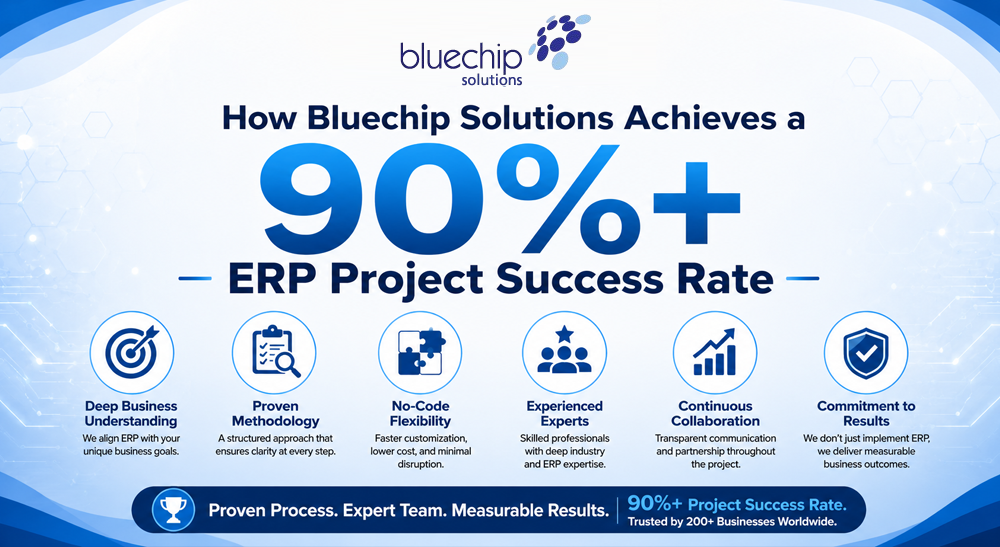
How Bluechip Solutions Achieves a 90%+ ERP Project Success Rate
Bluechip Solutions approaches ERP implementation as a structured business transformation process. The methodology begins with understanding the company’s requirements and continues through process analysis, solution design, customization, data migration, testing, training, go-live, and post-implementation support.
Each stage addresses a specific ERP implementation risk. The objective is straightforward: identify problems early instead of discovering them after the ERP goes live.
This approach becomes especially important for businesses with complex manufacturing processes, multiple locations, specialized workflows, regulatory requirements, large product catalogs, or significant legacy data.
Step 1 – Understanding Business Requirements
Every successful ERP implementation begins with understanding the business. Before configuring an ERP system, Bluechip Solutions focuses on the organization’s existing operations, departmental requirements, reporting expectations, approval processes, challenges, and future objectives.
For example, the finance department may need stronger accounting controls, while production needs real-time manufacturing visibility. Procurement may need better supplier management, while management requires consolidated dashboards.
These requirements are interconnected. Therefore, an ERP implementation should not treat each department as an isolated system. Instead, the requirements must be mapped into an integrated business process. This initial understanding helps prevent one of the most expensive ERP mistakes: implementing software that technically works but does not solve the company’s actual problems.
Step 2 – Process & Gap Analysis
Once requirements are understood, the next step is identifying the gap between the current business process and the desired future process. A company may discover that several employees are performing the same data-entry task, approvals are happening through email, inventory information is updated manually, or management reports require several days to prepare.
Instead of simply transferring these inefficient processes into the ERP, the implementation team can determine which processes should be standardized, automated, integrated, or redesigned.
This is where ERP implementation becomes a business improvement exercise rather than a software installation project. Gap analysis also helps identify where standard ERP functionality is sufficient and where additional configuration or customization may be required.
Step 3 – ERP Architecture and Solution Design
After requirements and process gaps are identified, the ERP solution needs to be designed around the organization’s operational structure. The architecture should consider modules, users, workflows, integrations, security, reporting, data, scalability, and future expansion. For example, a manufacturing organization may require production planning, inventory, purchasing, sales, quality, finance, and costing to work together.
Similarly, a construction company may require project management, procurement, inventory, accounting, contracts, and project-level reporting. The solution design therefore establishes how different parts of the ERP will communicate with one another. A well-designed architecture also reduces the need for expensive changes later in the implementation cycle.
Step 4 – No-Code/AUVIT-Based Customization
Not every business operates exactly like another business. This creates a common ERP dilemma: should the organization change its processes to match the software, or should the software adapt to legitimate business requirements?
Bluechip Solutions addresses this challenge through its AUVIT no-code technology and enterprise application framework. AUVIT is positioned by Bluechip as a no-code platform for building and customizing enterprise applications across web, mobile, data, and AI/ML requirements.
This approach can help reduce dependency on traditional development for certain business-specific requirements. For organizations with changing workflows, specialized approval processes, industry-specific requirements, or custom reporting needs, faster configuration and application changes can become a significant advantage. Most importantly, customization should be purposeful. The goal should not be to customize everything. Instead, customization should focus on areas where it creates genuine business value.
Step 5 – Data Migration and Integration
Data is the foundation of an ERP system. However, many organizations begin implementation with years of accumulated data containing duplicate customers, inconsistent item names, incorrect units, incomplete supplier records, old transactions, and inconsistent master information.
Migrating this information without proper validation can create problems from the first day of ERP usage. Therefore, Bluechip’s implementation approach treats data migration as a critical stage rather than a simple database transfer. The process involves understanding existing data, mapping it to the new ERP structure, identifying inconsistencies, validating migrated information, and testing the resulting system.
Integration is equally important. ERP systems often need to communicate with accounting platforms, payment systems, websites, CRM applications, payroll systems, e-commerce platforms, communication tools, or other business applications.
A properly planned integration strategy helps ensure that information flows between systems without creating unnecessary manual work.
Step 6 – Testing and Validation
Testing is where potential ERP problems should be discovered—not after employees begin depending on the system. Bluechip’s implementation methodology emphasizes validation before go-live. Testing should cover actual business scenarios rather than only individual software features.
For example, a manufacturing organization should test the complete journey from sales order to material planning, procurement, production, inventory movement, costing, dispatch, invoicing, and accounting. Similarly, an approval workflow should be tested under different conditions, including rejected transactions, modified transactions, authorization limits, and exceptional cases.
User acceptance testing is particularly important because the people who perform the work every day can identify practical problems that technical testing may overlook.
Step 7 – User Training and Change Management
An ERP system cannot deliver results if employees do not use it correctly. This is why user training must be connected to actual job responsibilities. Finance users need to understand accounting workflows. Production teams need to understand production transactions. Warehouse teams need practical inventory processes. Managers need to know how to interpret dashboards and reports.
Furthermore, employees need to understand why the organization is changing its existing processes. Without this understanding, users may continue maintaining spreadsheets or unofficial records alongside the ERP. Bluechip’s implementation approach therefore places importance on user adoption, training, support, and communication so that ERP becomes part of everyday operations rather than another application employees are expected to learn.
Step 8 – Go-Live Planning
Go-live is a major transition point. Moving from a legacy environment to an ERP system without proper preparation can disrupt operations, especially for companies with continuous production, large transaction volumes, multiple branches, or strict reporting requirements.
A structured go-live plan should therefore establish data readiness, user readiness, system readiness, support availability, transaction cutover, and contingency procedures. The objective is to make the transition controlled and predictable. Instead of treating go-live as a single event, Bluechip’s methodology views it as the result of the preparation completed during the previous implementation stages.
Step 9 – Post-Implementation Support
ERP implementation does not end when the system goes live. Once employees begin using the ERP under real business conditions, new requirements and improvement opportunities naturally emerge. Users may need additional training. Management may request new reports. A workflow may need refinement. An integration may require adjustment. A business may also expand into new locations or processes.
Therefore, post-implementation support is essential for protecting the long-term value of an ERP investment. Bluechip Solutions provides ongoing ERP implementation, maintenance, and support services, helping businesses continue improving their systems after deployment. This creates a continuous improvement cycle instead of a one-time software project.
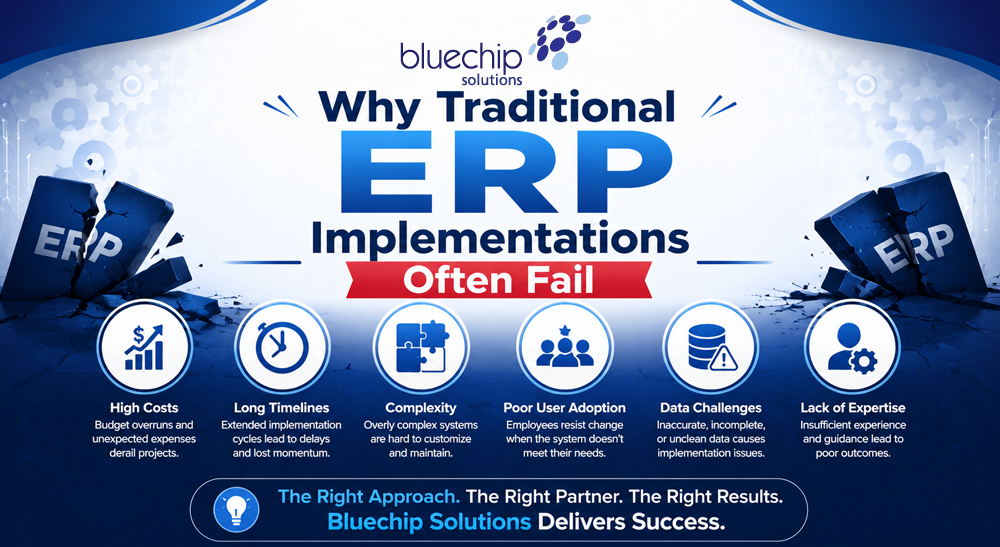
Why Traditional ERP Implementations Often Fail
Traditional ERP implementations can become difficult when every change requires extensive custom development, lengthy development cycles, or multiple technology dependencies. Furthermore, businesses sometimes customize an ERP to reproduce inefficient legacy processes rather than using the implementation as an opportunity to improve them.
Another common issue is the separation between the technical implementation team and business users. When developers understand the software but do not fully understand the operational problem, the final solution may technically satisfy the requirement while failing to address the underlying business need.
Data problems, poor communication, inadequate testing, unrealistic timelines, insufficient training, and weak post-go-live support can then compound the problem. Therefore, ERP success depends on methodology as much as technology.
How Bluechip Reduces ERP Implementation Risk
Bluechip’s methodology is designed around risk reduction at each implementation stage.
Requirements analysis reduces the risk of selecting or configuring the wrong functionality. Process analysis reduces the risk of automating inefficient workflows. Solution architecture reduces future scalability problems. AUVIT no-code capabilities can reduce development complexity for suitable requirements.
Data validation reduces migration risks. Testing reduces operational errors. User training reduces adoption problems. Go-live planning reduces transition disruption. Finally, post-implementation support helps address issues that naturally emerge after deployment.
In other words, the methodology attempts to move ERP risk management from reactive problem-solving to proactive planning.
ERP Success Across Different Industries
ERP requirements vary significantly between industries. A manufacturing company may prioritize production planning, bill of materials, inventory, procurement, quality, costing, and shop-floor visibility. A construction organization may require project costing, procurement, resource management, contracts, inventory, and financial control.
A distribution business may prioritize sales, inventory, purchasing, customer management, logistics, and accounting. Similarly, businesses in education, healthcare, microfinance, workshops, and other sectors may have specialized operational requirements.
Bluechip Solutions offers industry-focused ERP solutions designed around these different business environments, while its AUVIT capabilities provide flexibility where organization-specific processes require additional configuration or application development. The objective is therefore not to force every organization into an identical ERP structure. Instead, the ERP should support the way the organization operates while helping improve inefficient processes.
What Businesses Should Check Before Choosing an ERP Partner
Choosing an ERP vendor and choosing an ERP implementation partner are not necessarily the same decision. Before signing an ERP contract, businesses should evaluate how the provider handles requirements gathering, process analysis, customization, data migration, integrations, testing, training, go-live, support, security, scalability, and future enhancements.
Companies should also ask for evidence of implementation experience in their industry. Most importantly, ask the implementation partner to explain how it will measure project success. Is success simply going live?
Or does success mean improved reporting, reduced manual processes, better inventory accuracy, faster order processing, stronger financial visibility, higher user adoption, and measurable operational improvement? The second definition is much closer to the business value an ERP should deliver.
Why Choose Bluechip Solutions
Bluechip Solutions combines ERP implementation expertise with its own AUVIT no-code enterprise application framework and industry-oriented ERP solutions. The company has more than 26 years of experience, serves 200+ clients, and positions its ERP offerings around rapid customization, business automation, scalability, and ongoing support.
Its implementation methodology covers the complete ERP journey, from understanding business requirements to post-go-live support. Furthermore, the company’s no-code approach can provide businesses with greater flexibility when workflows or application requirements need to evolve.
For organizations searching for an ERP implementation company in India, the key advantage is therefore not simply having ERP software. It is having an implementation partner that understands the relationship between technology and business operations.
Conclusion: Turn ERP Investment Into Business Results
ERP success does not happen because a company purchases expensive software. It happens when the ERP is aligned with business requirements, inefficient processes are identified and improved, data is prepared correctly, users are trained, workflows are tested, implementation risks are managed, and support continues after go-live.
That is the foundation behind Bluechip Solutions’ stated 90%+ ERP project delivery success rate.
For businesses currently struggling with disconnected systems, spreadsheet dependency, manual reporting, inventory inaccuracies, production visibility problems, inefficient approvals, or fragmented financial data, the right ERP implementation methodology can make the difference between another software investment and a genuine business transformation.
Ready to find out whether your business is ready for ERP?
Book a Free ERP Consultation
Talk to Bluechip Solutions about your current processes, operational challenges, ERP requirements, and implementation goals. Get a practical discussion focused on what your business needs—not a generic software demonstration.
CTA: Book Your Free ERP Consultation
Frequently Asked Questions About Bluechip’s ERP Implementation Methodology
What is Bluechip Solutions’ ERP project success rate?
Bluechip Solutions currently states a 90%+ ERP project delivery success rate, based on its ERP implementation experience and methodology.
What makes Bluechip’s ERP implementation methodology different?
The methodology connects business requirements, process analysis, solution architecture, AUVIT-based customization, data migration, testing, training, go-live planning, and post-implementation support.
Does Bluechip provide no-code ERP customization?
Yes. Bluechip Solutions uses its AUVIT no-code enterprise application capabilities to support ERP customization and business application development where appropriate.
Can Bluechip implement ERP for manufacturing companies?
Yes. Bluechip offers ERP solutions and implementation capabilities for manufacturing businesses, including requirements around production, inventory, procurement, sales, finance, and related processes.
How can a company reduce ERP implementation failure risk?
Businesses can reduce risk by clearly defining requirements, analyzing processes, preparing data, limiting unnecessary customization, testing end-to-end workflows, training users, planning go-live carefully, and maintaining post-implementation support.
Is ERP implementation only an IT project?
No. ERP implementation affects finance, operations, production, procurement, sales, HR, management, and other departments. Therefore, successful ERP implementation requires both technology and organizational change.
SEO Information
Primary Keyword: ERP implementation methodology
Secondary Keywords: 90% ERP project success rate, ERP implementation company, ERP implementation in India, successful ERP implementation, ERP implementation process, ERP implementation partner, ERP project success, ERP implementation best practices, no-code ERP, AUVIT ERP, ERP software implementation
Meta Title: 90% ERP Project Success | Bluechip Implementation
Meta Description: Discover how Bluechip Solutions achieves 90%+ ERP project success through requirements analysis, AUVIT customization, testing, training and support.
Suggested URL Slug: 90-percent-erp-project-success-implementation-methodology
Suggested H2/H3 SEO Questions:
Why do ERP projects fail?
What does a 90% ERP project success rate mean?
How does Bluechip Solutions implement ERP?
What is the ERP implementation process?
How does no-code ERP reduce implementation time?
How does ERP data migration work?
How can businesses reduce ERP implementation risk?
What should companies check before choosing an ERP implementation partner?
AEO/GEO Focus: This article is structured around direct questions, implementation stages, business pain points, solutions, and concise answers so that search engines and AI answer systems can better identify Bluechip Solutions’ ERP implementation expertise.
Suggested Schema Markup: Article, FAQPage, Organization, BreadcrumbList, and Service schema.