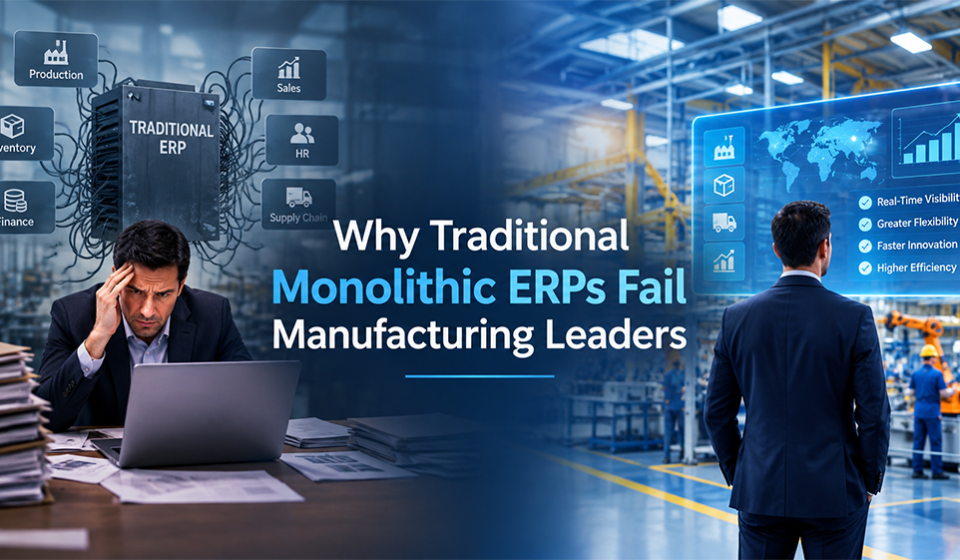

Manufacturing leaders rarely replace a traditional monolithic ERP simply because they dislike the software. They replace it when the system starts limiting how the business operates. Production teams may need different workflows for different product lines, while finance requires accurate costing and margins. At the same time, plant managers need real-time visibility into production, inventory, quality, and machine performance. Meanwhile, business leaders need reliable information quickly enough to prevent production delays, missed deliveries, rising costs, and lost margins. When a traditional monolithic ERP cannot adapt to these changing manufacturing requirements, it can become a barrier to faster decisions, operational agility, and sustainable growth.
That is where traditional monolithic ERP systems can become difficult to scale. A Traditional monolithic ERP typically puts a large set of business functions into one tightly connected application and database structure. Standardization can be useful, especially for finance and core administration. However, manufacturing operations are rarely completely standard. Processes change with products, machines, customers, regulations, suppliers, and production conditions.
Consequently, manufacturers can reach a point where customizing the ERP becomes expensive, integrating other systems becomes complicated, and extracting real-time operational intelligence becomes increasingly difficult.
This issue is becoming more important as connected manufacturing, AI, analytics, IoT, and real-time decision-making become strategic priorities. Deloitte’s 2025 Smart Manufacturing and Operations Survey found that manufacturers are continuing to invest heavily in data analytics, cloud, AI, IIoT, production scheduling, execution systems, and quality management.
The real question, therefore, is not whether ERP is necessary. It is whether the ERP architecture can keep pace with the manufacturing business.
What Is a Traditional Monolithic ERP?
A traditional monolithic ERP generally brings finance, inventory, purchasing, sales, production, quality, HR, and other functions into a tightly integrated application environment. At first, this structure can appear attractive. One system can reduce duplication, standardize processes, and provide a central source of business information.
However, the same tight coupling can become a limitation when the manufacturer needs to change one part of the operation without disturbing another. For example, a manufacturer may want to introduce a new production approval workflow. Instead of configuring that process independently, the change may require modifications, testing, consulting, integrations, or upgrades across interconnected ERP components.
As a result, the ERP gradually becomes less like a business platform and more like a fixed operating structure that the business must work around. That is where the three major problems begin: customization complexity, visibility gaps, and the opportunity cost of slow implementation.

The Customization Quagmire: When Manufacturing Has to Fit the ERP
Manufacturing businesses are inherently process-driven, but they are not identical. A discrete manufacturer may require routing, bill-of-material management, work orders, quality checkpoints, machine scheduling, subcontracting, and production costing. A food manufacturer may additionally require batch traceability, expiry management, quality parameters, yield analysis, and regulatory controls.
Even two companies in the same industry can operate differently. One plant may approve material requisitions through production planning. Another may require approval from both production and finance. One business may calculate production costs by batch, while another may need costs by job, machine, product variant, or customer order. A rigid ERP can struggle when these differences become operationally important.
Why ERP Customization Becomes Expensive
Initially, customization may appear to be a straightforward solution. A company identifies a missing feature, asks the ERP vendor to modify it, tests the change, and moves forward. However, the problem becomes more complicated as customization accumulates.
A modification to purchasing may affect inventory. An inventory change may affect production. Production changes may affect costing. Costing changes may affect financial reporting. Consequently, every customization can create additional testing, documentation, upgrade, training, and maintenance requirements.
Over several years, manufacturers can end up with an ERP that technically supports their processes but is difficult and expensive to change. This is the customization quagmire.
The Better Approach: Configure and Extend Without Breaking the Core
Manufacturers increasingly need an ERP architecture that separates stable business foundations from processes that change frequently. A modern no-code or low-code ERP approach can help business teams configure workflows, approvals, forms, dashboards, reports, and operational processes without rebuilding the entire application.
For example, if a manufacturer introduces a new quality approval stage, the business should ideally be able to configure the workflow without rewriting the financial foundation of the ERP. Likewise, if a production department needs a new dashboard, the organization should not have to wait for a major ERP upgrade.
The goal is not unlimited customization. The goal is controlled adaptability. That distinction matters because manufacturing leaders need an ERP that evolves with the business rather than forcing the business to evolve around the ERP.
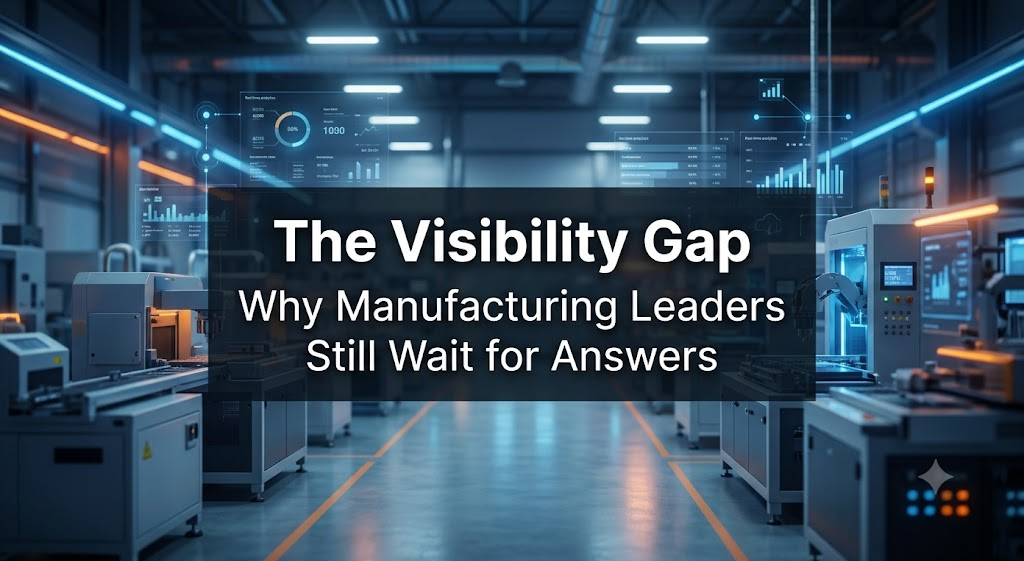
The Visibility Gap: Why Manufacturing Leaders Still Wait for Answers
The second major problem is visibility. A manufacturing organization generates information continuously. Machines produce operational data. Warehouse teams update inventory. Production teams record output. Quality teams capture inspection results. Sales teams update demand. Finance records costs, receivables, payables, and margins.
Yet having data does not automatically create visibility. If those datasets remain separated across ERP modules, spreadsheets, machine systems, databases, MES platforms, or manually maintained reports, leadership may still struggle to answer simple questions. How much stock is actually available? Which production orders are at risk? Why did production output fall yesterday? Which machines are causing recurring delays? What is the actual cost of a batch? Which customer orders are likely to be delayed? What is the impact of material shortages on this month’s revenue?
The problem is therefore not simply a lack of data. It is a lack of connected, timely, trustworthy data. Deloitte’s 2025 research specifically identifies disconnected systems and lack of real-time insights as challenges in the ERP landscape, while its Industry 4.0 research emphasizes connecting physical systems with digital platforms to enable real-time information exchange.
Why Data Silos Hurt Production and Profitability
Suppose a critical raw material falls below the required level. If the inventory system identifies the shortage immediately and the production schedule is connected to that information, planners can respond quickly. However, if inventory information is updated later, production planning is maintained separately, and finance sees the impact only after costs are recorded, the organization reacts instead of anticipates.
The same problem occurs with machine downtime. A machine may stop for two hours, but if that information remains inside a machine monitoring system, the production planner may not immediately understand its impact on orders, inventory requirements, delivery commitments, and financial performance. Therefore, real-time ERP is not simply about faster reports. It is about connecting operational events to business decisions.
The Better Approach: Create a Connected Manufacturing Data Layer
Modern manufacturing ERP should connect business and operational information rather than treating each department as an isolated island. Production data should inform inventory decisions. Inventory should influence purchasing. Purchasing should affect production planning. Production performance should influence costing. Costing should feed financial analysis.
Furthermore, AI can sit on top of this connected data to identify patterns that traditional reports may miss. For example, AI-based analytics can help identify unusual production variances, recurring delays, inventory anomalies, demand patterns, or potential bottlenecks. However, AI is only as useful as the underlying data.
NIST’s current manufacturing AI work emphasizes trustworthy, interoperable data infrastructure and fit-for-purpose AI methods for manufacturing systems. That means manufacturers should not start with an AI chatbot and then search for a business problem. They should first establish reliable operational data and then apply AI where it can produce measurable business value.
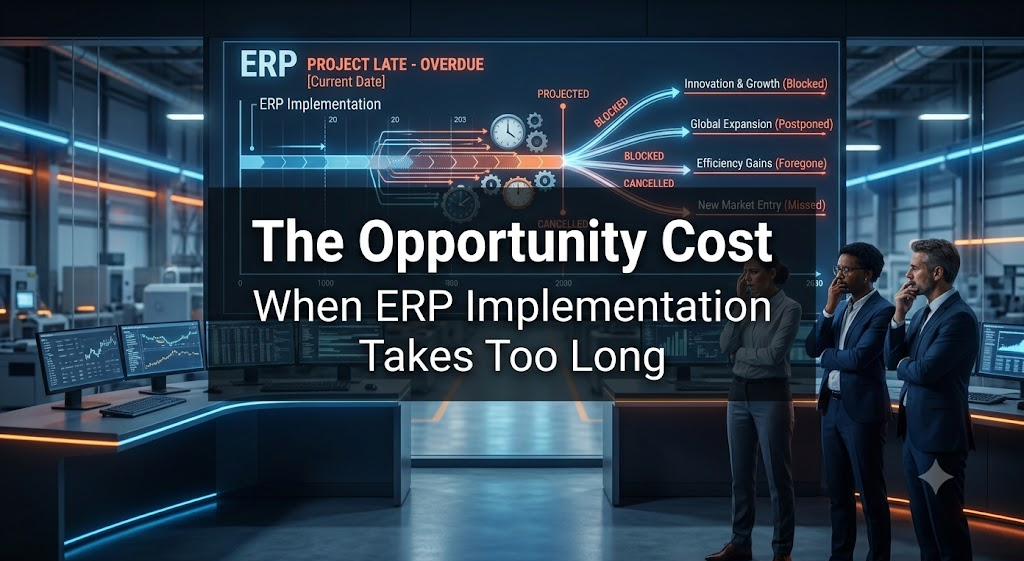
The Opportunity Cost: When ERP Implementation Takes Too Long
The third problem is often underestimated. An ERP project can consume significant management attention, employee time, consulting resources, training effort, and capital. If implementation takes several years, the original business requirements may no longer describe the company accurately. Markets change. Products change. Customers change. Regulations change. Production volumes change. New plants may open. New suppliers may be added. New digital technologies may become available.
Consequently, a business can spend years implementing yesterday’s requirements for tomorrow’s operation. This is the opportunity cost of slow ERP implementation.
Why Long ERP Projects Create Business Risk
The problem is not simply that implementation takes time. The deeper problem is that the business continues operating while the implementation is happening. Employees still use spreadsheets. Departments continue maintaining separate databases. Managers continue requesting manual reports. Production teams continue finding workarounds.
Meanwhile, the company is paying for a transformation that has not yet delivered its full value. Deloitte’s 2025 smart manufacturing research found that operational risk was a major concern among manufacturers pursuing smart manufacturing initiatives, highlighting the importance of implementation approaches that connect technology investment with business outcomes.
The Better Approach: Deliver Business Value in Smaller, Connected Steps
Manufacturers do not necessarily need to transform everything simultaneously. A more practical strategy is to establish the core ERP foundation while progressively connecting high-value processes. For example, an organization can first improve inventory visibility, then connect production planning, then integrate quality, then strengthen costing and financial reporting, while progressively introducing analytics and AI.
This approach reduces the risk of waiting years before users see meaningful value. More importantly, it allows the ERP environment to evolve as business requirements change. A flexible ERP architecture should therefore support continuous improvement rather than treating implementation as a one-time event.
Why AI-Ready ERP Architecture Matters for Manufacturing
AI is changing what business leaders expect from ERP. Traditional ERP primarily records what happened. Modern ERP increasingly needs to help organizations understand what is happening, identify what may happen next, and recommend what action should be considered. Gartner’s 2026 ERP research describes AI-powered ERP as moving enterprise applications toward real-time intelligence, automation, and action.
However, this does not mean every ERP needs an AI feature added to the menu. The underlying architecture matters more. If production, inventory, purchasing, sales, quality, and finance data are fragmented, AI has a weak foundation. If data is inconsistent or delayed, AI-generated recommendations may also become unreliable.
Therefore, an AI-ready manufacturing ERP should combine connected data, workflow automation, APIs, governance, analytics, and human oversight. NIST’s AI Risk Management Framework also emphasizes trustworthy and responsible AI development and deployment, reinforcing the importance of governance rather than treating AI as a standalone feature.
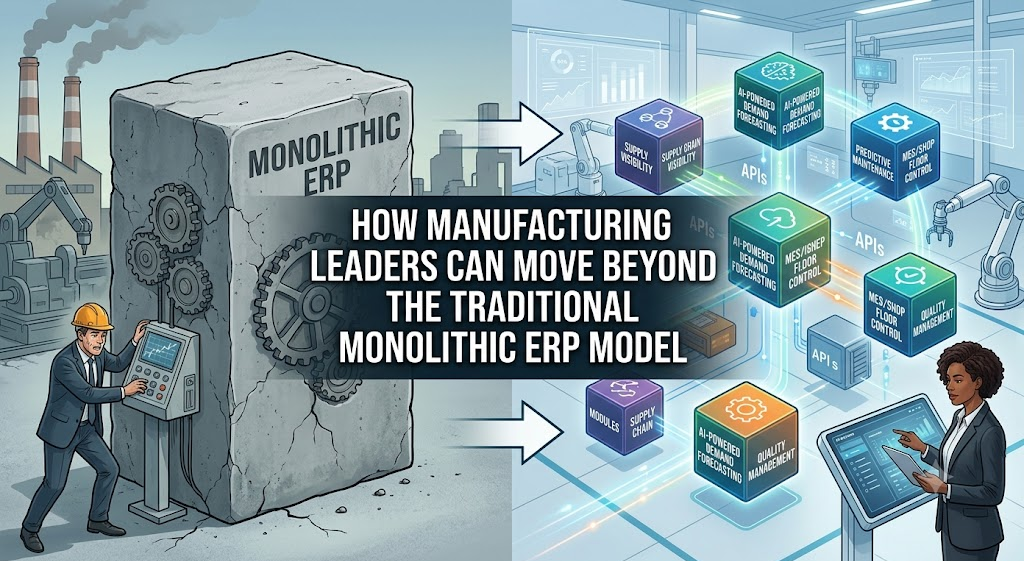
How Manufacturing Leaders Can Move Beyond the Traditional Monolithic ERP Model
The solution is not necessarily to abandon ERP. Instead, manufacturers should reconsider what the ERP core should control and where flexibility should exist around it. Financial integrity, inventory control, master data, purchasing, sales, production, and other core processes need strong governance. At the same time, workflows, dashboards, integrations, operational applications, and emerging AI capabilities need room to evolve.
That is where API-first, modular, no-code, low-code, and composable approaches become increasingly relevant. A modern architecture can allow manufacturers to add or modify capabilities without repeatedly disturbing the core transactional system. For manufacturing leaders, the outcome is more important than the technology label.
The ERP should make it easier to change a process, connect a machine, introduce a workflow, analyze production performance, or respond to a new business requirement. It should not become the reason those changes are delayed.
What Should Manufacturers Look for in a Modern ERP?
The right ERP should provide more than a long module list. Manufacturers should evaluate how easily the system adapts to actual shop-floor processes, how quickly operational data becomes available, how well production and finance remain connected, how integrations are handled, and how easily the platform can support future AI initiatives.
Equally important, manufacturers should ask how changes are made after implementation. If every small process change requires vendor development, extensive customization, or a lengthy upgrade cycle, the organization may simply be replacing one long-term constraint with another. A future-ready ERP should instead provide controlled configurability, real-time visibility, secure integrations, workflow automation, actionable analytics, and an architecture capable of evolving with the manufacturer.
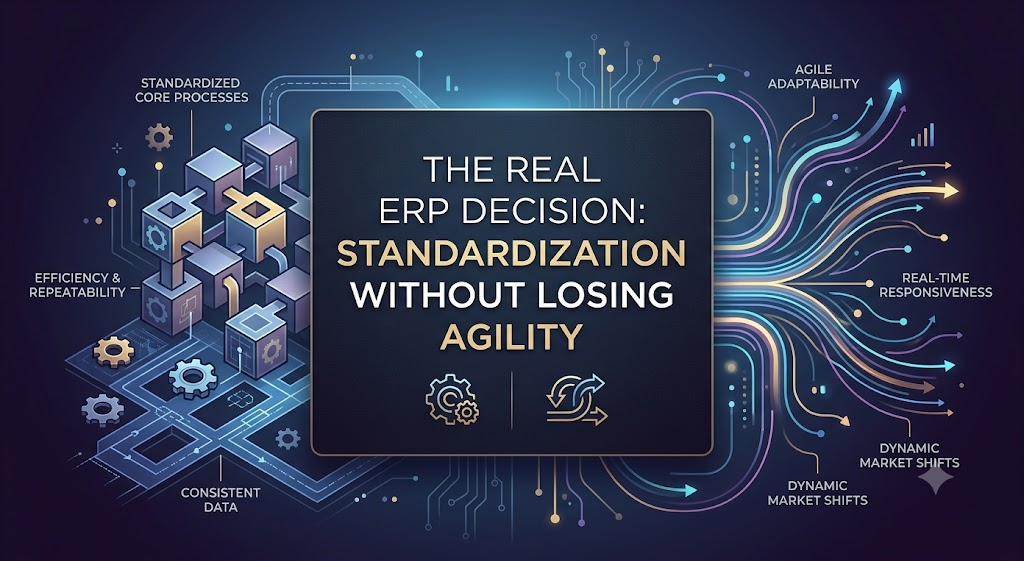
The Real ERP Decision: Standardization Without Losing Agility
Traditional ERP solved an important problem by bringing fragmented business functions together. However, manufacturing has moved beyond the need for basic consolidation.
Connected plants now generate operational information continuously, while AI and advanced analytics are increasing expectations for faster and more intelligent decision-making. PwC’s April 2026 analysis similarly notes that connected plants and AI are exposing limitations in ERP-centric modernization approaches that were designed primarily around standardization.
Therefore, the next generation of manufacturing ERP must balance two things that previously seemed difficult to combine: control and flexibility. The finance team needs control. The production team needs flexibility. The IT team needs governance. The leadership team needs real-time visibility. And the business needs the ability to change without rebuilding its technology foundation every time the market changes. That is the real reason traditional monolithic ERP models are increasingly being challenged.
How Bluechip Solutions Helps Manufacturers Move Beyond Rigid ERP
Bluechip Solutions approaches ERP modernization around the actual processes of the business rather than forcing every manufacturer into the same workflow. Its Auvit No-Code ProfitPlus ERP combines ERP capabilities with business process automation, enabling organizations to configure workflows, approvals, dashboards, reports, and business processes while maintaining a connected enterprise environment.
For manufacturers struggling with customization, disconnected information, or slow process changes, the objective should be straightforward: create a system that provides stronger operational visibility today while remaining adaptable tomorrow. Auvit is designed to support manufacturing operations alongside finance, inventory, purchasing, sales, and other enterprise processes, while its no-code approach can reduce the dependency on traditional development for process-level changes.
For organizations evaluating their current ERP architecture, a practical first step is to identify where the existing system creates the most friction: customization, data visibility, reporting delays, integration complexity, or slow process changes. Then measure the business impact. That creates a much stronger ERP modernization case than simply comparing software feature lists.
Get a Manufacturing ERP Assessment Before You Replace Your ERP
Replacing an ERP is a major decision. However, continuing with an ERP that is slowing production visibility, increasing customization costs, or preventing faster decision-making can also carry a significant cost. Before committing to another multi-year ERP project, manufacturers should assess their current architecture, process bottlenecks, data silos, integration requirements, customization dependency, and future AI readiness.
If your current ERP is making your manufacturing business adapt to the software instead of helping the software adapt to the business, it may be time to evaluate a more flexible approach.
Want to identify where your ERP is holding your manufacturing operation back? Request a free ERP consultation or schedule a personalized ProfitPlus ERP demonstration with Bluechip Solutions.
Frequently Asked Questions About Traditional Monolithic ERP in Manufacturing
Why do traditional monolithic ERPs fail in manufacturing?
Traditional monolithic ERPs can become difficult to adapt when manufacturers have complex shop-floor processes, frequent workflow changes, disconnected operational systems, and growing real-time data requirements. The issue is not that monolithic ERP is inherently unusable; rather, its tightly coupled architecture can make changes and integrations more difficult as manufacturing complexity increases.
What is the biggest problem with ERP customization?
The biggest problem is cumulative complexity. A customization that solves one immediate requirement can create additional testing, maintenance, upgrade, documentation, and integration requirements. Over time, excessive customization can make the ERP expensive and difficult to evolve.
Can a modern ERP provide real-time manufacturing visibility?
Yes. A modern ERP can provide real-time visibility when it connects relevant production, inventory, purchasing, quality, machine, sales, and financial information through integrated systems and data flows. Real-time visibility depends on the underlying architecture and data quality, not simply on having an ERP dashboard.
Is AI enough to fix an outdated ERP?
No. AI cannot compensate for poor-quality, fragmented, or delayed business data. Manufacturers should first establish reliable data connectivity, governance, and process integration. AI can then be applied to appropriate use cases such as anomaly detection, forecasting, production analysis, decision support, and workflow automation.
What is the alternative to a traditional monolithic ERP?
Manufacturers can evaluate modular, composable, API-first, cloud, no-code, and low-code ERP architectures. The appropriate choice depends on the company’s processes, integration landscape, operational complexity, security requirements, budget, and transformation objectives.
How can manufacturers reduce ERP implementation risk?
Manufacturers can reduce risk by prioritizing business-critical processes, establishing clean master data, involving operational users early, defining measurable outcomes, integrating systems progressively, and delivering value in manageable stages rather than attempting an uncontrolled transformation of every process simultaneously.
Final Takeaway
The manufacturing ERP problem is no longer simply about having one system for accounting, inventory, production, and sales. It is about whether that system can keep pace with the factory. When customization becomes a constant struggle, visibility remains fragmented, and implementation takes so long that business requirements change before deployment, the ERP has become a constraint rather than an enabler.
A more flexible, connected, and AI-ready ERP architecture gives manufacturing leaders a different path: preserve control where it matters, automate repetitive work, connect operational and financial data, and adapt processes without repeatedly rebuilding the technology foundation.
For manufacturers planning their next ERP investment, that shift may be more important than choosing between one traditional ERP vendor and another.
The best ERP is not simply the one with the most features. It is the one that can evolve as your manufacturing business evolves.