Monolithic vs. Composable ERP: Why Modern Manufacturers Are Switching to Microservices Architectures

A manufacturing company rarely changes its ERP because everything is working perfectly. More often, the problem starts with one department. Production needs real-time visibility. Finance needs accurate costing. Warehouse teams need faster inventory updates. Management wants dashboards. Meanwhile, IT is asked to integrate machines, applications, e-commerce platforms, supplier systems and emerging AI tools without disturbing the financial system that runs the business.
That is where the difference between monolithic ERP and composable ERP becomes important.
A traditional monolithic ERP can provide a broad set of functions inside one tightly connected application. However, when manufacturers need to replace, upgrade or customize one part of that system, the change can affect other processes. Consequently, even a relatively small improvement can become an expensive ERP project.
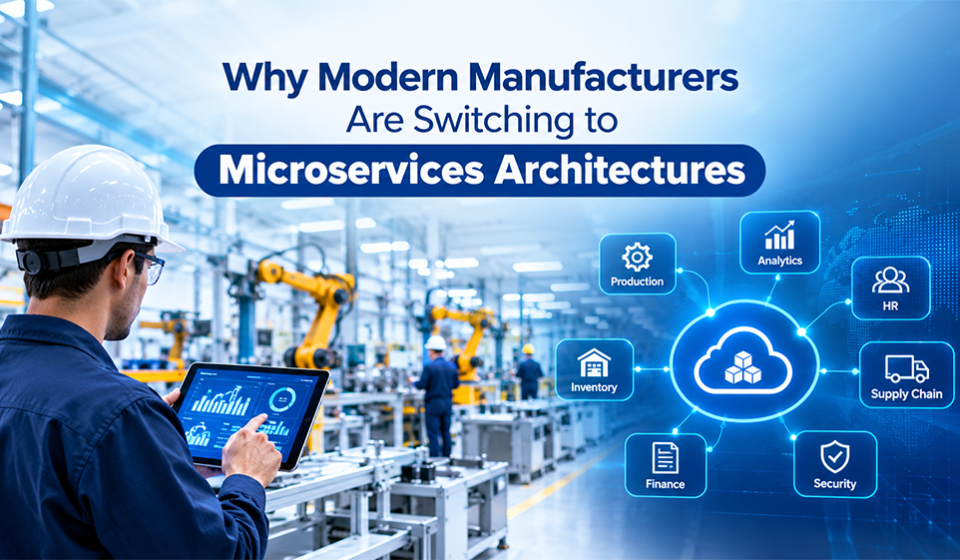
Composable ERP takes a different approach. Instead of treating the ERP as one inseparable application, it breaks business capabilities into modular services that can communicate through APIs. As a result, manufacturers can modernize production, warehouse management, planning or analytics without necessarily replacing the financial core.
This architectural shift is gaining attention in 2026. Current ERP research identifies composable ERP, cloud adoption, supply-chain visibility and AI-enabled capabilities among the important ERP trends for business leaders.
Why Monolithic ERP Becomes Difficult for Growing Manufacturers
The biggest problem with a monolithic ERP is not necessarily that it is old. Instead, the problem is that tightly coupled functionality can make change difficult. Consider a manufacturer that has used the same ERP for several years. Finance depends on the system for accounts receivable, accounts payable, taxation and financial reporting. At the same time, production depends on it for bills of materials, work orders and production costing. Inventory, purchasing and sales also depend on the same environment.
Initially, this looks efficient because everything is connected. However, problems appear when one department needs something the original ERP was not designed to provide. Suppose the production team wants a new shop-floor application. The application needs machine data, production quantities and downtime information. If accessing those records requires custom database connections or extensive vendor development, the integration becomes a project of its own.
Similarly, suppose the warehouse wants a specialist WMS while finance wants to retain the existing accounting system. With a tightly coupled ERP, replacing one component can create dependencies across purchasing, inventory, sales and accounting. Therefore, the real manufacturing problem is not simply ERP functionality. It is ERP changeability.
What Is Composable ERP for Manufacturing?
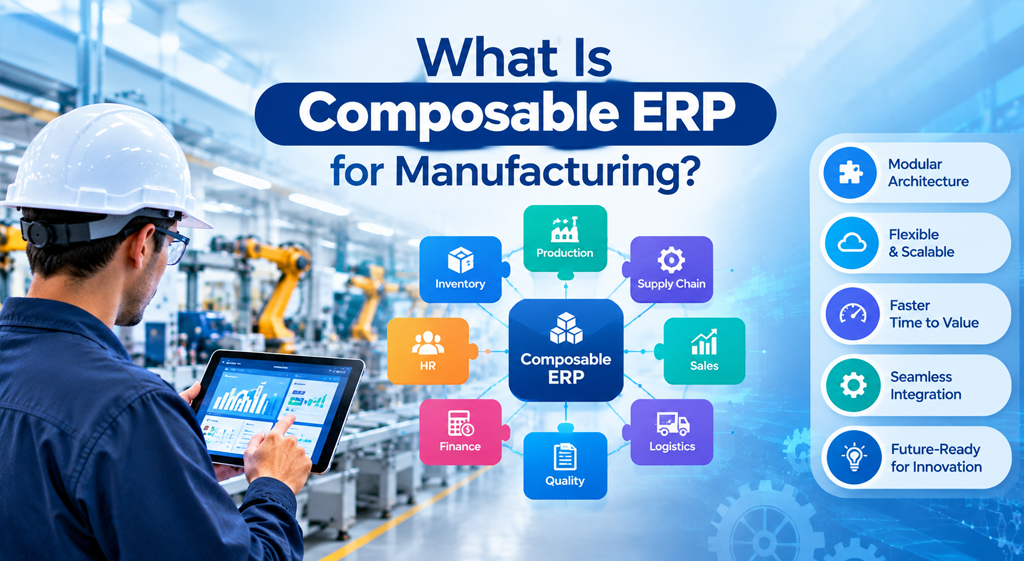
Composable ERP is an architectural approach in which business capabilities can be assembled from modular and replaceable components rather than being treated as one inseparable application. For a manufacturer, those components could include finance, inventory, procurement, production planning, warehouse management, quality, sales, maintenance, analytics and other specialized capabilities.
More importantly, these capabilities can communicate through APIs and events. Consequently, a manufacturer can improve one operational area while protecting the stability of another. For example, a company could retain its trusted financial processes while introducing a new production planning service. The production system can exchange approved information with finance through APIs rather than requiring both capabilities to be redesigned together. This is one of the fundamental ideas behind composable ERP: change the component that needs improvement without unnecessarily disturbing the components that already work.
Monolithic ERP vs Composable ERP: What Actually Changes?
The difference becomes clearer when looking at how each architecture responds to change. In a monolithic environment, applications are often tightly connected. Therefore, upgrading or customizing one area can require extensive regression testing across other functions. In a composable environment, business capabilities are more independent. Consequently, teams can develop, deploy and scale individual services without treating the entire ERP as one release.
That does not mean composable ERP eliminates integration complexity. In fact, it moves the architectural challenge from internal coupling toward well-designed interfaces, APIs, data governance and service management. This distinction is important for manufacturers because operational continuity matters more than architectural fashion. A new ERP architecture is valuable only when it reduces business disruption.
Why API-First ERP Matters on the Manufacturing Floor
APIs are the communication layer that makes composable ERP practical. An API-first ERP treats APIs as a fundamental part of the platform rather than something added only when an integration request appears. For manufacturers, this can connect ERP processes with shop-floor applications, warehouse systems, supplier portals, CRM platforms, e-commerce channels, reporting tools and other business applications.
For example, when a production order is completed, the manufacturing service can publish the relevant event. Inventory can then update stock availability, sales can receive fulfillment information and finance can receive the transaction required for costing or accounting. Therefore, employees do not necessarily need to re-enter the same information across multiple systems.
That becomes particularly valuable when production data is generated continuously. However, API connectivity also introduces responsibility. APIs need authentication, authorization, monitoring, rate controls and lifecycle management. NIST’s March 2026 API guidance specifically emphasizes identifying API risks across development and runtime and applying appropriate security controls.
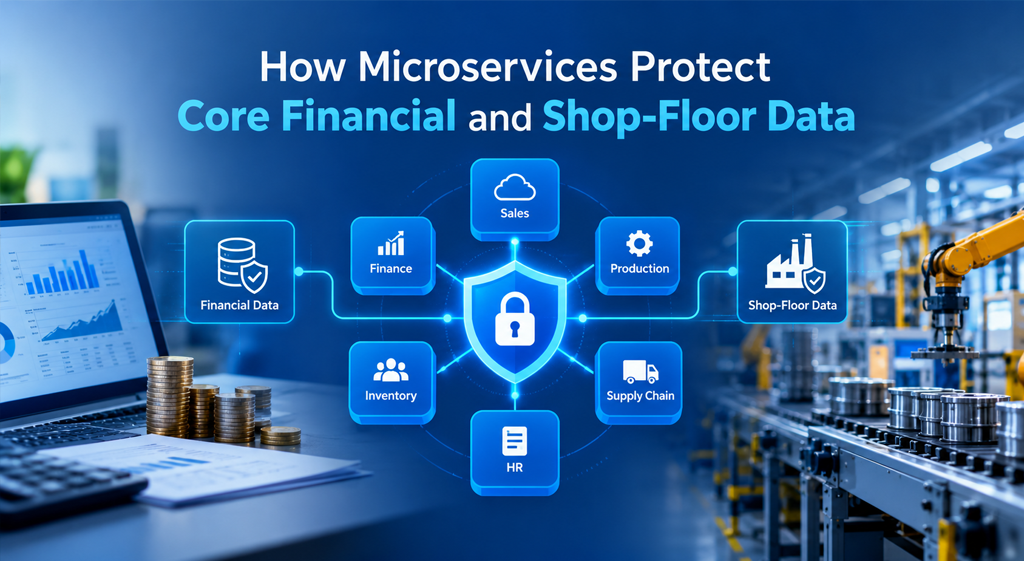
How Microservices Protect Core Financial and Shop-Floor Data
One of the strongest arguments for microservices architecture is isolation. Imagine that a manufacturer introduces a new warehouse service. Instead of embedding every warehouse function directly into the entire ERP application, the warehouse capability can operate as an independent service while exchanging controlled information with finance, sales and inventory.
As a result, warehouse functionality can evolve without forcing an accounting redesign. The same principle can apply to production scheduling, quality management, maintenance or customer portals. However, isolation does not mean disconnected systems. The objective is controlled connectivity.
Financial data remains governed by financial processes. Production data remains governed by manufacturing processes. APIs establish which information can move between them and under what rules.
Why No-Code and Low-Code Make Composable ERP More Practical
Architecture alone does not solve the manufacturing customization problem. Manufacturers also need the ability to change workflows without waiting months for traditional software development. This is where no-code and low-code capabilities become important. Suppose a company needs a special approval workflow for high-value purchases. Instead of changing the entire application codebase, a configurable workflow can route the transaction through the appropriate approval levels.
Similarly, a manufacturer may need a customized production dashboard, escalation rule, inspection process or management report. With a suitable no-code framework, these changes can be configured closer to the business process instead of becoming large development projects. This is particularly useful for SMEs and mid-sized manufacturers because business processes often change faster than their IT teams can accommodate.
The Manufacturing Pain Point: Replacing One Module Without Replacing Everything
This is where composable ERP can deliver its most practical value. A manufacturer might be satisfied with its accounting functionality but unhappy with its warehouse management. Another company might trust its inventory processes but require better production scheduling. A third manufacturer may need advanced analytics while keeping its existing operational systems.
Under a traditional architecture, these requirements can trigger major customization or replacement projects. With composable architecture, the organization can potentially introduce a specialized capability while preserving the stable core. For example, an organization could connect a modern warehouse application to its ERP through APIs. The warehouse system handles warehouse-specific operations, while approved inventory and financial transactions flow back into the core ERP.
Consequently, the business gets modernization without automatically turning modernization into an ERP replacement.
Why Data Governance Becomes More Important
Composable ERP does not mean manufacturers can connect everything to everything. In fact, the opposite is true. The more services an organization operates, the more important it becomes to define which system owns which data. For example, the ERP financial service might remain the authoritative source for accounting transactions. The manufacturing service could own production execution data. Meanwhile, the warehouse service could manage operational warehouse movements.
APIs then synchronize the information that other services genuinely need. Without this governance, a composable architecture can simply replace one large ERP problem with many smaller integration problems. Therefore, manufacturers should define data ownership, API contracts, security permissions, error handling and audit requirements before adding new services.
Can Composable ERP Support AI and Future Manufacturing Automation?
It can provide a stronger foundation for AI, provided the underlying data is reliable. AI systems need accessible, structured and trustworthy information. If production data is trapped in spreadsheets, disconnected applications or inconsistent databases, AI cannot reliably turn that information into useful operational decisions.
Composable architecture can help expose business capabilities through APIs. Consequently, an AI application could potentially access approved information from inventory, production, procurement or sales systems without directly modifying the underlying databases.
That creates an important distinction between AI-ready ERP and simply adding an AI chatbot to an ERP. Future manufacturing AI may need to detect a material shortage, identify a production risk, recommend a schedule adjustment and initiate an approved workflow.
However, such automation should operate within defined permissions and business rules. Therefore, manufacturers should design today’s ERP architecture with tomorrow’s automation requirements in mind.
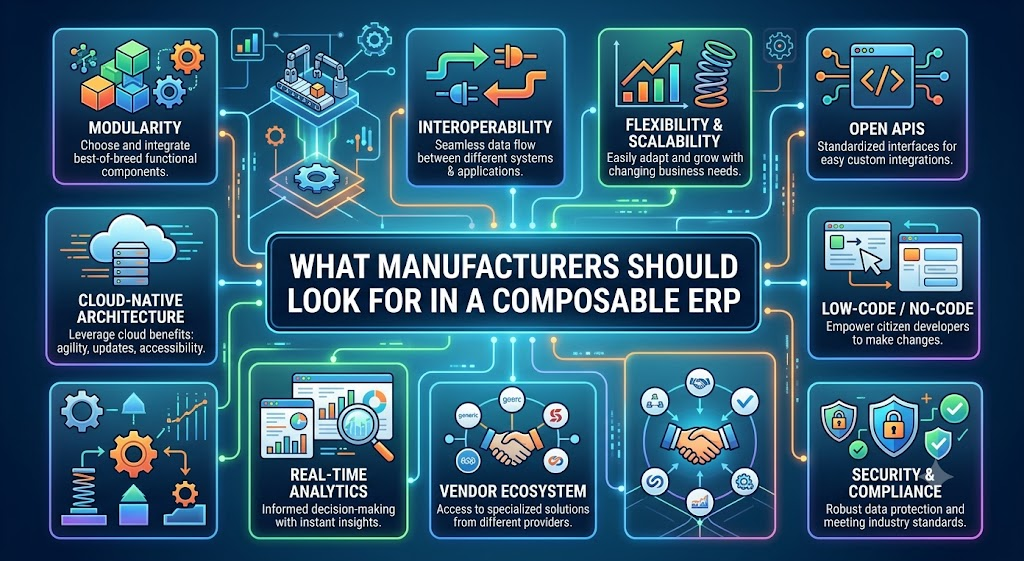
What Manufacturers Should Look for in a Composable ERP
The right question is not simply whether an ERP vendor says it uses microservices. Instead, manufacturers should examine how the architecture works in practice. The platform should provide meaningful APIs, clear data ownership, secure integration, modular business capabilities, workflow automation and flexible configuration. Furthermore, it should support reliable reporting and maintain transaction integrity across finance, inventory and production.
No-code capability should also be evaluated carefully. A platform that only allows cosmetic screen changes is not the same as one that allows organizations to configure workflows, business rules, forms, reports and process automation. Above all, the architecture should solve an operational problem rather than introduce unnecessary technical complexity.
Is Composable ERP Better Than Monolithic ERP?
Not automatically. A monolithic ERP can still be appropriate for organizations with stable processes, limited integration requirements and a strong preference for a single tightly integrated platform. However, manufacturers facing frequent process changes, multiple applications, real-time production requirements, specialized systems and increasing automation needs may benefit from a more modular architecture.
The important question is therefore not whether monolithic ERP is “bad.” The better question is whether the architecture gives the manufacturer enough freedom to change without breaking what already works. That is the real business case for composable ERP.
How Bluechip Solutions Approaches Flexible Manufacturing ERP
For manufacturers evaluating this transition, Auvit™ No-Code ProfitPlus ERP from Bluechip Solutions takes a business-process-focused approach to ERP flexibility. Instead of treating customization as a long development cycle for every requirement, a no-code and business-process-automation approach can help organizations configure workflows, forms, dashboards and processes around their operational requirements.
This becomes particularly relevant when manufacturing businesses need to connect finance, inventory, production, purchasing, sales and management information while still adapting processes as the organization grows. Bluechip Solutions positions Auvit as an AI-ready No-Code ERP and Business Process Automation platform, making modularity and process flexibility central considerations rather than treating customization as an afterthought.
For manufacturers, the objective should ultimately be simple: modernize the areas that create operational problems while protecting the financial and production processes that the business already depends on.
Frequently Asked Questions About Composable ERP
What is composable ERP?
Composable ERP is a modular ERP approach in which business capabilities can be assembled, integrated and changed independently through technologies such as APIs, microservices and configurable platforms.
What is the difference between monolithic ERP and composable ERP?
Monolithic ERP generally keeps many business capabilities tightly connected inside one application, while composable ERP separates capabilities into modular components that can communicate through APIs and other integration mechanisms.
Why are manufacturers adopting microservices ERP architecture?
Manufacturers need to integrate shop-floor systems, warehouse applications, analytics, supplier platforms and emerging AI capabilities without continuously redesigning the entire ERP. Microservices can allow individual capabilities to evolve and scale more independently.
Can a composable ERP protect financial data?
Yes, when the architecture uses clear data ownership, controlled APIs, authentication, authorization and appropriate governance. The objective is to allow operational systems to exchange approved information without giving every service unrestricted access to financial data.
Is no-code ERP suitable for manufacturing?
No-code ERP can be useful when manufacturers need to configure workflows, approvals, dashboards, forms and business processes quickly. However, organizations should evaluate the platform’s actual capabilities rather than relying only on the “no-code” label.
The Bottom Line for Manufacturing Leaders
The next ERP decision should not be based only on how many modules a vendor offers. Instead, manufacturers should ask a more important question: How easily can the business change one process without disrupting everything else?
That is where composable ERP becomes strategically important. With API-first integration, microservices, controlled data ownership and no-code process configuration, manufacturers can move toward an ERP environment that is easier to adapt as production, customers, regulations and technology change.
For a growing manufacturer, that flexibility can be more valuable than simply having one large system that does everything. Ready to see how a flexible, no-code manufacturing ERP can fit your processes? Explore how Bluechip Solutions can help you connect ERP, manufacturing workflows, automation and business intelligence without turning every change into a major software project.
Book a Free Manufacturing ERP Consultation
Download the “Manufacturing ERP Architecture Checklist 2026” to evaluate monolithic vs. composable ERP, API readiness, microservices, data governance, no-code capabilities and AI readiness before selecting your next ERP platform.