Top 5 ERP Features Every Flour Mill & Food Processing Business Needs in India

A flour mill or food processing business can lose margin without realizing where it happened. Grain prices change, moisture affects yield, production losses vary between batches, inventory sits longer than expected, customer orders change suddenly, and finance teams often discover the actual profitability only after the month has closed.
That is why ERP software for flour mills and food processing businesses needs to do much more than accounting and inventory management. It must connect procurement, quality, production, stock, sales, compliance and finance in one operational system.
This need is becoming more important as India’s organised consumer food industry continues to expand. A Ministry of Food Processing Industries study reported that organised consumer food industry sales grew 13% during fiscal 2025 and projected another 13–15% growth for fiscal 2026.
At the same time, flour milling has its own operational complexity. FSSAI’s flour-milling guidance covers activities ranging from grain procurement and transportation to storage, blending, processing, packaging and finished-goods handling.
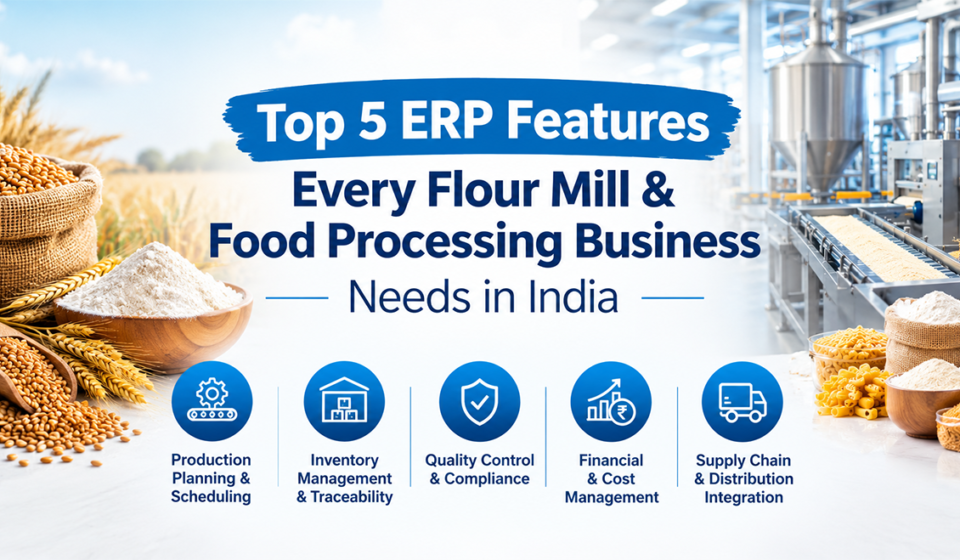
So, what should a food processing ERP software in India actually provide? Here are the five ERP features that can make the biggest operational difference.
1. Batch-Wise Production and Yield Management
For a flour mill, production is rarely as simple as purchasing wheat and selling flour. The same quantity of raw material can produce different quantities of finished goods depending on grain quality, moisture, cleaning losses, extraction rate, milling efficiency and product specifications.
This creates a major problem when production is managed through spreadsheets or disconnected software. Managers may know how much wheat entered the plant and how much flour was produced, but they may not immediately know why the yield changed. A specialised ERP for flour mills should therefore provide batch-wise production management.
Track raw material from procurement to finished product
The ERP should connect every production batch with its source material, purchase information, quality parameters, processing stage and finished output. For example, when wheat is received, the system can record the supplier, quantity, lot or batch number, purchase rate, moisture information and quality observations.
Once the wheat enters production, the ERP can connect that raw-material batch with cleaning, milling, blending and packing activities. Consequently, management gets a traceable production history instead of isolated entries.
Monitor yield, wastage and production variance
Yield monitoring becomes particularly important because even a small percentage of unexplained production loss can affect profitability at scale. An ERP system can compare planned production with actual production and highlight abnormal variances. For instance, if a particular production batch consistently produces lower-than-expected flour output, management can investigate the relevant raw material, machine, process or quality parameter instead of discovering the issue weeks later.
Therefore, production yield management software is not simply an operational feature. It becomes a margin-protection tool.
2. Real-Time Inventory and Warehouse Management
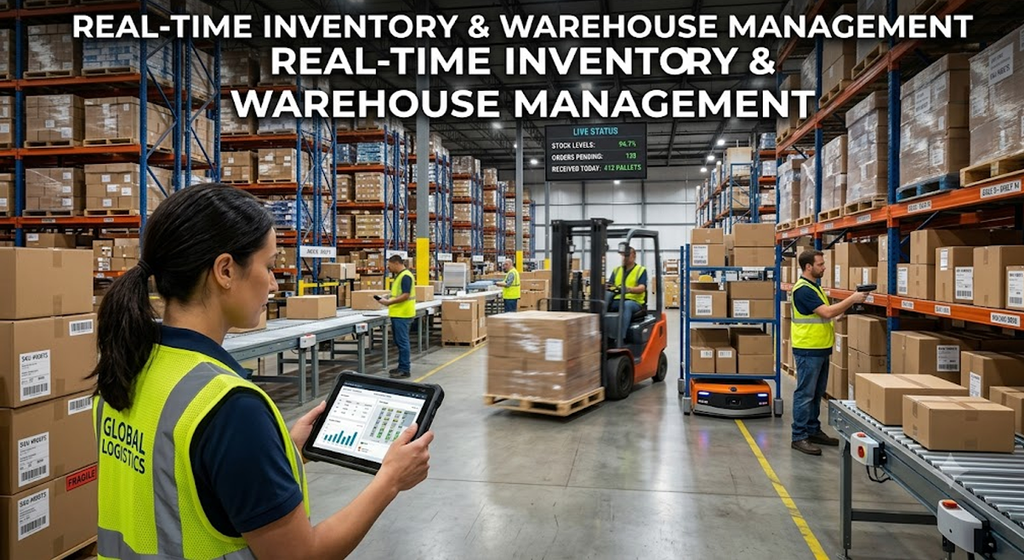
Inventory is one of the biggest financial commitments for flour mills and food processors. However, the challenge is not simply knowing how many tonnes of wheat or flour are available. Businesses also need to know where the stock is, which batch it belongs to, how long it has been stored and whether it is available for a particular customer order. This is where conventional inventory software often falls short.
Manage raw materials, work-in-progress and finished goods together
A food-processing ERP should provide visibility across raw materials, work-in-progress, packaging materials and finished products. For a flour mill, this could include wheat, maida, atta, sooji, bran, premixes, packaging bags and other materials. As a result, the purchase, production and sales teams can work from the same stock position.
Reduce excess stock and stock-outs
Too much inventory locks up working capital. Too little inventory can interrupt production or delay customer deliveries. An ERP can analyse historical consumption, current orders, production requirements and stock levels to help businesses make better purchasing decisions.
Furthermore, AI-enabled forecasting can identify demand patterns and recommend replenishment before inventory reaches a critical level. This moves inventory management from a reactive process to a more predictive one.
Improve batch traceability
Food businesses also need strong traceability because a problem with one batch should not become a problem across the entire warehouse. FSSAI’s flour-milling guidance specifically addresses grain storage, processing, packaging and finished-product handling as part of food safety management. Therefore, an ERP should allow businesses to trace finished products back to the relevant production and raw-material batches.
3. Quality Control and FSSAI Compliance Management
Quality control is not an optional department for food-processing companies. A production team may achieve its output target, but if the product does not meet the required quality parameters, the business can still face rejected batches, customer complaints, recalls, wastage and reputational damage.
FSSAI remains India’s central authority for food safety regulation and compliance, with regulations covering food businesses, product standards, contaminants, licensing and labelling.
Connect quality checks directly with production
Instead of recording quality information separately, a food processing ERP should connect quality inspection with the relevant material or production batch. Depending on the product and process, businesses may need to monitor parameters such as moisture, impurities, particle characteristics, weight, packaging information and other quality specifications.
The exact parameters will naturally differ according to the product and applicable standards. When quality data is connected with production, managers can identify which batch passed, which batch requires attention and which material should not proceed to the next stage.
Make traceability faster during a quality issue
Suppose a customer reports a quality problem with a particular flour batch. Without integrated ERP, employees may have to search through purchase registers, production sheets, warehouse records and invoices. With batch traceability, the business can identify the relevant production record, raw material source, stock movement and customer dispatch much faster. That improves response time and reduces the risk of treating every batch as potentially affected.
Keep compliance evidence organised
Modern food businesses also need better documentation. An ERP can maintain audit trails, quality records, approval histories and supporting documents in a structured manner. Consequently, compliance becomes part of everyday operations instead of a last-minute exercise before an audit.
4. GST, Sales, Purchase and Financial Management
A flour mill may have a strong production process and still lose visibility because finance operates separately from the factory. This creates familiar problems: purchase information does not match inventory, sales invoices are delayed, receivables are unclear and management cannot easily determine product-wise profitability. A modern ERP software for food processing industry should connect commercial transactions directly with inventory and accounts.
Automate GST and e-invoicing workflows
GST compliance has also made integrated financial systems increasingly important. The GST e-invoicing framework currently applies to taxpayers with aggregate annual turnover of ₹5 crore and above, subject to the applicable rules and exemptions. The threshold was reduced from ₹10 crore to ₹5 crore with effect from August 1, 2023.
Therefore, eligible businesses should ensure that their ERP can support appropriate GST and e-invoicing workflows rather than relying on manual duplication between systems.
Connect sales with stock and accounts
When a sales order is created, the ERP should be able to show available stock, allocate inventory, generate the relevant delivery documentation and ultimately connect the transaction with receivables. This reduces repetitive data entry and gives management a clearer view of outstanding payments.
Understand actual profitability
Revenue alone does not tell a flour mill whether a product is profitable. Management needs to consider raw-material cost, production cost, wastage, packaging, logistics, discounts and other expenses. An integrated ERP can therefore provide more meaningful product, batch or customer-level profitability analysis. That information can help management decide which products deserve greater production capacity and where margins are being eroded.
5. AI-Powered Analytics, Forecasting and Decision Support
The next major step for food-processing ERP is moving from recording information to helping management make decisions. Traditional ERP answers questions such as:
“What happened?” AI-enabled ERP can increasingly help answer:
“Why did it happen?” “What is likely to happen next?” “What should we do?”
Predict demand and production requirements
Historical sales, seasonal trends, customer orders and inventory movement can be analysed to improve demand forecasting. For example, if the system identifies a recurring increase in demand for a particular flour product during a specific period, production planning can be adjusted earlier. As a result, businesses can reduce emergency procurement and avoid unnecessary finished-goods accumulation.
Identify unusual production and inventory behaviour
AI-assisted analytics can also flag unusual patterns. If raw-material consumption suddenly increases, production yield drops, a particular customer delays payments or inventory movement changes significantly, management can investigate earlier. This is particularly valuable because managers cannot manually analyse every transaction across a growing business.
Build management dashboards around decisions
An effective ERP dashboard should not overwhelm management with hundreds of numbers. Instead, it should bring attention to the indicators that require action: production efficiency, yield variance, raw-material stock, slow-moving inventory, pending orders, receivables, purchase costs and profitability. That makes ERP a management decision system rather than simply a digital replacement for registers.
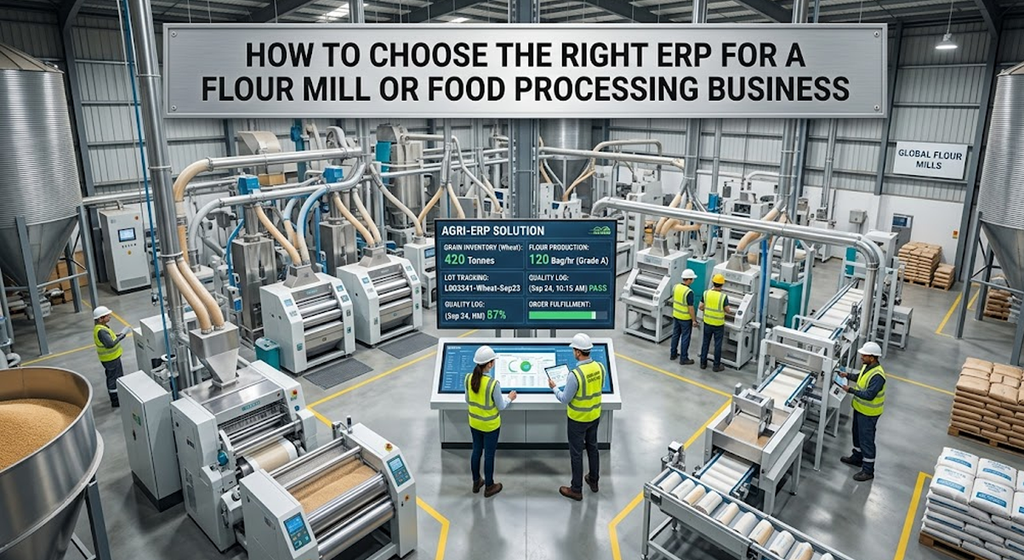
How to Choose the Right ERP for a Flour Mill or Food Processing Business
The biggest mistake is choosing an ERP because it has a long feature list. A better approach is to evaluate whether the system understands the actual workflow of your business. A flour mill should be able to demonstrate how the ERP handles raw-material procurement, batch tracking, production yield, wastage, quality control, warehouse movement, sales, GST, accounting and reporting.
Similarly, a food-processing company should test whether the system can handle its actual recipes, production processes, packaging requirements, batch traceability and customer-specific requirements. Most importantly, ask the ERP provider to demonstrate your real business scenario rather than presenting only generic screens. A good ERP should reduce manual work without forcing your production team to redesign every process around the software.
Why ERP Matters for Flour Mills and Food Processing Businesses
The objective of ERP implementation is not simply to replace Excel. The real objective is to create one reliable operational picture of the business. When procurement, production, quality, inventory, sales and finance are connected, management can identify problems earlier, control costs more effectively and make decisions using current information.
This becomes particularly valuable as the business expands into additional products, warehouses, distributors, regions or customer segments. India’s food-processing sector is also receiving significant policy and investment attention. Under the Production Linked Incentive Scheme for Food Processing Industry, the Ministry of Food Processing Industries estimated additional processed-food output of ₹33,494 crore and nearly 2.48 lakh employment opportunities by the end of the programme period.
That growth creates opportunities, but it also increases operational complexity. Businesses that build strong systems early can therefore scale with greater control.
Frequently Asked Questions About ERP for Flour Mills and Food Processing Businesses
What is the best ERP software for a flour mill in India?
The best ERP for a flour mill should support batch-wise production, yield management, raw-material and finished-goods inventory, quality control, traceability, GST, accounting, sales and management reporting. AI-based forecasting is an additional advantage for businesses looking to improve planning.
Why does a flour mill need ERP software?
A flour mill needs ERP software because procurement, grain storage, production, yield, quality, inventory, sales and finance are closely connected. Managing these activities in separate systems can make it difficult to identify wastage, production variance and actual profitability.
Can ERP track flour production batch-wise?
Yes. A suitable manufacturing ERP can associate raw-material lots with production batches and finished products, allowing businesses to trace production, stock movement and customer dispatches.
Can food-processing ERP help with FSSAI compliance?
ERP can help organise quality records, batch traceability, audit trails, documentation and operational controls. However, ERP software does not itself guarantee regulatory compliance; businesses must configure and operate the system according to the applicable FSSAI requirements.
Can ERP integrate GST and e-invoicing?
Yes. ERP platforms can integrate GST-related accounting and, where applicable, e-invoicing workflows. Businesses should verify that the specific ERP integration is maintained according to current GST requirements.
Make Your Flour Mill More Profitable With a Connected ERP
If your production team still depends heavily on spreadsheets, manual stock verification, disconnected accounting or delayed production reports, the problem may not be your people. The problem may be the system they are being asked to work with.
A purpose-built ERP for flour mills and food processing businesses can bring production, inventory, quality, sales and finance together so that management can see what is happening and act before small problems become expensive ones.
Want to know which ERP features your flour mill actually needs?
Book a personalised ERP consultation and see how a connected ERP workflow can be mapped to your procurement, production, inventory, quality and financial processes.
Get the “Flour Mill & Food Processing ERP Implementation Checklist” to evaluate production, inventory, batch traceability, FSSAI compliance, GST, costing and AI-readiness before selecting an ERP.