
Global ERP vs Multi-Entity Systems: Managing Multi-Currency and Multi-Region Operations

A company can operate in five countries and still struggle to answer a simple question: “What is our actual consolidated financial position right now?”
The problem usually is not a lack of accounting software. Instead, it is the growing complexity between legal entities, currencies, tax regulations, intercompany transactions, exchange-rate movements and regional reporting requirements. For companies expanding across India, the UAE, Europe, Southeast Asia, Africa or North America, conventional accounting systems often become difficult to scale. Consequently, finance teams end up maintaining separate spreadsheets, local accounting applications and manual consolidation files.
That is where global ERP solutions and multi-entity ERP architectures become strategically important. A modern global ERP can connect subsidiaries, currencies, tax structures, operational workflows and consolidated reporting within a governed enterprise environment. At the same time, a multi-entity system focuses specifically on managing multiple legal entities and their financial relationships.
The distinction matters because choosing the wrong architecture can increase implementation costs, create reporting delays and make cross-border compliance harder instead of easier.
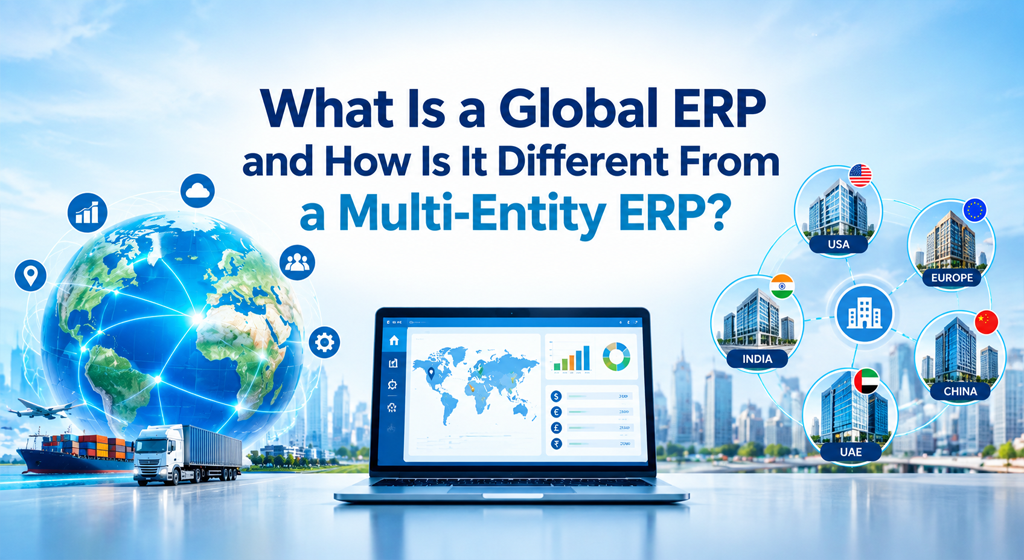
What Is a Global ERP and How Is It Different From a Multi-Entity ERP?
A global ERP is designed to manage business operations across multiple countries, currencies, regulatory environments and business entities from a connected enterprise platform. A multi-entity ERP, however, primarily addresses the challenge of managing multiple legal entities, subsidiaries, branches or business units while maintaining separate books and consolidated financial visibility.
Therefore, the difference is not simply the number of companies in the system. A business operating three companies in one country may need multi-entity capabilities. However, a business operating three subsidiaries across India, the UAE and the United States may require broader global ERP solutions covering currency management, taxation, compliance, localization, intercompany accounting and international reporting.
Current ERP research shows that multi-entity organizations increasingly prioritize automated intercompany accounting, financial consolidation, multi-currency capabilities and real-time group reporting. The right system, therefore, should not merely store transactions. It should understand how those transactions move between countries, currencies and legal entities.
Why Multi-Region Businesses Struggle With Traditional ERP Systems
International expansion creates operational complexity very quickly. For example, an Indian parent company may sell products in USD, purchase raw materials in EUR, operate a subsidiary in AED, pay employees in INR and consolidate group financials in INR or another reporting currency. Consequently, the finance team is no longer dealing with one ledger and one exchange rate.
They must manage functional currencies, transaction currencies, reporting currencies, exchange-rate differences, tax rules, intercompany balances and country-specific reporting requirements simultaneously. When these processes are spread across disconnected systems, the month-end close becomes particularly difficult. Teams export data, manipulate spreadsheets, reconcile balances and manually adjust currency differences.
This creates three major risks: inaccurate reporting, delayed decision-making and compliance exposure. A modern ERP approach solves the underlying problem by creating a controlled data model where entities, currencies, accounts, tax rules and transactions remain connected.
Multi-Currency Management Is More Than Currency Conversion
One of the biggest misconceptions about international ERP is that multi-currency simply means converting USD into INR. In reality, effective multi-currency management must cover the complete financial lifecycle. Suppose a UAE subsidiary purchases equipment for EUR 100,000. The supplier invoice is recorded in EUR, the subsidiary may have AED as its functional currency, while the parent company reports consolidated results in INR.
The ERP must preserve the original transaction currency while correctly calculating the functional-currency value and ultimately translating the subsidiary’s financial statements into the group’s presentation currency. Furthermore, exchange-rate movements can change the reported value of assets, liabilities, income and expenses.
IAS 21 specifically addresses foreign-currency transactions, functional currencies, translation of foreign operations and presentation currencies. Therefore, a serious global ERP implementation must define how exchange rates are sourced, stored, applied and audited rather than treating currency conversion as a simple reporting feature.
Multi-Currency Balance Sheets Need Controlled Translation
Balance-sheet translation becomes especially important when subsidiaries operate with different functional currencies. For example, consider a group headquartered in India with subsidiaries in the UAE and Germany. Each subsidiary maintains its own functional currency. However, the parent needs a consolidated view.
The ERP must translate financial statements using appropriate exchange-rate methodologies while maintaining the underlying entity-level books. This becomes even more important when exchange rates fluctuate significantly. A system that simply converts every transaction using today’s rate can produce misleading historical results. Instead, the ERP should maintain appropriate rate types, effective dates and translation rules.
Moreover, currency gains and losses must be treated correctly during consolidation. IAS 21 requires specific treatment of exchange differences associated with foreign operations, including circumstances where exchange differences remain visible in consolidated financial statements. Therefore, companies should evaluate the accounting engine behind an ERP rather than judging a platform solely by whether it displays multiple currencies.
Cross-Border Compliance Is Becoming a Core ERP Requirement
Currency management is only one side of international expansion. The other major challenge is compliance. Each country can have different tax structures, invoice requirements, statutory reports, electronic invoicing rules, withholding requirements and data obligations.
For example, India’s GST ecosystem continues to evolve. GSTN issued 2026 changes to e-invoice and e-way bill APIs, with production implementation scheduled from August 1, 2026. The changes included additional validations and requirements affecting invoice and shipment information.
Consequently, an ERP used by an international business must be capable of adapting to regulatory changes rather than relying on static configurations. This is particularly important for companies operating from India while selling or establishing subsidiaries internationally.
The ERP should separate global processes from local compliance requirements. In practice, this means maintaining a common enterprise structure while allowing country-specific tax, invoice and reporting rules. That balance is one of the most important characteristics of scalable global ERP solutions.
Intercompany Transactions Can Make or Break Consolidation
Intercompany accounting becomes increasingly complicated as the number of subsidiaries grows. A parent company may sell inventory to its subsidiary. The subsidiary records a purchase, while the parent records revenue. Later, the two entities must reconcile their balances and eliminate the relevant intercompany transactions during consolidation.
Without automation, this process becomes spreadsheet-heavy. Even a small mismatch in invoice value, currency, transaction date or exchange rate can create reconciliation problems. A properly designed multi-entity ERP can automate intercompany postings, matching and elimination workflows.
This means the system can recognize that the transaction is between related entities and maintain the relationship between the originating and receiving transactions. As a result, finance teams spend less time identifying differences and more time investigating genuine exceptions. That is especially valuable for groups with multiple subsidiaries, shared-service centers and high transaction volumes.
Consolidated Enterprise Reporting Gives Management One Version of the Truth
The biggest strategic benefit of a global ERP is not simply automation. It is visibility. Executives need to understand revenue, profitability, working capital, cash flow and operational performance across the entire enterprise. However, if every country maintains separate systems, management may receive financial reports weeks after transactions occur.
A centralized multi-entity architecture changes that model. The parent organization can maintain entity-level reporting while also producing consolidated views across regions, currencies and business units. Therefore, the CFO can analyze the performance of India separately, compare it with the UAE subsidiary and then examine the consolidated group position without waiting for multiple spreadsheets to be reconciled.
Current ERP research identifies real-time financial consolidation and multi-currency reporting among the core requirements of multi-entity businesses.
Where AI Fits Into Global ERP
AI is changing the role of ERP from a system of record into a system capable of identifying patterns, exceptions and business risks. However, AI should not replace financial controls. Instead, AI should work on top of a governed ERP data foundation.
For example, an AI-enabled ERP can identify unusual intercompany balances, detect unexpected exchange-rate impacts, highlight abnormal margins across subsidiaries or identify transactions requiring additional review. It can also support forecasting by analyzing historical revenue, currency movements, purchasing patterns and cash-flow behavior.
This direction is becoming increasingly significant. Gartner reported in 2026 that AI-enabled cloud ERP adoption is expected to accelerate substantially, with AI-enabled solutions forecast to represent 62% of cloud ERP spending by 2027. Gartner also projects that embedded AI could contribute to faster financial close processes.
At the same time, PwC emphasizes that AI and ERP have complementary roles: ERP provides governed transactional data and controls, while AI adds intelligence, prediction and orchestration. Therefore, companies should avoid buying an ERP simply because it has an AI label. The underlying financial data, controls, audit trails and entity structure must be reliable first.
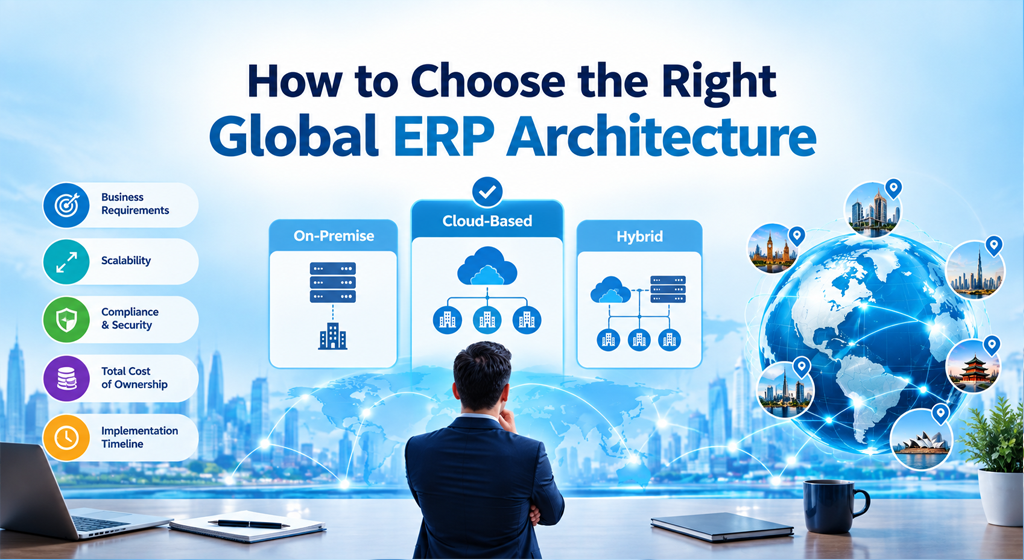
How to Choose the Right Global ERP Architecture
The correct architecture depends on the organization’s geographic footprint, legal structure and reporting complexity. A company with subsidiaries in multiple countries should first map its legal entities, functional currencies, reporting currency, tax jurisdictions, intercompany flows and statutory reporting requirements.
Next, it should determine which processes should be standardized globally and which must remain locally configurable. This is important because a completely centralized model may create local compliance problems, while completely independent local systems can make consolidation extremely difficult.
A practical global ERP architecture therefore combines centralized governance with controlled local flexibility. The ERP should allow headquarters to define common master data, financial controls and reporting structures while subsidiaries retain the country-specific configurations required for local operations. That approach creates scalability without forcing every country into an identical operating model.
Global ERP Implementation: What Companies Often Get Wrong
Many ERP projects fail to deliver expected value because companies begin with software selection instead of process design. During global ERP implementation, organizations should first document how transactions move across entities and countries.
For instance, an international sales transaction should be mapped from quotation through order management, taxation, invoicing, revenue recognition, receivables, payment and consolidation. The same exercise should be performed for procurement, inventory transfers, intercompany transactions and financial close.
Furthermore, master-data governance must be established before migration. If customer, supplier, chart-of-account and tax data are inconsistent across subsidiaries, implementing a new ERP will simply move the existing problem into a more expensive system. Therefore, successful implementation depends on process standardization, data governance, localization strategy, integration planning, user adoption and strong testing.
Multi-country ERP research similarly highlights the importance of deciding early between centralized, regional and hybrid deployment models because the architectural decision can influence the program for years.
Global ERP vs Multi-Entity Systems: Which One Should You Choose?
The answer depends on what problem the organization is actually trying to solve. If the primary challenge is managing several legal entities within the same country, a strong multi-entity ERP may be sufficient. However, if the business operates across multiple countries and needs localized compliance, multiple functional currencies, cross-border transactions, intercompany accounting and consolidated reporting, a broader global ERP approach is generally more appropriate.
The important point is that these capabilities should work together rather than operate as separate systems. For a growing international company, the ideal platform should provide a single source of truth while still respecting the accounting and regulatory realities of each jurisdiction.
What Does the Future of Global ERP Look Like?
The direction of ERP is moving toward connected, intelligent and increasingly automated enterprise operations. Cloud adoption is already widespread across the ERP ecosystem, while AI capabilities are becoming increasingly embedded into financial and operational workflows. At the same time, international organizations are demanding faster consolidation, better financial visibility and stronger compliance controls.
Consequently, the next generation of global ERP solutions will not simply record what happened. They will increasingly help organizations understand what is happening, identify what requires attention and predict what could happen next. That makes the ERP architecture a strategic business decision rather than merely an IT replacement project.
Frequently Asked Questions About Global ERP
What is a global ERP?
A global ERP is an enterprise resource planning system designed to manage operations across multiple countries, legal entities, currencies and regulatory environments while providing centralized control and consolidated reporting.
What is the difference between global ERP and multi-entity ERP?
A multi-entity ERP primarily manages multiple legal entities and consolidated financials. A global ERP extends those capabilities to international requirements such as multiple currencies, country-specific taxation, localization, cross-border compliance and global reporting.
Can a global ERP manage multiple currencies?
Yes. A capable global ERP should support transaction currencies, functional currencies, reporting currencies, exchange-rate management, currency revaluation and financial statement translation.
How does ERP help with international compliance?
ERP can centralize tax rules, invoice requirements, statutory reporting, audit trails and country-specific configurations. However, compliance requirements should always be validated against current regulations in each jurisdiction.
Does AI replace the need for ERP controls?
No. AI should enhance a governed ERP environment rather than replace financial controls. Reliable master data, approval workflows, audit trails and accounting rules remain essential.
How long does global ERP implementation take?
Implementation time varies significantly depending on the number of entities, countries, integrations, data volume, localization requirements and process complexity. A multi-country rollout should therefore be planned around business processes and entity readiness rather than an arbitrary implementation deadline.
Build a Global ERP Strategy That Can Scale With Your Business
International growth should not force your finance team to become dependent on spreadsheets. If your organization is dealing with multiple subsidiaries, currencies, tax jurisdictions or intercompany transactions, the right global ERP solution can create a connected foundation for financial control, operational visibility and sustainable expansion.
Bluechip Solutions helps businesses evaluate ERP requirements around finance, manufacturing, distribution, compliance and multi-entity operations, with solutions designed to reduce complexity and support faster business process automation.
Ready to evaluate whether your current ERP architecture can support your international expansion?
Book a free ERP consultation with Bluechip Solutions and identify the right approach for multi-entity, multi-currency and multi-region operations.
Global ERP Readiness Checklist
Before starting a global ERP implementation, assess your current readiness across entity structure, currencies, intercompany accounting, compliance, data migration, integrations, reporting and AI readiness.
Download the Global ERP Readiness Checklist to identify potential implementation gaps before they become expensive problems.
Conclusion
Managing international operations requires more than putting several companies inside one accounting database. Businesses need a connected architecture that understands legal entities, currencies, compliance requirements, intercompany relationships and consolidated reporting.
That is why the distinction between a basic multi-entity system and a comprehensive global ERP matters. With the right architecture, companies can maintain local flexibility while gaining centralized financial visibility. Moreover, they can automate intercompany processes, improve currency reporting, strengthen compliance and give leadership a clearer view of the entire enterprise.
Ultimately, the goal of global ERP implementation is not simply to deploy another software platform. It is to create a reliable digital foundation that allows the business to expand across borders without allowing operational complexity to expand at the same speed.