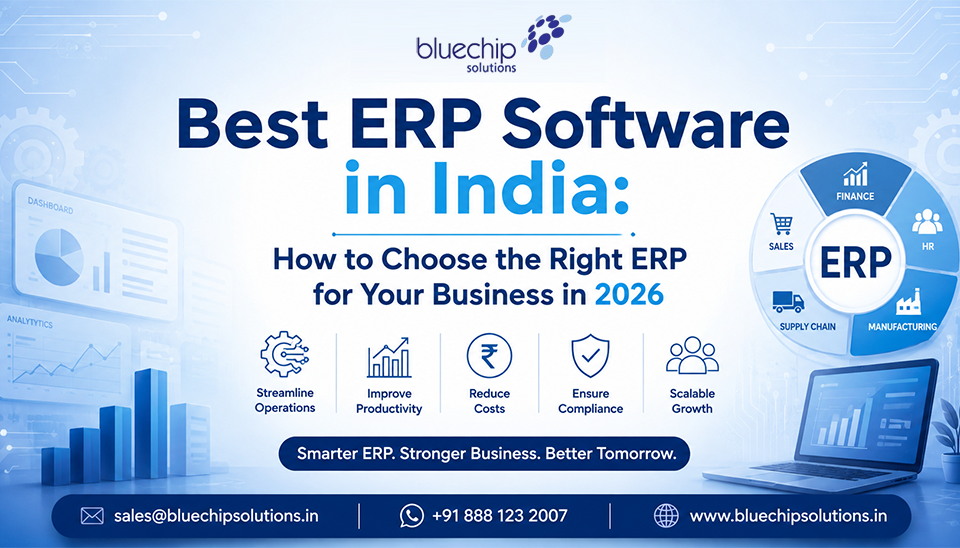

Choosing the best ERP software in India is no longer simply about selecting a well-known software brand. For Indian businesses, the right ERP must solve practical problems across finance, inventory, sales, purchasing, manufacturing, HR, compliance and customer management while remaining easy for employees to use.
Moreover, ERP adoption is growing as Indian businesses move toward cloud platforms, automation and integrated business operations. Recent market research estimates that the Indian ERP software market generated approximately US$3.37 billion in 2025 and is projected to reach about US$3.81 billion in 2026, with cloud ERP becoming an important part of the market.
However, choosing an ERP based only on market popularity can create another problem: a system may be powerful but still fail to match the way your company actually works.
The better question is therefore: Which ERP software is best for your specific business, industry, processes and growth plans?
What Is the Best ERP Software in India?
The best ERP software in India is a platform that brings critical business processes into one connected system while supporting Indian tax and regulatory requirements, industry-specific workflows, automation, reporting and future scalability.
There is no universal ERP that is automatically the best for every company. A manufacturing company may need production planning, BOM, MRP and shop-floor management, whereas a distributor may prioritize inventory, purchasing, sales and warehouse management. Similarly, a service company may need CRM, project management, billing and employee management.
Therefore, ERP selection should start with business requirements rather than brand names.
A good ERP should reduce duplicate data entry, eliminate disconnected spreadsheets, improve management visibility and help employees complete everyday tasks faster.
Why Indian Businesses Are Replacing Traditional Business Software
Many companies reach a point where their existing accounting software, spreadsheets and individual applications can no longer keep up with business growth.
Sales data may exist in one application, inventory in another, accounts in separate software and production information in spreadsheets. Consequently, management may spend hours asking different departments for information before making a decision.
This creates a familiar operational problem: the business has plenty of data, but not enough usable information.
An integrated ERP addresses this problem by connecting departments through a common database and workflow. When a sales order affects inventory, purchasing, production and accounts, the information can flow through the appropriate processes instead of being manually entered several times.
As a result, companies can reduce operational duplication while improving visibility and accountability.
What Problems Should the Best ERP Software Solve?
Disconnected Data and Duplicate Work
One of the biggest ERP pain points is duplicate data entry. When employees enter the same customer, product or transaction information into multiple systems, errors become almost unavoidable.
A centralized ERP can maintain common masters for customers, suppliers, products, employees and financial information. Consequently, departments can work from consistent data instead of maintaining separate versions of the truth.
Poor Inventory Visibility
Inventory problems directly affect profitability. Overstock increases working capital, while stock shortages can delay customer orders and production.
The right ERP should provide real-time visibility into available, reserved, incoming and consumed inventory. Furthermore, businesses should be able to connect purchasing, sales, warehouses and production so that inventory decisions are based on actual demand.
Manual GST and Compliance Processes
Indian businesses also need ERP systems that can handle local compliance requirements.
For example, the GST e-invoicing mandate was progressively expanded and currently covers businesses with aggregate annual turnover of ₹5 crore and above from 1 August 2023, subject to the applicable rules and exemptions.
Therefore, businesses should evaluate whether an ERP can support GST workflows, tax calculations, e-invoicing, e-way bills, HSN/SAC management and appropriate reporting rather than treating compliance as an afterthought.
Slow Management Reporting
Another common problem is waiting until the end of the week or month to understand business performance. Modern ERP software should provide dashboards and reports that allow decision-makers to monitor sales, receivables, payables, inventory, production, profitability and other operational indicators with less manual reporting. This is especially important when business owners manage multiple branches, warehouses or operating units.
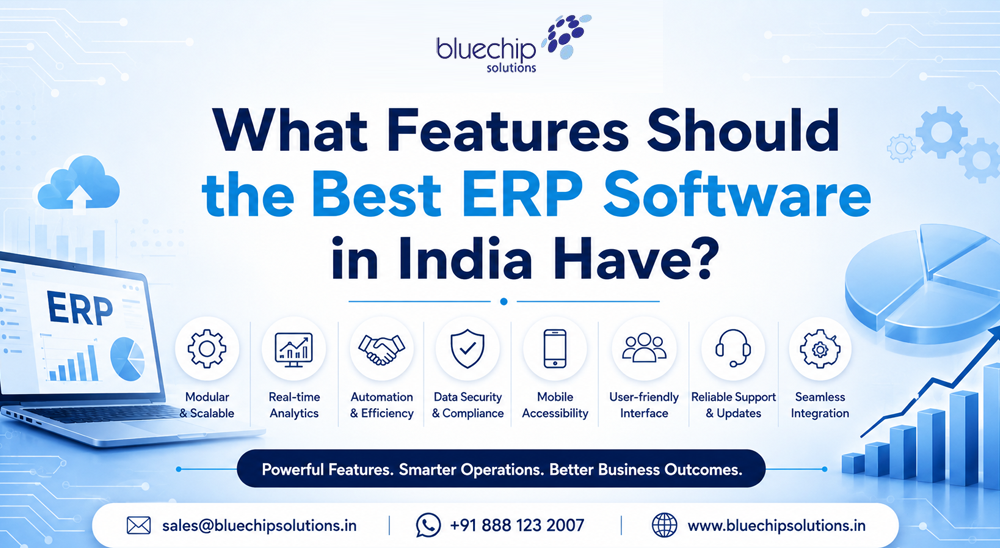
What Features Should the Best ERP Software in India Have?
Integrated Finance and Accounting
Finance should not operate separately from business operations. Sales invoices, purchases, expenses, receivables, payables and inventory transactions should connect with accounting workflows. This reduces reconciliation work and gives management a more complete view of financial performance.
Inventory and Supply Chain Management
An effective ERP should connect purchasing, suppliers, warehouses, stock movements, sales and consumption. For growing businesses, multi-location inventory, stock transfers, reorder controls, batch or serial tracking and inventory valuation can become increasingly important.
Manufacturing and MRP
For manufacturers, accounting alone is not enough. The ERP should support processes such as BOM management, material planning, production orders, work-in-progress, material consumption, production scheduling and finished-goods management. This is where an industry-focused ERP can provide significantly more value than a basic accounting application.
Sales and CRM
An ERP should also connect enquiries, quotations, sales orders, customers, invoicing and collections. When CRM and ERP processes are connected, sales teams can understand customer history while finance and operations can see what is happening after an order is confirmed.
HR and Employee Management
As organizations grow, employee records, attendance, payroll, leave, recruitment and employee self-service can become difficult to manage separately. Consequently, businesses looking for an integrated ERP should evaluate whether HR processes can connect with the rest of the organization.
How AI Is Changing ERP Software in India
AI is becoming an important differentiator in ERP software, but businesses should look beyond the phrase “AI-powered ERP.” A chatbot added to an old ERP does not automatically make the platform intelligent. Useful AI should help businesses interpret data, identify patterns, automate repetitive activities and support better decisions. For example, AI can potentially help identify unusual expenses, predict inventory requirements, highlight overdue receivables, summarize business performance and assist users in finding information through natural-language queries.
The real opportunity comes when AI works with structured ERP data and business workflows. Therefore, companies should ask vendors exactly what the AI does, what data it uses, how recommendations are generated and whether employees can verify AI-generated results.
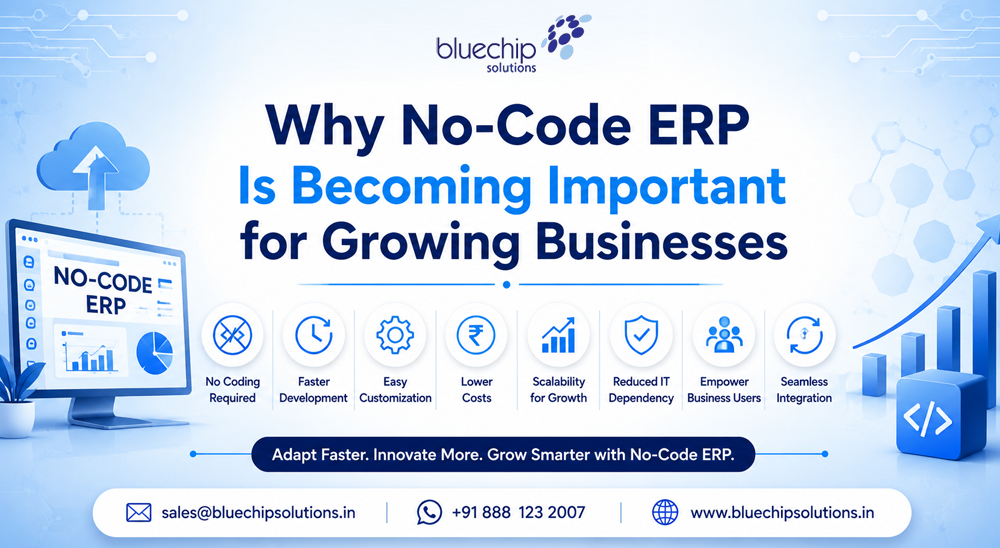
Why No-Code ERP Is Becoming Important for Growing Businesses
ERP implementation often becomes difficult when every business process requires technical customization. A company may need a specific approval workflow, customized quotation, industry-specific report or additional operational field. Traditionally, such changes could require developers, testing and lengthy implementation cycles.
No-code ERP platforms approach the problem differently by allowing authorized users or implementation teams to configure workflows, screens, reports and business processes with significantly less conventional programming. For businesses whose processes change frequently, this can improve flexibility and reduce dependence on extensive custom development.
A platform such as Auvit™ from Bluechip Solutions is positioned around no-code business process automation and ERP customization, making it particularly relevant for companies that need an ERP to adapt to their processes rather than forcing employees to change every workflow around the software.
Best ERP Software in India for Different Business Requirements
Best ERP for Manufacturing Companies
Manufacturers should prioritize ERP functionality for production planning, BOM, MRP, inventory, purchasing, work orders, quality and costing. A financial system with basic inventory may not be sufficient when production complexity increases.
Best ERP for Distribution Businesses
Distributors should focus on inventory visibility, purchasing, sales orders, warehouses, customer management, pricing, receivables and logistics. The ERP should make it easy to understand what is available, what has been ordered and what needs to be replenished.
Best ERP for Construction Companies
Construction businesses have different requirements because projects, materials, labour, subcontractors, expenses and project profitability must be monitored together. Therefore, project-oriented ERP capabilities can be more important than generic accounting features.
Best ERP for SMEs and MSMEs
For SMEs, affordability and usability matter just as much as functionality. A highly complex enterprise ERP may provide hundreds of features but still create unnecessary implementation costs and training requirements. The better approach is to choose an ERP that provides the required functionality today while allowing the business to expand later.
How to Choose the Right ERP Software in India
The safest approach is to evaluate an ERP using your actual business workflows. Instead of asking a vendor to demonstrate every feature, show the vendor how your company currently handles an enquiry, quotation, purchase, inventory transaction, production process, invoice, payment and management report.
Then ask the vendor to demonstrate how the ERP handles the same process. This immediately reveals whether the software actually fits the business. You should also evaluate implementation support, customization capability, integrations, data migration, security, mobile accessibility, reporting, scalability and total cost of ownership.
Most importantly, do not judge an ERP only by its licence price. Training, implementation, customization, migration, support and future upgrades can significantly affect the actual investment.
Is the Cheapest ERP Software the Best Choice?
Not necessarily. A low-cost ERP that requires extensive manual work can become expensive over time. Similarly, an expensive platform may provide capabilities that a smaller company never uses. The best ERP is the one that delivers measurable operational value for the organization.
Therefore, compare the total cost of ownership against expected business improvement, including reduced manual work, better inventory control, faster reporting, improved collections and fewer operational errors.
What Should You Ask Before Buying ERP Software?
Before signing an ERP contract, ask one fundamental question:
“Can this system solve our actual business problems without creating new ones?”
Request a workflow-based demonstration, understand implementation responsibilities, clarify customization costs, examine data migration procedures and ask how support will be provided after deployment. Additionally, request a realistic proof of concept using representative business scenarios where possible. This approach is much more reliable than selecting software because it appears at the top of a generic “top ERP software” list.
The Future of ERP Software in India
ERP is moving from being a back-office record-keeping system toward becoming a broader business decision platform. Cloud deployment, mobile access, workflow automation, analytics, AI assistance and no-code customization are increasingly shaping how organizations interact with enterprise software.
At the same time, data governance is becoming more important. India’s Digital Personal Data Protection Rules were notified in November 2025, with a phased implementation framework, making responsible handling of personal data an increasingly important consideration for software buyers. Consequently, businesses should evaluate not only features but also security, access controls, auditability and responsible data management.
Frequently Asked Questions About the Best ERP Software in India
Which is the best ERP software in India?
There is no single ERP that is best for every organization. The right choice depends on company size, industry, workflows, budget, compliance requirements, customization needs and growth plans.
Which ERP is best for Indian SMEs?
Indian SMEs should generally prioritize an ERP that is affordable, easy to implement, simple for employees to use, compliant with Indian business requirements and flexible enough to support future growth.
What is the difference between ERP and accounting software?
Accounting software primarily focuses on financial transactions and accounting processes. ERP connects finance with business operations such as sales, purchasing, inventory, manufacturing, HR, CRM and other workflows.
Is cloud ERP better than traditional ERP?
Cloud ERP can provide easier remote access, centralized updates and scalable infrastructure. However, the right deployment model depends on the company’s security, operational, integration and regulatory requirements.
Is AI important in ERP?
AI can add significant value when it is connected to real business data and workflows. However, businesses should evaluate practical AI capabilities rather than selecting software simply because it is marketed as “AI-powered.”
Final Verdict: Choose the ERP That Fits Your Business, Not Just the Search Ranking
The best ERP software in India is ultimately not the platform with the longest feature list. It is the platform that solves the organization’s biggest operational problems, gives employees a practical user experience and provides management with reliable information for decision-making.
For businesses struggling with disconnected applications, manual processes, spreadsheet dependency and expensive customization, a flexible no-code ERP can be worth evaluating alongside traditional ERP platforms.
If your organization is evaluating ERP software for manufacturing, distribution, construction, finance, HR or other business operations, Bluechip Solutions can help you assess your existing workflows and identify how Auvit™ can be configured around your business requirements.
Book a free ERP consultation to discuss your current processes, identify operational bottlenecks and explore a practical ERP implementation approach rather than choosing software based only on a generic feature comparison.
Lead Magnet: Download the ERP Selection Checklist for Indian Businesses 2026 to evaluate ERP features, GST readiness, customization, AI capabilities, implementation cost, scalability and vendor support before making your final decision.