

Choosing an ERP system is no longer simply a question of selecting software with accounting, inventory, HR, or manufacturing modules. For a growing business, the more important question is whether the ERP can support expansion without creating higher costs, operational complexity, or implementation problems.
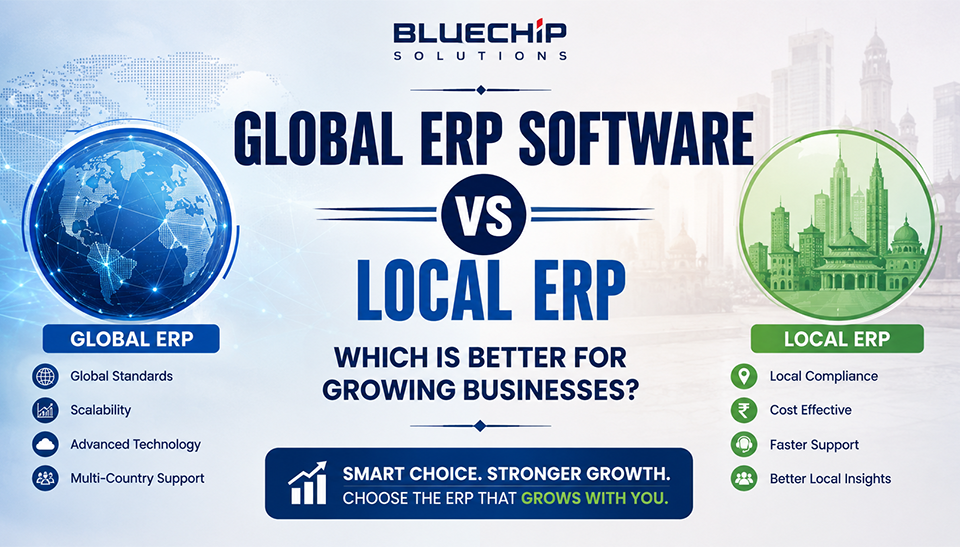
This is where the global ERP vs local ERP decision becomes important. A global ERP may offer extensive functionality, international capabilities, and a large ecosystem. On the other hand, a local ERP can provide stronger regional compliance, faster customization, localized support, and a better understanding of how businesses operate in a specific market.
Therefore, the right choice depends less on whether an ERP is “global” or “local” and more on how well it fits your company’s current processes and future growth plans.
The global ERP software market continues to expand. One recent 2026 estimate places the market at USD 106.22 billion, with projected growth to USD 281.58 billion by 2034. At the same time, cloud ERP adoption is accelerating because businesses increasingly want scalability, remote access, faster deployment, and lower infrastructure requirements.
For growing businesses, however, market size is not the deciding factor. Business fit, implementation capability, localization, scalability, integration, support, and total cost of ownership matter much more.
What Is the Difference Between Global ERP and Local ERP?
A global ERP is generally designed to serve organizations operating across multiple countries, regions, currencies, regulatory environments, and business units. These platforms often provide extensive functionality, sophisticated integrations, international financial capabilities, and large partner ecosystems.
A local ERP, by comparison, is designed with the requirements of a particular country or region in mind. Consequently, it may provide stronger support for local taxation, accounting practices, statutory reporting, language, payroll requirements, and regional business processes.
However, the distinction is becoming less clear.
Modern local ERP providers can offer cloud deployment, mobile applications, APIs, automation, analytics, and AI-enabled capabilities. Likewise, global ERP vendors increasingly provide localized country packs and regional functionality.
Therefore, businesses should not assume that global automatically means better or that local automatically means cheaper. The better question is: Which ERP gives your business the right balance of functionality, flexibility, cost, compliance, and scalability?
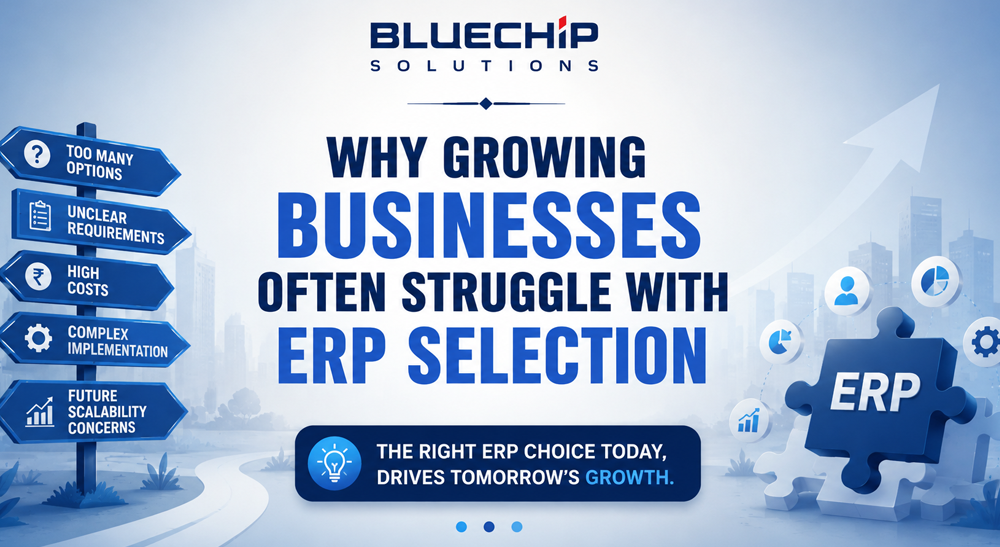
Why Growing Businesses Often Struggle With ERP Selection
ERP selection becomes difficult when a company has outgrown spreadsheets, disconnected accounting software, manual approvals, and department-specific systems.
At first, these tools may appear affordable. However, as transaction volumes increase, problems start appearing.
Finance may have one version of the data while sales has another. Inventory numbers may not match production records. Managers may wait days for reports. Employees may enter the same information repeatedly. Meanwhile, business owners may struggle to understand profitability in real time.
Consequently, companies sometimes purchase a powerful ERP only to discover that employees find it difficult to use or that the system requires expensive customization.
This is one of the biggest ERP buying mistakes: evaluating software capabilities without evaluating business usability.
Global ERP: Where Does It Make Sense?
Global ERP platforms can be an excellent choice for businesses with complex international operations.
For example, a company operating subsidiaries across several countries may need multiple currencies, consolidated financial reporting, international taxation capabilities, global procurement, complex supply chains, and standardized processes across locations.
In such situations, a mature global ERP ecosystem can provide significant value. Furthermore, global ERP vendors typically have extensive implementation partners and established integration ecosystems. Therefore, organizations with large IT teams and complex enterprise requirements may benefit from this maturity.
However, these advantages can come with trade-offs.
Global platforms can involve higher licensing costs, more complex implementations, longer deployment timelines, and significant configuration requirements. For a growing SME, this can become a problem when the organization needs practical automation rather than an extremely broad enterprise architecture.
Local ERP: Where Does It Have an Advantage?
Local ERP solutions can be particularly valuable when regional compliance and business processes are critical. For an Indian company, for example, ERP functionality needs to work naturally with Indian taxation, GST-related processes, local accounting practices, statutory requirements, banking workflows, and regional operational realities.
This localization can reduce the amount of customization required. Moreover, local ERP providers can often respond faster to country-specific regulatory changes. Local implementation teams may also understand the practical challenges faced by SMEs better because they work within the same business environment.
That does not mean every local ERP is automatically superior. Instead, businesses should evaluate whether the vendor has the technology, security, integration capabilities, product roadmap, and implementation experience necessary to support long-term growth.
Global ERP vs Local ERP: Which Is More Scalable?
Scalability is one of the most important considerations for a growing business.
A company may have 50 employees today and 500 employees five years from now. It may operate from one location today and expand into multiple branches tomorrow. It may begin with domestic sales and eventually start exporting. Therefore, an ERP should not simply solve today’s problems. It should also support tomorrow’s operating model.
Global ERP platforms often provide strong scalability for multinational structures. Nevertheless, a well-designed local or regional ERP can also scale effectively if it uses modern architecture, APIs, modular functionality, cloud deployment, and flexible configuration.
India’s ERP market illustrates this shift. Grand View Research estimates India’s ERP software market revenue at approximately USD 3.81 billion in 2026 and projects it to reach about USD 9.54 billion by 2033, with cloud ERP representing the largest deployment segment in 2025.
Therefore, scalability should be evaluated technically rather than geographically.
Ask whether the ERP can handle increasing users, transactions, locations, products, workflows, integrations, and reporting requirements without forcing the company into an expensive replacement project.
Cost Is More Than the ERP License
One of the biggest misconceptions in ERP selection is comparing only software subscription or license prices. The real cost includes implementation, customization, data migration, training, integrations, infrastructure, support, upgrades, and internal employee time.
A global ERP might appear expensive initially but provide capabilities that eliminate several separate applications. Conversely, a lower-cost ERP can become expensive if extensive customization is required. Similarly, a local ERP may provide lower implementation costs because it already supports regional requirements. However, businesses should still verify the vendor’s ability to handle future expansion.
Therefore, compare total cost of ownership, not merely the initial quotation.
Customization vs Standardization: Which Approach Is Better?
Growing businesses frequently face a difficult choice: should they adapt their processes to the ERP, or should the ERP adapt to their processes? Excessive customization can make an ERP expensive and difficult to maintain. However, forcing a company to completely change critical processes simply because the ERP cannot accommodate them can also damage productivity.
The best approach is usually controlled flexibility. Modern no-code and low-code ERP technologies can help businesses configure workflows, forms, approvals, reports, and business processes without extensive traditional programming. This can be particularly valuable for SMEs whose processes change frequently.
Consequently, businesses should ask ERP vendors how quickly a workflow or report can be changed after implementation and whether every modification requires developer intervention.
AI Is Changing What Businesses Should Expect From ERP
ERP selection in 2026 also needs to consider artificial intelligence. AI is increasingly moving ERP systems beyond basic transaction processing toward forecasting, anomaly detection, intelligent reporting, automation, and decision support. The Confederation of Indian Industry’s 2026 report on AI and ERP highlights the movement toward AI-powered ERP while also identifying data readiness, governance, and execution maturity as important challenges.
Therefore, simply asking whether an ERP has an “AI feature” is not enough. Businesses should ask how AI uses their ERP data, whether recommendations can be explained, how sensitive information is protected, and whether the underlying data is accurate enough for AI-driven decisions. An ERP with poor-quality data will not become intelligent simply because an AI layer has been added.
Global ERP vs Local ERP: Which Is Better for Indian Growing Businesses?
For many Indian SMEs and mid-sized businesses, a localized ERP can provide a practical advantage when the company primarily operates within India and needs strong local compliance, affordability, faster implementation, and accessible support.
However, a global ERP may become more attractive when the organization has multinational subsidiaries, complex international supply chains, multiple-country financial consolidation, or highly standardized global operations.
There is also a third option that growing businesses should consider: a locally relevant ERP built on globally scalable technology. This approach combines regional business knowledge with modern cloud architecture, APIs, mobile access, automation, analytics, and AI capabilities. In other words, companies do not necessarily have to choose between “local” and “global” technology. They can choose an ERP that is local in business understanding and global in technological capability.

How to Choose the Right ERP for Your Growing Business
Start by documenting the problems your business needs to solve. If delayed financial reporting is the problem, prioritize real-time finance and management reporting. If inventory accuracy is the issue, examine stock, purchasing, warehouse, and sales integration. If production delays are hurting margins, evaluate production planning, material requirements, shop-floor processes, and costing.
Next, evaluate how the ERP will support your growth over the next three to five years. Then assess implementation methodology, customization flexibility, integrations, cybersecurity, data migration, training, customer support, upgrade policies, and total cost of ownership. Finally, insist on a realistic product demonstration using your business scenarios rather than a generic sales presentation.
A good ERP demonstration should answer a simple question: Can this system solve our actual operational problems without creating new ones?
The Bottom Line: Global ERP vs Local ERP
There is no universal winner in the global ERP vs local ERP debate. A global ERP can be the right choice for multinational organizations with complex international requirements. Meanwhile, a local ERP can be the better option for growing businesses that prioritize regional compliance, faster implementation, flexibility, affordability, and accessible support.
For many growing companies, the strongest option is an ERP that combines local business expertise with globally scalable technology. Before making a decision, evaluate the software against your processes, people, data, compliance requirements, growth plans, and budget. Most importantly, choose an ERP based on measurable business outcomes rather than the size or reputation of the vendor. The right ERP should reduce operational friction, improve visibility, connect departments, automate repetitive work, and give management better information for faster decisions.
Frequently Asked Questions
Is global ERP better than local ERP?
Not necessarily. Global ERP is generally stronger for multinational operations and complex international requirements, while local ERP can be more suitable for businesses requiring strong regional compliance, localized processes, flexibility, and cost-effective implementation.
Which ERP is better for SMEs?
For many SMEs, a scalable cloud ERP with strong localization, simple implementation, flexible customization, and transparent total cost of ownership can be more practical than a highly complex enterprise platform.
Is local ERP secure enough for growing businesses?
Security depends on the vendor’s architecture and practices rather than whether the ERP is local or global. Businesses should evaluate access controls, encryption, backups, audit trails, infrastructure security, data protection, and disaster recovery before selecting an ERP.
Can a local ERP support international expansion?
Yes, provided the ERP supports the required currencies, taxation structures, locations, integrations, reporting, permissions, and international business processes. Businesses planning international expansion should verify these capabilities before implementation.
Should a growing business choose cloud ERP?
Cloud ERP can provide easier access, scalability, centralized updates, and lower infrastructure requirements. Current market research also shows strong momentum toward cloud-based ERP adoption among businesses and SMEs.
Ready to Find the Right ERP for Your Business?
Choosing an ERP should not begin with a software brochure. It should begin with your business problems.
If your organization is struggling with disconnected systems, manual processes, limited visibility, inventory challenges, production complexity, or slow decision-making, Bluechip Solutions can help you evaluate an ERP approach based on your actual business requirements.
Explore ERP solutions designed for growing businesses, or book a free ERP consultation and discuss your current processes with an ERP specialist. A practical assessment can help you understand which modules, integrations, deployment model, and customization approach make sense before you commit to an ERP investment.