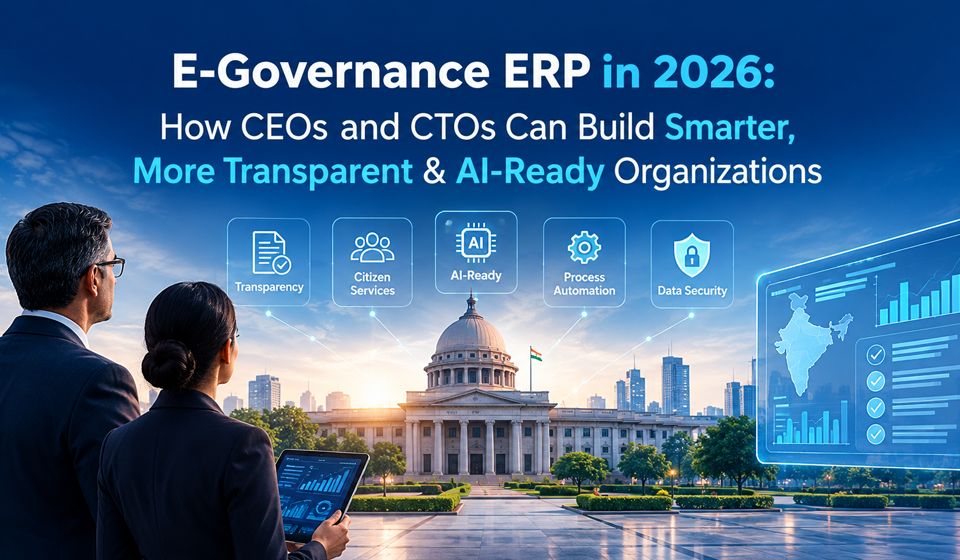
E-Governance ERP in 2026: How CEOs and CTOs Can Build Smarter, More Transparent & AI-Ready Organizations

A CEO does not need another dashboard showing yesterday’s numbers. A CTO does not need another disconnected application that creates another integration problem. What leadership needs is a reliable digital foundation where finance, procurement, human resources, assets, projects, citizen-facing processes, documents and operational data can work together. That is where E-Governance ERP is becoming increasingly important in 2026.
Digital government is moving beyond simply putting forms and services online. The next challenge is connecting the systems behind those services so that decisions can be made faster, processes can be audited more easily and organizational data can become useful for automation and artificial intelligence.
The direction is already visible globally. The World Bank’s 2025 GovTech Maturity Index evaluates digital transformation across 198 economies and measures four major areas: core government systems, public-service delivery, digital citizen engagement and GovTech enablers. The 2025 update also places greater emphasis on areas such as AI ethics, digital identity and the performance of existing digital platforms.
Consequently, organizations that still operate finance, HR, procurement, project management and operational workflows through disconnected systems face a strategic problem: they may be digitally active, but they are not necessarily digitally integrated.
What Is E-Governance ERP?
E-Governance ERP is an integrated enterprise resource planning approach designed to connect administrative, financial and operational processes within government organizations, public institutions and government-linked enterprises.
Instead of maintaining separate systems for finance, procurement, HR, assets, projects, inventory, document management and reporting, an E-Governance ERP creates a connected operational environment. For example, when a department raises a procurement requirement, the process should not end with a purchase order. The requirement should connect with approval workflows, budget availability, vendor information, procurement records, inventory or asset records, payment processing and management reporting.
As a result, leadership gets more than digitized transactions. It gets process visibility. This distinction matters because digital transformation is increasingly about how different systems work together rather than how many applications an organization owns. The World Bank’s GovTech framework specifically identifies government cloud, enterprise architecture and interoperability frameworks among the foundations of modern core government systems.
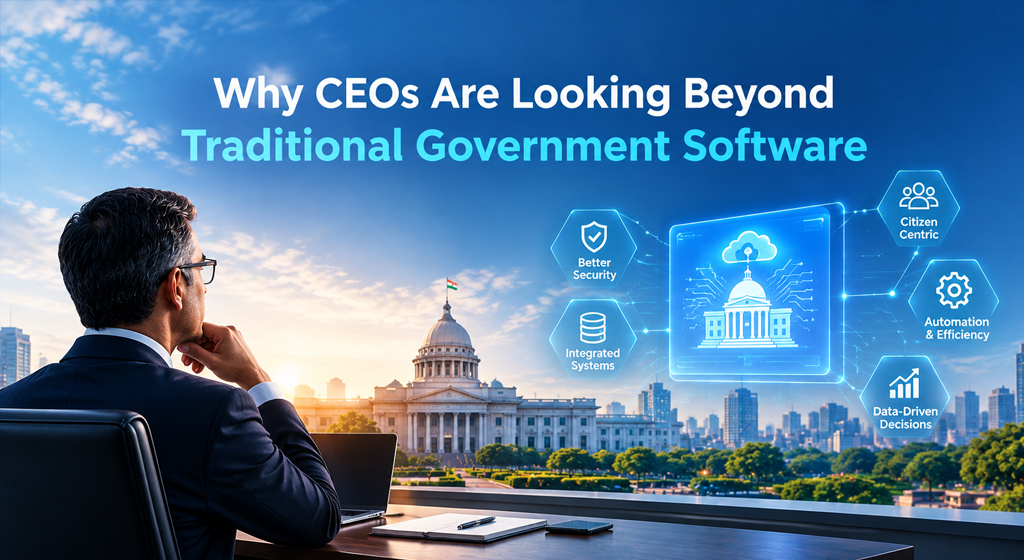
Why CEOs Are Looking Beyond Traditional Government Software
For CEOs, the biggest problem is rarely the absence of software. Instead, it is the lack of reliable information at the moment a decision needs to be made. A CEO may want to know why a project is delayed. However, the answer could be spread across procurement, finance, workforce allocation, inventory, vendor correspondence and project records.
Similarly, leadership may want to understand whether a department is operating within its budget. Yet, if financial data is updated separately from procurement and operational systems, management may receive information after the opportunity to correct the problem has already passed. Therefore, the real business case for E-Governance ERP is not simply automation.
It is decision visibility. An integrated ERP can help leadership move from “What happened?” to “Why did it happen?” and eventually to “What is likely to happen next?” That progression is especially important as organizations introduce AI and advanced analytics.
Why CTOs Need an AI-Ready ERP Architecture
For CTOs, implementing AI is not simply a matter of purchasing an AI tool. AI depends on data. If organizational information is fragmented across spreadsheets, legacy applications, email attachments and isolated databases, an AI system may struggle to establish a consistent operational picture. Therefore, an AI-ready ERP should provide structured data, controlled access, consistent master data, APIs, workflow information, audit trails and integration capabilities.
For instance, an AI system could potentially identify unusual procurement patterns, highlight delayed approvals, detect abnormal expenditure trends or summarize operational performance. However, those capabilities become significantly more useful when the underlying ERP contains connected and trustworthy information. The World Bank’s latest GovTech work also reflects this shift toward modern digital infrastructure, interoperability and responsible technology adoption.
In other words, AI should sit on top of a strong digital operating foundation rather than compensate for a weak one.
The Biggest Problem: Data Silos Across Government Operations
One of the most persistent challenges in government organizations is the data silo. Finance may maintain one database. HR may use another application. Procurement may maintain separate records. Projects may be tracked through spreadsheets, while documents remain scattered across email and shared folders. Consequently, management spends time reconciling information instead of acting on it.
An E-Governance ERP addresses this problem by connecting processes around a common information structure. For example, an employee participating in a government project should be connected to HR records, project allocation, attendance or workforce data and associated financial information where appropriate. Likewise, a procurement transaction can connect requisition, approval, vendor, purchase order, receipt, inventory, invoice and payment information. This creates a continuous digital trail. That trail is valuable not only for efficiency but also for accountability.
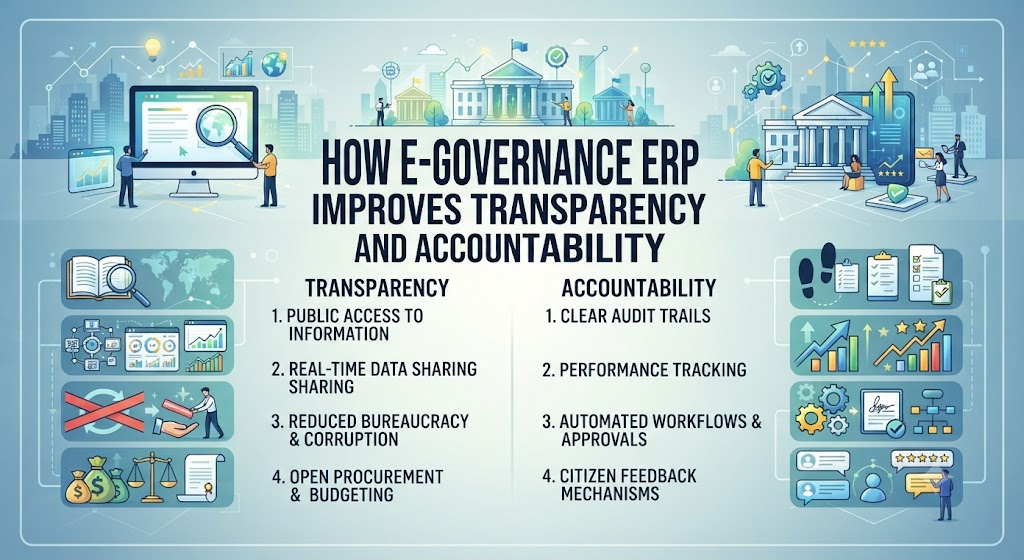
How E-Governance ERP Improves Transparency and Accountability
Transparency becomes difficult when an organization cannot clearly establish who initiated a transaction, who approved it, what changed and when the change occurred. Therefore, workflow-driven ERP can play an important role in strengthening accountability. A properly configured E-Governance ERP can maintain role-based access, approval workflows, transaction histories, document references and audit information.
For leadership, this means fewer “black boxes” inside critical processes. and auditors, it can mean easier access to supporting information. For department heads, it can mean clearer responsibility. and employees, it can mean fewer manual follow-ups.
Citizens and stakeholders, the long-term result can be more transparent and responsive service delivery. The United Nations has similarly emphasized that modern digital government increasingly involves integrated digital services, AI, data analytics, digital identity and open-data capabilities, while also highlighting the need to balance innovation with risks.
Government Process Automation: From Approval Delays to Digital Workflows
Manual approvals can quietly become one of the most expensive inefficiencies inside a large organization. A document may move from one desk to another. An approval may remain in an inbox. A department may wait for information from another department. Meanwhile, management may not know where the process is stuck. E-Governance ERP changes this by converting predefined processes into digital workflows.
For example, a procurement request can automatically move through department verification, budget validation, authorization, purchasing and finance. Similarly, employee-related requests can move through HR and management approval without relying on physical files. Consequently, automation does not merely reduce paperwork. It creates process visibility.
When a workflow is delayed, management can identify the stage instead of repeatedly asking employees for updates.
How AI Can Transform E-Governance ERP in 2026
AI is increasingly changing what organizations expect from ERP systems. Traditional ERP primarily records transactions. AI-ready ERP can additionally help users interpret those transactions. For example, leadership could ask a natural-language question such as:
“Which projects have experienced repeated procurement delays this quarter?” Instead of manually opening multiple reports, an AI-enabled analytics layer could identify relevant records and present the underlying information. Similarly, finance teams could use intelligent analytics to identify unusual spending patterns, while HR teams could analyze workforce trends and department heads could identify recurring process bottlenecks.
However, AI should not automatically make high-impact decisions simply because technology makes it possible. Government organizations need governance around AI usage, data access, security, human oversight and accountability. This is particularly important because the World Bank’s 2025 GovTech update explicitly introduced indicators related to the ethical use of artificial intelligence.
Therefore, the strongest approach is not “AI everywhere.” It is AI where it improves decisions, efficiency and service quality while maintaining appropriate human control.
What CEOs Should Expect From an E-Governance ERP
CEOs should evaluate ERP from an organizational outcome perspective rather than simply comparing feature lists. The system should help leadership understand financial performance, operational performance, resource utilization, project progress and workflow bottlenecks through connected information.
More importantly, executives should be able to move from historical reporting toward near-real-time operational visibility. That means asking a different question during ERP evaluation. Instead of asking, “How many modules does the ERP have?” leadership should ask, “Can these modules work together to give us one reliable operational picture?” That question reveals the difference between a collection of software modules and an integrated digital platform.
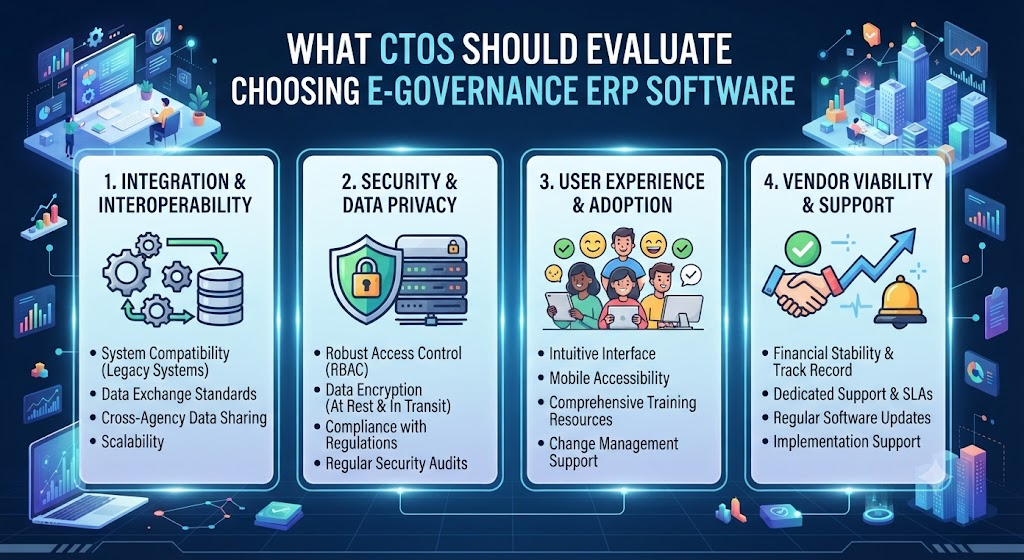
What CTOs Should Evaluate Before Choosing E-Governance ERP Software
CTOs should look closely at architecture because replacing one legacy silo with another does not solve the underlying problem. Integration capabilities, APIs, role-based security, scalability, auditability, data governance, workflow configuration, reporting and interoperability should therefore be evaluated before implementation. Furthermore, CTOs should consider how easily the system can adapt when government processes change.
A rigid ERP may require expensive development whenever a workflow, approval hierarchy or reporting requirement changes. A configurable or no-code/low-code architecture can reduce this dependency by allowing authorized teams to modify workflows and business processes without repeatedly rebuilding the entire application. This becomes particularly valuable for organizations operating across multiple departments, entities or administrative structures.
E-Governance ERP and the Future of Digital Public Services
The future of digital governance is unlikely to be defined by one application. Instead, it will depend on connected platforms that allow government organizations to share information securely across processes and services. The UN E-Government Survey 2024 reported substantial global improvement in digital government development, with the share of the world’s population in countries in the lowest EGDI group falling from 45% in 2022 to 22.4% in 2024. At the same time, the UN highlighted continuing differences between national and local digital government capabilities.
That gap creates an important opportunity. Organizations can no longer treat digital transformation as simply launching another online portal. The internal operating model also needs to become digital. Therefore, E-Governance ERP can become the operational layer connecting internal processes with broader digital-government initiatives.
How to Build an AI-Ready and Transparent E-Governance Strategy
The most practical approach is to start with the organization’s most important business processes. First, leadership should identify where delays, duplication and information gaps are affecting decisions. Next, those processes should be mapped from initiation to completion. Then, data ownership, approval responsibility and integration requirements should be defined.
After that, the organization can prioritize ERP workflows, dashboards, APIs, analytics and automation. Finally, AI should be introduced where reliable data and clearly defined business processes already exist. This sequence is important. Trying to implement AI before fixing fragmented processes can simply automate confusion.
Building the digital foundation first allows AI to create measurable value later.
E-Governance ERP: The Strategic Advantage for 2026 and Beyond
E-Governance ERP is no longer just an IT modernization project. For CEOs, it can become a decision-making foundation. and for CTOs, it can become an integration and data foundation. Finance teams, it can provide stronger financial control. For department heads, it can provide operational visibility.
For employees, it can reduce repetitive administrative work. And ultimately, for citizens and stakeholders, better-connected internal processes can contribute to faster and more accountable service delivery. The organizations that benefit most will not necessarily be those that purchase the largest ERP.
Instead, they will be the organizations that build an ERP environment capable of connecting people, processes and data while remaining flexible enough for AI-driven decision support.
Frequently Asked Questions About E-Governance ERP
What is E-Governance ERP?
E-Governance ERP is an integrated ERP approach that connects finance, HR, procurement, projects, assets, documents, workflows, reporting and other organizational processes to improve operational visibility, automation and accountability.
How is E-Governance ERP different from traditional ERP?
Traditional ERP focuses primarily on integrating enterprise transactions. E-Governance ERP places greater emphasis on transparent workflows, accountability, public-sector processes, interoperability, digital service delivery and governance-oriented reporting.
Can E-Governance ERP support AI?
Yes. An ERP can provide structured operational data, APIs, workflows and historical records that form an important foundation for AI-enabled analytics, automation and decision support. However, AI effectiveness depends on data quality, governance, security and appropriate human oversight.
Why should government organizations consider ERP in 2026?
Because digital government is increasingly moving toward connected systems, interoperability, AI-enabled services, digital identity, data-driven decision-making and citizen-centric delivery. The World Bank’s 2025 GovTech framework specifically tracks progress across core systems, service delivery, citizen engagement and GovTech enablers.
Can a no-code ERP support changing government workflows?
A configurable no-code or low-code ERP can help organizations adapt workflows, forms, approvals and reporting requirements more quickly than highly rigid architectures. However, governance, security and technical controls should remain part of the implementation strategy.
Ready to Build a Smarter E-Governance Organization?
The first step is not buying another application. It is understanding where fragmented data, manual approvals, disconnected departments and delayed reporting are affecting decision-making.
Bluechip Solutions helps organizations explore integrated, AI-ready and configurable ERP approaches designed to connect business processes, workflows, data and management visibility.
Request a Free ERP Consultation or ERP Demo to identify where automation, integration and real-time reporting can create measurable operational improvements.
Download the “2026 E-Governance ERP Readiness Checklist for CEOs & CTOs” and assess your organization’s data integration, workflow automation, transparency, security and AI readiness before selecting an ERP platform.
Key Takeaway
The real opportunity with E-Governance ERP in 2026 is not simply digitizing existing processes. It is creating a connected digital operating model where information moves securely, workflows become measurable, decisions become data-driven and AI can be introduced responsibly. For CEOs, that means better visibility. CTOs, it means a stronger technology foundation.
For organizations, it means moving closer to a smarter, more transparent and AI-ready model of governance.