
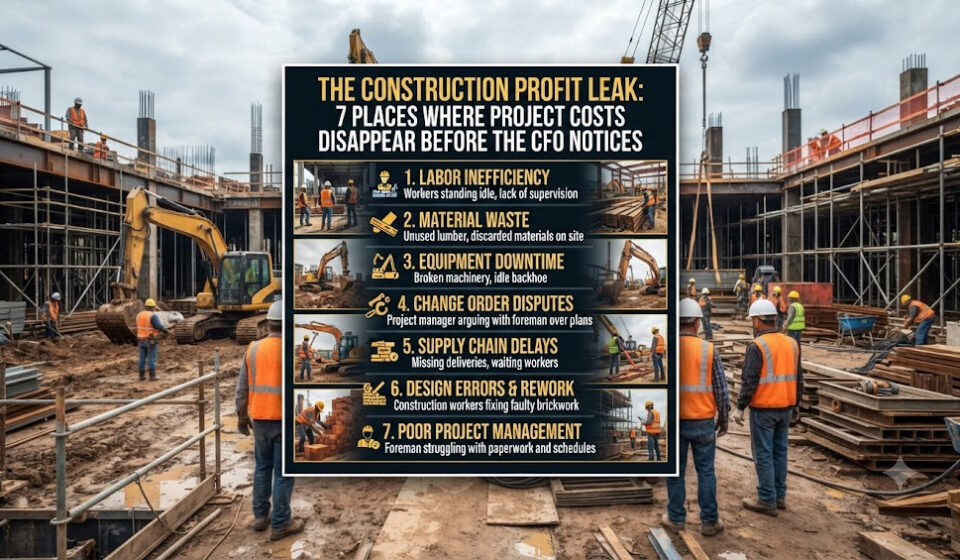
The Construction Profit Leak: 7 Places Where Project Costs Disappear Before the CFO Notices

A construction project can generate strong revenue and still deliver disappointing profit. The problem is often not one dramatic financial mistake. Instead, profitability gradually disappears through small cost variances that remain invisible until the project reaches its final accounts.
For CFOs, project directors, contractors and construction business owners, this creates a difficult question: Where did the project profit go? The answer often sits between the approved budget and what actually happens on the construction site.
A field variation may never reach the billing team. A material purchase may cost more because procurement reacted too late. Equipment may remain idle while rental charges continue. A subcontractor may lose productivity without triggering an early warning. Meanwhile, accounting may receive the information only after the cost has already been incurred.
Consequently, construction cost control cannot depend only on monthly financial reports. Companies need continuous visibility across project execution, procurement, labour, equipment, subcontractors and finance.
This matters even more when rework enters the picture. A 2026 report from the American Society of Civil Engineers, based on contractor project data, found average pre-completion field rework costs of 0.38% of contract value and approximately 0.76% when post-completion corrections were included. The study also found that rework had been underreported by about 300% in the projects examined.
Therefore, the real construction profit leak is often a visibility problem before it becomes an accounting problem.
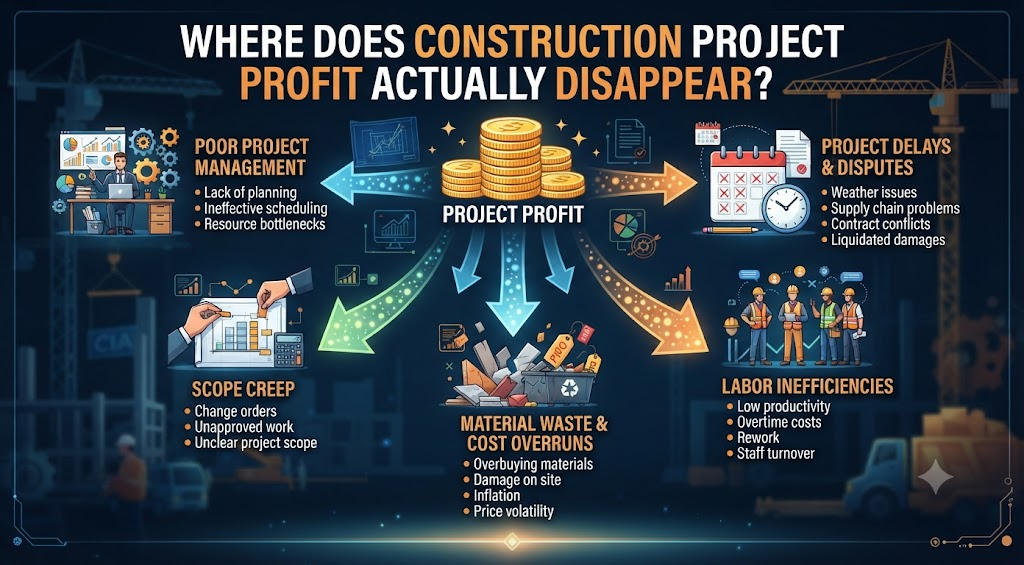
Where Does Construction Project Profit Actually Disappear?
Construction companies typically monitor revenue, gross margin, expenses and cash flow. However, these financial indicators show what has already happened. The bigger opportunity is identifying what is beginning to go wrong.
AI-assisted construction analytics can help companies compare planned costs with actual operational signals, identify unusual variances and prioritize projects or cost categories that require management attention. However, AI should support human decision-making rather than replace project controls, contractual approvals or financial governance.
Here are seven areas where construction project costs can quietly escape control.
1. Unapproved Scope Creep Turns Small Changes Into Major Revenue Leakage
One additional electrical point may not concern a project manager. A minor wall modification may appear insignificant. An extra site visit may seem unavoidable. However, when hundreds of these decisions accumulate, the financial impact becomes substantial.
Micro-scope creep usually begins when site teams respond quickly to client instructions without following the formal variation process. The work gets completed, but the commercial team does not always receive enough documentation to raise a corresponding change order. As a result, the contractor absorbs labour, materials, equipment and supervision costs without recovering the associated revenue.
Why Traditional Change Order Processes Miss the Problem
The fundamental issue is timing. If the project office learns about a variation days or weeks after execution, recovering the cost becomes harder. Documentation may be incomplete, approvals may be disputed and the site team may no longer remember exactly what changed.
A digital construction management workflow can instead capture the request at source. The site engineer can record the change using a mobile device, attach photographs or drawings, identify the affected activity and send it through an approval workflow. The commercial team can then evaluate the financial impact before execution wherever the contract permits.
This creates a much stronger connection between field activity, variation approval, project cost and billing.
2. Fragmented Procurement Creates Material Cost Variances
Materials represent a major portion of construction expenditure, so procurement decisions can quickly affect project profitability. Yet many contractors still manage purchasing through disconnected spreadsheets, emails, phone calls and supplier conversations. That creates several problems.
A project may purchase urgently because procurement did not receive an early requirement signal. Another site may already hold the same material. A supplier may increase pricing because the company has not consolidated demand. Alternatively, materials may arrive too early and remain exposed to damage, deterioration or site losses. The result is not simply a higher purchase price.
It can also create storage costs, transportation expenses, schedule delays and working-capital pressure.
How Construction ERP Improves Procurement Control
An integrated construction ERP can connect project schedules, material requirements, purchase requests, purchase orders, inventory and supplier information. More importantly, AI-based analytics can identify unusual purchasing patterns.
For example, the system can flag a material whose actual purchase price is consistently above the approved estimate. It can also identify repeated emergency purchases, unusual supplier price movements or material consumption that differs significantly from the project baseline.
Instead of asking, “Why did material cost increase last month?”, management can ask, “Which project and material category is showing an abnormal cost trend right now?”
That shift from retrospective reporting to early intervention can make construction cost control considerably more effective.
3. Idle Equipment Keeps Consuming Money Without Producing Output
Cranes, excavators, loaders, generators and specialized equipment can represent significant capital or rental expenditure. The problem is that equipment cost does not stop simply because utilization stops. Rental charges, depreciation, insurance, maintenance and financing costs can continue while machinery remains unused. Consequently, an excavator standing idle for several days is not merely an operational inconvenience. It can become a direct project profitability issue.
Move From Equipment Ownership to Equipment Visibility
Construction companies need to know where equipment is located, which project is using it, how frequently it is operating and when it is expected to become available. An integrated asset management system can connect equipment allocation with project schedules and utilization information.
AI models can further analyze historical utilization and project requirements to identify potential underutilization. For example, if one project requires a machine for only three days while another project needs the same equipment for two weeks, management can investigate whether internal reallocation is more economical than arranging another rental.
The objective is not simply to monitor equipment. It is to connect equipment utilization with project cost and revenue generation.
4. Subcontractor Productivity Gaps Hide Inside Project Delays
Subcontractors can strongly influence construction project profitability because their work affects labour costs, schedule performance, quality and downstream activities. However, subcontractor problems are often discovered only when the project begins missing milestones. By then, the company may already face overtime, additional supervision, idle labour and accelerated work costs.
Measure Productivity Before the Schedule Slips
Construction companies should connect subcontractor commitments with measurable site progress. Daily work completion, planned quantities, actual quantities, labour deployment, quality issues and pending activities can provide a more useful picture than a monthly progress report. For instance, if a subcontractor was expected to complete 1,000 square metres during a defined period but repeatedly delivers substantially less, management can investigate the cause immediately.
The issue may be labour availability, material shortages, design clarification, site access or productivity. This distinction matters because the solution depends on the cause. A construction ERP with workflow and project dashboards can bring these signals together instead of leaving them across separate spreadsheets and communication channels.
5. Rework Converts One Construction Activity Into Two
Rework is one of the clearest examples of how operational mistakes become financial losses. When completed work must be demolished, corrected and rebuilt, the contractor may pay twice for labour and materials while also losing valuable schedule time. However, the visible correction cost is only part of the problem.
Rework can also create equipment downtime, subcontractor claims, additional supervision, delayed handovers and customer dissatisfaction.
The latest research makes the issue particularly relevant. The ASCE-reported study found that actual field rework costs were underreported by approximately 300% in the projects studied, demonstrating why companies should measure rework systematically rather than rely on assumptions.
Turn Rework Into a Measurable Cost Category
Every significant rework event should be connected to its cause. Was the problem caused by a design change? Poor workmanship? Incorrect material? Inadequate supervision? Coordination failure? Once companies classify rework by cause, they can identify recurring patterns.
AI-assisted analytics can help identify relationships between project phase, subcontractor, activity, material and rework frequency. The goal is not to let an algorithm decide what caused a failure. Instead, it can help project teams identify patterns that deserve investigation. That makes rework management proactive rather than reactive.
6. Siloed Construction Data Delays the CFO’s Visibility
A CFO may receive an accurate financial report and still not have an accurate picture of the project’s current financial health. Why? Because financial reporting depends on when operational information reaches finance. If the site team records progress in one system, procurement maintains purchase information in another, payroll operates separately and accounting receives documents later, the financial picture becomes fragmented. By the time the numbers reach management, the cost event may already be irreversible.
Connect Project Operations With Finance
A construction ERP should bring estimating, budgeting, procurement, inventory, subcontracting, project execution, billing and accounting into a connected environment. This creates a more useful project-cost picture. Instead of reviewing only the amount already spent, management can compare:
Budget → Committed Cost → Actual Cost → Work Progress → Forecast Cost → Expected Margin
This is particularly important because committed costs can reveal financial pressure before invoices reach the accounting system. AI-based forecasting can then examine historical project patterns and current cost behaviour to highlight potential budget deviations. The human decision remains with the CFO and project leadership, but the system can make the warning arrive earlier.
7. Compliance Failures Create Expensive Late-Stage Corrections
Compliance is often treated as a legal or administrative responsibility. Financially, however, compliance failures can become project-cost events. A missed requirement can result in redesign, additional materials, inspection delays, rework, consultant fees or schedule extensions. Moreover, the longer a compliance issue remains undiscovered, the more expensive the correction can become.
Build Compliance Into the Project Workflow
Instead of checking compliance only before inspections, companies can integrate document approvals, inspection records, design revisions, quality checks and required certifications into project workflows. Digital audit trails also make it easier to identify who approved a document, when a revision occurred and whether the correct version was used.
AI can assist by comparing project documentation, identifying missing information and highlighting records that require human review. However, regulatory interpretation should remain with qualified professionals and responsible project teams. Technology should improve visibility and consistency rather than replace professional judgment.
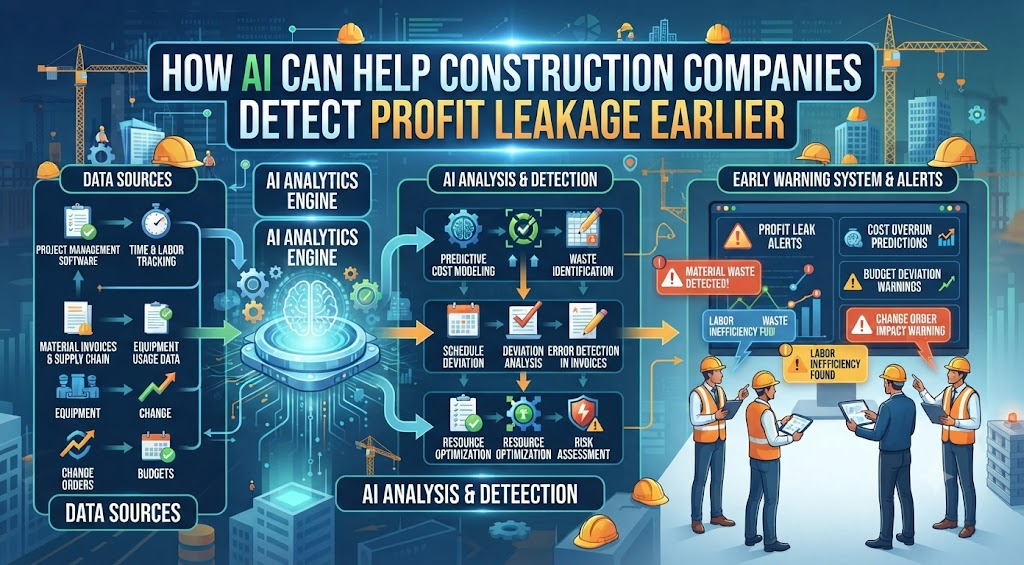
How AI Can Help Construction Companies Detect Profit Leakage Earlier
AI has a practical role in construction financial management when it works with reliable operational data. A modern AI-assisted construction analytics model can examine historical project costs, planned budgets, procurement activity, equipment utilization, subcontractor performance, progress data and financial transactions.
The system can then identify unusual patterns. For example, if material costs are rising faster than project progress, subcontractor productivity is declining or equipment utilization is falling, the system can flag those conditions for investigation.
This approach is more valuable than simply adding an AI chatbot to existing construction software. The real opportunity comes from connecting AI with structured project data, workflows and business rules.
What Should a CFO Look for in a Construction ERP?
The right construction ERP should provide more than accounting and invoicing. It should connect project estimation with execution, procurement with inventory, site activities with approvals, subcontractors with progress monitoring and operational transactions with finance.
Most importantly, the system should provide traceability. When project margin changes, management should be able to move from the financial variance to the operational cause. That is the difference between simply reporting a construction profit leak and actually controlling it.
Stop Finding Construction Cost Leaks After the Project Is Finished
Construction profitability rarely disappears in one dramatic transaction. Instead, it leaks through small variations, material inefficiencies, idle equipment, productivity gaps, rework, delayed information and compliance issues. By the time these costs become visible in the final financial statement, the opportunity to recover them may already be gone.
Therefore, construction companies need a connected approach that brings project management, procurement, inventory, equipment, subcontractors, approvals and finance into one operational view. A modern ERP platform can provide that foundation, while AI-assisted analytics can help management identify unusual patterns earlier and focus attention where financial risk is emerging.
Want to know where your construction projects are losing money?
Get the Construction Financial Health Checklist: 25 Diagnostic Questions Every CFO Should Ask Before Closing a Project and use it to review project cost control, procurement, variations, subcontractor performance, rework and financial visibility.
Protecting construction margins starts with finding the leakage before it reaches the final accounts.
Explore Bluechip Solutions Construction ERP and discover how connected project management, financial control and workflow automation can improve construction cost visibility.