
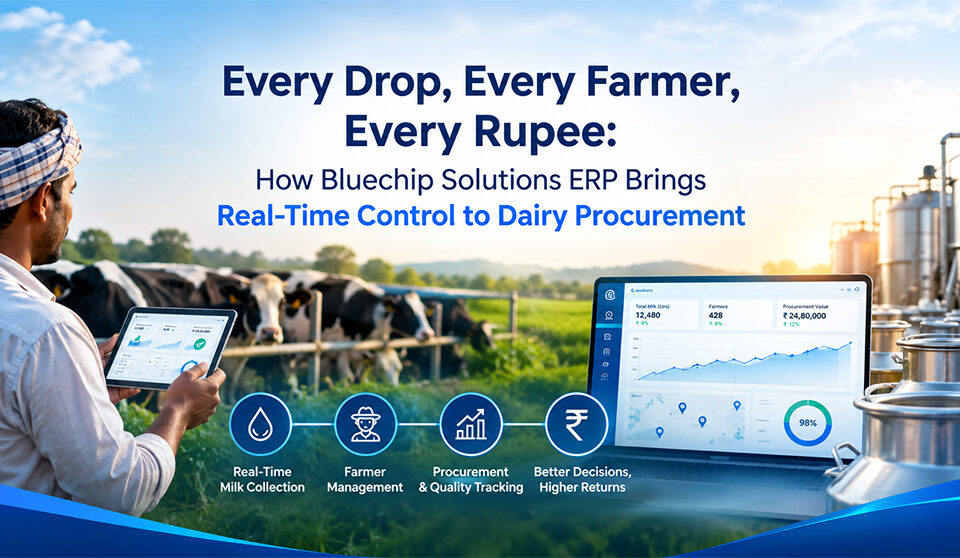
Every Drop, Every Farmer, Every Rupee: How Bluechip Solutions ERP Brings Real-Time Control to Dairy Procurement

Dairy procurement looks simple until the numbers start moving. A dairy business may collect milk from hundreds or thousands of farmers every day. However, behind every litre are collection centres, farmer records, quality tests, fat and SNF measurements, procurement rates, transport costs, payment calculations, rejections, shortages, and constantly changing supply volumes.
When these activities depend on spreadsheets, handwritten registers, disconnected software, phone calls, and WhatsApp messages, management can lose visibility exactly where it matters most. The bigger problem is that procurement decisions often happen before finance or senior management gets a complete picture.
A farmer may deliver less milk than expected. Quality may fluctuate. Collection costs may increase. A payment calculation may require correction. A procurement centre may receive unexpected volumes. Meanwhile, the finance team is still waiting for consolidated information. This is where a Dairy Procurement ERP can change the operating model.
Bluechip Solutions ERP can bring farmer management, milk procurement, quality information, procurement transactions, payments, inventory, finance, reporting, and business workflows into a connected ERP environment. Instead of asking what happened after the day ends, management can work with information that is captured as procurement happens.
Why Dairy Procurement Becomes Difficult as the Business Grows
A small dairy operation can manage procurement through familiar methods because the number of farmers, collection centres, transactions, and payment calculations remains manageable. Growth changes that equation. As the farmer network expands, procurement teams have to manage more records and more exceptions. Consequently, even a small data-entry mistake can affect payment calculations, procurement reporting, or farmer reconciliation.
For example, consider a dairy procuring milk from multiple collection centres. One centre records a different quantity from the transport record, while the quality information arrives separately. The procurement team then reconciles the information manually. That process consumes time.
More importantly, it creates uncertainty. Management may know the total milk collected, but may not immediately know which centres are underperforming, where procurement costs are rising, which farmers are supplying less than expected, or how quality trends are changing. A connected ERP for dairy procurement addresses this gap by creating a common operational environment where procurement information can flow into related business processes.
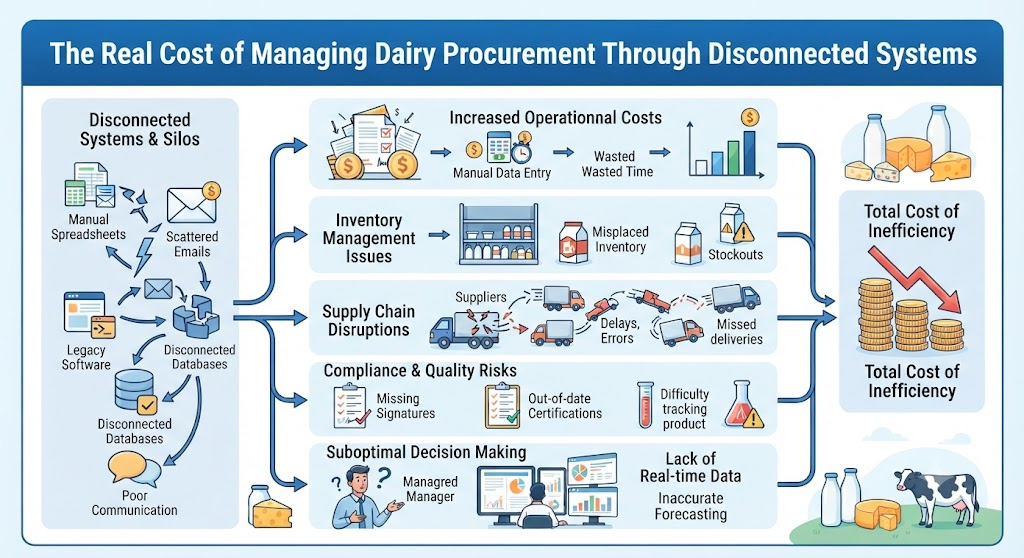
The Real Cost of Managing Dairy Procurement Through Disconnected Systems
The obvious cost of disconnected procurement is administrative work. However, the hidden cost can be much larger. When farmer information sits in one system, milk collection records in another, quality data in spreadsheets, and payment calculations elsewhere, employees become the bridge between systems. That creates dependency on manual reconciliation.
Furthermore, disconnected information makes it difficult to establish a reliable operational history. When management wants to investigate a payment discrepancy, procurement variation, or quality issue, employees may need to search through multiple records. This is particularly difficult when dairy businesses operate across multiple collection centres.
Therefore, the objective of dairy ERP software should not simply be to digitise existing registers. The system should connect the processes that determine procurement performance.
Farmer Management Needs More Than a Farmer Master
Farmer management is one of the most important foundations of dairy procurement. However, maintaining only a farmer name, contact number, and address does not provide enough operational visibility. A modern dairy procurement ERP should allow the business to maintain structured farmer information and connect that information with procurement transactions, quality measurements, collection locations, payment records, and relevant operational activities.
Consequently, procurement teams can move from asking, “How much milk did we collect?” to more useful questions such as:
Which farmers consistently contribute to a collection centre? How has an individual farmer’s procurement changed over time? Are quality parameters changing? Are payment records matching procurement transactions? Where are unusual variations occurring? These questions become much easier to investigate when farmer information and procurement transactions exist within the same business environment.
Real-Time Milk Procurement Visibility Can Change Daily Decision-Making
Milk procurement is highly time-sensitive. Unlike many conventional inventory transactions, milk collection happens continuously and the product itself has a limited shelf life. Therefore, delayed information can reduce the value of the information. A dairy management team may need to know current procurement quantities, collection-centre performance, quality variations, and expected supply before making operational decisions.
With a connected ERP system, procurement data can feed dashboards and reports as transactions are captured. As a result, management can monitor procurement performance without waiting for manually prepared end-of-day reports. This does not mean every business decision should be automated. Instead, real-time ERP visibility gives managers a stronger information base for making those decisions.
Milk Quality Data Should Drive Procurement Intelligence
Quantity alone cannot tell the complete procurement story. Milk quality parameters such as fat and SNF can influence procurement calculations and operational decisions. Therefore, capturing quality information alongside procurement transactions is essential. When quality information remains separate from procurement data, teams may struggle to understand the relationship between quantity, quality, farmer performance, and procurement value.
A connected system can associate relevant quality information with procurement transactions and farmer records. Over time, this creates a more useful operational dataset. That dataset can support trend analysis, exception identification, and management reporting. Moreover, AI-assisted analytical models can help identify unusual patterns that deserve human attention.
For example, an AI-based anomaly-detection model could flag a sudden deviation from a farmer’s historical procurement pattern. The system does not need to make the final decision. Instead, it can bring the exception to the procurement team’s attention so that the team can investigate the underlying reason.
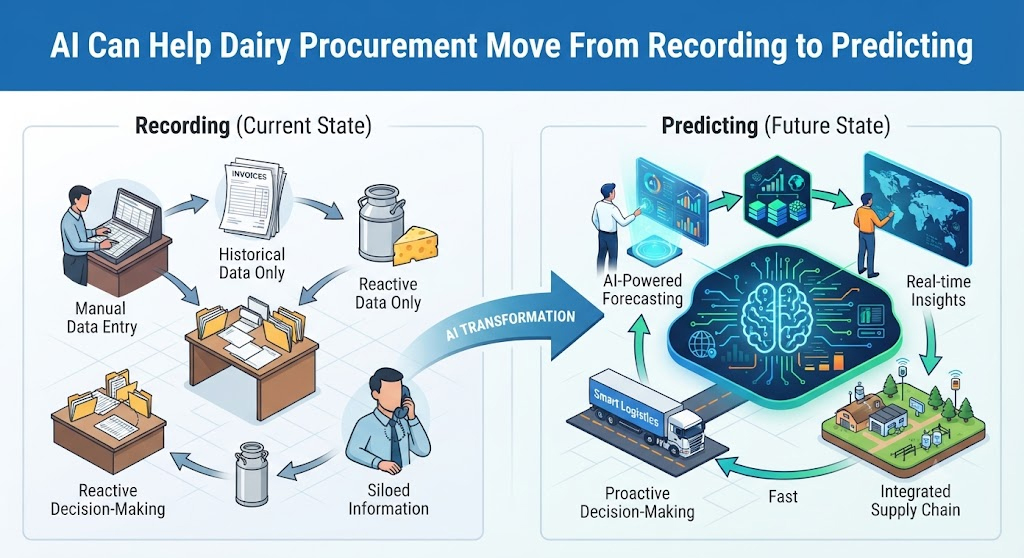
AI Can Help Dairy Procurement Move From Recording to Predicting
AI becomes valuable when it solves a real operational problem. For dairy procurement, one practical application is demand and supply forecasting. Historical procurement records can contain patterns related to farmer contribution, collection centres, seasons, procurement cycles, quality trends, and other business variables. An AI-assisted forecasting model can analyse these patterns and generate estimates that help management prepare for expected procurement variations.
For example, if a collection centre historically experiences a recurring supply reduction during a particular period, the system can identify that pattern and support advance planning. Similarly, anomaly-detection algorithms can identify transactions that differ significantly from established historical patterns. However, AI should support—not replace—the people managing procurement.
The procurement manager still needs to understand why a variation occurred. Weather, local farming conditions, farmer behaviour, transportation issues, animal health, or collection-centre operations may all influence the numbers. Therefore, the strongest approach is AI-assisted dairy ERP, where algorithms highlight patterns and people make informed decisions.
Payment Accuracy Is a Procurement Control Issue
Farmer payments are not simply a finance function. They directly influence farmer relationships and procurement continuity. When procurement quantities, quality measurements, rates, deductions, and payment calculations pass through disconnected processes, reconciliation becomes difficult. Even when the final payment is correct, the effort required to verify it can become significant.
A dairy procurement ERP can connect procurement transactions with the relevant payment and accounting workflows. Consequently, finance and procurement teams can work from a common transaction history. This creates stronger traceability. If a payment needs investigation, users can trace the relevant procurement information instead of reconstructing the transaction manually from multiple sources.
For management, this also creates a clearer connection between milk procurement and financial control.
Collection Centres Need Operational Control, Not Just Data Entry
Collection centres are where procurement becomes real. If collection-centre operations are not connected to the central ERP environment, head-office visibility can remain incomplete. A well-designed dairy ERP can connect collection activities with farmer records, procurement transactions, quality information, approvals, reporting, and downstream financial processes.
As a result, management can compare operational performance across centres and identify unusual variations. This becomes increasingly important when a dairy expands its procurement network. Instead of scaling administrative workload alongside business growth, the organisation can use structured workflows and centralised information to improve operational control.
How Bluechip Solutions ERP Can Support Dairy Procurement Management
Bluechip Solutions approaches ERP as a connected business platform rather than simply a collection of isolated screens. For dairy procurement operations, the objective is to connect the information generated across farmer management, procurement, quality, payments, inventory, finance, reporting, and business workflows. This approach becomes particularly relevant when every dairy business has its own procurement rules and operational requirements.
A rigid process may force the organisation to change its business around the software. A configurable ERP approach can instead allow the business to structure workflows around its actual operating model. Bluechip Solutions’ ERP capabilities can therefore be positioned around dairy procurement management, farmer data management, procurement control, workflow automation, reporting, and integrated financial processes, while supporting business-specific requirements.
For decision-makers, the important question is not whether an ERP has hundreds of features. The more important question is whether the ERP can connect the processes that directly affect procurement performance.
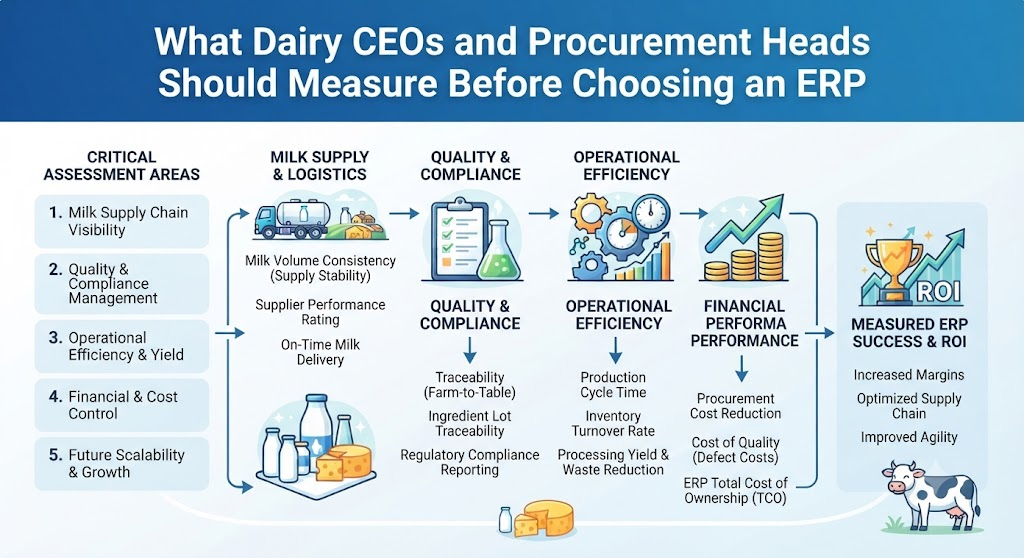
What Dairy CEOs and Procurement Heads Should Measure Before Choosing an ERP
Choosing dairy ERP software should start with operational problems rather than a feature checklist. Management should first identify where information currently gets delayed, duplicated, or lost. The next question should be whether the proposed ERP can create a single operational flow from farmer registration to procurement, quality capture, payment processing, reporting, and finance.
Data ownership also matters. Users should understand who can create, modify, approve, and access procurement information. Furthermore, the system should maintain appropriate controls and traceability for important transactions. AI capabilities should also be evaluated carefully.
An ERP vendor should be able to explain what data the AI model uses, what type of predictions or anomaly detection it provides, how users validate its recommendations, and where human approval remains necessary. This practical evaluation can prevent a business from purchasing an ERP simply because it contains an “AI” label.
From Milk Collection Data to Management Intelligence
The real value of dairy procurement ERP is not the ability to enter more data. It is the ability to turn operational data into usable business intelligence. When farmer information, procurement transactions, quality data, payments, and financial records connect, management gains a stronger foundation for understanding the business. When dashboards provide timely visibility, managers can investigate issues earlier.
When workflows reduce repetitive manual work, employees can spend more time resolving operational problems. When AI-assisted analytics identify unusual patterns, procurement teams can investigate exceptions before they become larger issues. That is the difference between an ERP that merely records procurement and an ERP that helps management control procurement.
Why Every Drop, Every Farmer and Every Rupee Matters
Dairy procurement operates on thousands of small transactions that collectively determine the financial and operational health of the business. One incorrect quantity may appear insignificant. One quality variation may seem isolated. One delayed payment may look manageable.
One collection-centre discrepancy may appear temporary. However, when these issues repeat across hundreds or thousands of transactions, their cumulative impact can become significant. That is why dairy businesses need visibility at the transaction level while giving management a consolidated view of the entire procurement operation.
Bluechip Solutions ERP can help dairy businesses connect procurement operations, farmer information, quality data, payments, workflows, reporting, and financial processes within a unified ERP environment.
The result is not simply better record keeping. It is stronger operational visibility, better traceability, faster decision support, and a more structured foundation for scaling dairy procurement.
Frequently Asked Questions About Dairy Procurement ERP
What is a Dairy Procurement ERP?
A Dairy Procurement ERP is an enterprise resource planning system designed to connect dairy procurement activities such as farmer management, milk collection, quality recording, procurement transactions, payment processing, reporting, and related financial processes.
How can ERP improve dairy farmer management?
ERP can centralise farmer records and connect them with procurement transactions, quality information, payment history, and collection-centre operations. This gives procurement teams a more complete view of farmer-related activities.
Can AI be used in dairy procurement?
Yes. AI-assisted models can support applications such as procurement forecasting, anomaly detection, trend identification, and decision support. However, human review remains important because operational conditions can change for reasons that historical data alone cannot explain.
Why is real-time visibility important in dairy procurement?
Real-time visibility helps management access current procurement information instead of relying entirely on delayed manual reports. This can support faster investigation of quantity, quality, collection-centre, and payment-related variations.
What should a dairy company check before selecting ERP software?
The company should evaluate farmer management, procurement workflows, quality integration, payment processing, reporting, financial integration, access controls, scalability, configurability, mobile accessibility, and AI/analytics capabilities against its actual procurement processes.
Get a Clearer View of Your Dairy Procurement Operations
If your procurement team still depends heavily on spreadsheets, registers, disconnected applications, or manual reconciliation, the first step is not necessarily replacing everything at once. Start by mapping how farmer data moves from registration to milk collection, quality recording, procurement calculation, payment, accounting, and management reporting. Then identify where information gets delayed or duplicated.
Bluechip Solutions can help you evaluate how an ERP-driven dairy procurement workflow can fit your business processes and growth requirements.
Request a Free ERP Consultation →
Discuss your dairy procurement workflow with the Bluechip Solutions team and identify where automation, real-time reporting, and integrated ERP processes can improve operational control.
Get the Dairy Procurement ERP Readiness Checklist →
Evaluate your current farmer management, milk collection, quality tracking, payment, reporting, workflow, and AI-readiness before selecting an ERP platform.