Best ERP Software for Manufacturing: Complete Guide to Choosing the Right Manufacturing ERP in 2026

Introduction
Manufacturing companies are under constant pressure to increase productivity, reduce operational costs, improve supply chain visibility, and meet customer expectations without compromising quality. While demand continues to grow across industries, manufacturers are simultaneously facing labor shortages, rising raw material costs, inventory fluctuations, supply chain disruptions, compliance requirements, and increasing competition.
As a result, many organizations are discovering that spreadsheets, disconnected software systems, and manual processes no longer support sustainable growth. Information becomes scattered across departments, production planning becomes inaccurate, inventory levels become difficult to manage, and decision-making slows down significantly.
This is precisely where the best ERP software for manufacturing creates a competitive advantage.
A modern Manufacturing ERP system integrates production, inventory management, procurement, finance, quality control, maintenance, sales, warehouse operations, and supply chain management into a single platform. Consequently, manufacturers gain complete visibility into operations while improving productivity, reducing waste, and increasing profitability.
Furthermore, modern ERP platforms now leverage Artificial Intelligence (AI), Machine Learning (ML), predictive analytics, and real-time business intelligence to help manufacturers make faster and more accurate decisions.
This comprehensive guide explains everything manufacturing businesses need to know about selecting the best ERP software for manufacturing in 2026, including key features, benefits, implementation considerations, AI capabilities, and how to choose the right solution for long-term growth.
Why Manufacturing Companies Need ERP Software More Than Ever
Manufacturing operations involve multiple interconnected processes. Production planning depends on inventory availability. Procurement depends on demand forecasting. Quality control depends on production consistency. Finance depends on accurate operational data.
However, when these functions operate in isolation, inefficiencies begin to emerge.Production managers struggle to obtain accurate inventory information. Procurement teams order excess materials due to poor visibility. Warehouse teams experience stock discrepancies. Finance teams spend hours reconciling data from multiple systems.
Consequently, organizations experience delayed deliveries, increased operational costs, excess inventory, reduced customer satisfaction, and lower profit margins.Manufacturing ERP software eliminates these challenges by creating a centralized digital ecosystem where all departments work with the same real-time information.Instead of reacting to problems after they occur, manufacturers gain the ability to predict issues, optimize operations, and improve overall business performance.
Common Challenges Faced by Manufacturing Companies
Lack of Real-Time Visibility
Many manufacturers operate using multiple software systems that do not communicate effectively with each other. As a result, managers often make decisions using outdated information. For example, production teams may believe sufficient inventory exists for an order while warehouse records indicate otherwise. Consequently, production delays occur, customer commitments are missed, and operational efficiency declines. A modern ERP system provides real-time visibility across departments, ensuring every stakeholder works with accurate and current information.
Inventory Management Problems
Inventory remains one of the largest investments for manufacturing organizations. However, without proper inventory control, businesses frequently experience overstocking, stockouts, obsolete inventory, and inaccurate inventory records. Excess inventory increases carrying costs and ties up working capital. Conversely, stock shortages disrupt production schedules and affect customer deliveries.
Manufacturing ERP software continuously tracks inventory movements while providing accurate stock visibility across warehouses, production facilities, and distribution centers.
Production Planning Inefficiencies
Production planning becomes increasingly difficult as product complexity grows. Without integrated planning tools, manufacturers struggle to balance demand, material availability, machine capacity, labor resources, and delivery schedules. Consequently, bottlenecks develop throughout the production process. Advanced ERP systems utilize AI-powered scheduling algorithms that optimize production plans based on real-time operational conditions.
Rising Operational Costs
Manufacturers worldwide continue facing increasing expenses related to labor, transportation, energy, and raw materials. Therefore, improving operational efficiency has become a strategic priority. ERP software identifies inefficiencies, reduces manual tasks, improves resource utilization, and enables data-driven decision-making. As a result, organizations reduce operating costs while improving profitability.
Supply Chain Disruptions
Global supply chains have become increasingly unpredictable. Supplier delays, transportation challenges, geopolitical events, and demand fluctuations create significant operational risks. ERP platforms help manufacturers proactively manage supply chain disruptions through predictive analytics, supplier performance monitoring, and demand forecasting.
What Is Manufacturing ERP Software?
Manufacturing ERP software is an integrated business management platform specifically designed to manage manufacturing operations from end to end. Unlike generic business software, manufacturing ERP systems include specialized functionality for production planning, material requirements planning (MRP), shop floor management, quality assurance, inventory control, procurement, maintenance, and supply chain operations.
The system serves as a central source of truth for the entire organization. Whenever a sales order is entered, inventory levels update automatically. Production schedules adjust accordingly. Procurement requirements are recalculated. Financial records are updated in real time. Consequently, departments become aligned while operational efficiency improves dramatically.
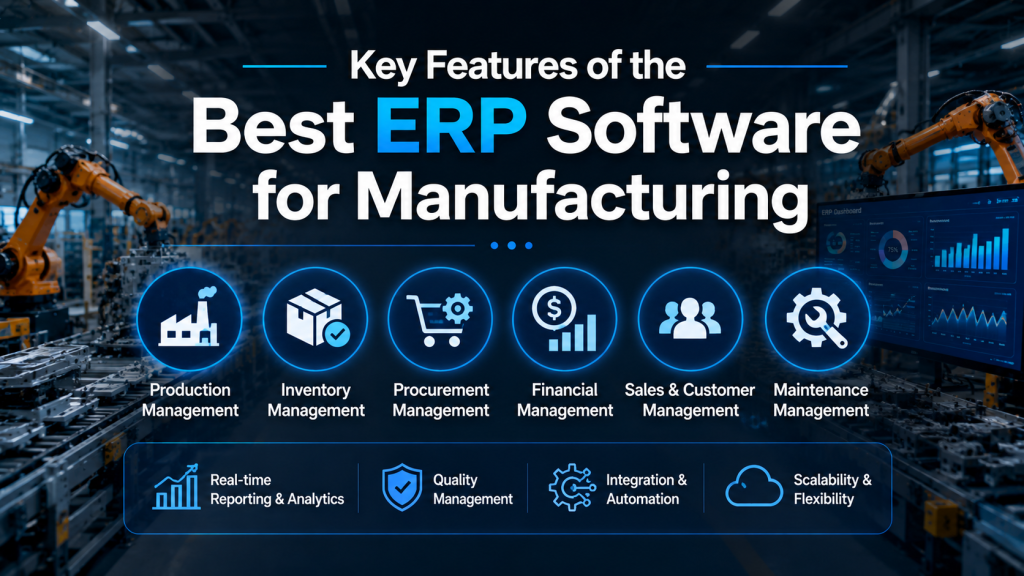
Key Features of the Best ERP Software for Manufacturing
Production Planning and Scheduling
Production planning is the foundation of manufacturing success. The best ERP software for manufacturing enables organizations to create optimized production schedules based on demand forecasts, machine availability, labor capacity, and inventory levels. Furthermore, AI-driven scheduling capabilities automatically adjust plans when unexpected disruptions occur. As a result, manufacturers improve throughput while minimizing downtime.
Material Requirements Planning (MRP)
MRP functionality ensures the right materials are available at the right time. Instead of relying on manual calculations, ERP systems automatically determine material requirements based on production schedules and customer demand. Consequently, organizations reduce inventory costs while preventing production delays.
Inventory Management
Inventory management capabilities provide complete visibility into raw materials, work-in-progress inventory, finished goods, and warehouse operations. Real-time inventory tracking improves accuracy while reducing inventory carrying costs. Additionally, automated replenishment recommendations ensure optimal stock levels.
Quality Management
Product quality directly impacts customer satisfaction and business reputation. Therefore, modern manufacturing ERP systems incorporate quality management processes throughout production operations. Quality inspections, compliance tracking, defect management, and corrective action workflows become integrated into daily operations. Consequently, organizations reduce defects while improving product consistency.
Supply Chain Management
Supply chain performance significantly influences manufacturing profitability. ERP systems improve supplier collaboration, procurement management, logistics coordination, and demand planning. Moreover, predictive analytics help identify potential supply chain risks before they impact production.
Financial Management
Financial management capabilities integrate accounting, budgeting, cost control, accounts payable, accounts receivable, and financial reporting. Because operational and financial data reside within a single platform, organizations gain accurate insights into profitability and performance. Management teams can therefore make faster and more informed decisions.
Business Intelligence and Analytics
Data-driven decision-making has become essential for modern manufacturing organizations. ERP systems collect and analyze operational data across the enterprise. Interactive dashboards, KPI tracking, predictive analytics, and executive reporting provide valuable insights into business performance. Consequently, leaders identify opportunities for improvement while responding quickly to changing market conditions.
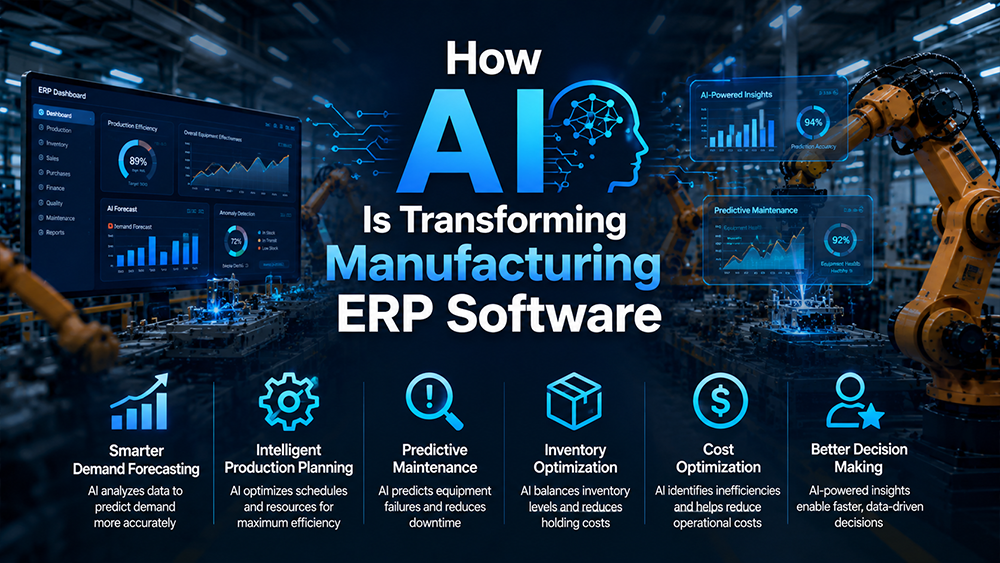
How AI Is Transforming Manufacturing ERP Software
Artificial Intelligence has become one of the most significant innovations in manufacturing technology. Rather than simply recording transactions, modern ERP platforms actively analyze business data and recommend actions. AI-powered forecasting models evaluate historical sales patterns, seasonal trends, market conditions, supplier performance, and production data to improve demand planning accuracy. Simultaneously, machine learning algorithms continuously improve forecasting precision as additional data becomes available. Furthermore, predictive maintenance capabilities analyze equipment performance data to identify potential failures before breakdowns occur.
Consequently, manufacturers reduce downtime, extend equipment lifespan, and improve operational reliability. AI also enhances inventory optimization by identifying ideal stock levels based on demand fluctuations, lead times, and supplier reliability. As a result, businesses reduce inventory costs while maintaining service levels. Additionally, intelligent analytics help executives uncover hidden trends, operational bottlenecks, and profit improvement opportunities that traditional reporting methods often fail to detect.