
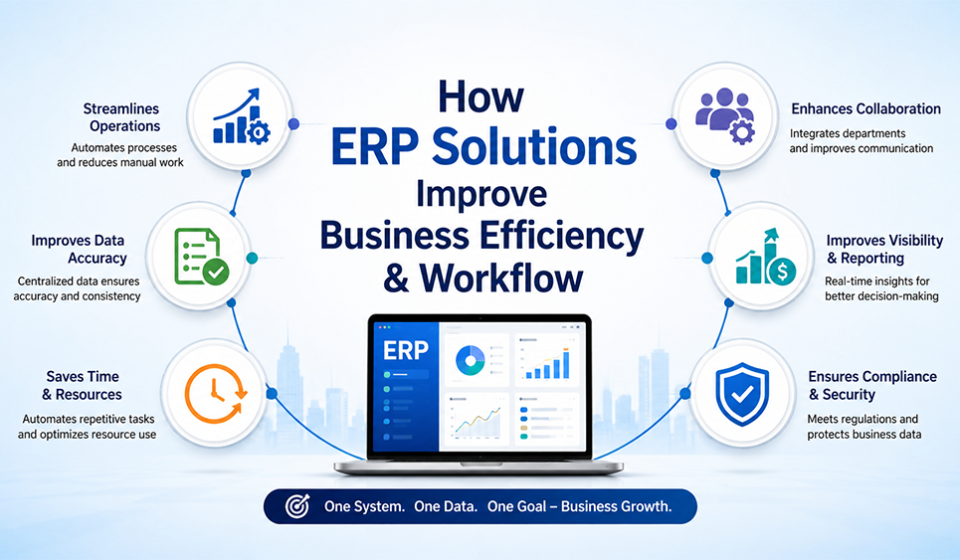

Enterprise Resource Planning (ERP) solutions have become the foundation of modern business operations. Organizations across manufacturing, retail, distribution, healthcare, construction, logistics, and service industries are increasingly adopting ERP systems to eliminate inefficiencies, improve productivity, and gain complete visibility into their operations. While many businesses continue to rely on disconnected software applications, spreadsheets, and manual processes, these approaches often create data silos, operational bottlenecks, and costly errors that hinder growth.
As businesses expand, managing finance, inventory, procurement, sales, human resources, customer relationships, production planning, and reporting through separate systems becomes increasingly difficult. Consequently, leaders struggle to make informed decisions because critical information is scattered across multiple departments. ERP solutions address these challenges by integrating all business functions into a single centralized platform, thereby enabling seamless workflows, real-time data access, and improved collaboration.
Furthermore, the rise of Artificial Intelligence (AI), Machine Learning (ML), predictive analytics, and automation has transformed ERP systems into intelligent business management platforms. Modern ERP solutions no longer simply record transactions. Instead, they analyze business patterns, predict future outcomes, automate repetitive tasks, and provide actionable insights that help organizations remain competitive.
Why Business Efficiency Matters More Than Ever
Business efficiency directly impacts profitability, customer satisfaction, employee productivity, and organizational growth. Companies that operate inefficiently often face rising operational costs, delayed deliveries, inaccurate reporting, inventory issues, and poor customer experiences.
Moreover, inefficient workflows consume valuable resources and reduce employee productivity. Staff members spend significant time manually entering data, searching for information, generating reports, and correcting errors. As a result, operational costs increase while overall productivity declines.
On the other hand, organizations that prioritize efficiency can optimize resource utilization, improve decision-making, reduce costs, and respond faster to market changes. Therefore, ERP solutions play a critical role in helping businesses achieve operational excellence.
Understanding ERP Solutions and Their Role in Modern Businesses
ERP solutions are integrated software platforms designed to manage and automate core business processes within a single system. Rather than maintaining separate applications for accounting, inventory, sales, procurement, manufacturing, and HR, businesses can manage everything from one centralized platform.
This centralized approach ensures that information flows seamlessly between departments. Consequently, every team works with accurate and up-to-date information.
For example, when a sales order is created, inventory levels are automatically updated. Simultaneously, procurement teams receive replenishment alerts, finance teams track revenue, and management gains visibility into order status. This level of integration significantly improves operational efficiency and eliminates manual intervention.
Common Business Challenges That Reduce Efficiency
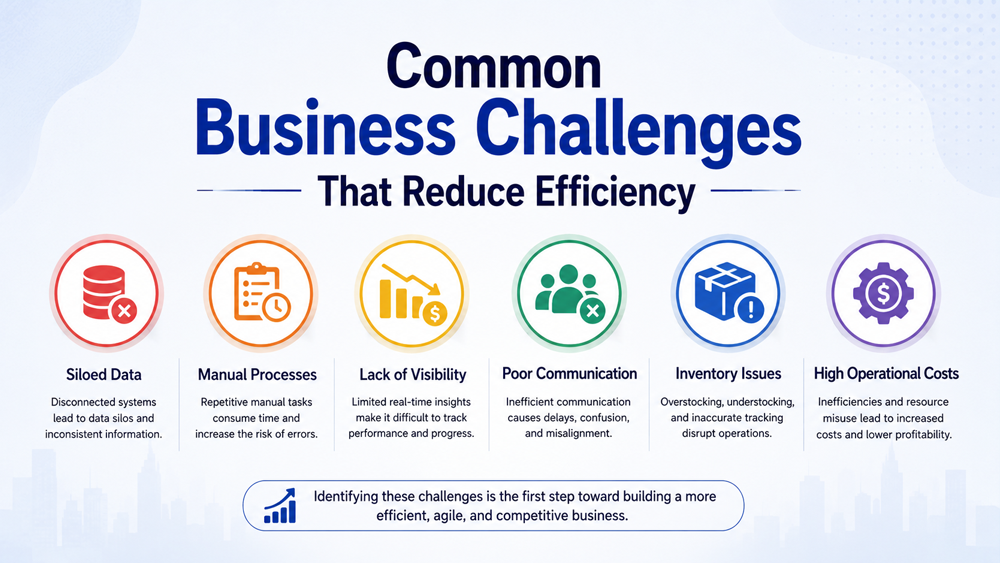
Data Silos Across Departments
Many organizations operate with disconnected software systems. Sales teams use one platform, finance departments use another, while inventory and production teams rely on spreadsheets.
As a result, information becomes fragmented and inconsistent. Employees spend valuable time gathering data from multiple sources, which often leads to errors and delays. ERP solutions eliminate these silos by creating a single source of truth for the entire organization.
Manual Processes and Repetitive Tasks
Manual processes continue to be one of the largest productivity killers in modern businesses. Employees frequently spend hours entering data, preparing reports, approving transactions, and updating records. Consequently, human errors increase while efficiency decreases. ERP systems automate routine tasks, thereby allowing employees to focus on strategic activities that generate business value.
Lack of Real-Time Visibility
Without real-time visibility, management teams struggle to identify operational issues before they become major problems. For instance, delayed inventory updates may result in stock shortages, while outdated financial information may affect budgeting decisions. ERP solutions provide real-time dashboards and reporting capabilities that enable proactive decision-making.
Inefficient Resource Allocation
Organizations often face difficulties allocating labor, inventory, equipment, and financial resources effectively. Consequently, resources remain underutilized while operational costs continue to rise. ERP systems provide comprehensive visibility into resource utilization, helping businesses optimize their operations.
How ERP Solutions Improve Business Efficiency
Centralized Data Management
One of the most significant advantages of ERP software is centralized data management. Instead of maintaining multiple databases, organizations store all business information within a unified system. Therefore, employees can access accurate and consistent information whenever needed. This centralized approach reduces duplication, improves collaboration, and enhances productivity across departments.
Workflow Automation
Workflow automation significantly reduces manual effort and accelerates business processes. Modern ERP systems automate:
- Purchase approvals
- Invoice processing
- Inventory updates
- Sales order management
- Employee onboarding
- Payroll processing
- Production scheduling
As a result, businesses experience faster processing times, fewer errors, and increased operational efficiency.
Enhanced Communication Between Departments
Poor communication often causes project delays, inventory discrepancies, and customer dissatisfaction. ERP solutions enable seamless communication by connecting all departments through a shared platform. Consequently, teams can collaborate more effectively while maintaining visibility into ongoing activities.
Improved Decision-Making Through Real-Time Analytics
Business leaders require accurate information to make informed decisions. ERP systems provide real-time dashboards, Key Performance Indicators (KPIs), and advanced reporting tools that transform raw data into actionable insights. As a result, executives can identify trends, monitor performance, and respond quickly to changing market conditions.
How AI-Powered ERP Systems Transform Workflow Management
Artificial Intelligence has become one of the most influential innovations in ERP technology. Unlike traditional ERP systems, AI-powered ERP platforms continuously analyze data patterns and recommend actions that improve operational performance.
Predictive Demand Forecasting
Inventory management remains a major challenge for many organizations. AI algorithms analyze historical sales data, market trends, seasonal patterns, and customer behavior to forecast future demand accurately. Consequently, businesses can maintain optimal inventory levels while reducing carrying costs and stock shortages.
Intelligent Inventory Optimization
Excess inventory ties up capital, while insufficient inventory leads to lost sales opportunities. AI-powered ERP solutions continuously monitor inventory levels and automatically recommend replenishment strategies. As a result, organizations can achieve higher inventory turnover and improved cash flow.
Automated Financial Analysis
Financial teams often spend significant time preparing reports and analyzing data. AI-enabled ERP systems automate financial analysis by identifying spending trends, anomalies, and cost-saving opportunities. Consequently, finance departments can focus more on strategic planning and business growth initiatives.
Smart Process Automation
Machine learning algorithms continuously analyze workflows and identify inefficiencies. Therefore, ERP systems can recommend process improvements, automate repetitive activities, and optimize resource allocation. This capability significantly enhances organizational productivity.
ERP Benefits for Different Business Functions
Finance and Accounting
Financial management becomes more efficient when all transactions are integrated within a single platform. ERP solutions automate bookkeeping, accounts payable, accounts receivable, tax calculations, budgeting, and financial reporting. As a result, organizations gain greater financial visibility and compliance.
Inventory Management
Inventory-related inefficiencies often lead to unnecessary costs and operational disruptions. ERP systems provide real-time inventory tracking, automated replenishment, warehouse management, and demand forecasting capabilities. Consequently, businesses can improve inventory accuracy and reduce waste.
Human Resource Management
Managing employee information, attendance, payroll, recruitment, and performance evaluations manually can be time-consuming. ERP-based HR modules automate these processes, thereby improving workforce management and employee productivity.
Procurement Management
Procurement inefficiencies often result in delayed purchases and increased costs. ERP systems streamline vendor management, purchase requests, approvals, and supplier performance tracking. Therefore, organizations can achieve better procurement efficiency and cost control.
Manufacturing Operations
Manufacturers face challenges such as production delays, material shortages, quality issues, and scheduling conflicts. ERP software improves production planning, material requirements planning (MRP), quality control, and shop floor management. As a result, manufacturers can increase production efficiency while reducing operational costs.
The Role of ERP in Eliminating Business Bottlenecks
Operational bottlenecks reduce productivity and negatively impact customer satisfaction. ERP solutions help organizations identify and eliminate these bottlenecks through process visibility and automation. For example, if procurement approvals are delaying production schedules, ERP workflow analytics can highlight the issue and automate approval processes.
Consequently, organizations experience smoother operations and faster turnaround times.
How ERP Improves Customer Experience
Customer expectations continue to rise across industries. Businesses must provide accurate information, timely deliveries, and exceptional service to remain competitive. ERP systems improve customer experiences by enabling:
- Faster order processing
- Accurate inventory visibility
- Improved delivery tracking
- Better customer communication
- Personalized service experiences
As a result, customer satisfaction and retention rates improve significantly.
ERP and Digital Transformation
Digital transformation initiatives require integrated technology platforms capable of supporting business growth. ERP solutions serve as the foundation for digital transformation by connecting people, processes, and technology. Furthermore, modern ERP systems integrate seamlessly with:
- Artificial Intelligence
- Machine Learning
- Internet of Things (IoT)
- Business Intelligence tools
- Cloud platforms
- Customer Relationship Management systems
Therefore, businesses can build scalable and future-ready operations.
Cloud ERP vs Traditional ERP for Business Efficiency
Cloud ERP solutions have gained significant popularity due to their flexibility and scalability. Unlike traditional on-premise systems, cloud ERP platforms offer:
Lower Infrastructure Costs
Organizations avoid expensive hardware investments and maintenance expenses.
Faster Deployment
Cloud ERP solutions can be implemented much faster than traditional systems.
Remote Accessibility
Employees can access critical business information from anywhere.
Automatic Updates
Cloud providers regularly update software with new features and security enhancements. Consequently, businesses can remain technologically competitive without significant IT investments.
Measuring ERP Success Through Key Performance Indicators
Successful ERP implementation should deliver measurable business improvements. Organizations typically track:
Operational Efficiency Metrics
Process cycle times, productivity levels, and resource utilization rates provide valuable performance insights.
Financial Performance Indicators
Revenue growth, profit margins, and cost reductions help evaluate ERP effectiveness.
Customer Satisfaction Metrics
Order accuracy, response times, and customer retention rates indicate service improvements.
Employee Productivity Metrics
Task completion rates and workflow efficiency demonstrate workforce performance gains. Monitoring these KPIs helps organizations maximize ERP value.
Future Trends Shaping ERP Solutions
ERP technology continues to evolve rapidly. Several emerging trends are expected to influence ERP adoption in the coming years.
AI-Driven Decision Intelligence
ERP platforms will increasingly provide predictive recommendations and automated decision support.
Hyperautomation
Organizations will automate complex end-to-end business processes using AI and robotic process automation.
Advanced Analytics
Real-time business intelligence will become even more sophisticated and accessible.
Industry-Specific ERP Solutions
Vendors will continue developing tailored ERP platforms for manufacturing, healthcare, construction, retail, and logistics industries. These advancements will further improve operational efficiency and workflow optimization.
Choosing the Right ERP Solution for Your Business
Selecting the right ERP platform requires careful evaluation of business objectives, operational requirements, scalability needs, and industry-specific challenges. Organizations should prioritize solutions that offer:
- Comprehensive functionality
- AI-powered automation
- Cloud deployment options
- Real-time reporting
- Industry-specific capabilities
- Scalability for future growth
- Strong security and compliance features
A well-chosen ERP solution not only addresses current challenges but also supports long-term business success.
Conclusion
ERP solutions have evolved from basic business management systems into intelligent platforms that drive efficiency, productivity, and sustainable growth. By integrating business processes, automating workflows, eliminating data silos, and providing real-time visibility, ERP software enables organizations to operate more effectively and make faster, data-driven decisions.
Furthermore, AI-powered ERP systems are transforming how businesses manage inventory, finances, procurement, production, and customer relationships. As competition continues to intensify, organizations that invest in modern ERP solutions gain a significant advantage through improved agility, operational excellence, and enhanced customer experiences.
Businesses seeking to streamline workflows, reduce operational costs, improve collaboration, and accelerate growth should consider implementing a robust ERP solution that aligns with their strategic goals. The right ERP platform can become the foundation for digital transformation, helping organizations achieve higher efficiency, stronger profitability, and long-term success.


Hi there! Wishing you a great day ahead.
Hi, I am seeking more information about your online business offers Could you please get back to me using the contact info listed below to discuss this in detail? Thank you. my whatsapp +66888281010