Bluechip ERP vs SAP Business One: Which ERP Solution is Best for Growing Businesses in 2026?

Introduction
Selecting the right ERP software has become one of the most critical decisions for growing businesses. While organizations continue to face increasing operational complexity, rising costs, supply chain disruptions, workforce challenges, and intense competition, the demand for a scalable and intelligent ERP platform has never been greater.
Many businesses begin their ERP evaluation by comparing Bluechip ERP and SAP Business One. Both solutions aim to streamline operations, improve visibility, automate workflows, and support data-driven decision-making. However, their approach, implementation methodology, customization capabilities, and overall cost structure differ significantly.
Consequently, choosing the wrong ERP can result in budget overruns, delayed implementation, employee resistance, fragmented data, and reduced operational efficiency. On the other hand, selecting the right ERP can transform business performance, improve profitability, and provide a strong foundation for long-term growth.
This detailed comparison explores Bluechip ERP and SAP Business One across critical business parameters, including functionality, scalability, customization, implementation, AI capabilities, total cost of ownership, and industry suitability.
Why ERP Selection Has Become More Important in 2026
Business leaders are no longer investing in ERP systems solely for accounting and inventory management. Instead, modern ERP platforms are expected to provide real-time insights, predictive analytics, intelligent automation, workflow optimization, and cross-departmental collaboration.
Organizations frequently struggle with disconnected software systems, manual reporting, duplicate data entry, delayed approvals, inaccurate forecasting, inventory mismatches, and poor customer visibility. As a result, decision-makers often spend more time gathering information than acting upon it.
An advanced ERP solution addresses these challenges by creating a single source of truth across finance, procurement, sales, inventory, manufacturing, HR, customer service, and project management.
Therefore, businesses evaluating Bluechip ERP and SAP Business One must consider not only current requirements but also future growth objectives.
Understanding Bluechip ERP
What is Bluechip ERP?
Bluechip ERP is an enterprise resource planning solution designed to help organizations automate and optimize core business operations through a flexible and highly customizable platform.
Built on modern architecture and powered by intelligent business process automation, Bluechip ERP enables organizations to manage finance, inventory, procurement, manufacturing, CRM, HR, projects, asset management, and analytics within a unified ecosystem.
Unlike traditional ERP solutions that often require extensive coding and long deployment cycles, Bluechip ERP focuses on rapid implementation, adaptability, and business-specific customization.
As a result, organizations can align the software with their operational workflows rather than changing their business processes to fit the software.
Key Business Challenges Solved by Bluechip ERP
Many growing businesses encounter operational bottlenecks caused by fragmented systems. Data often resides across spreadsheets, accounting software, standalone inventory applications, and disconnected CRM platforms.
Consequently, management struggles to obtain accurate and real-time visibility into business performance.
Bluechip ERP addresses these issues by integrating business functions into a centralized environment. Therefore, decision-makers gain access to reliable information while employees spend less time performing repetitive tasks.
Furthermore, workflow automation reduces manual intervention, minimizes errors, accelerates approvals, and improves overall operational efficiency.
Understanding SAP Business One
What is SAP Business One?
SAP Business One is an ERP solution developed by SAP specifically for small and medium-sized enterprises. The platform provides modules for finance, sales, purchasing, inventory management, customer relationship management, production, and reporting.
Because SAP has established a strong reputation within the enterprise software industry, many organizations consider SAP Business One during ERP evaluations.
The platform offers standardized business processes and comprehensive functionality for organizations seeking a structured ERP framework.
However, businesses with unique operational requirements often need additional customization and implementation support to align the system with their processes.
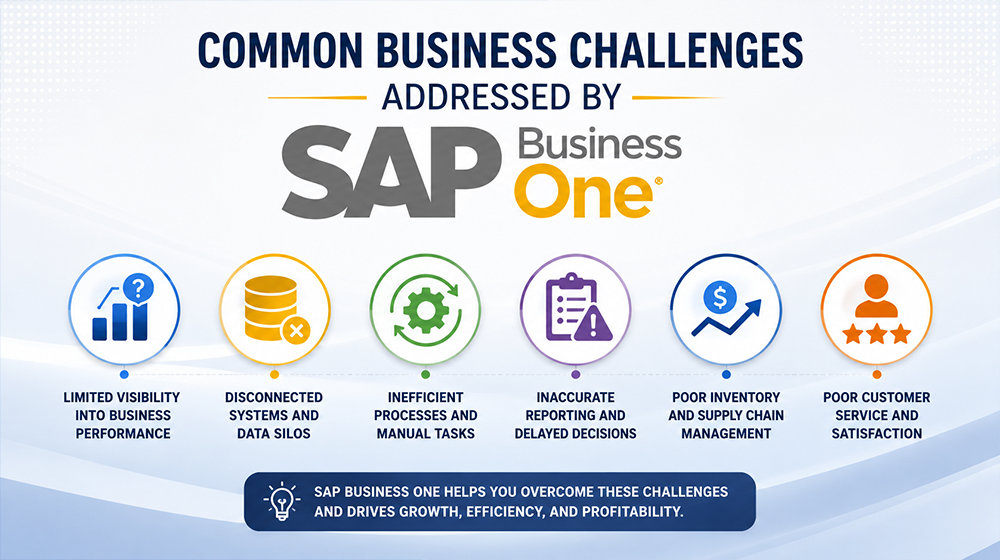
Common Business Challenges Addressed by SAP Business One
SAP Business One helps organizations improve financial visibility, inventory control, procurement management, and reporting accuracy.
Additionally, businesses benefit from standardized workflows and centralized information management.
Nevertheless, organizations with highly specialized workflows may encounter limitations that require additional customization investments.
Bluechip ERP vs SAP Business One: Feature Comparison
Business Process Automation
Automation has become a major requirement for organizations aiming to improve productivity and reduce operational costs.
Bluechip ERP places significant emphasis on business process automation. Approval workflows, document routing, procurement processes, inventory transactions, project management activities, and customer service workflows can be automated according to organizational requirements.
As a result, businesses experience faster turnaround times and reduced administrative overhead.
SAP Business One also provides workflow capabilities. However, extensive process customization may require additional configuration and technical expertise.
Therefore, organizations seeking flexibility often find Bluechip ERP advantageous.
Customization Flexibility
One of the most common reasons ERP projects fail is the inability to accommodate unique business processes.
Bluechip ERP offers extensive customization capabilities through its flexible architecture. Consequently, businesses can tailor modules, workflows, dashboards, reports, and user interfaces according to operational requirements.
SAP Business One generally follows a more standardized structure. While customization is possible, modifications may increase implementation complexity and overall costs.
Therefore, organizations requiring industry-specific workflows often evaluate Bluechip ERP favorably.
Reporting and Business Intelligence
Executives require real-time information to make informed decisions.
Bluechip ERP delivers advanced dashboards, analytics, KPI monitoring, and business intelligence capabilities. Therefore, leaders can identify trends, monitor performance, and respond quickly to operational changes.
Furthermore, integrated reporting reduces dependency on spreadsheets and manual data consolidation.
SAP Business One also provides reporting functionality through built-in tools and integrations. However, advanced analytical requirements may necessitate additional configuration.
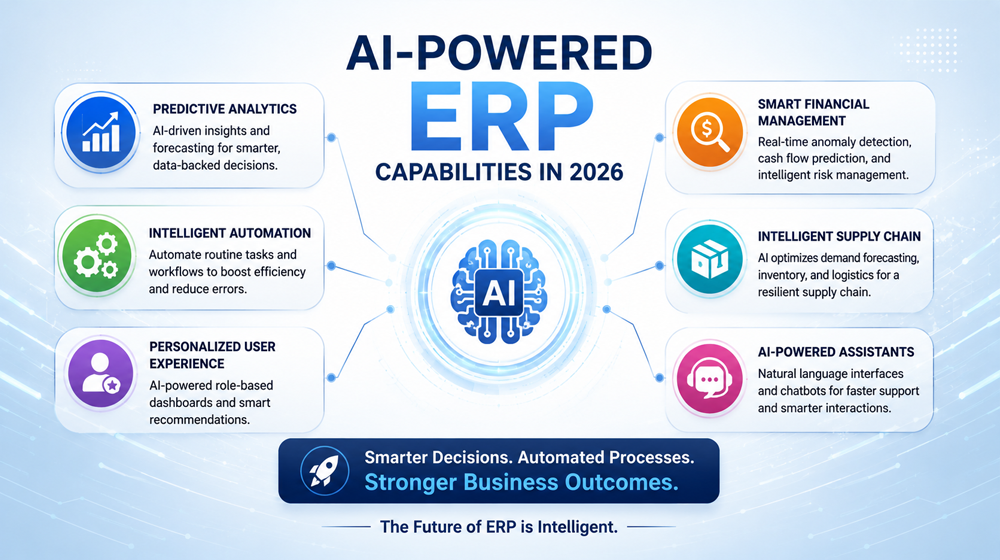
AI-Powered ERP Capabilities in 2026
The Rise of AI-Driven ERP Systems
Artificial Intelligence is transforming enterprise software at an unprecedented pace.
Modern organizations increasingly rely on AI-driven forecasting, predictive maintenance, intelligent inventory optimization, automated anomaly detection, customer behavior analysis, and demand planning.
Consequently, ERP systems are evolving from transaction-processing platforms into intelligent decision-support systems.
How Bluechip ERP Supports AI-Based Business Optimization
Bluechip ERP supports intelligent automation and data-driven decision-making through integrated analytics and AI-ready architecture.
Organizations can leverage predictive insights to optimize inventory levels, improve procurement planning, identify operational bottlenecks, and enhance customer satisfaction.
As a result, businesses gain a competitive advantage through proactive rather than reactive decision-making.
SAP Business One and AI Integration
SAP continues to invest heavily in AI technologies across its product ecosystem.
Although SAP Business One benefits from SAP’s broader innovation strategy, AI adoption often depends on deployment architecture, integrations, and additional solutions.
Therefore, organizations should carefully assess AI requirements during ERP selection.
Implementation Time and Project Success
ERP implementation delays remain one of the biggest concerns for business leaders.
Long implementation cycles frequently lead to increased costs, reduced user adoption, and operational disruption.
Bluechip ERP focuses on rapid deployment and business-specific configuration. Consequently, organizations can achieve faster time-to-value while minimizing implementation risks.
SAP Business One implementations vary depending on project complexity, customization requirements, and integration scope.
Therefore, implementation planning plays a critical role in overall project success.
Total Cost of Ownership Comparison
ERP investment extends beyond software licensing.
Organizations must also consider implementation costs, customization expenses, infrastructure requirements, training investments, support fees, and future upgrades.
Bluechip ERP is often preferred by businesses seeking a cost-effective and scalable solution with extensive customization capabilities.
Meanwhile, SAP Business One may involve additional expenditures related to implementation partners, customization, and long-term support requirements.
Consequently, decision-makers should evaluate total cost of ownership rather than focusing solely on initial licensing costs.
Industry Suitability
Manufacturing
Manufacturers require production planning, inventory optimization, quality control, procurement management, and shop-floor visibility.
Bluechip ERP provides extensive manufacturing capabilities tailored to operational requirements.
Retail and Distribution
Retailers and distributors depend on accurate inventory management, order fulfillment, warehouse control, and customer visibility.
Both platforms support these requirements; however, customization flexibility often becomes a deciding factor.
Construction and Projects
Project-driven organizations require budgeting, resource allocation, project tracking, and cost control.
Bluechip ERP’s adaptable workflow capabilities help address industry-specific requirements more effectively.
Which ERP Solution Should You Choose?
The ideal ERP solution depends on business objectives, operational complexity, growth plans, industry requirements, and budget considerations.
Organizations prioritizing flexibility, rapid implementation, business process automation, and extensive customization often find Bluechip ERP to be a compelling choice.
Meanwhile, businesses seeking a structured ERP environment within the SAP ecosystem may consider SAP Business One.
However, long-term success depends on selecting a solution that aligns with operational realities rather than forcing the organization to adapt to software limitations.
Conclusion
ERP selection influences operational efficiency, profitability, customer satisfaction, and business growth for years to come.
Bluechip ERP and SAP Business One both offer powerful capabilities. Nevertheless, organizations seeking a highly customizable, scalable, AI-ready, and cost-effective ERP platform frequently view Bluechip ERP as a strong strategic investment.
As businesses continue to embrace digital transformation in 2026, ERP platforms that combine intelligent automation, real-time analytics, workflow flexibility, and rapid adaptability will deliver the greatest competitive advantage.
Before making a final decision, organizations should conduct a detailed requirements analysis, evaluate current pain points, assess future scalability needs, and request a comprehensive ERP demonstration aligned with their industry-specific processes.