
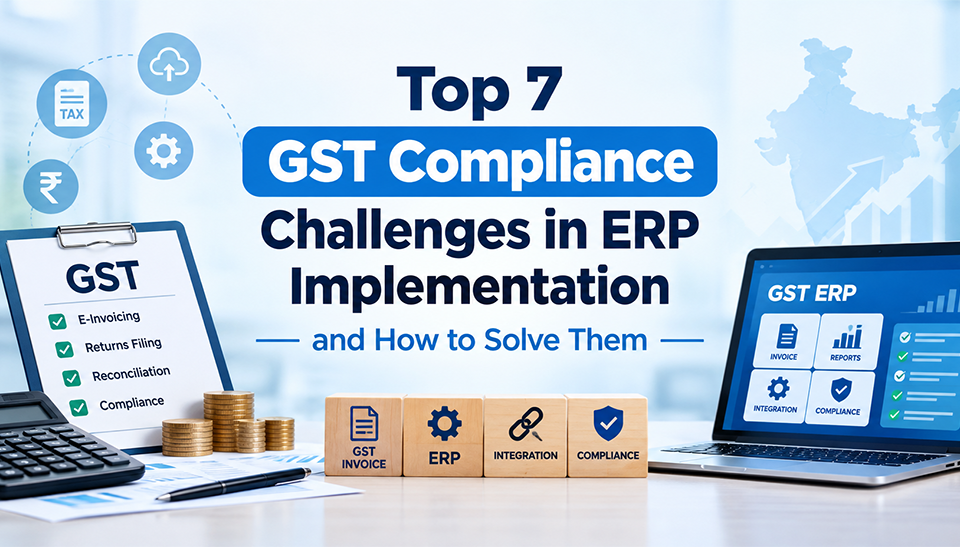

GST compliance becomes significantly more difficult when a business manages sales, purchases, inventory, accounting and multiple GST registrations through disconnected systems. Consequently, choosing a GST compliant ERP is no longer simply about generating tax invoices. A properly integrated ERP must help businesses maintain accurate GST data, automate invoice processes, support e-invoicing, reduce reconciliation problems and create reliable information for return filing.
For Indian businesses, this becomes particularly important as GST reporting increasingly depends on digitally exchanged transaction data. For example, e-invoices generated through the Invoice Registration Portal (IRP) can be auto-populated into relevant GSTR-1 tables.
However, ERP implementation can introduce new compliance risks if GST rules are not correctly mapped into the system. This guide explains the top 7 GST compliance challenges in ERP implementation, why businesses face them and, more importantly, how a modern GST ERP integration in India can solve them.
What Does GST Compliance Mean in an ERP System?
GST compliance within an ERP means configuring the system so that transactions are recorded, calculated, invoiced and reported according to applicable GST requirements. Instead of treating GST as an accounting activity performed at the end of the month, businesses should build GST controls directly into their everyday workflows.
For instance, when a sales order becomes an invoice, the ERP should already understand the customer’s GSTIN, place of supply, HSN or SAC, applicable tax rate, tax type and transaction category. Therefore, the correct GST treatment can happen before the transaction reaches the accounts team.
This approach becomes even more valuable when the business operates across multiple states, handles thousands of invoices or manages several GST registrations.
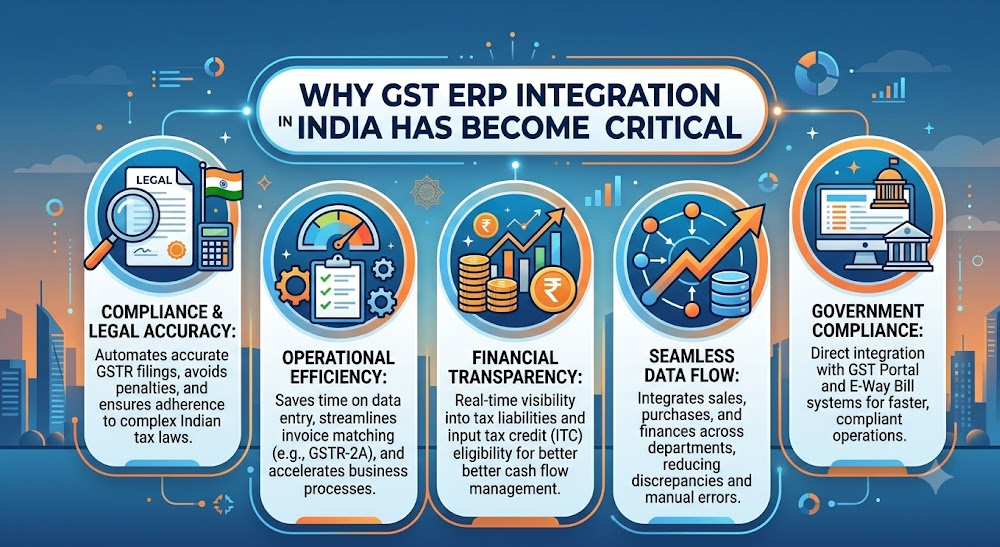
Why GST ERP Integration in India Has Become Critical
GST data does not remain isolated inside the accounting department. Instead, it moves across sales, purchasing, inventory, finance, logistics and statutory reporting. The GST portal itself requires detailed invoice-level information in GSTR-1, including B2B invoices, exports, credit and debit notes, amendments and HSN/SAC-wise summaries.
Moreover, e-invoicing has been progressively expanded. The current e-invoicing applicability timeline lists an AATO threshold of ₹5 crore or more from August 1, 2023, subject to the applicable rules and exemptions. Additionally, taxpayers with AATO of ₹10 crore or more have been required, from April 1, 2025, to report e-invoices within 30 days of the invoice date. This restriction covers invoices, credit notes and debit notes. Therefore, GST compliance needs to be considered during ERP design rather than added after implementation.
1. Incorrect GST Master Data Creates a Chain Reaction of Errors
One of the most common ERP implementation problems is poor GST master data. Businesses often migrate thousands of customers, suppliers, products and services from legacy systems. Unfortunately, old records may contain incorrect GSTINs, outdated HSN codes, wrong tax classifications, incomplete addresses or inconsistent state information.
Once this information enters the ERP, the problem can spread rapidly. A wrong HSN code can affect tax calculation and reporting. Similarly, an incorrect place of supply can result in the wrong application of IGST, CGST or SGST. Consequently, a small master-data error can eventually become an invoice, reconciliation and return-filing problem.
How to Solve the GST Master Data Problem
The solution is to make GST validation part of ERP implementation itself. Before migration, businesses should clean and standardise customer, supplier and item masters. The ERP should also separate GST-relevant fields from ordinary business information so that critical compliance data receives stronger validation. For example, a GST compliant ERP should support GSTIN validation, state mapping, HSN/SAC classification, tax-rate mapping and transaction-type configuration.
Furthermore, master-data changes should be controlled through role-based permissions and audit trails. That way, finance teams can identify who changed a GST-sensitive record and when the change occurred.
2. GST Invoice Automation Fails When Business Rules Are Not Properly Configured
Manual invoice preparation remains a major compliance risk, particularly for businesses processing large transaction volumes. Employees may select the wrong tax rate, forget mandatory information, apply the wrong GST treatment or manually enter customer details. Consequently, the accounts team spends additional time correcting invoices instead of managing financial controls. This is where GST invoice automation becomes valuable.
How GST Invoice Automation Solves the Problem
A modern ERP should calculate GST automatically based on predefined business rules. When a user creates an invoice, the system should consider factors such as customer GST registration, place of supply, product classification, transaction type and applicable tax configuration.
Furthermore, the ERP should prevent incomplete invoices from progressing when essential compliance fields are missing. The objective is not simply to generate invoices faster. Instead, the objective is to reduce the number of compliance decisions employees have to make manually.
That distinction is important because automation is most effective when the ERP controls the process before an error reaches the GST reporting stage.
3. E-Invoicing and IRP Integration Can Become a Major Bottleneck
E-invoicing is another area where ERP implementation can fail if integration is poorly designed. An e-invoice is not merely a PDF invoice generated by accounting software. GSTN describes e-invoicing as reporting specified GST documents to the Invoice Registration Portal and obtaining an Invoice Reference Number (IRN).
After successful reporting, relevant e-invoice information can flow into GSTR-1. However, businesses can face problems when their ERP does not properly handle IRN generation, QR codes, API responses, duplicate submissions, cancellation workflows or failed transactions.
How to Build Better GST ERP Integration
The ERP should establish a controlled connection between invoice creation and IRP reporting. Instead of asking employees to download invoices and upload them manually, the system should send validated invoice data through the appropriate integration layer, capture the IRN response and store the associated compliance information. Additionally, failed transactions should enter an exception queue rather than silently disappearing.
This is particularly important because duplicate IRN requests and validation failures can occur during e-invoice processing. For businesses with AATO of ₹10 crore or more, the 30-day e-invoice reporting restriction makes timely processing even more important.
4. GSTR-1 and GSTR-3B Reconciliation Becomes Difficult with Disconnected Data
Another major pain point appears when sales, purchase and accounting systems operate separately. For example, the sales team may maintain invoices in one application while finance maintains tax records in another. Meanwhile, GST data is downloaded separately for reconciliation.
As a result, differences can appear between ERP records, GSTR-1, GSTR-3B and input-tax-credit information. The GST portal itself explains that system-generated GSTR-3B uses information from GSTR-1/1A and GSTR-2B to assist taxpayers and reduce mismatches.
How ERP Reconciliation Can Be Improved
The better approach is to create one controlled source of transactional truth. Sales invoices should originate in the ERP. Purchase records should flow into accounts. GST transactions should then be mapped consistently to reporting requirements. Furthermore, the ERP should provide reconciliation dashboards that highlight mismatches rather than forcing finance teams to search through spreadsheets.
For example, an exception dashboard can identify differences in taxable value, GST amount, invoice number, GSTIN, credit notes or transaction status. Consequently, the finance team can investigate exceptions before return filing rather than discovering problems afterward.
5. Multi-State GST Registrations Create Complex Compliance Workflows
Businesses expanding across India often discover that GST compliance becomes substantially more complicated when multiple GSTINs are involved. A company may have offices, warehouses, manufacturing units or branches in different states. However, the underlying ERP may have originally been designed around a single company or GST registration. That creates problems with tax determination, inventory transfers, invoicing, accounting and reporting.
How to Solve Multi-GSTIN ERP Complexity
A GST-ready ERP should support multiple GST registrations while maintaining clear organisational separation. Each GSTIN should have appropriate configuration for its registration details, state, tax rules, invoice numbering and reporting requirements.
At the same time, management should be able to view consolidated business performance without mixing statutory records between registrations. This balance is critical. The finance team needs GSTIN-level compliance, while management needs enterprise-level visibility. A well-designed ERP should provide both.
6. GST Rule Changes Can Make Static ERP Systems Outdated
GST compliance is not a one-time configuration exercise. Tax rates, validations, reporting requirements and portal processes can change. For example, IRP production updates have included changes to validation behaviour and tax-rate master data. In February 2026, IRIS IRP documented changes associated with RSP-based calculation validations under Notification No. 20/2025-Central Tax. Therefore, an ERP that depends heavily on hard-coded GST rules can become difficult to maintain.
How AI and Rule-Based Automation Can Help
Modern ERP architecture should separate business rules from core application logic wherever practical. AI can additionally help identify unusual transactions, repeated invoice errors, abnormal tax patterns and reconciliation exceptions. However, AI should support compliance controls rather than replace statutory interpretation or professional tax advice.
For example, an intelligent ERP could flag a transaction where the GST treatment differs significantly from the company’s normal pattern. Instead of automatically changing the transaction, it can alert the responsible finance user for review. This creates a safer combination of automation + human oversight.
7. Lack of Audit Trails Makes GST Investigation More Difficult
Finally, businesses often underestimate the importance of auditability. Suppose an invoice was originally created with one tax amount and later modified. If the ERP does not maintain a proper audit trail, the finance team may struggle to determine what changed, who changed it and why. This becomes especially problematic during internal audits, statutory reviews or GST-related investigations.
How a GST Compliant ERP Improves Audit Readiness
Every important GST transaction should have a traceable history. The system should record relevant activities such as invoice creation, modification, cancellation, approval, IRN generation, credit-note processing and master-data changes.
Moreover, access should be controlled according to user roles. Consequently, businesses gain not only compliance visibility but also stronger internal controls.
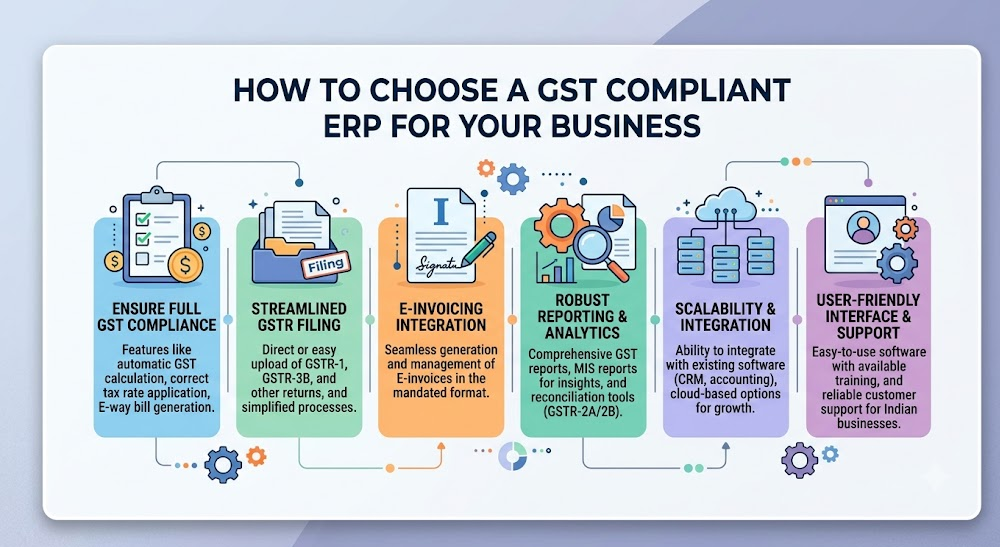
How to Choose a GST Compliant ERP for Your Business
Choosing an ERP purely because it has a “GST module” is not enough. Instead, evaluate how GST works throughout the entire business process. The ERP should connect sales, purchasing, inventory, accounting, invoicing, e-invoicing, reconciliation and reporting. It should also support multiple GST registrations where required and provide clear exception handling.
Most importantly, ask the ERP provider to demonstrate an actual business scenario rather than showing only a feature list. For example, ask them to demonstrate how the system handles a B2B invoice, an interstate transaction, a credit note, an e-invoice rejection, a multi-GSTIN transaction and a reconciliation mismatch. That demonstration will reveal much more than a generic product presentation.
GST ERP Implementation: What Businesses Should Do Before Going Live
A successful implementation should begin with GST process mapping. First, document how transactions currently move from quotation to sales order, delivery, invoice, e-invoice and accounting. Next, identify every GST-sensitive field and master record. Then, clean legacy data before migration.
After that, configure tax rules and test real business scenarios. Finally, run parallel validation before moving completely to the new ERP. This approach reduces the risk of discovering critical GST problems after the system has already gone live.
Can GST ERP Integration Reduce Manual Compliance Work?
Yes. However, the biggest benefit does not come simply from automating invoice generation. The real advantage comes from connecting the entire transaction lifecycle. When customer data, product classification, tax calculation, invoice generation, IRP reporting, accounting and reconciliation operate within a controlled workflow, businesses can significantly reduce repetitive manual work and improve data consistency. At the same time, finance teams can focus more on reviewing exceptions instead of manually checking every transaction.
Frequently Asked Questions About GST ERP Integration
What is a GST compliant ERP?
A GST compliant ERP is an enterprise system configured to support GST-related business processes such as tax calculation, GST invoicing, e-invoicing, GSTIN management, reporting, reconciliation and audit controls. Compliance ultimately depends on correct configuration, business processes and adherence to applicable law; an ERP alone does not guarantee statutory compliance.
What is GST ERP integration in India?
GST ERP integration in India refers to connecting an ERP’s sales, purchase and accounting workflows with GST-related processes and, where applicable, government-notified systems or authorised integration mechanisms for activities such as e-invoicing and reporting.
How does GST invoice automation work?
GST invoice automation uses predefined tax and transaction rules to calculate applicable taxes and generate invoices with relevant GST information. When properly integrated, it can also support e-invoice generation, IRN capture and downstream reporting workflows.
Does e-invoice data automatically reach GSTR-1?
For applicable e-invoices, data reported through the IRP is transmitted to the GST system and auto-populated into relevant GSTR-1 tables. Taxpayers should still review the populated information before filing.
Is e-invoicing applicable to businesses with ₹5 crore turnover?
The current IRP applicability timeline states that e-invoicing was extended to taxpayers with AATO of ₹5 crore or more from August 1, 2023, subject to applicable conditions and exemptions. Businesses should verify their specific applicability against the latest GST notifications and their GSTIN status.
The Bottom Line: GST Compliance Should Be Built Into the ERP, Not Added Later
GST compliance becomes difficult when businesses treat taxation as a separate activity from their operational systems. Instead, GST controls should be embedded directly into sales, purchasing, inventory, finance and invoicing workflows. The seven major challenges—poor master data, manual invoicing, e-invoice integration, reconciliation, multiple GST registrations, changing rules and weak audit trails—are interconnected.
Therefore, solving them individually is not enough. A modern GST compliant ERP should create a continuous flow of accurate data from the original transaction through invoice generation, e-invoicing, accounting, reconciliation and reporting. For growing Indian businesses, that approach can reduce manual work, improve visibility and make GST compliance more manageable as transaction volumes increase.
Ready to Make GST Compliance Easier With ERP?
If your business is still managing GST invoices, e-invoicing, reconciliation and accounting across multiple disconnected systems, ERP implementation can be an opportunity to eliminate those gaps rather than simply replace your existing software.
Explore a GST-focused ERP workflow with Bluechip Solutions and identify where automation can reduce your team’s compliance workload.
Book a Free ERP Consultation → Get the GST ERP Implementation & Compliance Checklist for Indian Businesses
Visit : Bluechip Solutions