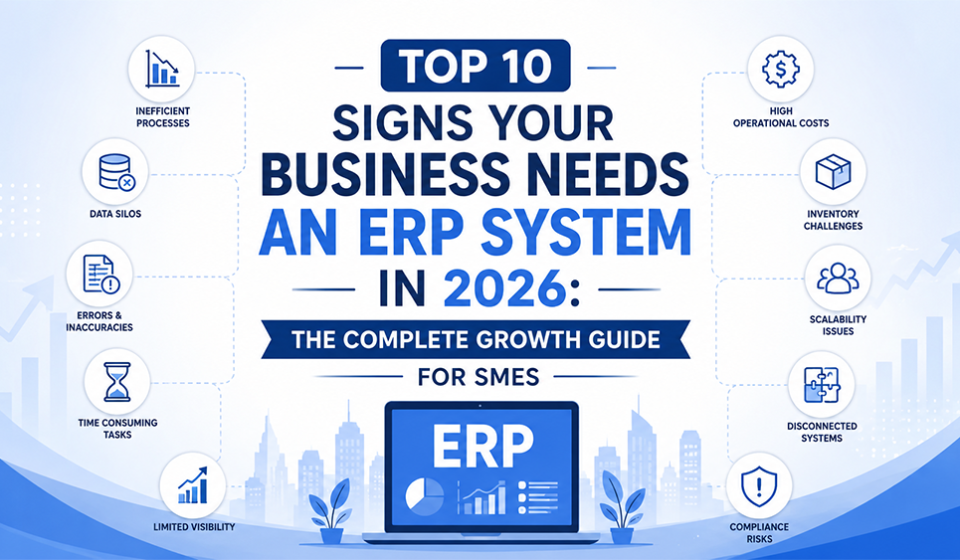
Top 10 Signs Your Business Needs an ERP System in 2026: The Complete Growth Guide for SMEs

Introduction: Why Growing Businesses Are Struggling More Than Ever in 2026
Small and medium-sized enterprises are experiencing a period of unprecedented growth opportunities. At the same time, they are facing increasing operational complexity. Customer expectations are rising, supply chains are becoming more unpredictable, compliance requirements are expanding, and business leaders are expected to make decisions faster than ever before.
Consequently, many businesses that once managed successfully using spreadsheets, emails, disconnected software applications, and manual reporting processes are now finding these methods insufficient. While these tools may have worked during the early stages of growth, they often become major obstacles when organizations attempt to scale operations.
According to recent industry reports, digital transformation remains one of the top investment priorities for SMEs in 2026. Furthermore, organizations implementing modern ERP systems report significant improvements in operational efficiency, decision-making speed, inventory accuracy, and overall profitability.
However, many business owners continue asking the same question:
“How do I know when my business truly needs an ERP system?”
The answer lies in recognizing the warning signs before inefficiencies begin affecting profitability, customer satisfaction, and growth potential.
This comprehensive guide explores the top signs that indicate your organization is ready for ERP implementation and how modern AI-powered ERP platforms can transform business operations.
What Is an ERP System and Why Is It Critical in 2026?
Enterprise Resource Planning (ERP) software is a centralized business management platform that integrates various departments including finance, sales, inventory, procurement, production, human resources, customer service, and analytics into a single system.
Instead of managing information across multiple disconnected tools, ERP creates one source of truth across the organization.
As artificial intelligence, predictive analytics, automation, and real-time business intelligence continue reshaping industries, ERP systems have evolved from operational tools into strategic growth platforms.
Therefore, businesses that delay ERP adoption often find themselves struggling to compete against more agile and data-driven competitors.
Sign #1: Your Team Is Spending Too Much Time Managing Spreadsheets
One of the most common indicators that a business needs ERP software is excessive dependence on spreadsheets.
Initially, spreadsheets appear cost-effective and flexible. However, as business operations expand, spreadsheet management becomes increasingly difficult.
Employees begin maintaining multiple versions of the same file. Departments create separate databases. Critical information becomes scattered across different locations.
As a result, employees spend more time searching for data than acting on it.
For example, a sales manager may use one spreadsheet to track orders while the inventory team uses another spreadsheet to monitor stock levels. Meanwhile, the finance department maintains separate records for invoicing.
Eventually, discrepancies emerge.
Management meetings become dominated by discussions about which data source is accurate instead of focusing on strategic decisions.
A modern ERP system eliminates these challenges by creating a centralized database where every department accesses real-time information.
Consequently, businesses reduce manual effort, improve data accuracy, and increase productivity across all functions.
Sign #2: You Lack Real-Time Visibility into Business Performance
Many SME owners face a frustrating reality.
They cannot instantly answer critical questions such as:
- What is today’s revenue?
- Which products are generating the highest margins?
- Which customers have overdue payments?
- What inventory is running low?
- Which production orders are delayed?
Instead, obtaining these answers often requires multiple phone calls, emails, and report generation processes.
This delay creates a significant competitive disadvantage.
In today’s fast-moving business environment, leaders need access to real-time information.
Without it, opportunities are missed and risks increase.
Modern ERP systems provide live dashboards powered by AI-driven analytics.
Consequently, business owners can monitor KPIs, track operational performance, and identify emerging trends instantly.
Rather than relying on historical reports, decision-makers gain proactive visibility that supports faster and more confident decisions.
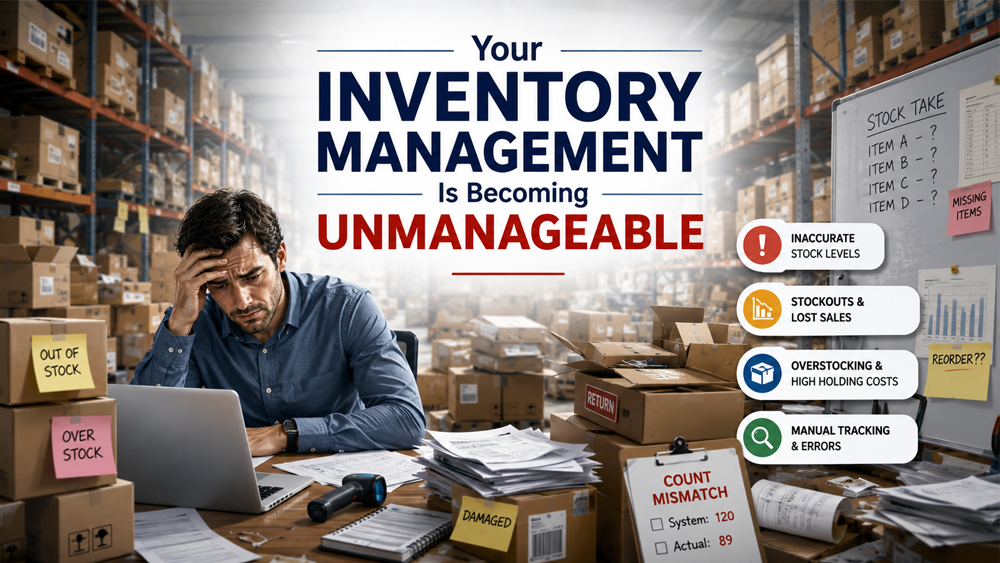
Sign #3: Your Inventory Management Is Becoming Unmanageable
Inventory challenges represent one of the biggest profit killers for growing businesses.
Many organizations experience a recurring cycle:
They either stock too much inventory and tie up working capital or stock too little and lose sales opportunities.
Both scenarios impact profitability.
Furthermore, inaccurate inventory records often lead to delayed deliveries, dissatisfied customers, emergency purchases, and increased operational costs.
As businesses expand across multiple warehouses, branches, or production facilities, inventory complexity grows exponentially.
Without ERP software, maintaining accurate stock visibility becomes nearly impossible.
Modern ERP systems utilize automation, barcode integration, AI forecasting, and real-time stock tracking.
Therefore, businesses gain complete visibility into inventory movement while reducing stockouts and excess inventory.
As a result, cash flow improves and customer satisfaction increases significantly.
Sign #4: Different Departments Operate in Silos
One of the most damaging operational issues within growing businesses is departmental isolation.
Sales teams often work independently from finance.
Procurement teams operate separately from production.
Customer service departments rarely have complete visibility into operational processes.
Consequently, communication breakdowns occur frequently.
Orders get delayed.
Customers receive conflicting information.
Internal efficiency declines.
Most importantly, valuable organizational knowledge remains trapped within individual departments.
ERP systems solve this problem by connecting all business functions through a unified platform.
When a customer places an order, relevant information automatically becomes available to inventory, procurement, production, finance, and management teams.
Therefore, collaboration improves naturally.
Employees spend less time exchanging information manually and more time focusing on customer value creation.
Sign #5: Business Growth Is Creating Operational Chaos
Growth is exciting.
However, unmanaged growth can become dangerous.
Many SMEs experience rapid increases in customers, transactions, employees, and product lines.
Initially, existing systems appear capable of handling the expansion.
Eventually, cracks begin to appear.
Order processing slows down.
Customer complaints increase.
Reporting becomes difficult.
Managers struggle to maintain operational control.
This situation is often referred to as “growth chaos.”
Ironically, success itself becomes the source of operational challenges.
ERP software is specifically designed to support scalability.
As transaction volumes increase, the system continues providing structure, automation, and visibility.
Consequently, businesses can grow confidently without sacrificing efficiency or customer experience.
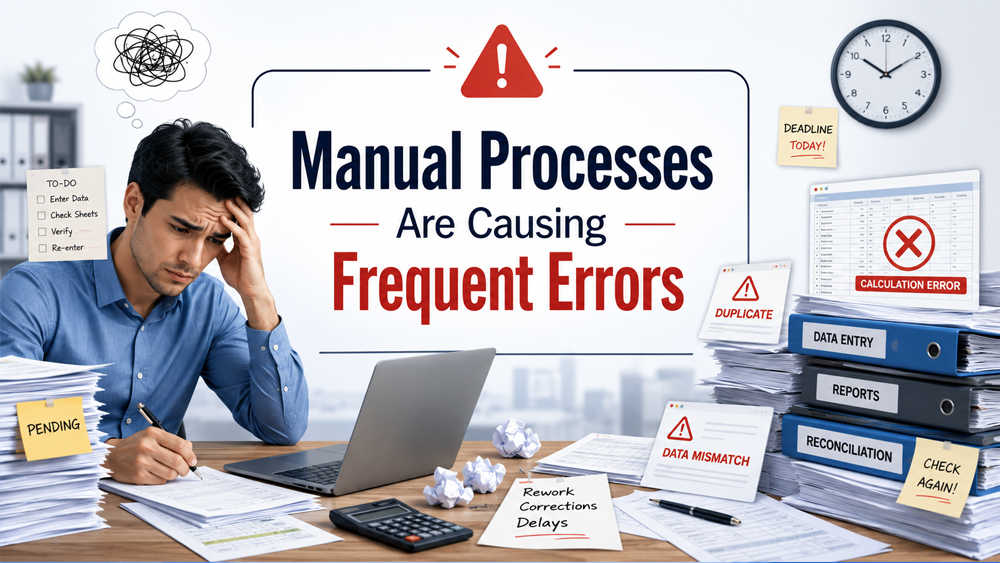
Sign #6: Manual Processes Are Causing Frequent Errors
Human errors remain one of the most expensive hidden costs in business operations.
Employees manually entering data across multiple systems inevitably make mistakes.
A single incorrect inventory entry can disrupt production schedules.
An invoicing error can delay payments.
A procurement mistake can increase purchasing costs.
Furthermore, manual workflows consume valuable employee time that could be redirected toward strategic initiatives.
Modern ERP platforms automate repetitive tasks including:
- Purchase order generation
- Inventory updates
- Invoice processing
- Payroll calculations
- Approval workflows
- Compliance reporting
As automation increases, error rates decline dramatically.
Therefore, businesses improve operational accuracy while reducing administrative overhead.
In addition, employees become more productive because they can focus on higher-value activities.
Conclusion
If your organization is experiencing spreadsheet dependency, limited visibility, inventory issues, departmental silos, growth-related chaos, or costly manual errors, these are not isolated operational problems.
Instead, they are clear indicators that your business has outgrown traditional management methods.
An ERP system is no longer a luxury reserved for large enterprises. In 2026, it has become a strategic necessity for SMEs seeking sustainable growth, operational excellence, and competitive advantage.
In Part 2, we will cover Signs #7 through #10, AI-powered ERP trends for 2026, implementation best practices, industry-specific ERP use cases, SEO-focused FAQs, and a high-conversion ERP adoption roadmap designed for growing businesses.