
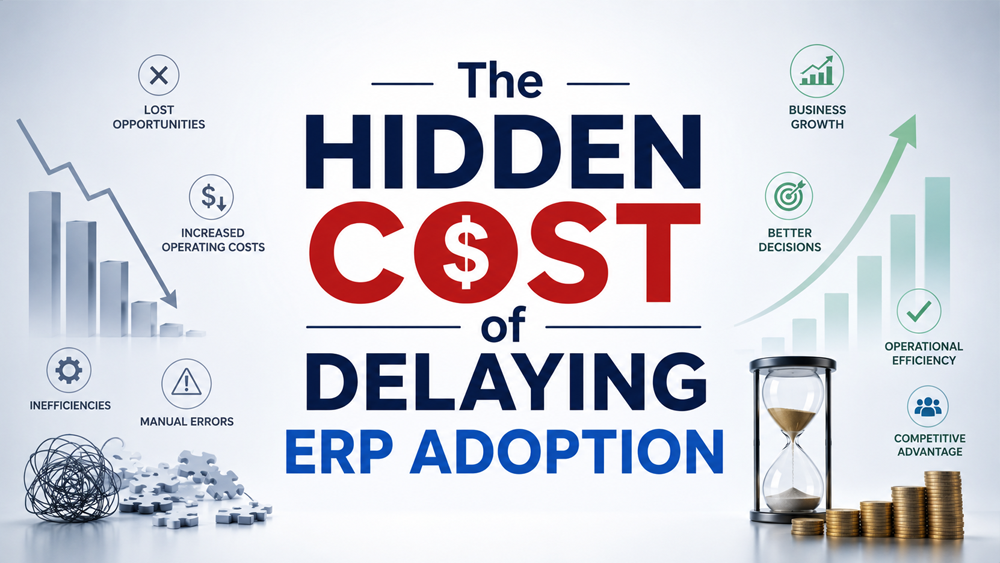
Introduction: The Hidden Cost of Delaying ERP Adoption
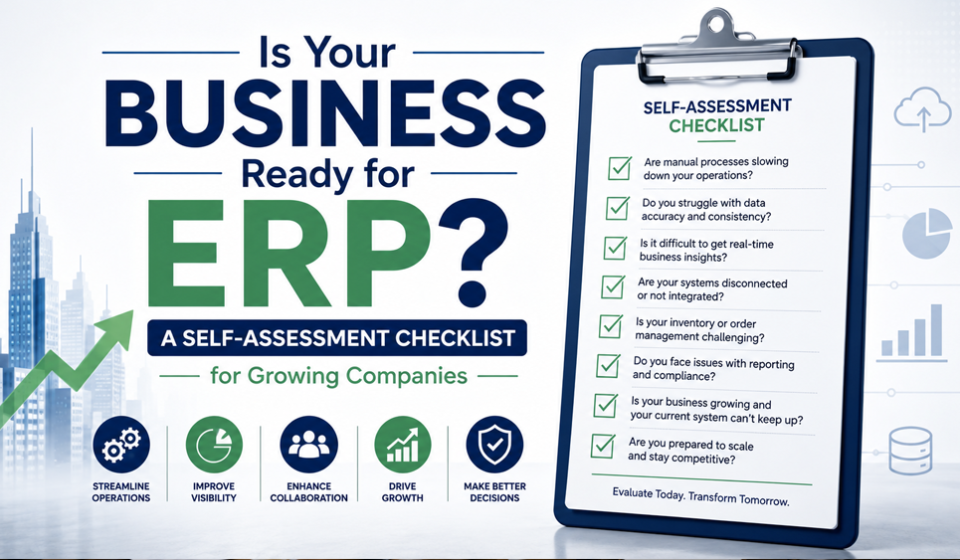
As businesses grow, managing operations through spreadsheets, emails, and disconnected systems for accounting, inventory, CRM, and HR becomes increasingly difficult. While these tools may work initially, growing complexity often leads to inefficiencies, data silos, and delayed decision-making. An ERP Readiness Checklist helps organizations evaluate whether they have reached the stage where an integrated ERP system can streamline processes, improve visibility, and support sustainable business growth.
Many business owners assume ERP implementation is only necessary for large enterprises. Nevertheless, the reality in 2026 is dramatically different. Today’s cloud-based, AI-powered ERP solutions have become essential growth enablers for small and medium-sized businesses.
The problem is that most organizations realize they need ERP only after operational inefficiencies start affecting profitability, customer satisfaction, employee productivity, and growth opportunities.
Therefore, the most important question is not whether ERP is valuable.
Instead, the real question is:
Is your business ready for ERP right now?
This comprehensive self-assessment guide will help you identify the warning signs, growth indicators, and operational challenges that suggest your company is prepared for ERP implementation.
More importantly, it will help you understand how modern AI-enabled ERP systems solve the exact problems growing businesses face today.
Why ERP Readiness Matters More Than Ever in 2026
The business environment has changed significantly over the last few years.
Customers expect faster responses. Supply chains have become increasingly volatile. Competition is no longer limited to local markets. Furthermore, artificial intelligence, automation, predictive analytics, and real-time decision-making are transforming how successful companies operate.
Consequently, organizations relying on disconnected systems are finding it increasingly difficult to compete.
According to recent digital transformation studies, businesses that successfully integrate their operations through ERP platforms often experience measurable improvements in operational efficiency, customer service performance, inventory accuracy, and decision-making speed.
Meanwhile, companies that delay modernization frequently encounter rising operational costs and declining productivity.
Therefore, ERP readiness has become a critical strategic consideration rather than merely an IT decision.
Understanding ERP Readiness: What Does It Actually Mean?
ERP readiness does not mean your business must be experiencing severe operational problems.
Instead, readiness indicates that your company has reached a growth stage where centralized processes, automation, and real-time visibility can deliver substantial business value.
Many organizations mistakenly believe ERP should only be implemented after chaos appears.
However, successful businesses often adopt ERP before inefficiencies become major obstacles.
Consequently, they avoid operational bottlenecks and create a stronger foundation for future growth.
ERP readiness typically involves evaluating business processes, data management practices, employee collaboration, reporting capabilities, customer service performance, and scalability requirements.
The following assessment areas will help determine whether your business is approaching this critical transition point.
Assessment Area 1: Are Spreadsheets Running Your Business?
When Spreadsheet Dependency Becomes a Business Risk
Most companies begin their journey using spreadsheets.
Initially, spreadsheets are flexible, affordable, and easy to implement.
However, as businesses grow, spreadsheets gradually become operational liabilities.
For example, sales teams maintain customer records in one file while inventory teams update stock information in another. Meanwhile, finance departments rely on separate spreadsheets for budgeting and reporting.
Eventually, information becomes fragmented.
Employees spend valuable time searching for data instead of serving customers or driving growth initiatives.
Furthermore, version control issues create confusion about which information is accurate.
As a result, management decisions become slower and riskier.
The ERP Solution
Modern ERP platforms eliminate spreadsheet dependency by creating a centralized business database.
Instead of maintaining multiple versions of the same information, employees access a single source of truth.
Consequently, decision-makers gain confidence in data accuracy while teams become significantly more productive.
If your organization spends hours every week managing spreadsheets, your ERP readiness score is already increasing.
Assessment Area 2: Can You Access Real-Time Business Data Instantly?
The Reporting Delays That Slow Growth
Many growing companies struggle with reporting delays.
Business leaders often wait days or even weeks for critical information.
Revenue reports require manual compilation.
Inventory updates depend on employee input.
Financial summaries involve multiple departments.
As a result, important decisions are frequently based on outdated information.
In today’s competitive environment, this creates substantial risk.
Market conditions change rapidly.
Customer demand fluctuates unexpectedly.
Operational issues require immediate attention.
Therefore, delayed reporting directly affects business agility.
The ERP Solution
AI-powered ERP systems provide real-time dashboards that display current business performance across all departments.
Rather than reacting to historical events, leaders gain visibility into what is happening right now.
Consequently, organizations become more responsive, proactive, and competitive.
If obtaining accurate business data requires multiple emails, meetings, or spreadsheets, ERP readiness is becoming increasingly evident.
Assessment Area 3: Are Inventory Challenges Affecting Customer Satisfaction?
The Cost of Inventory Inaccuracy
Inventory management remains one of the most difficult challenges for growing companies.
Many organizations experience recurring stock shortages despite carrying excessive inventory.
Others struggle with inaccurate stock records that lead to delayed deliveries and dissatisfied customers.
Moreover, inventory errors often impact multiple areas simultaneously.
Sales teams promise unavailable products.
Procurement teams place unnecessary orders.
Finance departments struggle to manage cash flow effectively.
Consequently, operational inefficiencies multiply.
The ERP Solution
Modern ERP systems integrate inventory management with sales, procurement, warehousing, and production operations.
Additionally, AI-driven forecasting models analyze historical trends and purchasing patterns.
As a result, businesses can optimize inventory levels while reducing stockouts and excess carrying costs.
If inventory problems are becoming more frequent as your business grows, ERP implementation may be the next logical step.
Assessment Area 4: Are Departments Working in Isolation?
The Hidden Impact of Operational Silos
One of the most common growth challenges involves departmental disconnect.
Sales teams often lack visibility into inventory availability.
Customer service teams cannot access order fulfillment status.
Finance departments struggle to track operational performance in real time.
Meanwhile, management spends excessive time coordinating information between departments.
Consequently, communication breakdowns become increasingly common.
Customers receive inconsistent information.
Internal efficiency declines.
Employee frustration increases.
Most importantly, growth becomes more difficult to manage.
The ERP Solution
ERP platforms connect all business functions through a unified operational framework.
Information flows automatically between departments.
Employees gain access to relevant real-time data.
Management gains visibility across the entire organization.
Therefore, collaboration improves naturally while customer experiences become more consistent.
If your teams frequently rely on emails, phone calls, and manual updates to exchange information, ERP readiness is likely accelerating.
Assessment Area 5: Is Business Growth Creating Operational Pressure?
When Success Becomes Difficult to Manage
Growth should be exciting.
However, many businesses discover that rapid expansion creates unexpected challenges.
As customer numbers increase, operational complexity grows.
Order volumes rise.
Product portfolios expand.
Employee headcounts increase.
Supplier relationships become more complicated.
Eventually, existing systems struggle to keep pace.
Managers spend more time solving operational issues and less time focusing on strategic growth.
Consequently, growth itself becomes harder to sustain.
The ERP Solution
ERP systems are specifically designed to support scalable operations.
Automation replaces manual processes.
Workflows become standardized.
Information becomes accessible.
Decision-making becomes faster.
As a result, businesses can grow confidently without sacrificing operational control.
If growth feels increasingly difficult to manage despite strong market demand, ERP implementation should be considered a strategic priority.
Assessment Area 6: Are Manual Processes Consuming Too Much Time?
The Productivity Drain Most Companies Ignore
Many organizations underestimate the impact of manual work.
Employees spend hours entering data, creating reports, processing approvals, updating records, and coordinating routine activities.
Although each task appears minor individually, the cumulative impact is substantial.
Furthermore, manual processes increase the likelihood of errors.
A single mistake can create delays, customer dissatisfaction, financial discrepancies, or compliance issues.
Consequently, operational efficiency declines while labor costs increase.
The ERP Solution
Modern ERP platforms automate repetitive tasks across finance, procurement, inventory, sales, HR, and operations.
Additionally, AI-enabled workflow automation reduces administrative burdens while improving accuracy.
As a result, employees can focus on strategic activities that generate value rather than routine administrative work.
If your workforce spends significant time on repetitive manual processes, ERP readiness is becoming increasingly clear.
Conclusion
ERP readiness is not determined by company size alone.
Instead, it is determined by operational complexity, growth ambitions, process efficiency, data visibility, and scalability requirements.
If your organization relies heavily on spreadsheets, struggles with reporting delays, faces inventory challenges, experiences departmental silos, encounters growth-related pressures, or depends on manual processes, these indicators suggest that ERP could deliver significant business value.
More importantly, addressing these issues before they become major obstacles can create a stronger foundation for long-term growth.
In Part 2, we will cover the remaining ERP readiness indicators, introduce an AI-based ERP Readiness Scorecard, discuss ERP implementation best practices, explore industry-specific use cases, and provide SEO-optimized FAQs designed to increase organic search visibility and conversions.