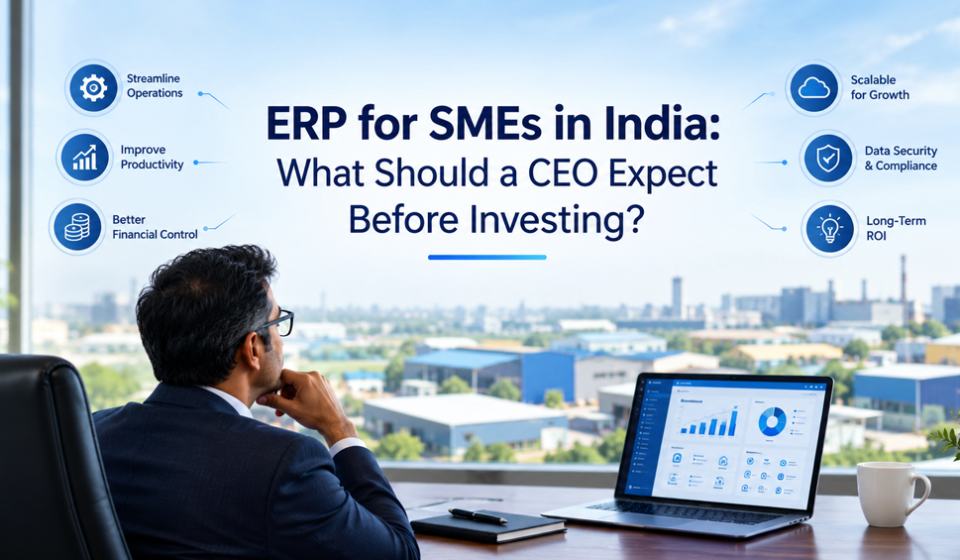

Choosing an ERP for an SME in India is no longer simply a software purchase. For a CEO, it is a decision about how the company will control finance, inventory, production, sales, purchasing, people, compliance, and business growth without adding unnecessary complexity.
That is why the real question is not, “Which ERP software should we buy?” The better question is, “What should our business expect from an ERP investment, and how do we know whether it will actually solve our problems?”
This matters particularly for Indian SMEs because business operations are becoming more connected. GST compliance, e-invoicing, multi-location operations, digital payments, customer expectations, rising operating costs, and growing interest in AI are changing the way businesses manage information. Recent research reported that 36% of Indian small businesses surveyed were investing in AI in 2025, up from 26% in 2024, while 42% identified increasing expenses as their biggest concern.
At the same time, India’s official Udyam portal shows the scale of the MSME ecosystem. As of September 18, 2026, more than 5.36 crore enterprises were registered on Udyam, while the combined Udyam and Udyam Assist Platform records exceeded 9.62 crore registrations.
For a CEO, therefore, ERP should be evaluated as a business-control system rather than another application.
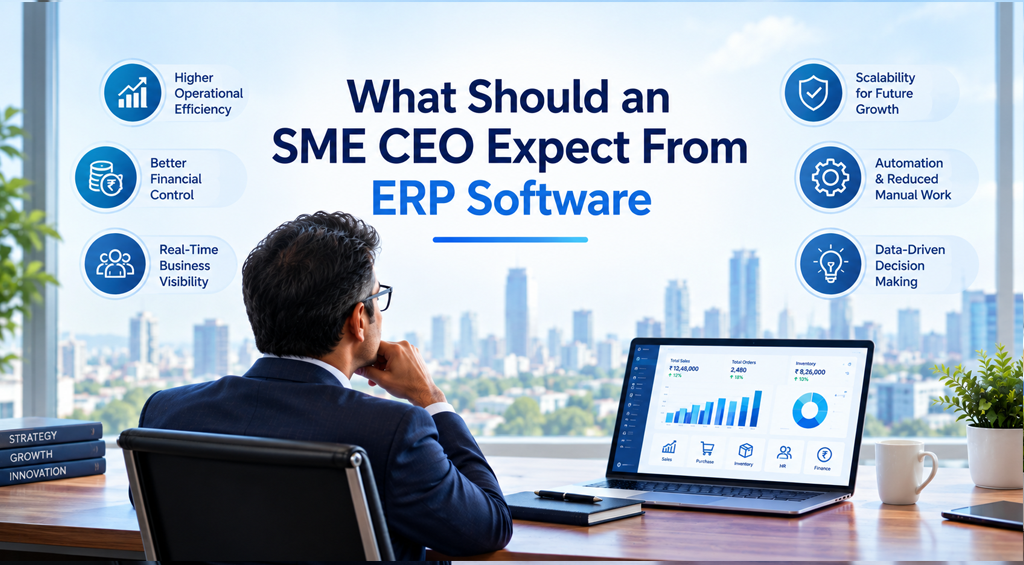
What Should an SME CEO Expect From ERP Software?
An SME ERP system should first create one reliable operational picture of the business. For example, when sales confirms an order, the CEO should not have to call the purchase manager to find out whether materials are available. Similarly, the finance team should not need separate spreadsheets to understand receivables, while the production team maintains another file for stock and work orders.
An effective ERP connects these processes. Sales information can flow into inventory planning. Inventory can connect with purchasing. Purchasing can affect cash-flow planning. Production can update material consumption. Finance can capture the resulting transactions. Management dashboards can then convert these transactions into useful business information.
Consequently, the value of ERP is not simply the number of modules installed. The value comes from how effectively those modules work together. For an SME CEO, the expectation should be simple: fewer disconnected processes, better visibility, stronger controls, and faster decision-making.
The First Expectation: Real-Time Visibility Across the Business
One of the biggest problems growing SMEs face is delayed information. A CEO may know yesterday’s sales, but not today’s outstanding orders. The finance team may know what has been invoiced, while the sales team knows what has been promised. Meanwhile, inventory records may not accurately reflect what is actually available.
This creates a visibility gap. An ERP for SMEs in India should therefore provide dashboards and reports that bring critical information into one environment. Sales, purchase, inventory, receivables, payables, production, expenses, and profitability should be available according to the user’s role and permissions. More importantly, the information should be actionable.
For instance, knowing that receivables are high is useful. Knowing which customers have overdue invoices, how long those invoices have remained unpaid, and what collection action is pending is far more valuable to a CEO. Therefore, before investing in ERP software, an SME should ask whether the system can convert operational data into management decisions.
The Second Expectation: Better Financial Control, Not Just Accounting
Many businesses begin their ERP journey because accounting has become difficult to manage. However, an ERP should go beyond basic bookkeeping. As a company grows, financial control becomes connected with sales, purchasing, inventory, expenses, projects, production, and customer payments.
Suppose a company increases sales but its cash position continues to deteriorate. A standalone accounting system may show the financial result, but management needs to understand the operational reasons behind it. An integrated ERP can connect invoices, receivables, purchases, expenses, inventory valuation, orders, and other business transactions.
This creates a more complete financial picture. Furthermore, Indian businesses must consider GST-related processes as part of their digital workflow. The GST e-invoicing system has progressively expanded its coverage, reaching taxpayers with aggregate annual turnover of ₹5 crore or more from August 1, 2023, subject to applicable rules and exemptions.
Therefore, an SME CEO should evaluate whether the ERP can support the company’s current compliance requirements while remaining adaptable as regulations and business structures change.
The Third Expectation: ERP Should Reduce Manual Work
If employees still move information manually between Excel sheets, emails, accounting systems, and ERP screens, the business may not be receiving the full value of automation. Manual data entry creates another problem: errors. A sales order entered incorrectly can affect inventory. Incorrect inventory can affect production planning. Production discrepancies can affect costing. Ultimately, a small data-entry issue can become a financial or customer-service problem.
ERP should reduce these repeated activities through workflow automation, approvals, alerts, document management, scheduled processes, and integrated data. For example, instead of asking a manager every day whether a purchase order has been approved, the system can route the document to the appropriate authority and notify the relevant person. Consequently, employees spend less time chasing information and more time acting on it.
The Fourth Expectation: AI Should Solve Business Problems, Not Become a Marketing Label
AI is becoming an important consideration when SMEs evaluate new business software. However, CEOs should distinguish between genuine AI capabilities and software simply using the word “AI” in its marketing. An AI-ready ERP should have a clear purpose.
For example, AI can potentially assist with identifying unusual transactions, forecasting demand, highlighting overdue receivables, detecting operational patterns, assisting users with business queries, summarizing reports, and supporting decision-making.
However, AI should work with controlled business data and appropriate permissions. An ERP vendor should therefore explain what data is used, what the AI actually does, how users can verify outputs, and where human approval remains necessary. For SMEs, the practical objective should not be “adding AI.” The objective should be reducing repetitive work, identifying important exceptions faster, and helping management make decisions using better information.
The Fifth Expectation: Customization Without Endless Development Costs
Traditional ERP customization can become a major concern for SMEs. A business may initially require a few changes. Then another department requests a modification. Later, a new approval process is required. Eventually, upgrades become difficult because the ERP has accumulated extensive custom development.
This is where modern no-code and low-code approaches can change the economics of ERP customization. For an SME, the ideal ERP should allow legitimate business-process changes without requiring every minor requirement to become a large software-development project. That does not mean every business should customize everything.
Instead, CEOs should ask whether the platform can adapt to important workflows while maintaining system stability, security, upgradeability, and governance. The goal is not unlimited customization. The goal is controlled flexibility.
The Sixth Expectation: Scalability Without Replacing the ERP Every Few Years
An SME may have one location today and multiple branches tomorrow. It may initially operate in one state and later expand across India. It may eventually manage multiple entities, currencies, warehouses, distributors, or international customers. Therefore, ERP selection should consider future operating complexity rather than only today’s requirements.
The Indian government’s current MSME classification itself recognizes larger investment and turnover thresholds from April 1, 2025, with the small enterprise turnover threshold rising to ₹100 crore and the medium enterprise threshold to ₹500 crore. This reinforces an important point for growing businesses: the system should be capable of supporting an organization as its scale changes.
A CEO should therefore examine user capacity, locations, databases, integrations, APIs, reporting, security controls, workflows, and multi-entity capabilities before signing a long-term ERP contract. What Should an SME Check Before Buying ERP?
The ERP demonstration should start with business problems rather than software features. Instead of asking a vendor to show every screen, management should bring real scenarios. For example, what happens when a customer places an urgent order but the required stock is unavailable? How does the system identify the shortage? How is purchasing triggered? Who approves the purchase? How does the CEO know whether the order will be delivered on time?
Similarly, management can test a financial scenario. What happens when an invoice becomes overdue? Does the system automatically identify it? Can management see the customer exposure? Can users configure reminders or approval workflows? These practical questions reveal much more about an ERP than a generic product presentation.
ERP Cost Should Be Measured Against Business Impact
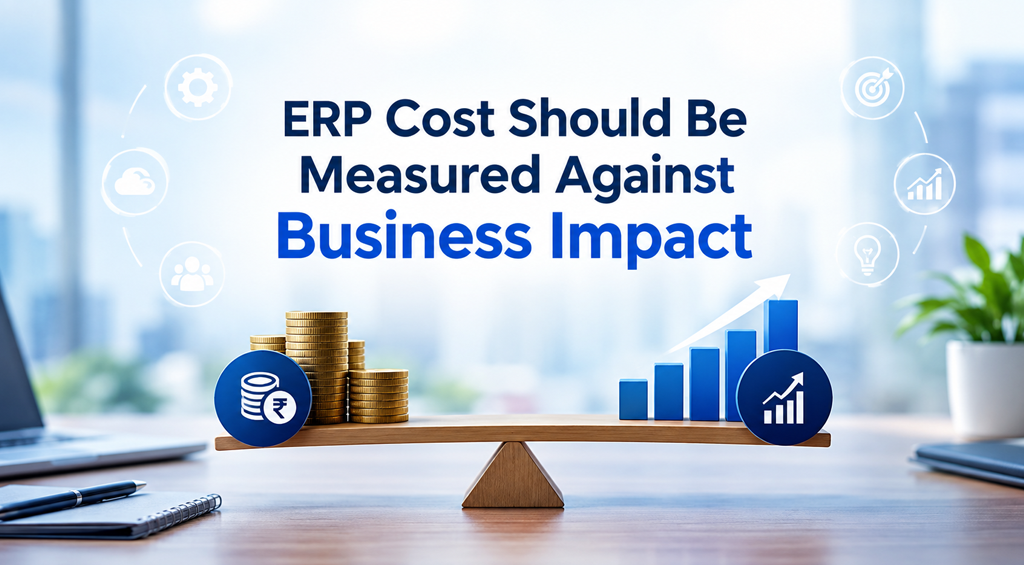
The cheapest ERP is not necessarily the lowest-cost ERP. An inexpensive system that requires significant manual work, extensive customization, frequent external support, or separate applications can become expensive over time. Conversely, a higher initial investment may make financial sense if the system reduces manual processes, improves visibility, strengthens controls, and supports expansion.
Therefore, CEOs should calculate the total cost of ownership. That includes software licensing, implementation, customization, data migration, training, integrations, support, upgrades, infrastructure, and internal employee time. Most importantly, management should identify measurable business outcomes.
For example, the company can track reduction in manual data entry, faster month-end reporting, improved receivable follow-up, lower inventory discrepancies, faster approvals, reduced duplicate work, and improved order visibility. This creates a much more meaningful ERP ROI discussion.
Implementation Is Just as Important as the ERP Product
Even capable ERP software can fail to deliver value when implementation is poorly managed. The reason is straightforward: ERP changes how people work. Employees who previously maintained Excel files may need to follow standardized workflows. Managers may need to approve transactions digitally. Finance may receive information from operational modules rather than manually entering everything.
Therefore, implementation should include process understanding, data migration, configuration, user training, testing, role-based access, reporting, and post-go-live support. A CEO should also ask who will own the implementation internally. Without clear ownership, employees may continue using old systems alongside the ERP, creating duplicate data and defeating the purpose of integration.
Security and Data Control Should Be CEO-Level Questions
ERP contains commercially sensitive information. Customer data, supplier information, pricing, financial transactions, employee records, inventory data, and management reports may all exist within the system. Therefore, security should not be treated as an IT-only issue. Management should understand authentication, role-based access, authorization, backups, audit trails, data protection, integration security, and access controls.
The right question is not simply whether an ERP is “secure.” The question is whether the organization has appropriate controls over who can access, create, modify, approve, and export business information.
A CEO’s ERP Investment Checklist
Before signing an ERP contract, management should be able to clearly explain the business problems the system is expected to solve. The company should know which processes need integration, which reports management requires, which workflows need automation, which compliance requirements apply, how much customization is genuinely necessary, and how the system will scale.
The vendor should also provide clarity about implementation methodology, data migration, training, support, upgrades, integrations, security, pricing, and measurable outcomes. Most importantly, the ERP should fit the organization’s operating model rather than forcing the organization into an unnecessarily complicated software structure.
Why No-Code ERP Is Becoming Relevant for Growing SMEs
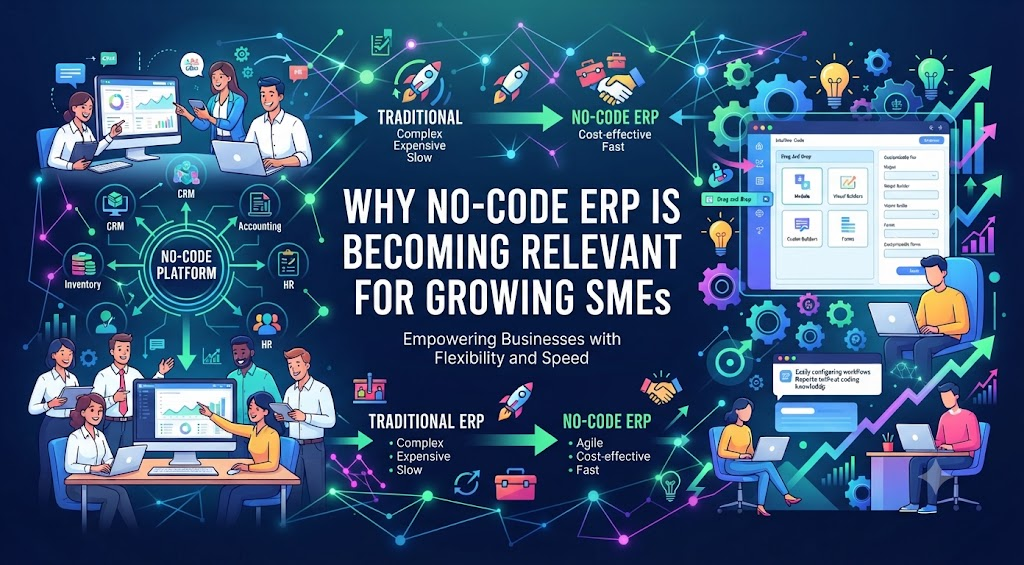
For many SMEs, business requirements change faster than traditional ERP development cycles. A new approval process, branch, product line, reporting requirement, customer workflow, or regulatory requirement can create pressure for software changes. A no-code ERP approach can provide a different model by allowing organizations to configure or extend business processes with less dependence on conventional programming for every change.
When properly governed, this can help SMEs respond faster while controlling customization effort. However, CEOs should still evaluate the underlying architecture, scalability, security, integration capabilities, vendor experience, and long-term support before choosing any no-code ERP platform.
What Should the Final ERP Decision Look Like?
The final decision should be based on business fit rather than the number of features shown during a demonstration. An ERP should give management better visibility, employees clearer processes, finance stronger control, and the organization a foundation for future growth. For an SME in India, the right evaluation therefore connects operational efficiency with compliance, automation, scalability, security, and measurable business outcomes.
Bluechip Solutions approaches ERP around this broader business requirement through ProfitPlus ERP and Auvit, a no-code business process automation platform designed to connect business processes and support configurable workflows. With experience across ERP implementations and more than 200 clients globally, Bluechip Solutions focuses on helping businesses evaluate ERP around their operational requirements rather than treating ERP as simply an accounting or billing application.
The practical starting point is not another product brochure. It is an assessment of where the business is losing time, visibility, control, and money today.
Get an SME ERP Readiness Assessment Before You Invest
If your business is currently managing operations across Excel, accounting software, disconnected applications, emails, and manual approvals, the first step should be understanding whether an ERP investment is justified and what capabilities your business actually needs. A structured ERP consultation can help identify process gaps, integration requirements, automation opportunities, reporting needs, and the areas where an ERP could create measurable operational value.
Book a Free ERP Consultation with Bluechip Solutions to discuss your current processes and ERP requirements.
Get the SME ERP Investment Checklist for 2026 and use it to evaluate ERP features, implementation requirements, hidden costs, security, scalability, automation, AI readiness, and vendor support before signing a contract.