
Contract Farming ERP Software in Bangalore: How Agribusinesses Can Control Farmer Networks, Procurement and Payments

Managing contract farming across hundreds of farmers is not just an agricultural challenge. It is also a complex business management problem. Contract Farming ERP Software in Bangalore helps agribusinesses coordinate farmer registration, crop planning, field activities, input distribution, quality checks, procurement, transportation and payments through a connected system. However, when these operations depend on spreadsheets, paper records, phone calls and disconnected software, even a profitable farming contract can become difficult to manage.
For agribusiness companies in Bangalore working with farmers across Karnataka and other Indian states, these gaps can lead to inaccurate crop estimates, procurement delays, disputed quantities and delayed farmer payments. Consequently, management teams struggle to understand how much produce will arrive, whether it meets quality standards and what the actual procurement cost will be.
Contract Farming ERP Software in Bangalore helps address these challenges by connecting farmer management, agricultural operations, procurement, inventory and finance within a unified business system. With configurable workflows, real-time reporting and AI-assisted analytics, companies can improve operational visibility while building stronger relationships with farmers.
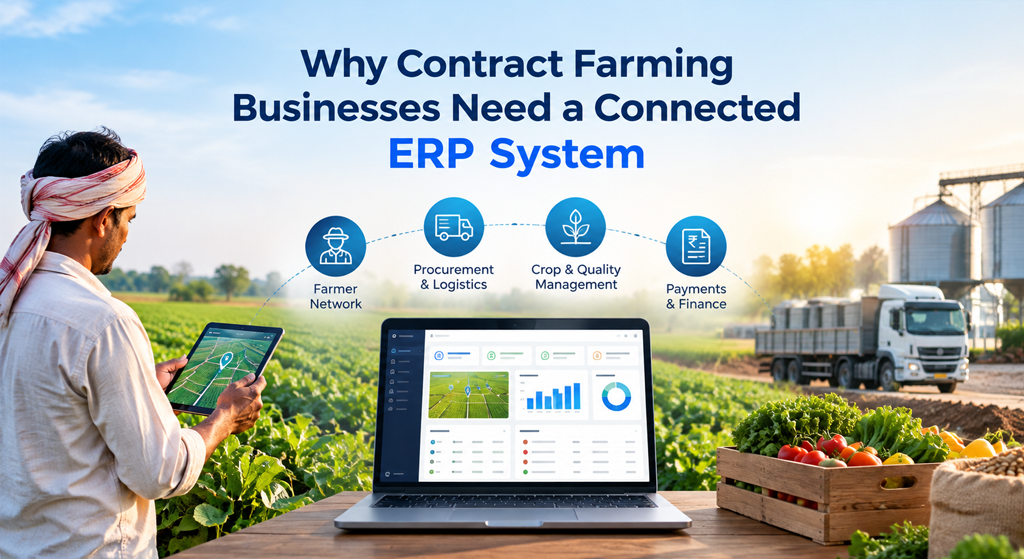
Why Contract Farming Businesses Need a Connected ERP System
Contract farming requires companies and farmers to coordinate their activities around agreed crops, cultivation practices, quantities, quality specifications and commercial terms. Nevertheless, information frequently becomes fragmented as the number of farmers, collection centres and procurement locations increases.
For example, a procurement manager may receive one crop estimate from a field officer, another from a collection centre and a different figure from the finance team. Since these records are not connected, management cannot confidently plan transportation, storage, working capital or customer deliveries.
Digital agricultural infrastructure in India is expanding rapidly. According to a Government of India Press Information Bureau update published in April 2026, the National Agriculture Market (e-NAM) had integrated 1,656 mandis across 23 states and four Union Territories by March 2026, with more than 1.80 crore registered farmers. Although e-NAM and contract farming ERP systems serve different purposes, this growth demonstrates the increasing scale of digital agricultural coordination in India.
Therefore, agribusinesses need more than a basic accounting or inventory application. They need a connected system that follows the entire contract farming lifecycle, from farmer onboarding to final payment and profitability analysis.
1. Farmer Network Management: Replace Fragmented Records With a Centralised System
The problem: Incomplete farmer information and limited field visibility
As farmer networks expand, maintaining accurate records becomes increasingly difficult. Field officers may collect farmer details through paper forms or messaging applications, while procurement teams maintain separate lists of registered growers. As a result, duplicate registrations, outdated contact information and incorrect cultivation details can affect planning.
Moreover, managers may not know which farmers have committed to a particular crop, how much land is under cultivation or whether field verification has been completed.
The ERP solution: Build a reliable farmer database
A Contract Farming Management Software system can maintain a central farmer master containing contact details, farm locations, land area, crop information, seasonal agreements, expected yields and historical procurement records. Where appropriate and legally permitted, it can also support location tagging and document management.
Furthermore, configurable approval workflows can ensure that registrations are verified before farmers are included in production and procurement plans. Field officers can update cultivation progress, while authorised managers can review the same information without waiting for manual reports.
Consequently, agribusinesses gain better visibility into their farmer networks, reduce duplicate records and improve communication between field teams, procurement departments and finance.
2. Crop Planning and Yield Forecasting: Reduce Procurement Uncertainty
The problem: Estimated production does not match actual arrivals
One of the most expensive challenges in contract farming is the gap between expected and actual crop production. Weather changes, pest attacks, irrigation problems, input shortages and variations in farming practices can affect yields. Meanwhile, inaccurate estimates may lead companies to arrange too much transportation or insufficient storage capacity.
For example, if procurement teams plan collection schedules using outdated crop estimates, vehicles may arrive before produce is ready or farmers may have to wait because collection capacity is unavailable.
The ERP solution: Connect crop plans with field-level updates
Agriculture ERP Software can link farmer agreements with crop varieties, cultivation areas, expected harvest dates, input requirements and projected production quantities. Field teams can record crop progress at defined stages, allowing planners to compare expected output with updated field conditions.
Additionally, AI-assisted forecasting can analyse historical procurement, previous yields, crop calendars, weather information and other available data to estimate likely harvest volumes. Where reliable data and suitable integrations are available, predictive models can flag potential supply shortages or unusual changes in expected yields.
However, these forecasts should support, rather than replace, agronomists’ assessments and field verification. By combining historical patterns with current observations, businesses can plan procurement capacity more intelligently and respond earlier to supply risks.
3. Agricultural Procurement Management: Improve Quantity and Quality Control
The problem: Procurement discrepancies reduce margins
When farmers deliver produce to collection centres, differences can arise between contracted quantities, actual weights, accepted quantities and quality-approved quantities. Manual registers and delayed data entry make these discrepancies difficult to investigate.
Furthermore, inconsistent grading or missing inspection records can cause disputes between farmers, procurement officers and buyers. Without reliable traceability, management may struggle to determine whether a loss occurred during weighing, quality rejection, handling or transportation.
The ERP solution: Track every procurement transaction
Agricultural Procurement Software can connect farmer contracts, purchase orders, weighment records, quality inspection, accepted quantities and payment calculations. Each delivery can be linked to its farmer, collection location, crop, date and applicable commercial terms.
For instance, when produce fails to meet agreed quality specifications, the system can record the inspection result and route the transaction for review according to the company’s approval policy. Similarly, approved quantities can flow into inventory records and finance calculations, reducing repetitive data entry.
As a result, procurement managers can compare contracted quantities with actual receipts, investigate unusual variations and maintain a more reliable audit trail.
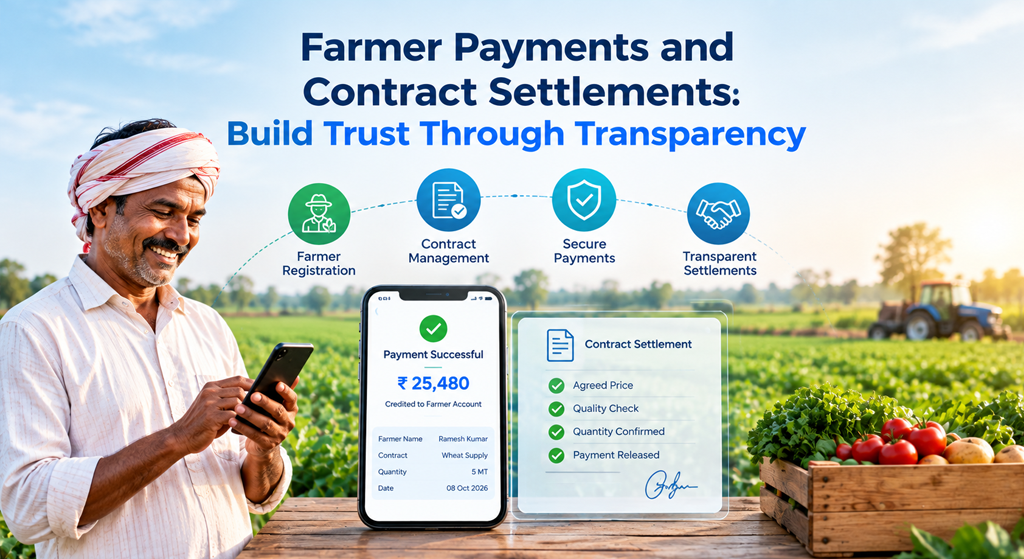
4. Farmer Payments and Contract Settlements: Build Trust Through Transparency
The problem: Delayed payments and disputed deductions
Farmer relationships can deteriorate when payment calculations are unclear or settlements take longer than expected. Procurement teams may have completed the purchase, yet finance teams might still be waiting for quality approvals, transport adjustments or supporting documents.
In addition, advance payments, agricultural input recoveries, agreed deductions and outstanding balances can become difficult to reconcile when records are maintained separately.
The ERP solution: Link procurement directly with finance
A connected ERP system can calculate settlement amounts using approved quantities, agreed prices, quality adjustments and authorised deductions. It can also maintain records of advances, outstanding balances, payment approvals and completed transactions.
Moreover, workflow-based alerts can notify finance teams when settlements are awaiting approval or have exceeded their internal payment timelines. Subject to banking integrations and authorisation controls, approved payments can be processed through supported payment channels.
Consequently, agribusinesses can reduce reconciliation delays, explain settlement calculations more clearly and monitor outstanding farmer payments through a central dashboard. Importantly, payment visibility benefits both sides. Farmers receive clearer information about their settlements, while management gains better control over cash flow and procurement liabilities.
5. Inventory, Transportation and Traceability: Connect the Farm to the Buyer
The problem: Produce losses and disconnected stock records
Harvested produce is time-sensitive, particularly when businesses handle fruits, vegetables and other perishable commodities. Delays in collection, inadequate storage planning, inaccurate stock records and poor batch identification can increase wastage and reduce saleable quantities.
At the same time, procurement teams may know how much produce was purchased without knowing its current location, quality status or dispatch readiness.
The ERP solution: Create end-to-end produce visibility
An integrated system can connect procurement receipts with inventory, batch identification, warehouse transfers, transport planning and dispatch records. Accordingly, teams can track produce from the farmer or collection centre through storage and onward delivery.
For perishable commodities, configurable rules can support expiry monitoring, freshness-based dispatch planning and alerts for stock requiring immediate attention. Furthermore, management dashboards can compare quantities received, accepted, rejected, stored and dispatched.
These controls help identify where quantity losses occur and improve coordination between procurement, warehouse and logistics teams. They also support more reliable traceability when customers request information about a particular batch.
6. AI-Powered Contract Farming Analytics: Turn Operational Data Into Better Decisions
The problem: Managers discover risks after they affect profitability
Traditional reports often explain what has already happened rather than identifying what may happen next. For instance, a company might discover a procurement shortage only after harvest begins or identify rising input costs after the season has ended.
The ERP solution: Use AI-assisted, data-driven decision support
A modern ERP platform can provide dashboards for farmer performance, expected procurement, quality rejection, payment ageing, crop-wise costs and operational exceptions. When sufficient reliable historical data is available, AI and machine-learning models can help identify patterns that deserve management attention.
For example, predictive analytics may highlight a region where expected production is falling, identify repeated differences between estimated and received quantities, or detect unusual procurement costs compared with historical patterns. Similarly, anomaly detection can flag duplicate transactions, unexpected price variations or settlements that require verification. These alerts should be treated as indicators for investigation rather than automatic proof of fraud or error.
Nevertheless, AI is only as reliable as the data, model design and validation behind it. Agribusinesses should begin with accurate farmer records, standardised procurement processes and clearly defined performance indicators before introducing advanced predictive capabilities. The objective is practical: help managers identify risks earlier, allocate resources more effectively and make decisions using current operational evidence.
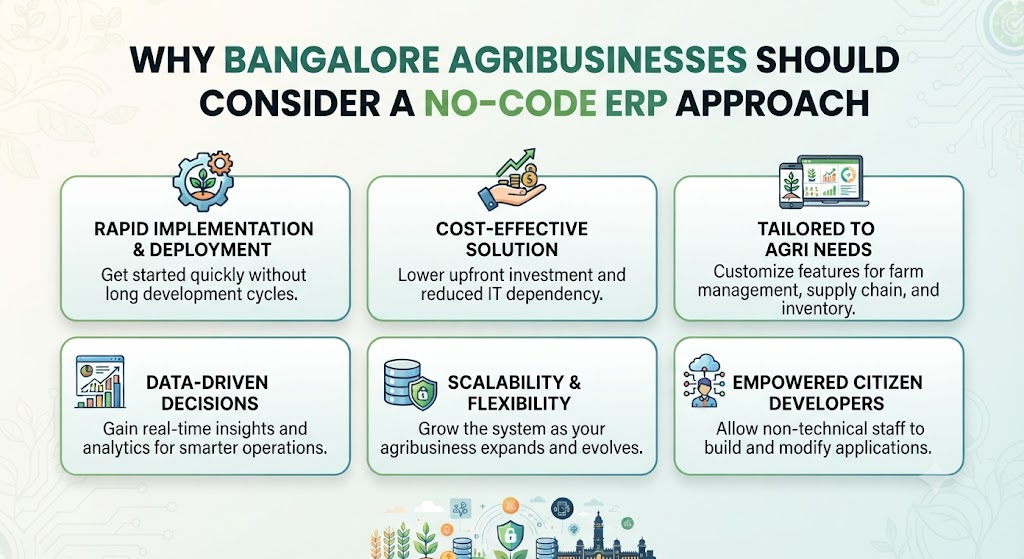
7. Why Bangalore Agribusinesses Should Consider a No-Code ERP Approach
Agribusiness operations differ according to crop type, contract structure, procurement model, geography and quality requirements. Therefore, a rigid software package may not accommodate every workflow without expensive modifications. A configurable no-code ERP platform offers an alternative by allowing businesses to adapt forms, approval processes, dashboards and business rules to their operational requirements, subject to the platform’s capabilities.
For companies evaluating Contract Farming ERP Software in Bangalore, this flexibility can be useful when existing processes need to change across seasons or when new collection centres, crops and farmer groups are introduced.
Bluechip Solutions offers Auvit™ No-Code ProfitPlus ERP, a business process automation and ERP platform designed to support configurable business workflows. Agribusinesses can explore whether its farmer management, procurement, inventory, finance and reporting capabilities can be configured to meet their specific contract farming requirements.
Before selecting any ERP solution, companies should evaluate mobile usability for field officers, offline requirements, integration options, access controls, reporting flexibility, implementation support and the ability to maintain reliable transaction histories. The right system should fit the actual farming operation rather than forcing every department to follow an unsuitable standard process.
8. How to Measure the Business Impact of Contract Farming ERP
ERP implementation should be evaluated through measurable operational outcomes rather than the number of modules installed. Initially, businesses should establish baseline figures for farmer registration errors, forecast accuracy, procurement discrepancies, quality rejection, payment turnaround time and post-harvest losses.
Subsequently, management can compare these indicators over equivalent crop seasons and procurement cycles. For example, measuring the percentage of farmer settlements completed within the agreed payment period can reveal whether finance workflows are improving.
Similarly, comparing estimated procurement quantities with actual accepted quantities can help assess planning accuracy. Tracking the time required to resolve quantity disputes can also indicate whether digital records are improving accountability.
Although results vary by crop, location, process maturity and adoption, this approach gives decision-makers a practical way to evaluate ERP performance and identify areas requiring further improvement.
Frequently Asked Questions About Contract Farming ERP Software
What is Contract Farming ERP Software?
Contract Farming ERP Software connects farmer registration, crop planning, field monitoring, procurement, inventory, financial settlements and reporting within a central business system. It helps agribusinesses manage agricultural contracts with better visibility and accountability.
How does contract farming software help agribusinesses in Bangalore?
It helps agribusinesses coordinate distributed farmer networks, monitor cultivation progress, plan procurement, verify delivered quantities and track farmer payments. Additionally, configurable workflows can support operations across Karnataka and other regions.
Can ERP software automate farmer payments?
ERP software can automate settlement calculations, approval workflows, payment-status tracking and reconciliation. Actual fund transfers depend on supported banking integrations, authorisations and applicable payment procedures.
Can AI improve contract farming management?
AI-assisted analytics can support crop forecasting, procurement planning, anomaly detection and operational risk monitoring. However, reliable results depend on suitable data, validated models and human review.
How should a company choose the right contract farming ERP?
A company should assess farmer network size, crop diversity, mobile access, procurement complexity, payment workflows, traceability requirements, integration capabilities, data security and implementation support. A demonstration using real operational scenarios can help determine whether the system meets its requirements.
Conclusion: Build a More Connected and Profitable Contract Farming Operation
Contract farming becomes harder to control when farmer information, crop estimates, procurement records and payments remain scattered across disconnected systems. Consequently, businesses may experience avoidable delays, disputes, stock losses and limited visibility into seasonal profitability.
Contract Farming ERP Software in Bangalore can help agribusinesses address these problems by connecting farmer networks, field operations, procurement, inventory and finance. Furthermore, configurable workflows and AI-assisted analytics can improve planning, strengthen accountability and help managers respond to operational risks earlier.
For agribusinesses preparing to expand their farmer networks or improve procurement efficiency, the first step is to identify where information gaps are affecting costs, delivery commitments and farmer relationships.
Looking to improve farmer management, agricultural procurement and payment control?
Bluechip Solutions can help you explore Auvit™ No-Code ProfitPlus ERP and assess how configurable ERP workflows can support your contract farming operations.
Request a Free ERP Consultation
Explore Auvit No-Code ERP : BLUECHIPSOLUTIONS
Discuss your farmer registration, seasonal procurement and payment workflows with our experts to find the right Contract Farming ERP Software in Bangalore for your business.