
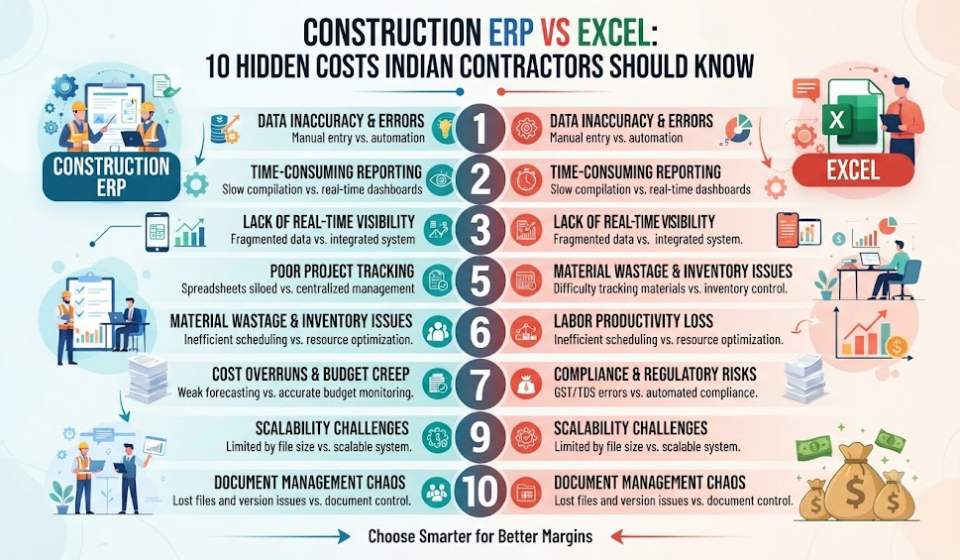
Construction ERP vs Excel: 10 Hidden Costs Indian Contractors Should Know

Excel can start as the simplest solution for a construction business. A contractor creates a project-costing sheet, adds material purchases, records labour expenses, tracks subcontractor payments and prepares a monthly report. At first, it works. However, as projects increase, teams expand and multiple sites start operating at the same time, the same Excel-based process can become surprisingly expensive.
The problem is not that Excel is a bad tool. Rather, the problem is using spreadsheets as the central system for construction project management when the business has outgrown them.
For Indian contractors, this matters because construction operations involve project-wise costing, material movement, subcontractors, labour, purchase orders, work progress, billing, retention amounts, GST documentation and cash-flow management. When businesses distribute these activities across multiple spreadsheets, WhatsApp messages, emails, and accounting systems, management can lose visibility precisely when it matters most.
Therefore, the real question is not simply “Construction ERP vs Excel: which is better?” The more useful question is: How much is Excel actually costing your construction business?
India’s infrastructure and construction ecosystem continues to receive significant investment. The Economic Survey 2025–26 highlights large infrastructure initiatives and increasing use of technology such as drone surveys, automated intelligent machine-aided construction and AI-based monitoring in major projects.
As construction operations become more technology-driven, contractors need better control over project information, costs and execution.
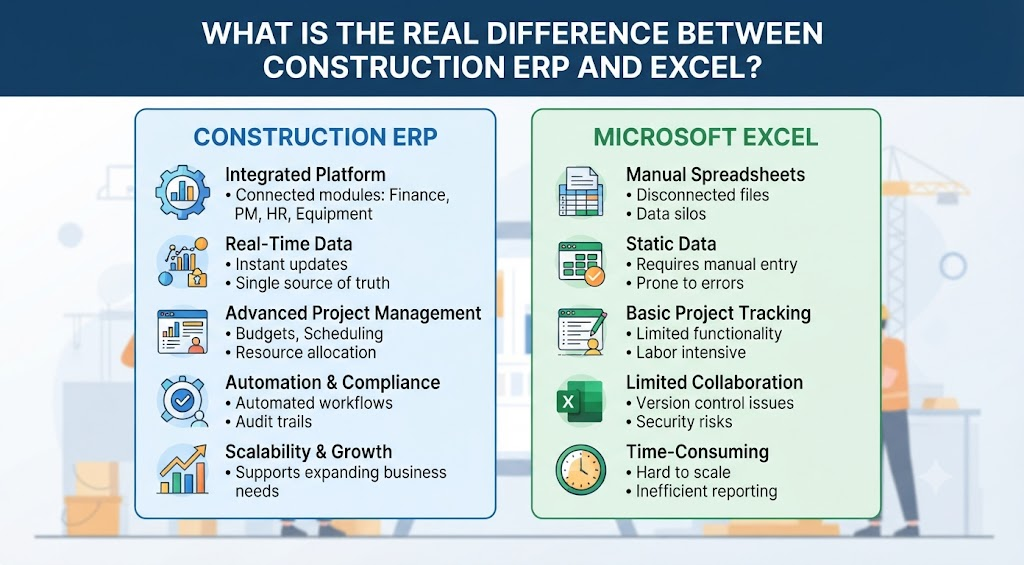
What Is the Real Difference Between Construction ERP and Excel?
Excel is primarily a spreadsheet tool. Construction ERP software, on the other hand, connects business processes into a controlled system. With Excel, a project manager may maintain one file for materials, another for labour, another for subcontractors and another for project billing. Consequently, the accounts team may have a different version of the same information.
A construction ERP brings these processes together. Project costs, procurement, inventory, subcontracting, billing, finance, and management reporting can work together through a connected system, allowing information to flow between functions without repeated data entry. That distinction becomes increasingly important as the number of projects grows.
Hidden Cost 1: Duplicate Data Entry Consumes More Than Employee Time
One of the first hidden costs of Excel is repeated data entry. Suppose a contractor purchases ₹5 lakh worth of construction material. The purchase team may record the transaction in a spreadsheet, enter the same details into accounting software, share the information with the project team, and then add it to a management report. Every additional entry creates another opportunity for employees to introduce a mismatch.
Moreover, employees spend valuable time checking whether they have entered the same information consistently across different systems. A construction ERP connects purchasing, inventory, project costing, and accounting workflows, allowing teams to use the same transaction across multiple business processes without manually recreating the data.
Therefore, the savings go beyond the hours employees spend entering data. Businesses also save the time they would otherwise spend identifying, correcting, and reconciling errors caused by repeated data entry.
Hidden Cost 2: Project Cost Overruns Become Visible Too Late
Construction profitability can change long before the final project report shows a loss. Material prices can increase. Labour requirements can change. A subcontractor can submit an additional claim. Site consumption can exceed the estimate. Equipment utilisation can vary. With spreadsheet-based project tracking, these changes may remain scattered across different files.
Consequently, management may discover a cost overrun after the project has already absorbed a significant amount of additional expenditure. A construction ERP can provide project-wise cost tracking against budgets, estimates and actual transactions. This gives contractors a clearer opportunity to identify deviations earlier. The objective is not merely to produce a better report at the end of the project. Instead, the objective is to give management information while there is still time to act.
Hidden Cost 3: Material Leakage and Uncontrolled Consumption
Material is one of the most sensitive areas in construction. Cement, steel, aggregates, electrical materials, plumbing components and other items move between suppliers, warehouses and project sites. Without structured inventory control, the contractor may struggle to answer a basic question: Where did the material go?
Excel can record quantities, but maintaining an accurate record becomes difficult when multiple people update different sheets. Furthermore, physical stock and spreadsheet stock can gradually diverge. A construction ERP can connect purchase orders, goods receipts, stock movements, issue transactions and project consumption. Therefore, management gets a more structured view of material movement. This becomes especially valuable when several construction sites operate simultaneously.
Hidden Cost 4: Subcontractor Tracking Becomes Difficult
Many Indian contractors depend heavily on subcontractors for specialised construction activities. However, subcontractor management involves much more than recording final payments. Teams must track work orders, quantities, measurements, advances, deductions, retention, bills, and approvals throughout the project.
When teams spread this information across multiple Excel files, the commercial team must spend considerable time reconciling orders, completed work, and payments. A construction ERP can bring subcontractor work orders, billing and project costing into a connected workflow. Consequently, management can assess subcontractor costs in relation to the actual project instead of treating subcontractor accounting as a separate activity.
Hidden Cost 5: Businesses Discover Cash-Flow Problems Too Late
Profit on paper does not automatically mean healthy cash flow. Construction businesses can have money locked in receivables, retention amounts, advances, work-in-progress and unpaid customer bills. At the same time, businesses must continue paying suppliers, subcontractors, and employees. Excel-based reporting can make cash-flow forecasting more difficult because teams often keep financial information separate from project progress.
A construction ERP connects project billing, receivables, payables, and financial transactions, helping management track expected cash inflows and planned cash outflows more effectively.Therefore, contractors can move from simply asking “How much have we billed?” to asking the more important question: “How much cash can this project actually generate, and when?”
Hidden Cost 6: Version Conflicts Create Expensive Decisions
Consider a situation where the project manager has one Excel file, the accounts team has another and the head office has a third. Which one is correct? This sounds like a small administrative issue. However, the consequences can be significant.
A decision based on outdated material cost, incorrect project progress or an old receivables figure can affect purchasing, billing and cash management. Therefore, the hidden cost is not the spreadsheet itself. The real cost is making business decisions using information that is no longer current. ERP software creates a centralised environment where authorised users can work from the same underlying business information.
Hidden Cost 7: GST and E-Invoicing Processes Become More Difficult to Control
Construction companies operating across India need to pay close attention to GST documentation and invoice processes. The e-invoicing system has expanded in phases, and official GST sources currently describe the notified threshold at ₹5 crore aggregate annual turnover for covered taxpayers, subject to applicable conditions and exemptions.
For contractors, therefore, disconnected billing and accounting processes can create unnecessary compliance risk. A construction ERP with integrated financial and invoicing workflows can help reduce manual duplication and improve traceability between transactions and financial records. Importantly, ERP does not replace professional tax advice. Instead, it provides a structured system from which finance teams can manage applicable processes more consistently.
Hidden Cost 8: Management Reports Take Too Long to Prepare
A construction company’s leadership team should not have to wait several days to understand project performance. Yet, when information sits in different spreadsheets, preparing a consolidated report often means collecting files, checking formulas, correcting formats and reconciling numbers. By the time the report reaches management, the underlying situation may already have changed.
Construction ERP software can automate dashboards and management reports using transaction-level information. For example, management can analyse project costs, procurement, receivables, payables and financial performance through connected reporting rather than manually assembling the information every reporting cycle. This changes the role of reporting from historical documentation to operational decision support.
Hidden Cost 9: Excel Does Not Scale Easily With Multiple Projects
One project with a few employees is very different from a contractor managing ten, twenty or fifty projects. As the business grows, spreadsheet structures tend to become more complicated. More tabs are added and formulas are created, users need access. More files are shared. Eventually, the spreadsheet becomes a system that nobody fully understands.
At that point, adding another project does not simply add revenue. It also adds administrative complexity. A construction ERP structures business processes in one connected system. Consequently, teams can add new projects without creating a separate set of disconnected spreadsheets for every location.
Hidden Cost 10: The Biggest Cost Is Losing Management Visibility
The most expensive hidden cost of Excel is often the one that is hardest to calculate: delayed visibility. A contractor may know the total sales value. However, management also needs to understand project-wise profitability, material consumption, outstanding customer payments, subcontractor exposure, procurement commitments and cost deviations.
When these numbers are scattered, leadership is forced to depend on manual updates. That creates a gap between what is happening at the site and what management knows at the office. Construction ERP closes that visibility gap by connecting operational and financial information.
For example, a project cost transaction should not exist only as an accounting entry. Management should be able to understand which project it belongs to, what category it affects and how it compares with the planned cost. That is where an ERP becomes more than accounting software.
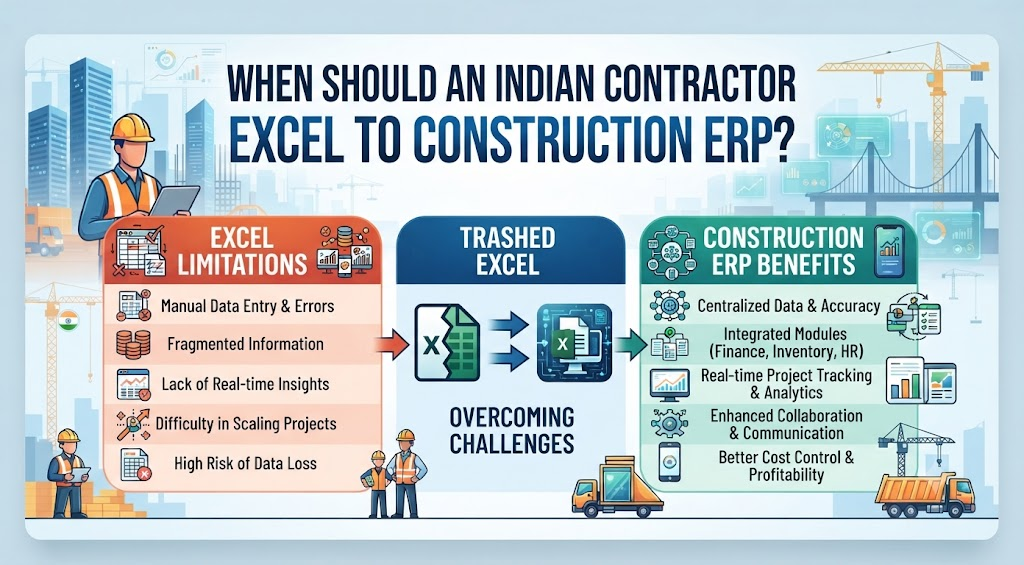
When Should an Indian Contractor Move From Excel to Construction ERP?
Not every contractor needs an ERP immediately. However, the need becomes increasingly clear when project volume, transaction volume and management complexity start increasing. If your teams are maintaining multiple project spreadsheets, repeatedly reconciling data, struggling to obtain real-time project costs or preparing management reports manually, the issue is no longer simply spreadsheet convenience.
It is a process-control issue. Similarly, if your company is managing multiple sites, subcontractors, material locations, customer billing and project-wise profitability, a construction ERP can provide a more structured operating environment. The right time to evaluate ERP is therefore not necessarily when Excel completely fails. It is when the cost of maintaining control through Excel starts affecting decision-making.
Can Construction ERP Replace Excel Completely?
Not necessarily. Excel can remain useful for analysis, temporary calculations and specialised scenarios. The objective should not be to eliminate every spreadsheet. Instead, the objective is to ensure that critical business transactions do not depend on uncontrolled spreadsheets.
A practical approach is to keep Excel where it adds value while using ERP as the central source for operational and financial information. This gives teams flexibility without allowing spreadsheets to become the system of record for the entire construction business.
How Construction ERP Solves the Excel Problem
The transition from Excel to ERP should not be treated as simply purchasing software. First, the contractor needs to identify where information is currently being created, approved, transferred and reported. Then, the ERP should be configured around those workflows.
For example, a material purchase can move from requirement to purchase order, receipt, inventory update, project allocation and accounting. Likewise, subcontractor work can move through work orders, measurements, bills, approvals and payment tracking. When these processes are connected, the business reduces the number of manual handoffs. That is ultimately the value of construction ERP: connecting information before the business loses control of it.
How AI Can Make Construction ERP More Useful
AI is increasingly becoming relevant to business software because ERP systems contain large volumes of structured operational data. For construction companies, AI-assisted analysis can potentially help identify unusual cost movements, delayed transactions, recurring purchasing patterns, abnormal consumption or changes in project performance.
However, AI should not be treated as a replacement for project managers or financial professionals. Instead, its practical value comes from helping people find important information faster. For example, instead of manually comparing months of project expenditure, an AI-enabled analytics layer could highlight significant deviations for management review. The quality of those insights still depends on the quality, consistency and completeness of the underlying ERP data.
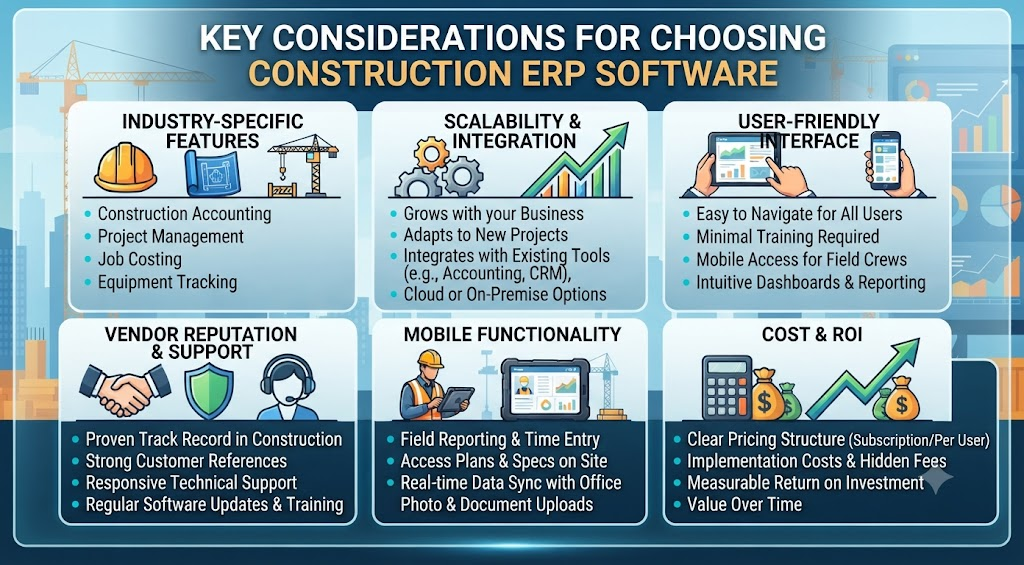
What Should Contractors Check Before Buying Construction ERP Software?
The most important question is not how many features appear in the product brochure. Instead, contractors should examine whether the system can handle their actual workflow. Can it track projects separately? Can it connect procurement and inventory? and it manage subcontractors? Can finance see project-wise costs? management access dashboards? Can approvals be controlled? Can the system support GST-related processes? it scale as projects increase?
Furthermore, contractors should ask how easily the software can adapt when their processes change. A rigid ERP may create a different problem: the company starts changing its business process to fit the software. A flexible or no-code ERP approach can reduce that dependency by allowing workflows and business processes to be configured more efficiently.
Construction ERP vs Excel: The Real Cost Is Bigger Than Software Price
Excel may appear inexpensive because the software itself is familiar and widely available. However, the real cost of a system includes employee time, duplicate entry, reconciliation, delayed reporting, project overruns, material control problems, billing delays and decisions made using outdated information.
Therefore, comparing only the licence cost of Excel with the purchase price of ERP does not provide a complete business comparison. The better comparison is between the cost of maintaining fragmented information and the cost of creating controlled, connected information. For a growing contractor, that difference can become significant.
Frequently Asked Questions About Construction ERP vs Excel
Is Excel good enough for a small construction company?
Excel can be useful for a small construction company with limited projects and simple processes. However, as project volume, employees, subcontractors and transactions increase, maintaining reliable information across spreadsheets becomes more difficult.
What is construction ERP software?
Construction ERP software is a business management system designed to connect construction-related processes such as project costing, procurement, inventory, subcontracting, billing, accounting, approvals and management reporting.
Why do contractors move from Excel to ERP?
Contractors generally consider ERP when spreadsheets become difficult to maintain across multiple projects, when reporting takes too much manual effort, or when management needs more reliable project-wise financial and operational visibility.
Can ERP track project-wise profitability?
Yes. Depending on the ERP’s capabilities and configuration, project-related revenues and costs can be associated with individual projects, allowing management to analyse project financial performance more systematically.
Is construction ERP useful for multiple project sites?
Yes. Multi-project and multi-site environments are among the situations where centralised ERP systems can provide value because procurement, inventory, project costs, billing and finance can be managed through connected processes.
Is construction ERP better than Excel?
The answer depends on the size and complexity of the contractor. Excel can work well for simple tasks, while construction ERP becomes increasingly useful when a business needs connected workflows, project-level control, multi-site visibility and structured reporting.
A Practical Next Step for Indian Contractors
If your team is currently using Excel for project costing, procurement, subcontractor management, material tracking and financial reporting, do not start by replacing everything at once. Instead, map one active project. Compare the estimated cost with actual expenditure. Check how many spreadsheets are involved. Identify how many times the same information is entered. Then measure how long management takes to obtain a reliable project report.
That exercise often reveals the real cost of the current system. Bluechip Solutions provides ERP solutions designed to connect business processes, reporting and automation through a central platform. Its ProfitPlus ERP/Auvit approach is positioned around no-code business process automation, allowing organisations to adapt workflows without treating every process change as a major software development project.
For a construction company evaluating ERP, the useful next step is not a generic software demonstration. It is a discussion around your actual project workflow, costing structure, procurement process, subcontractor management and reporting requirements.
Request a construction ERP consultation or schedule a personalised ERP demo to see how your current Excel-based processes can be structured into a connected ERP workflow.
The goal is simple: less time reconciling spreadsheets, more time controlling projects.