
AI-Powered Accounting ERP: How Businesses Can Reduce Errors and Improve Financial Control

A finance team can spend hours correcting accounting errors that should never have happened in the first place. A duplicate invoice, an incorrect ledger entry, an unreconciled bank transaction, or an approval that remains pending can quickly affect cash-flow visibility and management reporting.
However, the problem is rarely the accounting team’s lack of effort. More often, disconnected systems, manual data entry, spreadsheets, delayed reconciliations, and approval bottlenecks create the conditions for these errors. That is where an AI accounting ERP can make a practical difference.
Instead of treating accounting as a separate back-office function, an AI-powered ERP connects financial transactions with purchasing, sales, inventory, production, projects, payments, and approvals. Moreover, AI-based algorithms can identify unusual patterns, highlight exceptions, automate repetitive reconciliation work, and help finance teams focus on transactions that actually require human attention.
For businesses looking to strengthen financial control without continuously increasing manual accounting work, this approach offers a more connected way to manage finance.
What Is an AI Accounting ERP?
An AI accounting ERP combines traditional enterprise resource planning with artificial intelligence, automation, accounting controls, and real-time business data. A conventional accounting system primarily records financial transactions. An ERP goes further by connecting those transactions to the operational events that created them.
For example, when a purchase order leads to a goods receipt and subsequently to an invoice, the accounting system should not need finance employees to repeatedly enter the same information. Instead, the ERP can connect these transactions and maintain the financial trail automatically.
AI adds another layer. Rather than simply storing information, the system can analyse transaction patterns and identify exceptions. Depending on the implementation, AI algorithms can assist with transaction classification, anomaly detection, reconciliation, document processing, forecasting, and decision support.
Therefore, the objective is not to replace accountants. The objective is to reduce unnecessary manual work while giving finance teams better control over what requires their attention.
Why Businesses Still Struggle With Accounting Errors
Accounting errors often begin outside the finance department. A sales order may contain incorrect information. A purchase invoice may arrive with a mismatch. Inventory may be updated later than the physical movement. An employee may enter the same transaction twice. Meanwhile, a payment can remain unreconciled because the supporting information exists in another system.
Consequently, finance teams often discover operational problems only when they reach the accounting stage. Spreadsheets can make this more difficult. Although spreadsheets remain useful for analysis, relying on multiple disconnected files for core financial processes can create version-control problems and make it difficult to establish a single source of truth.
An AI accounting ERP addresses this problem by connecting transactions across departments and creating a continuous flow of information.
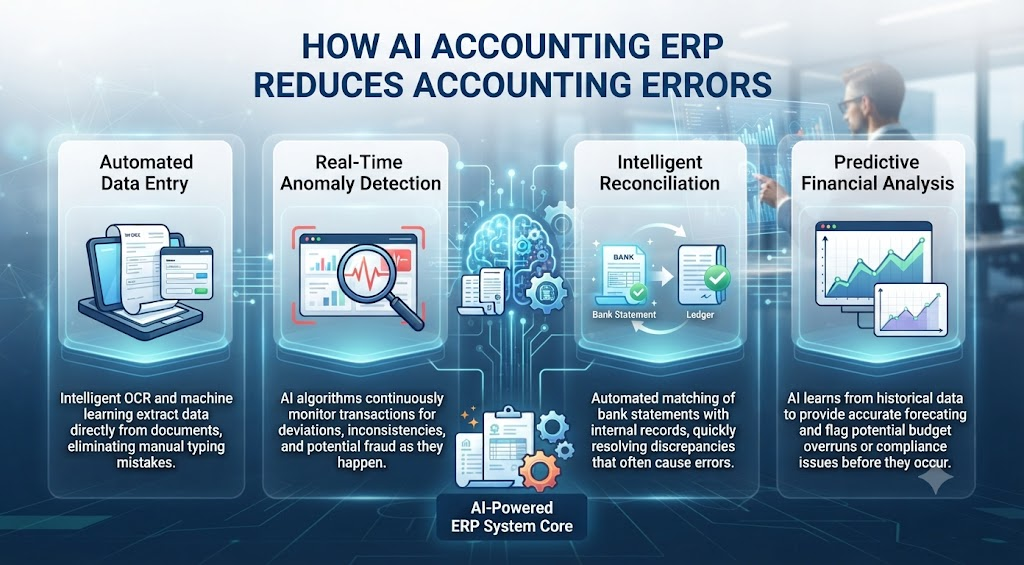
How AI Accounting ERP Reduces Accounting Errors
Automated Data Capture Reduces Manual Entry
Manual data entry creates a simple but expensive problem: every additional manual touchpoint creates another opportunity for an error. AI-enabled document processing can extract relevant information from invoices and other financial documents, subject to the quality of the document and the capabilities of the implementation. The extracted information can then be validated against ERP records and business rules before posting.
For example, the system can compare an invoice with the relevant purchase order and goods receipt. If the quantities or values do not match, the transaction can be flagged instead of being processed blindly. As a result, finance teams can spend less time checking routine transactions and more time investigating exceptions.
AI-Based Anomaly Detection Identifies Unusual Transactions
Not every unusual transaction is an error. However, unusual activity deserves attention. AI models can analyse historical transaction patterns and identify deviations based on factors such as transaction value, frequency, supplier behaviour, timing, account combinations, or other available business data.
For instance, if a supplier normally receives invoices within a predictable range but suddenly submits an unusually large invoice, the ERP can flag the transaction for review. Importantly, the system should assist rather than make unsupported financial decisions automatically. Human review remains important, particularly when an anomaly could represent a legitimate business event.
Duplicate Transaction Detection Strengthens Control
Duplicate invoices and repeated entries can directly affect accounts payable and cash flow. An AI accounting ERP can compare transaction attributes such as supplier, invoice number, date, amount, purchase order, and other relevant fields. When the system detects a potential duplicate, it can alert the responsible user before payment processing.
This approach changes the workflow from discovering errors after posting to preventing or reviewing them before they become financial problems.
AI-Powered Reconciliation for Better Financial Accuracy
Bank reconciliation is one of the areas where finance teams can lose significant time. When transactions from banks, payment gateways, accounting records, and ERP modules do not automatically align, employees may have to compare records manually. An AI-enabled reconciliation process can match transactions using predefined rules and pattern-based techniques. Straightforward matches can move through the process automatically, while exceptions can be presented to the finance team.
For example, a customer payment may appear in the bank statement without an immediately obvious reference. The system can use available transaction information to identify potential matches and present them for confirmation. Therefore, instead of reviewing every transaction with the same level of effort, accountants can concentrate on unmatched and unusual items.
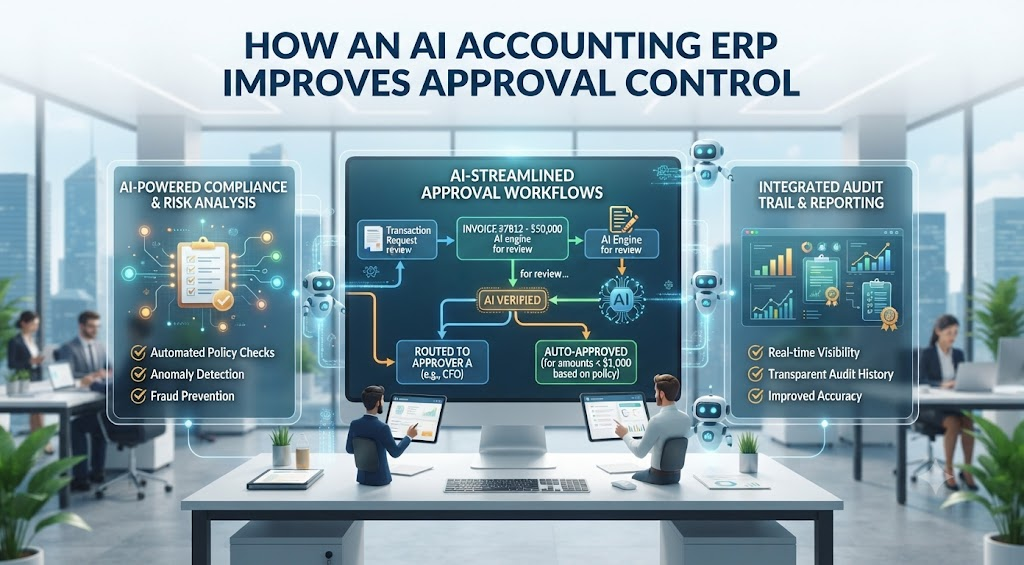
How an AI Accounting ERP Improves Approval Control
Financial control does not stop with accurate accounting entries. Businesses also need controlled approvals. A purchase invoice, expense claim, credit note, payment request, or purchase order may require approval based on value, department, project, location, or authority level.
When these approvals happen through email or informal communication, management can lose visibility into who approved what and when. An ERP can enforce predefined approval workflows. Moreover, AI can help identify unusual approval patterns or transactions that fall outside established norms, depending on the system’s capabilities.
This creates a clearer audit trail and reduces the risk of transactions bypassing established controls.
Real-Time Financial Visibility for Business Leaders
A financial report is only useful when decision-makers can trust the information behind it. If sales, inventory, purchases, receivables, payables, and accounting records are maintained separately, management may have to wait for finance teams to consolidate information before making decisions. An integrated ERP changes this workflow.
When business transactions flow into a central system, management can monitor relevant financial indicators closer to the time when transactions occur. Dashboards can bring together information such as receivables, payables, expenses, sales, inventory value, cash positions, and outstanding approvals. AI can then add analytical context by identifying patterns and exceptions.
For example, instead of simply showing that receivables increased, an AI-enabled system can help identify customers, transaction groups, or periods contributing to the change. That distinction matters because visibility is not simply about seeing more data. It is about finding the information that requires action.
AI Accounting ERP for CFOs and Finance Teams
For CFOs and finance leaders, the value of an AI accounting ERP goes beyond automation. The bigger objective is financial control with fewer blind spots. When financial and operational data share the same system, finance leaders can trace transactions back to their business origin. They can investigate discrepancies, monitor approval bottlenecks, analyse cash-flow movements, and review exceptions without depending entirely on manually prepared reports.
At the same time, accountants can move away from repetitive transaction checking and focus more on analysis, compliance, controls, and business support. This creates a more useful division of responsibility: automation handles predictable work, while people handle judgement.
AI Accounting ERP and the Human-in-the-Loop Approach
A common concern about AI in finance is whether businesses should allow algorithms to make financial decisions independently. For most organisations, a controlled human-in-the-loop approach is more practical. AI can identify a potential duplicate, recommend a transaction match, flag an unusual payment, classify information, or highlight an exception. However, financial teams can review the recommendation before final action where appropriate.
This approach combines computational speed with human judgement. It also creates an important control principle: AI should make financial teams more informed, not make financial accountability disappear.
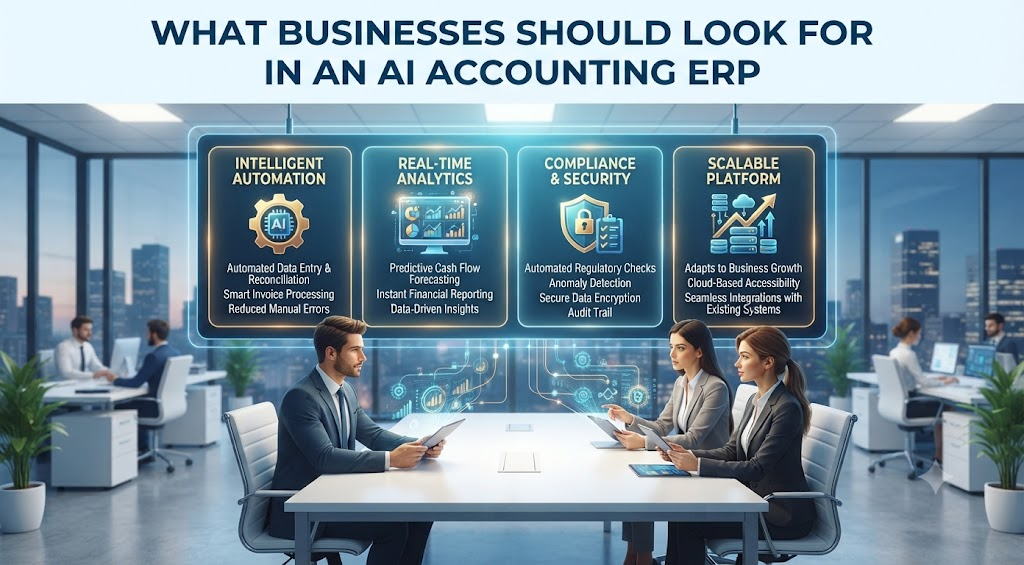
What Businesses Should Look for in an AI Accounting ERP
Choosing an AI accounting ERP requires more than checking whether a vendor uses the word “AI.” The important question is how the technology works inside actual financial processes. Businesses should examine whether accounting connects with sales, purchasing, inventory, production, projects, banking, payments, and approvals. They should also examine audit trails, access controls, approval workflows, exception handling, reporting, integration capabilities, and data governance.
Furthermore, companies should understand what AI capabilities are actually available rather than assuming that every ERP feature labelled “AI-powered” provides the same functionality. A useful evaluation should begin with the business problem: Which accounting process creates the most manual work? Where do errors occur? Which reconciliations consume the most time? Where does management lack visibility?
The ERP should then be evaluated against those specific problems.
AI Accounting ERP vs Traditional Accounting Software
Traditional accounting software can remain effective for businesses with relatively straightforward financial requirements. However, complexity increases when an organisation manages multiple departments, locations, inventory processes, manufacturing operations, projects, approval levels, or high transaction volumes.
At that stage, the challenge is no longer simply recording accounts. The business needs connected financial control. An AI accounting ERP can provide that connection by bringing operational and financial information into a common workflow while using automation and AI-assisted analysis to identify exceptions.
Therefore, the decision should not be based solely on whether a business needs “AI.” It should be based on whether disconnected financial processes are creating measurable operational and control problems.
How to Implement AI Accounting ERP Without Creating Another Problem
Technology alone cannot fix a poorly designed accounting process. Businesses should first document their current workflows and identify where errors, delays, duplicate work, and approval bottlenecks occur. Next, they should establish clear accounting rules, master-data standards, user permissions, approval hierarchies, and reconciliation procedures.
After that, AI automation can be introduced where it provides measurable value. Starting with high-volume, rule-driven processes is often more practical than attempting to automate every financial decision at once. The organisation can then monitor results, review exceptions, improve workflows, and gradually expand automation. This approach also gives employees time to understand how the new system changes their responsibilities.
The Future of Financial Control Is Exception-Driven
The direction of accounting automation is increasingly moving away from manually reviewing every transaction and towards exception-based management. That means the system handles predictable activities according to configured rules, while finance professionals concentrate on transactions that require investigation, judgement, or approval.
AI accounting ERP technology supports this model by combining transaction data, business rules, automation, analytics, and AI-assisted pattern recognition. The result is not simply faster accounting. It is a finance function that can see problems earlier, investigate them faster, and maintain stronger control over the financial side of the business.

How Bluechip Solutions Can Help Businesses Build Connected Financial Control
For businesses evaluating an AI accounting ERP, the starting point should be the actual accounting and operational challenges they face. Bluechip Solutions’ ProfitPlus ERP brings business processes together across areas such as finance, sales, purchasing, inventory, manufacturing, and other operational functions. Its no-code approach also supports business-specific process configuration without treating every organisation as if it follows the same workflow.
For companies that need to move beyond disconnected accounting tools, spreadsheets, and manually coordinated processes, an integrated ERP can provide a stronger foundation for financial visibility and process control. The next step is to map your current accounting workflow, identify the highest-risk manual processes, and determine where automation can produce measurable improvement.
Ready to identify where accounting automation can reduce manual work and improve financial control?
Get a Free ERP Consultation
Discuss your accounting workflow, reconciliation challenges, approval processes, reporting requirements, and integration needs with the Bluechip Solutions team.
Schedule a Free ERP Consultation
Download the AI Accounting ERP Evaluation Checklist
Before selecting an ERP, evaluate its accounting automation, reconciliation, approval workflow, financial visibility, audit controls, integration, scalability, and AI capabilities.
Get the AI Accounting ERP Checklist
Frequently Asked Questions About AI Accounting ERP
What is an AI accounting ERP?
An AI accounting ERP combines ERP-based financial management with artificial intelligence, automation, analytics, and connected business data. It can assist with accounting processes such as data capture, reconciliation, anomaly detection, approvals, reporting, and financial analysis.
Can AI accounting ERP eliminate accounting errors?
No system can guarantee that every accounting error will disappear. However, automation, validation rules, duplicate detection, reconciliation, approval workflows, and AI-assisted anomaly detection can reduce opportunities for manual errors and help teams identify exceptions earlier.
How does AI improve bank reconciliation?
AI-enabled reconciliation can analyse transaction information and identify potential matches between bank records and ERP transactions. Routine matches can be processed according to configured rules, while unmatched or unusual transactions can be routed to finance users for review.
Is AI accounting ERP suitable for SMEs?
It can be suitable for SMEs when the business has growing transaction volumes, multiple operational processes, complex approvals, inventory requirements, or a need for stronger financial visibility. The appropriate solution depends on the organisation’s processes, transaction complexity, budget, and implementation requirements.
Does AI replace accountants?
AI accounting ERP is generally designed to automate repetitive activities and support financial analysis rather than eliminate the need for accountants. Human professionals remain important for judgement, financial controls, compliance, exception review, and business decision-making.
Conclusion
Accounting accuracy depends on more than entering transactions correctly. It depends on how purchasing, sales, inventory, payments, approvals, reconciliation, and finance work together. An AI accounting ERP can connect these processes while using automation and AI-assisted analysis to reduce repetitive work, identify unusual transactions, improve reconciliation, strengthen approval controls, and provide better financial visibility.
For businesses dealing with spreadsheet dependency, manual reconciliation, delayed reporting, or fragmented financial information, the most important question is not whether AI sounds innovative.
The more practical question is:
Where are manual financial processes creating errors, delays, and blind spots—and how can an integrated ERP help control them?
That is where AI-powered accounting becomes a business solution rather than simply another technology feature.