
Construction ERP Software in India: 15 Must-Have Features for Builders & Contractors in 2026

A construction project can look profitable on paper and still lose money during execution. A material purchase may exceed the estimate, labour costs can rise unexpectedly, subcontractor bills may arrive late, or a running-account bill can remain pending while project expenses continue. When these issues are tracked across Excel sheets, WhatsApp messages, registers and disconnected accounting systems, management often discovers the problem only after the margin has already disappeared.
That is why Construction ERP Software in India is becoming increasingly important for builders, civil contractors, infrastructure companies, real estate developers and project-based construction businesses.
The need is also becoming more pressing as construction activity continues to expand. Government data released in 2026 showed infrastructure and construction goods growing year over year, including 6.9% growth in July 2026. At the same time, recent research on Indian public housing projects highlights how delays and cost overruns remain significant project-management challenges.
However, simply buying an ERP is not enough. The software must actually understand how construction businesses operate. So, what should builders and contractors look for in 2026?
What Is Construction ERP Software?
Construction ERP software is an integrated business management system designed to connect construction activities such as estimation, BOQ management, project execution, procurement, inventory, labour, subcontracting, billing, finance and reporting within a common platform. Unlike generic accounting software, a construction ERP follows the project lifecycle from estimation to execution and finally billing and profitability analysis.
This distinction matters because construction companies do not simply sell products. They execute projects involving multiple sites, materials, labour teams, subcontractors, vendors, equipment, approvals and client payments.
Therefore, the right ERP should give management a clear answer to a critical question at any time: How much have we spent, how much work is completed, how much remains, and are we still going to make the expected profit?
1. Project Estimation and BOQ Management
Poor estimation is one of the easiest ways for a construction project to become unprofitable. If the original estimate is maintained separately from actual purchases, material consumption and labour expenses, there is no reliable baseline for measuring project performance. A strong construction ERP should allow companies to create detailed estimates and Bills of Quantities while maintaining quantities, rates, materials, labour and other project costs.
The real advantage comes when the BOQ becomes a live reference rather than a document created only during tendering. Actual consumption and expenditure can then be compared with the approved estimate. As a result, project managers can identify deviations earlier instead of discovering them when the project is nearly complete.
2. Real-Time Project Costing and Budget Control
Construction profitability depends on controlling costs while the project is still running. The problem with traditional systems is that accounts may know the expense, procurement may know the purchase and the site engineer may know the consumption, but nobody sees the complete picture in real time. Construction ERP software should connect budgeted costs with actual expenses across materials, labour, subcontractors, equipment and other project activities.
This makes budget-versus-actual analysis much more meaningful. Moreover, AI-assisted analytics can identify unusual spending patterns and highlight significant deviations for management review. Instead of asking why the project exceeded its budget after completion, management can investigate the variance while corrective action is still possible.
3. Material Procurement and Purchase Management
Material procurement is directly connected to project profitability. When site requirements are communicated through calls, messages or spreadsheets, duplicate purchases, delayed orders and unauthorised purchases become difficult to control. A construction ERP should connect material indents, purchase requests, quotations, purchase orders, approvals, receipts and supplier invoices.
For example, if a site requires steel, the system should allow the requirement to move through the appropriate approval and procurement process while maintaining its connection to the relevant project and BOQ. Consequently, procurement becomes controlled, traceable and project-specific rather than simply recording purchases after they happen.
4. Multi-Site Inventory and Material Tracking
Material does not necessarily remain in one warehouse in construction. It moves from suppliers to central stores, from central stores to project sites and sometimes between different sites. Without proper tracking, management can struggle to determine where materials are actually located. A construction ERP should therefore support site-wise inventory, material receipts, issues, transfers, returns and stock reconciliation.
This becomes particularly valuable for companies managing multiple projects simultaneously. Instead of calling every site supervisor to ask about available stock, management can obtain a consolidated view and make procurement decisions based on actual requirements.
5. Subcontractor Management and Billing
Subcontractors are central to construction execution, yet subcontractor management is frequently disconnected from project costing. A contractor may complete work at a site while the commercial team separately verifies quantities and prepares bills. If these processes are not connected, discrepancies and payment delays can occur.
Construction ERP software should connect subcontractor work orders, agreed rates, work progress, measurements, bills, deductions, retention and payments. This creates a transparent commercial trail. Furthermore, management can compare subcontractor commitments with the original project budget and identify whether subcontracting costs are moving beyond the planned level.
6. RA Billing and Progress-Based Billing
Delayed billing can create a serious cash-flow problem even when project execution is progressing well. Construction businesses frequently work with running-account bills based on completed work, approved measurements, contractual terms and applicable deductions. A construction ERP should therefore support progress-based and RA billing workflows rather than treating every transaction like a standard retail invoice.
When completed work, contract rates, deductions, retention, taxes and previous billing are connected, the billing team can prepare accurate claims faster. That means the company can reduce unnecessary delays between completing work and raising the corresponding claim.
7. Labour and Workforce Management
Labour costs can quickly affect project margins when attendance, overtime and deployment are not properly tracked. Manual registers also make it difficult to consolidate workforce information across several locations. An ERP for construction companies should connect employee and labour records with project allocation, attendance, wages and related costs.
For contractors managing daily-wage workers as well as permanent employees, this creates a clearer understanding of the actual labour cost associated with each project. Therefore, labour management becomes part of project costing rather than remaining an isolated HR activity.
8. Equipment and Machinery Management
Construction equipment represents a significant investment, and poor utilisation can increase project costs. Consider an excavator assigned to a project but sitting idle for several days. If utilisation is not monitored, the company may continue carrying operating, maintenance or rental costs without receiving equivalent project value.
Construction ERP software should track equipment allocation, usage, maintenance, operating costs and project association. With this information, management can make better decisions about whether equipment should be retained, transferred, rented or serviced.
9. Change Order and Variation Management
Construction projects rarely remain exactly as originally estimated. Clients may request additional work, quantities may change, drawings may be revised or site conditions may require modifications. The danger arises when additional work is executed without properly documenting its commercial impact.
A construction ERP should record variations and change orders against the relevant project, estimate and client contract. This creates a clear connection between what changed operationally and what needs to change commercially. As a result, companies are less likely to complete additional work without recovering the associated cost.
10. Financial Accounting and Project-Wise Profitability
Accounting tells a company what happened financially. Construction ERP should go one step further and explain where it happened. Management should be able to view revenue, expenditure, receivables, payables, project costs and profitability by project or business unit. This is particularly important when a company manages multiple projects simultaneously.
One project may appear highly profitable while another silently consumes the company’s cash. Consolidated accounting alone may hide this difference. Project-wise financial visibility therefore allows management to focus attention where it matters most.
11. GST and Compliance Management
Construction companies in India operate within a complex tax and compliance environment. An ERP should support the company’s applicable GST processes, tax calculations, invoices, accounting records and reporting requirements while keeping financial information connected to transactions.
The important point is not simply generating a tax invoice. It is maintaining consistency between procurement, billing, accounting and project records. This reduces manual reconciliation and gives finance teams a more reliable audit trail.
12. Mobile Access for Site Teams
Construction happens at the site, not inside the corporate office. Therefore, an ERP that works well only from a desktop can create adoption problems. Site engineers and supervisors may need to check material requirements, submit information, review approvals or update project progress while working away from headquarters.
Mobile-friendly construction ERP software allows operational information to move from the site to management without unnecessary delays. This is particularly valuable for companies managing geographically distributed projects.
13. Real-Time Dashboards and Management Reports
Senior management should not have to wait until the end of the month to understand project performance. A construction ERP should provide dashboards covering project progress, budget versus actual expenditure, procurement, inventory, receivables, payables, billing and profitability.
More importantly, dashboards should convert raw transactions into decisions. For example, instead of simply showing that material expenditure increased, an intelligent dashboard can highlight which project, cost category or activity is responsible for the deviation. That makes reporting actionable rather than decorative.
14. AI-Powered Analytics and Predictive Insights
AI is becoming an important layer in modern ERP systems, but construction companies should focus on practical applications rather than AI as a marketing label. AI-assisted ERP analytics can examine historical project costs, procurement patterns, billing cycles and operational deviations to identify potential risks.
For example, if material consumption consistently exceeds the expected quantity for a particular activity, the system can flag the variance for investigation. Similarly, predictive analytics can help management identify emerging cost, procurement or cash-flow risks before they become larger problems. The goal is simple: move from reporting what happened to identifying what may happen next.
15. Integrated ERP Across the Complete Construction Lifecycle
The most important feature may actually be integration. A construction company can have excellent accounting software, inventory software and project-management tools and still suffer from poor visibility if these systems do not communicate. The ideal construction ERP connects the workflow from enquiry and estimation to BOQ, procurement, inventory, execution, subcontracting, billing, accounting and project profitability.
This eliminates repeated data entry and reduces information gaps between departments. Consequently, management receives one connected view of the business instead of several conflicting versions of the truth.
How to Choose the Right Construction ERP Software in India
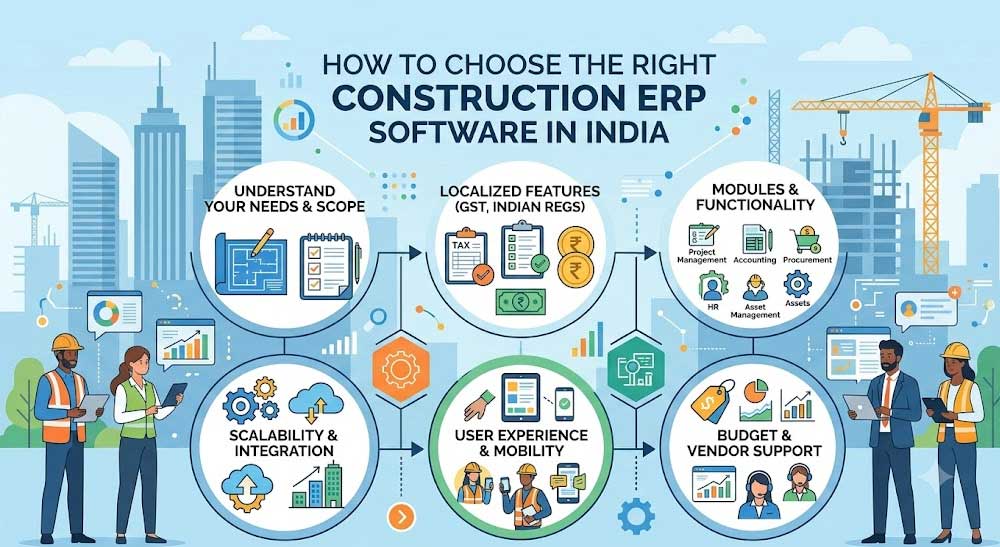
Choosing an ERP should begin with business processes rather than a feature checklist. Before making a decision, construction companies should map their current workflow and identify where money, time and information are being lost. Ask whether the software can handle multiple projects, project-wise costing, BOQ, procurement, site inventory, subcontractor billing, RA billing, GST, accounting, mobile access and management reporting.
Most importantly, ask the vendor to demonstrate these processes using a realistic construction scenario. Do not accept a generic sales presentation. Give the vendor an actual workflow such as:
Estimate → BOQ → Material Indent → Purchase Order → GRN → Site Issue → Subcontractor Work → RA Bill → Client Billing → Collection → Project Profitability.
If the system can demonstrate this complete flow without excessive manual intervention, you have a much stronger basis for evaluating it.
Why Construction ERP Is Becoming a Business Necessity in 2026
Construction companies are handling increasingly complex projects while margins remain highly sensitive to material prices, labour costs, delays, financing and execution efficiency. At the same time, research published in 2026 continues to identify project delays and cost overruns as important challenges in Indian construction.
Therefore, the competitive advantage is no longer simply completing projects. It is knowing which project is profitable, where costs are increasing, which materials are required, how much work has been completed, what can be billed and where cash is getting stuck — before the problem becomes expensive. That is precisely where a well-implemented Construction ERP Software in India can create measurable operational value.
Frequently Asked Questions About Construction ERP Software in India
What is the best ERP software for construction companies in India?
The best ERP is not necessarily the one with the longest feature list. It should match the company’s construction workflow, including estimation, BOQ, procurement, inventory, subcontractors, project costing, RA billing, accounting, compliance and reporting. Builders should evaluate the software using their own real project processes before selecting a solution.
How does Construction ERP reduce project cost overruns?
Construction ERP connects budgets with actual material, labour, subcontractor and other project expenses. This allows managers to identify cost deviations earlier and take corrective action while the project is still active.
Can Construction ERP manage multiple projects and sites?
Yes. A properly designed construction ERP should provide project-wise and site-wise visibility while also giving management a consolidated view across the organisation.
Is Construction ERP useful for small and medium-sized contractors?
Yes. In fact, smaller contractors can benefit significantly when they replace disconnected spreadsheets and manual registers with integrated processes. However, the system should be scalable so that the company can add projects, users and processes as it grows.
Does Construction ERP support AI?
Modern ERP platforms can incorporate AI-assisted analytics, anomaly detection, forecasting and predictive insights. However, companies should evaluate the actual business use cases rather than selecting software simply because it advertises AI.
The Bottom Line: The Right Construction ERP Should Protect Your Project Margin
Construction companies rarely lose profitability because of one dramatic mistake. More often, the margin disappears gradually through material leakage, unplanned purchases, labour inefficiencies, delayed billing, subcontractor variations, cost overruns and poor visibility. That is why the right Construction ERP Software in India should do more than automate accounting. It should connect the entire project lifecycle and help management identify problems while there is still time to solve them.
If your teams are still moving between Excel files, WhatsApp messages, paper registers and separate accounting systems, it may be time to evaluate what an integrated ERP can change.
Want to see how Construction ERP can work for your projects?
Book a free Construction ERP consultation and demo with Bluechip Solutions and explore how project estimation, BOQ, procurement, inventory, subcontractors, billing, accounting and project profitability can be connected in one system.
Lead Magnet: Download the 2026 Construction ERP Buyer’s Checklist and use it to compare ERP vendors before making your investment.
Suggested CTA: Book a Free Construction ERP Demo → See Your Complete Project Workflow in Action