ERP Software Companies in Bangalore: 10 Things to Check Before You Choose One

Choosing among ERP software companies in Bangalore is not simply a matter of comparing features, prices, or software demos. For a growing business, the ERP partner you select can influence financial visibility, inventory accuracy, production efficiency, compliance, employee productivity, customer service, and ultimately the cost of scaling the business.
That is why an attractive demo should never be the final reason to select an ERP vendor. A system may look impressive during a presentation but become difficult to customize after implementation. Likewise, a low initial quotation can become expensive when customization, integrations, training, migration, upgrades, and support are added later.
This matters even more as ERP systems evolve toward cloud, automation, analytics, and AI. A 2026 market report estimates the India ERP software market at approximately USD 1.31 billion, with cloud-native applications and AI-enabled capabilities becoming increasingly important.
Therefore, businesses looking for ERP software companies in Bangalore should evaluate the technology and the implementation partner together. Here are the ten factors that can help you make a safer and more practical ERP decision.
1. Does the ERP Actually Fit Your Business Processes?
The first question is not “How many modules does the ERP have?” It is “How closely can the ERP support the way our business actually operates?” This distinction is critical. A manufacturing company, distributor, construction company, service organization, and retail business may all need finance, inventory, purchasing, sales, and reporting. However, their workflows are completely different.
For example, a manufacturer may require BOM management, production planning, material consumption, work orders, quality control, subcontracting, and production costing. A distributor may instead need dealer management, warehouse transfers, batch tracking, sales orders, dispatch, and outstanding management. The problem occurs when companies change their business processes simply because the ERP cannot accommodate them.
The solution: Demand a process-mapping exercise
Before signing a contract, ask the ERP company to understand your existing workflow. Your vendor should demonstrate how an actual transaction moves from enquiry to quotation, sales order, inventory allocation, delivery, invoicing, accounting, and reporting. Similarly, procurement, production, employee management, approvals, and financial processes should be tested using your real scenarios. A strong ERP implementation starts with your business rather than the software screen.
2. Can the ERP Be Customized Without Becoming Expensive?
Customization is one of the biggest differences between a convenient ERP investment and a long-term technical headache.
Almost every growing company eventually needs changes. You may need a new approval workflow, industry-specific report, additional field, mobile application, integration, dashboard, or automated notification.
The problem is not customization itself. The problem is how customization is delivered. Traditional development-heavy ERP projects can become dependent on programmers for every small change. Consequently, even a simple modification may require additional development time, testing, cost, and vendor involvement.
The solution: Evaluate customization architecture
Ask the ERP provider exactly how customization works. Can workflows be configured? Can forms and reports be modified? business rules be changed without rewriting the core application? Can new applications be created when your requirements evolve? No-code and low-code ERP architectures can be particularly useful here because they can reduce dependence on conventional programming for certain business changes.
Bluechip, for example, positions its AUVIT framework around no-code enterprise application development across web, mobile, data, and AI/ML. The important point, however, is not simply whether a vendor uses the term “no-code.” Ask the vendor to show you a real customization during the evaluation.
3. Does the ERP Support Indian GST and Compliance Requirements?
An ERP can be operationally excellent and still become problematic if compliance is handled poorly. Indian businesses may need GST-related processes, e-invoicing, e-way bills, tax calculations, TDS/TCS, payroll-related statutory requirements, and financial reporting depending on their operations. Therefore, “GST compliant” should not be accepted as a vague marketing statement.
The solution: Test compliance with real transactions
Ask the ERP company to demonstrate your actual tax scenarios. For example, test interstate and intrastate sales, purchases, returns, tax-inclusive pricing, credit notes, debit notes, and relevant reports. Furthermore, ask how regulatory updates are handled. Who maintains the compliance logic when requirements change? Is it included in the support agreement? How quickly are updates released? This question becomes particularly important for businesses operating across multiple states.
4. How Strong Is the ERP Implementation Methodology?
Buying ERP software is only one part of the project. Implementation determines whether the software actually works inside your organization. Businesses frequently experience problems because the vendor starts configuration before properly understanding workflows, data structures, approval hierarchies, user roles, and reporting requirements. Consequently, employees continue using Excel, WhatsApp, or legacy applications even after ERP go-live.
The solution: Look for a structured implementation process
A reliable ERP company should be able to explain how it handles discovery, process mapping, configuration, customization, data migration, integration, testing, training, go-live, and post-go-live support. More importantly, ask whether your employees participate in user acceptance testing. Your team should test real business transactions before the system becomes operational.
Bluechip currently highlights end-to-end ERP implementation, implementation methodology, and ongoing support as part of its ERP offering. A good implementation partner should therefore be accountable not merely for installing software, but for helping your organization successfully adopt it.
5. What Is the Total Cost of ERP Ownership?
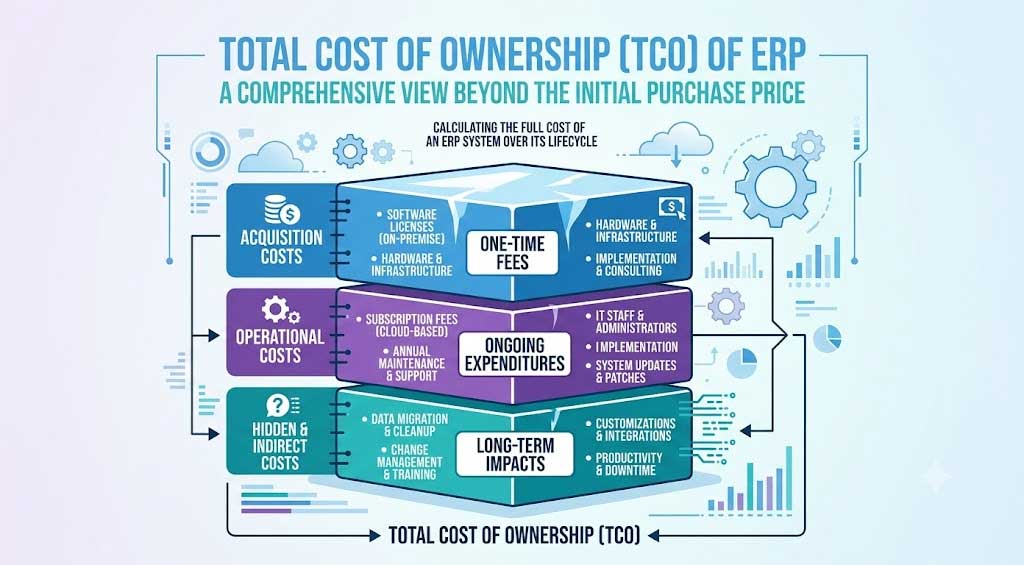
The cheapest ERP quotation is rarely the cheapest ERP project. The initial proposal may cover licenses or subscriptions while excluding implementation, customization, integrations, migration, training, support, upgrades, additional users, infrastructure, and future changes. As a result, businesses sometimes discover the real cost only after the project has started.
The solution: Calculate TCO before comparing vendors
Instead of comparing only the software price, calculate the expected Total Cost of Ownership (TCO) over several years.
Ask:
What is included in implementation? What customization costs extra? Are integrations charged separately? What happens when new users are added? Is support included? Are upgrades included? What are the cloud or hosting costs? What happens if you require a new report or workflow after go-live? A transparent ERP company should be comfortable answering these questions before you sign.
6. Can the ERP Integrate With Your Existing Systems?
ERP should not become another isolated application. Many Bangalore businesses already use accounting tools, CRM systems, e-commerce platforms, payment gateways, HR software, logistics applications, banking systems, or industry-specific applications. If these systems cannot communicate, employees may continue entering the same information multiple times.
The solution: Check APIs and integration capability
Ask whether the ERP provides APIs and integration mechanisms for the systems your company already uses. More importantly, ask the vendor to demonstrate an integration instead of simply saying “API integration is supported.” For example, demonstrate what happens when a sales order is created in one system. Does inventory update automatically? accounting receive the transaction? Does the customer receive a notification? The goal should be a connected business environment rather than another data silo.
7. Is the ERP Scalable as Your Company Grows?
An ERP should solve today’s problems without creating tomorrow’s limitations. Your business may currently have 30 employees, two warehouses, or one manufacturing unit. However, that could change significantly over the next three to five years. Therefore, scalability should include more than the number of users.
The solution: Evaluate business scalability
Ask whether the ERP can support additional branches, warehouses, products, users, business entities, workflows, reports, and integrations. Also consider performance. Can the system handle increasing transaction volumes without becoming slow? Can management access consolidated reports across multiple locations? A scalable ERP should grow with the organization instead of forcing another expensive implementation when the business expands.
8. Does the ERP Use AI for Practical Business Problems?
AI is rapidly becoming part of modern ERP discussions. However, businesses should avoid choosing a platform simply because its marketing material contains the word “AI.” The real question is whether AI improves an actual business process. For example, AI can potentially support forecasting, anomaly detection, document processing, intelligent reporting, demand planning, workflow recommendations, and decision support.
The Confederation of Indian Industry’s 2026 research on AI and ERP highlights the movement toward AI-powered enterprise systems while also identifying data readiness, governance, and execution maturity as important challenges.
The solution: Ask for an AI use case, not an AI presentation
Ask the ERP provider to demonstrate one practical AI scenario using business data. Can the system identify unusual transactions? it assist with forecasting? Can managers ask questions about operational data? repetitive document-related processes be automated? Can the AI capability work with your ERP data securely? This approach separates genuine AI-enabled ERP capabilities from simple marketing claims.
9. How Good Is the Vendor’s Post-Go-Live Support?
ERP problems do not magically disappear after implementation. In fact, the first few months after go-live are often when users discover practical issues that were not visible during testing. Employees may require additional training. Reports may need refinement. Workflows may require adjustment. Integration problems may appear under real workloads.
The solution: Examine the support model before signing
Ask who will support your company after implementation. Will you have a dedicated support team? What is the response time? Is remote support available? Can the vendor provide on-site assistance when necessary? How are critical issues escalated? What is covered under AMC or annual support? These questions matter because vendor support can directly influence ERP uptime, user confidence, and business continuity.
10. Can the ERP Vendor Prove Its Experience?
Finally, do not choose an ERP company based entirely on a polished website or impressive sales presentation. Experience should be verifiable. Look for evidence of implementations in businesses similar to yours. Check whether the vendor understands your industry, company size, compliance environment, and operational complexity.
The solution: Ask for evidence, not promises
Request relevant case studies, implementation references, product demonstrations, client examples, and explanations of previous challenges. Ask the vendor what went wrong in difficult projects and how those problems were solved. That question can reveal more about an implementation partner than asking only about successful projects. For example, Bluechip Solutions states that it is headquartered in Bangalore and provides ERP, implementation, support, AI/ML, and no-code enterprise application capabilities through its AUVIT framework.
Ultimately, the strongest ERP vendor is not necessarily the one with the longest feature list. It is the one that can demonstrate a clear connection between your business problems, the ERP solution, implementation methodology, measurable outcomes, and long-term support.
How to Compare ERP Software Companies in Bangalore Before Making a Decision
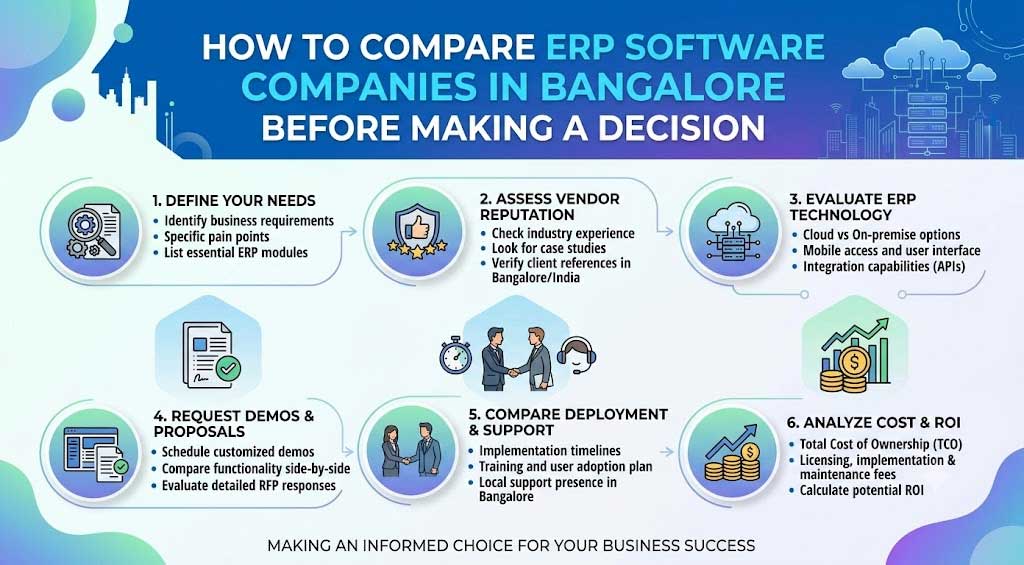
Once you have shortlisted ERP vendors, avoid making the decision based on price alone. Instead, evaluate each provider against the same business scenarios. Give every vendor identical requirements and ask them to demonstrate the workflow. Compare implementation methodology, customization, integration, compliance, scalability, AI capabilities, training, support, and total cost.
Most importantly, involve the people who will actually use the ERP. Finance should evaluate financial workflows. Operations should test operational processes. Production should evaluate manufacturing functionality. HR should assess employee processes. Management should examine dashboards and decision-making visibility. This approach produces a much more realistic comparison than a conventional sales demo.
Why Choosing a Local ERP Partner in Bangalore Can Matter
Bangalore has a strong technology ecosystem, but that does not mean every ERP software company is equally suitable for your organization. A local implementation partner can provide practical advantages when your business requires workshops, process discussions, on-site training, implementation reviews, or faster communication.
However, geographic proximity should not replace capability. The ideal combination is local accessibility + industry knowledge + proven ERP technology + customization capability + implementation expertise + long-term support.
Frequently Asked Questions About ERP Software Companies in Bangalore
Which ERP software company is best in Bangalore?
There is no single ERP company that is best for every business. The right choice depends on industry requirements, company size, workflows, budget, customization needs, integrations, scalability, and implementation support. Businesses should therefore compare vendors using real operational scenarios rather than relying solely on rankings.
How much does ERP software cost in Bangalore?
ERP cost varies significantly depending on the number of users, modules, customization, integrations, deployment model, data migration, training, and support requirements. Therefore, businesses should compare total cost of ownership rather than only the initial software quotation.
What should I ask an ERP company before buying?
Ask about business-process fit, customization, implementation methodology, GST and compliance capabilities, integrations, scalability, AI functionality, data migration, training, support, security, upgrades, and the complete cost of ownership.
Is cloud ERP better for Bangalore businesses?
Cloud ERP can provide easier access, centralized data, scalability, and simplified infrastructure management. However, the right deployment model depends on security requirements, operational needs, integration architecture, budget, and IT capabilities.
Is AI necessary in modern ERP software?
AI is not automatically necessary for every ERP project. Nevertheless, practical AI capabilities can improve forecasting, anomaly detection, automation, analytics, and decision support when the underlying business data is reliable and well governed.
Final Decision: Choose the ERP That Solves Your Problems, Not the One With the Best Demo
The right ERP software company in Bangalore should do more than sell software.
It should understand why your inventory numbers do not match, why management reports arrive late, why employees repeatedly enter the same information, why approvals remain stuck in email or WhatsApp, why production planning is difficult, and why management lacks real-time visibility.
Most importantly, the vendor should be able to translate those problems into a practical ERP roadmap.
The safest approach is therefore simple: map your processes, test real scenarios, calculate total ownership cost, verify implementation capability, examine support, and demand evidence before making the final decision.
If your organization is evaluating ERP software and wants to understand which modules, workflows, customization options, and implementation approach would fit your business, a practical ERP assessment can be a better starting point than another generic software demo.
CTA: Book a Free ERP Consultation with Bluechip Solutions and discuss your current processes, operational challenges, ERP requirements, and possible implementation roadmap with an ERP specialist. Bluechip Solutions currently offers AI-powered ERP, the AUVIT framework, no-code enterprise application capabilities, implementation, and support from its Bangalore headquarters.
Lead Magnet: Download the Free “ERP Vendor Evaluation Checklist” — 30 questions to ask before selecting an ERP software company in Bangalore.