

If you are searching for ERP software cost in Bangalore, you have probably already noticed one frustrating problem: most ERP companies do not show the complete price.
One vendor may advertise a low monthly subscription. Another may quote only the software licence. A third may give you a project price that appears expensive. However, none of these numbers necessarily tells you what your business will actually spend before the ERP becomes fully operational. That is where ERP budgeting becomes difficult.
In 2026, ERP software pricing in India can range from a few lakh rupees for a focused SME implementation to several crores for complex enterprise deployments. Recent Indian market estimates put small and mid-sized ERP projects across a wide range because users, modules, implementation, customization, integrations and business complexity can change the final investment dramatically.
Therefore, the better question is not simply, “How much does ERP software cost in Bangalore?” Instead, the question should be:
“How much will the complete ERP system cost my business to implement, operate, customize and scale?”
That difference can save your company from an ERP project that looks affordable at the beginning but becomes expensive after implementation starts.
What Is the Average ERP Software Cost in Bangalore in 2026?
There is no single ERP software price in Bangalore because ERP systems are not sold as one standard product for every business. A small trading company with 10 users, accounting, inventory and GST requirements has completely different requirements from a 100-user manufacturer managing production, purchase, inventory, quality, finance and multiple warehouses.
As a broad 2026 benchmark, Indian SME ERP projects can fall roughly within the ₹3 lakh to ₹15 lakh+ range for many smaller implementations, while more complex manufacturing, multi-location and customized ERP projects can move into the ₹15 lakh to ₹50 lakh+ range. Large enterprise implementations can go substantially higher. Current Indian ERP cost studies show similarly wide ranges, with implementation and customization often becoming more significant than the initial licence price.
However, these figures should be treated as budgeting benchmarks rather than quotations.
For example, a company requiring only finance, billing and inventory may need a comparatively smaller implementation. On the other hand, a manufacturer requiring production planning, BOM, MRP, quality management, purchase automation, warehouse management, GST, dashboards, mobile access and third-party integrations will naturally require a larger investment. Consequently, comparing ERP prices without comparing scope is one of the biggest mistakes businesses make.
Why ERP Quotes in Bangalore Can Look So Different
The biggest problem with comparing ERP vendors is that every vendor may define “ERP cost” differently. One quotation may include software, implementation and training. Another may show only the subscription. Meanwhile, another vendor may provide a low initial price and charge separately for customization, migration, integrations and support. As a result, three quotations for the same company can look completely unrelated.
The real ERP investment normally consists of several connected costs: software access, implementation, configuration, customization, data migration, integrations, training, infrastructure, support and future enhancements. Recent 2026 Indian ERP cost analyses similarly emphasize that licence or subscription pricing represents only one part of the overall investment. Therefore, when an ERP provider gives you a price, ask what is actually included before comparing it with another quotation.
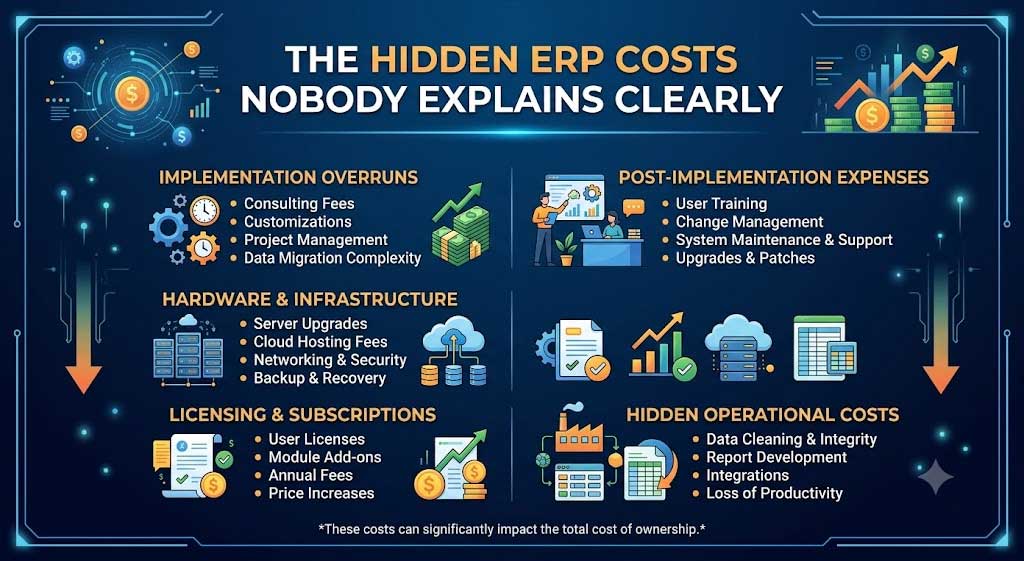
The Hidden ERP Costs Nobody Explains Clearly
The software licence is usually the easiest ERP cost to understand. The difficult part starts after you sign the agreement.
ERP Implementation Cost
Implementation is where your business processes are converted into the ERP system. It can include requirement analysis, process mapping, configuration, workflow setup, user roles, approval structures, testing and go-live support.
For many businesses, implementation can cost as much as or even more than the software licence, particularly when the company has multiple departments, locations or complicated workflows. Some recent Indian estimates place implementation at a substantial share of the first-year ERP budget. Therefore, a quotation showing a low licence price should never be considered automatically cheaper.
ERP Customization Cost
Customization becomes necessary when the standard ERP workflow does not match the way your company operates. For instance, a manufacturer may require a special production approval process. A construction company may require project-wise cost tracking. A distributor may need a particular scheme or commission calculation.
However, excessive customization can increase cost, implementation time and future maintenance. Consequently, the better approach is to customize only where the business process creates genuine operational value.
Data Migration Cost
Many companies underestimate data migration because they assume moving Excel or accounting data into an ERP is simply a matter of uploading a file. In reality, old customer records may contain duplicates. Product codes may be inconsistent. Opening balances may need reconciliation. Supplier information may be incomplete. Historical transactions may follow different structures.
Therefore, data cleaning and migration can become a major part of the ERP project. A good ERP implementation should define exactly what historical data will be migrated, how it will be validated and who will approve the migrated information.
Integration Cost
Your ERP rarely works alone. It may need to communicate with banks, payment gateways, e-commerce platforms, CRM systems, payroll software, biometric devices, WhatsApp services, GST systems or other business applications. Each integration adds technical and testing requirements. Consequently, an ERP quotation that excludes integrations may appear cheaper initially but become considerably more expensive later.
Training and Change Management Cost
Even the best ERP system cannot deliver value if employees continue using Excel, WhatsApp or manual registers instead. Training therefore becomes an important part of the investment. Furthermore, employees need time to understand new workflows, approvals and responsibilities. Management must also monitor adoption after go-live. This is why ERP should not be treated merely as a software purchase. It is a business-process transformation project.
What Actually Determines ERP Software Cost in Bangalore?
The number of users is one major factor, but it is not the only one. The number of modules can significantly affect the project because finance and inventory require a different implementation effort from production, HRMS, CRM, project management or supply-chain automation. Similarly, the number of branches and warehouses affects the configuration and reporting structure.
Business complexity matters even more. A company operating from one location with standardized processes can generally implement ERP more easily than a business operating across several branches with different approval workflows. Furthermore, integrations, custom reports, mobile applications, dashboards, approval workflows, security requirements and historical data can all influence the final cost.
Therefore, a vendor should ideally calculate your ERP investment after understanding your business rather than giving you an arbitrary number over a phone call.
Cloud ERP vs On-Premise ERP: Which Costs Less?
Cloud ERP often looks attractive because businesses can avoid large upfront infrastructure investments. Instead, the company typically pays through a subscription or recurring pricing model. On-premise ERP, on the other hand, may require servers, infrastructure, backup systems, security management and internal technical resources.
However, the cheapest deployment model is not necessarily the cheapest over three to five years. The right comparison is Total Cost of Ownership (TCO).
For example, a cloud system may have a higher recurring subscription but lower infrastructure and maintenance requirements. Conversely, an on-premise solution may provide greater control but require additional investment in hardware, maintenance and IT administration. Therefore, Bangalore businesses should compare the expected three-year or five-year cost rather than looking only at the first invoice.
Why Cheap ERP Software Can Become Expensive
Suppose a company chooses ERP software primarily because it is the cheapest quotation. Initially, the decision may appear financially sensible. However, after implementation begins, the company discovers that essential reports are extra. Data migration is excluded. Integrations require additional charges. Custom workflows are billed separately. Training is limited. Support is available only under another plan.
Consequently, the original “cheap ERP” can become more expensive than a properly scoped solution. This is why the right ERP question is not:
“Which vendor has the lowest price?”
It is:
“Which vendor provides the highest business value for the total investment?”
That distinction is particularly important for growing SMEs.
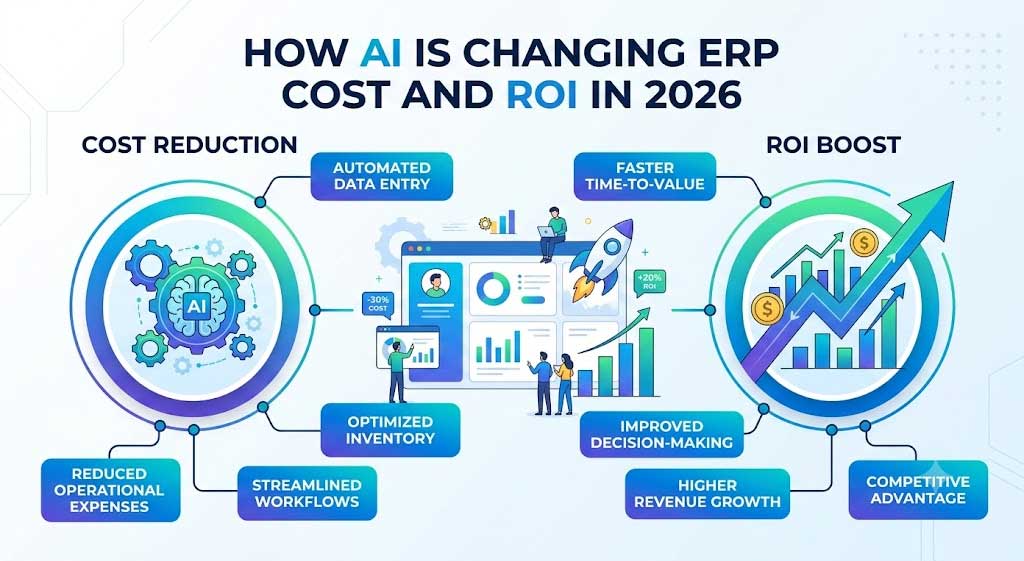
How AI Is Changing ERP Cost and ROI in 2026
ERP systems are increasingly moving beyond transaction recording toward intelligent decision support. AI can help businesses identify unusual transactions, forecast demand, detect anomalies, summarize financial information and provide decision-support insights. However, AI should not be added simply because it appears in a product brochure.
The real value comes when AI solves a measurable business problem. For example, predictive inventory insights can help reduce excess stock. Automated invoice processing can reduce manual accounting work. Intelligent dashboards can help management identify exceptions faster.
At the same time, AI requires reliable business data, appropriate governance and well-defined processes. A 2026 Confederation of Indian Industry report on AI and ERP transformation similarly highlights data readiness, governance and execution maturity as important challenges in realizing value from AI-enabled enterprise systems. Therefore, when evaluating an AI-enabled ERP, ask how the AI improves your actual workflow rather than simply asking whether the software “has AI.”
How to Calculate the Real ERP Budget Before Buying
The safest approach is to calculate the Year-One Total ERP Cost. Start with the software or subscription cost. Then add implementation, customization, data migration, integrations, training, support and infrastructure where applicable. After that, estimate the recurring annual cost.
Finally, calculate the expected three-year Total Cost of Ownership. For example, a company should not compare an ERP subscription of ₹2 lakh per year against another ERP quotation of ₹6 lakh without checking implementation, customization and support costs.
The second system may actually be cheaper over three years if more services are included and fewer custom developments are required. Therefore, always ask every ERP vendor to provide a written Year-One Total Cost and an estimated Three-Year TCO based on exactly the same scope.
How Bangalore Businesses Can Reduce ERP Implementation Cost
Reducing ERP cost does not mean choosing the cheapest software. Instead, it means removing unnecessary complexity. Start with the processes that create the greatest operational problems. Then prioritize the modules that directly address those problems.
For example, if inventory inaccuracies are causing financial losses, inventory and purchasing should receive priority. If production visibility is the biggest problem, manufacturing and planning should be addressed early. Furthermore, avoid unnecessary customization during the first phase.
A configurable ERP or no-code/low-code ERP platform can sometimes reduce the time and cost associated with modifying business workflows because changes can be configured more quickly than traditional development. The objective should be simple: pay for business value, not unnecessary software complexity.
What Should Be Included in an ERP Quote?
Before signing an ERP agreement in Bangalore, ask the vendor to clearly document what the quoted price includes. The proposal should explain the software or subscription charges, implementation scope, number of users, modules, customization, data migration, integrations, training, testing, go-live support, annual maintenance and future enhancement charges.
It should also explain the expected implementation timeline and the responsibilities of both the vendor and customer. Most importantly, ask:
“What costs could I be charged for after signing this agreement?”
That single question can reveal hidden implementation expenses before they become a problem.
Is ERP Software Worth the Investment for a Bangalore SME?
For a growing business, ERP can be valuable when operational inefficiency is already costing more than the ERP investment. If employees spend hours reconciling spreadsheets, management cannot see real-time inventory, finance closes accounts slowly, purchase decisions are based on incomplete information or different departments maintain disconnected data, the company is already paying an invisible cost.
ERP attempts to replace that fragmented environment with connected processes and centralized information. Therefore, the ROI should not be measured only by software savings. It should also consider reduced manual work, faster reporting, improved inventory control, fewer errors, better purchasing decisions, improved visibility and faster management decision-making.
Frequently Asked Questions About ERP Software Cost in Bangalore
How much does ERP software cost in Bangalore?
ERP software cost in Bangalore varies significantly according to users, modules, implementation complexity, customization and integrations. For many Indian SMEs, 2026 project budgets can range from several lakh rupees to ₹15 lakh or more, while complex manufacturing and enterprise implementations can reach ₹50 lakh or significantly higher.
What is the ERP implementation cost in Bangalore?
ERP implementation cost depends on the scope of configuration, customization, migration, integrations, testing and training. It can represent a significant portion of the first-year ERP investment and should always be quoted separately from the software licence.
Is cloud ERP cheaper than traditional ERP?
Cloud ERP can reduce upfront infrastructure and IT maintenance costs, but the best option depends on the company’s users, modules, integrations and expected usage period. Comparing three-year Total Cost of Ownership provides a better answer than comparing only the monthly subscription.
What is the biggest hidden ERP cost?
Implementation, customization, data migration, integrations and training are among the costs most frequently underestimated. Therefore, businesses should request an all-inclusive implementation scope before selecting an ERP vendor.
How can I get an accurate ERP cost for my company?
The most accurate estimate requires information about your number of users, business locations, departments, required modules, existing software, integrations, data migration requirements and customization needs. A vendor should use this information to prepare a scope-based quotation rather than giving you a generic ERP price.
The Real ERP Cost Is the Cost of Getting Your Business Under Control
The cheapest ERP quotation is not necessarily the most economical decision. Likewise, the most expensive ERP is not automatically the best solution. The right ERP investment is the one that fits your business processes, budget, growth plans and operational requirements without forcing you to pay for unnecessary complexity.
For Bangalore businesses evaluating ERP in 2026, the safest strategy is therefore to compare total implementation cost, recurring cost, customization requirements, scalability, support and expected business ROI rather than comparing licence prices alone. If you are currently comparing ERP vendors, do not make the decision from a single quotation.
Get your ERP scope assessed first.
Bluechip Solutions can help businesses evaluate ERP requirements based on users, modules, workflows, industry requirements, customization and implementation needs before making a technology decision.
CTA: Request an ERP Cost Consultation and get a practical budget estimate based on your business requirements.
Lead Magnet: Download the “ERP Cost Checklist for Indian Businesses 2026” to understand what should be included in an ERP quotation before you sign a contract.