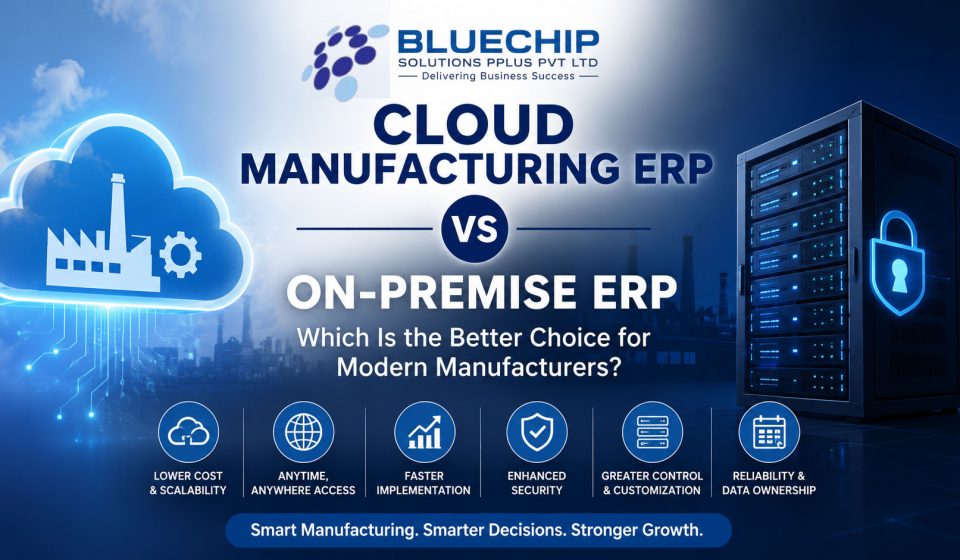
Cloud Manufacturing ERP vs On-Premise ERP: Which Is the Better Choice for Modern Manufacturers?

Manufacturing companies are under constant pressure to reduce production costs, improve efficiency, eliminate manual errors, maintain compliance, and deliver products faster than ever before. However, many manufacturers still struggle with disconnected software, spreadsheets, legacy systems, delayed reporting, and rising IT maintenance costs. As production complexity increases, choosing the right ERP deployment model becomes one of the most important technology decisions for business growth.
The biggest question manufacturers ask is simple: Should you invest in Cloud Manufacturing ERP or continue with an On-Premise ERP?
The answer depends on your business goals, operational challenges, scalability requirements, and long-term digital transformation strategy. This comprehensive guide explains every important difference, helping manufacturers make an informed decision based on current industry trends, AI-driven manufacturing practices, cybersecurity requirements, and future-ready ERP capabilities.
What Is Cloud Manufacturing ERP?
Cloud Manufacturing ERP is an enterprise resource planning system hosted on secure cloud infrastructure instead of your company’s local servers. Users access the software through a secure internet connection from desktops, laptops, tablets, or mobile devices.
Unlike traditional software installations, cloud ERP providers manage the infrastructure, backups, security patches, software updates, and disaster recovery, allowing manufacturers to focus entirely on production and business growth.
Modern cloud ERP platforms integrate production planning, inventory management, procurement, finance, HR, CRM, quality control, warehouse management, sales, supplier collaboration, and analytics into one centralized platform.
More importantly, cloud ERP now incorporates Artificial Intelligence, predictive analytics, IoT integration, machine learning, and real-time dashboards to support smarter manufacturing decisions.
What Is On-Premise ERP?
On-Premise ERP is installed directly on servers located inside the company’s own facility. The business owns and manages the complete infrastructure, including servers, networking equipment, operating systems, databases, software updates, cybersecurity, and backups.
Although this model provides greater infrastructure control, it also requires significant capital investment, dedicated IT resources, regular maintenance, and periodic hardware upgrades.
Many manufacturing companies adopted On-Premise ERP years ago because cloud technology was still evolving. However, changing business demands are causing organizations to reconsider whether maintaining local infrastructure still delivers the best return on investment.
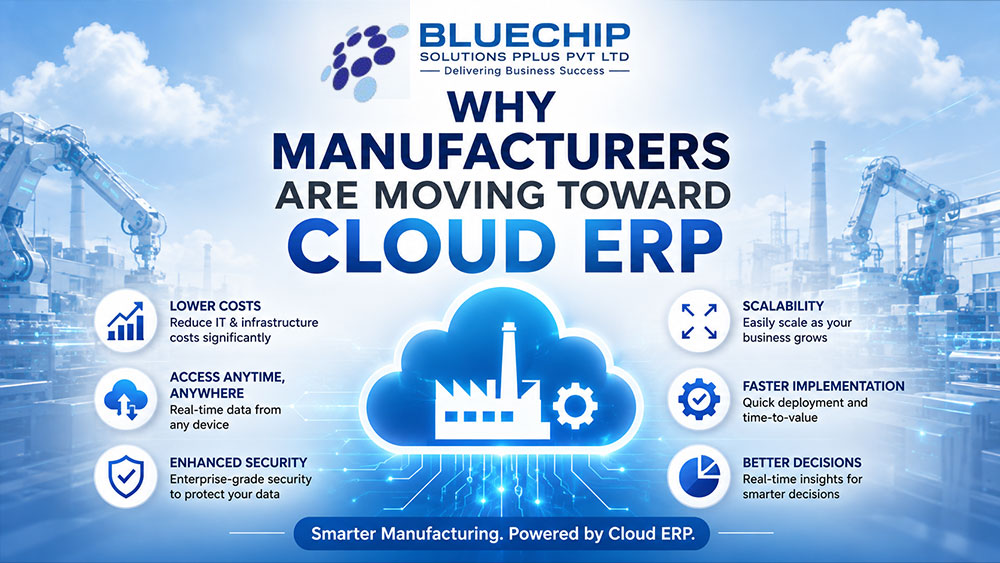
Why Manufacturers Are Moving Toward Cloud ERP
Manufacturing operations no longer happen inside a single factory. Suppliers, distributors, customers, warehouses, remote employees, production plants, and service teams need instant access to accurate business information.
Cloud ERP solves this challenge by providing secure real-time visibility across every business function.
According to multiple industry research reports published during 2025 and 2026, cloud ERP adoption continues to accelerate because manufacturers prioritize scalability, lower infrastructure costs, cybersecurity improvements, AI-driven analytics, and faster deployment over traditional server-based implementations.
Organizations investing in smart factories, Industry 4.0, Industrial IoT, and AI-assisted production planning increasingly prefer cloud-based ERP because it supports continuous innovation without major infrastructure investments.
Cloud Manufacturing ERP vs On-Premise ERP: A Detailed Comparison
Initial Investment
One of the largest barriers to implementing traditional ERP has always been the upfront investment.
An On-Premise ERP requires purchasing servers, networking equipment, database licenses, operating systems, backup solutions, security appliances, disaster recovery infrastructure, and implementation services before the system even becomes operational.
Cloud ERP significantly reduces these initial expenses because businesses pay a predictable subscription fee instead of investing heavily in infrastructure. This allows manufacturers to allocate more capital toward production expansion rather than IT assets.
Implementation Speed
Manufacturers often cannot afford year-long ERP implementations because production interruptions directly affect revenue.
Cloud ERP deployments are generally much faster since infrastructure already exists. Configuration, user training, data migration, and process optimization become the primary implementation activities.
On-Premise ERP projects usually require additional time for infrastructure procurement, server installation, security configuration, hardware testing, and system optimization.
For growing manufacturers, faster implementation means realizing ROI much sooner.
Scalability for Business Growth
Business growth creates new operational requirements.
Adding production units, warehouses, suppliers, users, or international branches can become complicated with traditional infrastructure.
Cloud ERP offers virtually unlimited scalability. Businesses can expand users, storage, processing power, and business modules without purchasing new servers.
This flexibility becomes especially valuable for manufacturers expanding into new markets or increasing production capacity.
Remote Accessibility
Manufacturing leaders frequently travel between factories, supplier locations, customer facilities, and branch offices.
Cloud ERP enables secure access from anywhere using authorized devices, making approvals, production monitoring, inventory tracking, purchase management, and executive reporting available in real time.
Traditional ERP systems often require VPN configurations, complex networking, and additional infrastructure to provide similar remote access capabilities.
Software Updates and Innovation
Cloud ERP vendors continuously release feature improvements, security enhancements, AI capabilities, workflow automation, and compliance updates without requiring major customer intervention.
On-Premise ERP upgrades typically involve lengthy planning, testing, downtime, IT resources, and additional costs.
Consequently, many manufacturers continue using outdated software versions for years, increasing operational risk.
Cybersecurity
A common misconception is that local servers are automatically more secure.
In reality, leading cloud providers invest billions annually in cybersecurity, encryption, continuous monitoring, vulnerability management, identity protection, and compliance certifications.
Small and medium manufacturers rarely possess equivalent cybersecurity resources internally.
Cloud ERP providers also maintain geographically distributed backups, ensuring business continuity even during hardware failures or natural disasters.
Total Cost of Ownership
When organizations compare only software licensing costs, On-Premise ERP may initially appear economical.
However, the true Total Cost of Ownership includes hardware replacement, electricity, server maintenance, backup systems, IT salaries, cybersecurity investments, software upgrades, disaster recovery, and infrastructure expansion.
Cloud ERP generally provides a lower long-term ownership cost because these responsibilities remain with the service provider.
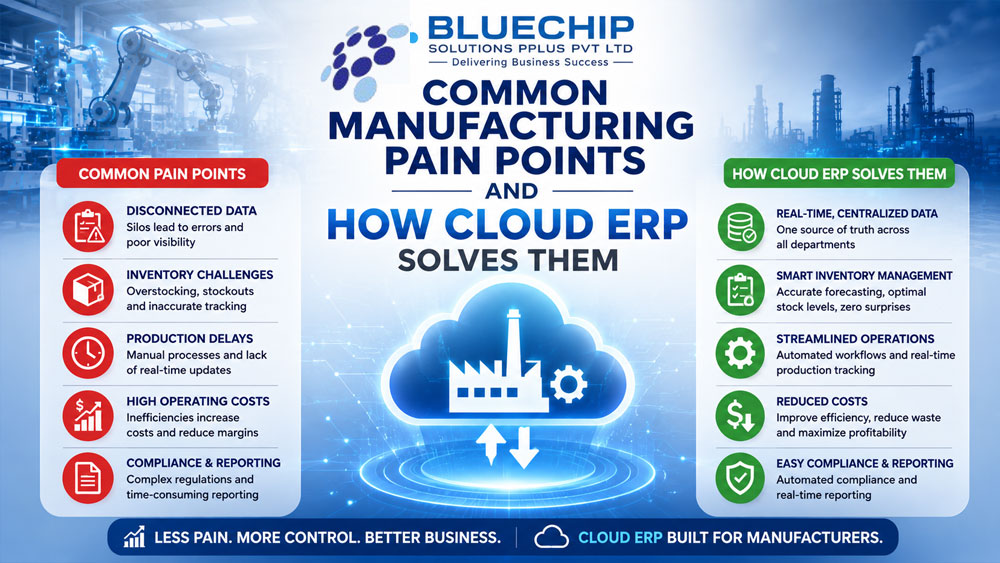
Common Manufacturing Pain Points and How Cloud ERP Solves Them
Many manufacturers continue facing delayed production schedules because departments work with disconnected systems.
Production teams often rely on spreadsheets while procurement uses separate software and finance maintains independent records. As a result, information becomes inconsistent, leading to inventory shortages, production delays, inaccurate forecasting, and customer dissatisfaction.
Cloud Manufacturing ERP eliminates these silos by integrating every department into one unified platform.
Production planners receive live inventory updates, procurement teams know exact material requirements, finance monitors operational costs instantly, and management gains complete visibility through real-time dashboards.
Another major challenge is inaccurate production forecasting.
AI-powered cloud ERP analyzes historical production trends, seasonal demand, customer purchasing behavior, supplier performance, and inventory movement to generate more accurate forecasts. Consequently, manufacturers reduce excess inventory while preventing stock shortages.
Equipment downtime also creates significant financial losses.
Modern cloud ERP integrated with Industrial IoT sensors can predict maintenance schedules before equipment failures occur. Predictive maintenance minimizes unexpected downtime, extends machine life, and improves production efficiency.
AI Is Changing Manufacturing ERP
Artificial Intelligence is no longer a future concept.
Modern Manufacturing ERP platforms increasingly include AI-powered capabilities such as intelligent production scheduling, demand forecasting, anomaly detection, supplier risk analysis, quality prediction, automated invoice processing, chatbot-assisted support, and predictive inventory optimization.
Machine learning continuously improves these recommendations by learning from operational data over time.
Manufacturers adopting AI-enabled ERP gain faster decision-making, reduced operational waste, improved customer satisfaction, and stronger competitive advantages.
Which ERP Is Better for Small and Medium Manufacturers?
Small and medium manufacturers typically need rapid implementation, lower investment, simplified maintenance, and scalable technology.
Cloud Manufacturing ERP addresses these priorities effectively by reducing infrastructure complexity while providing enterprise-grade capabilities previously available only to large organizations.
Businesses can start with essential modules and gradually expand into production planning, quality management, CRM, warehouse management, HRMS, finance, supplier portals, AI analytics, and business intelligence without replacing the entire ERP platform.
This phased growth significantly lowers implementation risk.
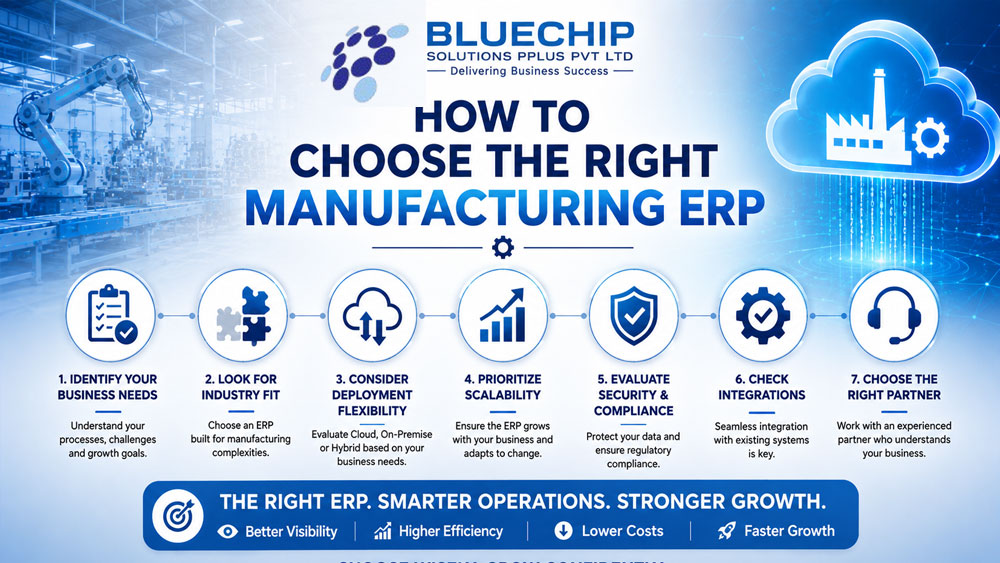
How to Choose the Right Manufacturing ERP
Choosing ERP should never focus only on deployment type.
Manufacturers should evaluate whether the solution supports production planning, batch management, BOM management, MRP, shop floor control, quality assurance, inventory optimization, GST compliance, financial accounting, supplier collaboration, mobile accessibility, AI-powered reporting, API integrations, cybersecurity standards, and future scalability.
The ideal ERP should adapt to your business processes instead of forcing your organization to change successful operational practices.
No-code customization capabilities also reduce dependency on software developers while accelerating process improvements.
Final Verdict: Cloud Manufacturing ERP vs On-Premise ERP
The manufacturing industry is evolving rapidly through automation, AI, connected factories, predictive analytics, and digital transformation.
While On-Premise ERP still suits organizations with specialized regulatory or infrastructure requirements, Cloud Manufacturing ERP has become the preferred choice for most manufacturers seeking agility, lower ownership costs, stronger security, continuous innovation, and AI-driven operational excellence.
Selecting the right ERP is no longer simply an IT decision—it is a strategic investment that directly influences productivity, profitability, customer satisfaction, and long-term business growth.
Manufacturers that embrace scalable cloud technologies today position themselves to compete more effectively in an increasingly digital industrial landscape.
Frequently Asked Questions
Is Cloud Manufacturing ERP secure?
Yes. Leading cloud ERP providers implement enterprise-grade encryption, multi-factor authentication, continuous security monitoring, automated backups, disaster recovery, and international compliance standards that often exceed what many organizations can achieve internally.
Can Cloud ERP support multiple factories?
Absolutely. Modern cloud ERP platforms centralize operations across multiple manufacturing plants, warehouses, branches, and international locations while providing real-time reporting from a single system.
Is Cloud ERP more cost-effective than On-Premise ERP?
For most manufacturers, yes. Lower infrastructure investment, reduced maintenance costs, automatic software updates, faster deployment, and simplified scalability generally result in a lower total cost of ownership.
Ready to Modernize Your Manufacturing Operations?
If your manufacturing business is struggling with disconnected systems, manual processes, delayed production planning, inventory inaccuracies, or rising IT maintenance costs, it may be time to evaluate a modern Cloud Manufacturing ERP solution.
A scalable, AI-powered, no-code ERP platform can help you streamline production, improve operational visibility, reduce costs, enhance compliance, and support long-term business growth.
Book a Free Manufacturing ERP Demo and discover how your factory can become smarter, faster, and more profitable.
Free Lead Magnet: Download the Manufacturing ERP Readiness Checklist (2026 Edition) to evaluate whether your current ERP is limiting your business growth and identify the capabilities needed for future-ready manufacturing.