

Businesses rarely struggle because they lack software. Instead, they struggle because their software cannot keep up with the way the business actually operates.
A manufacturing company may need a different approval process for every product category. A construction company may require project-specific workflows. A growing distributor may need new inventory rules, reports and integrations. However, with traditional ERP software, even a small process change can require developers, consultants, custom coding, testing and additional implementation costs.
That is where no-code ERP is changing the approach to enterprise software.
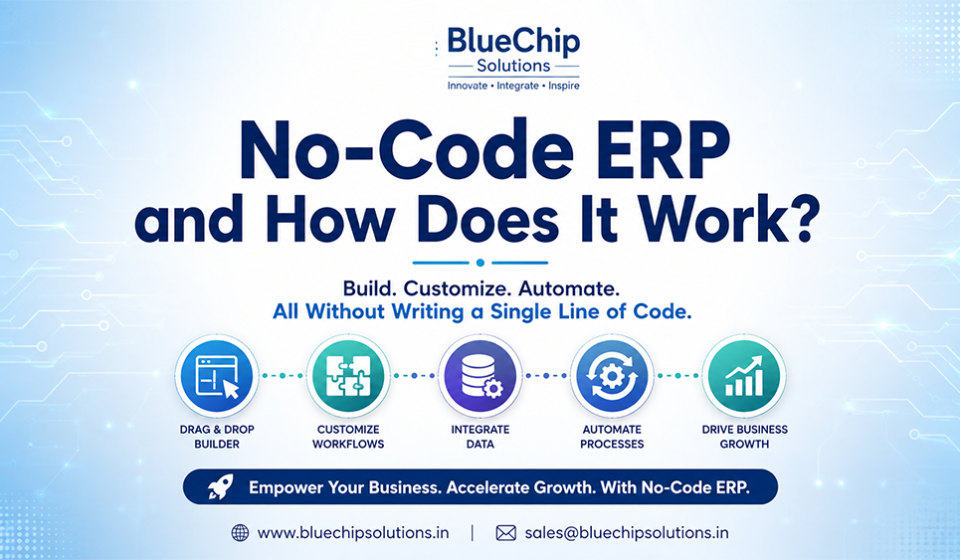
Instead of rebuilding software every time the business changes, a no-code ERP platform allows organisations to configure workflows, forms, dashboards, applications and business processes visually, with little or no traditional programming.
What Is No-Code ERP?
A no-code ERP is enterprise resource planning software that allows businesses to configure and automate business processes using visual tools rather than relying heavily on conventional programming.
In simple terms, traditional ERP tells a business, “Adapt your process to the software.” No-code ERP takes a different approach: “Configure the software around your business process.” That difference becomes especially important when companies have unique workflows that cannot be handled efficiently by standard ERP configurations.
For example, suppose a manufacturing company receives raw materials, performs quality inspection, moves approved materials into inventory, creates production orders and finally sends finished goods for dispatch. A traditional ERP may support these processes, but changing the workflow later can involve technical development.
With a no-code ERP platform, however, administrators and authorised business teams can visually configure forms, approval rules, workflows, notifications, dashboards and other process elements without rewriting the underlying application. Consequently, businesses can respond faster when customers, regulations, suppliers, products or internal processes change.
How Does No-Code ERP Work?
A no-code ERP works by combining a visual development environment with an ERP backend, workflow engine, database, integrations, security controls and reporting capabilities. First, the business defines the process it wants to automate. Then, the required forms, fields, approvals, rules and workflows are configured through visual interfaces.
For instance, when a purchase request is submitted, the system can automatically determine who should approve it based on the purchase value, department or supplier category. Next, the ERP records the transaction in a central database. Subsequently, inventory, finance, procurement and management dashboards can access the relevant information according to user permissions.
Therefore, instead of creating separate software for every department, the organisation operates through connected business processes. Modern no-code platforms are also increasingly incorporating AI capabilities. Gartner’s recent research highlights the growing relationship between low-code platforms, AI and agentic AI, showing how enterprise application development is moving toward more intelligent and automated systems.
Why Are Companies Looking Beyond Traditional ERP?
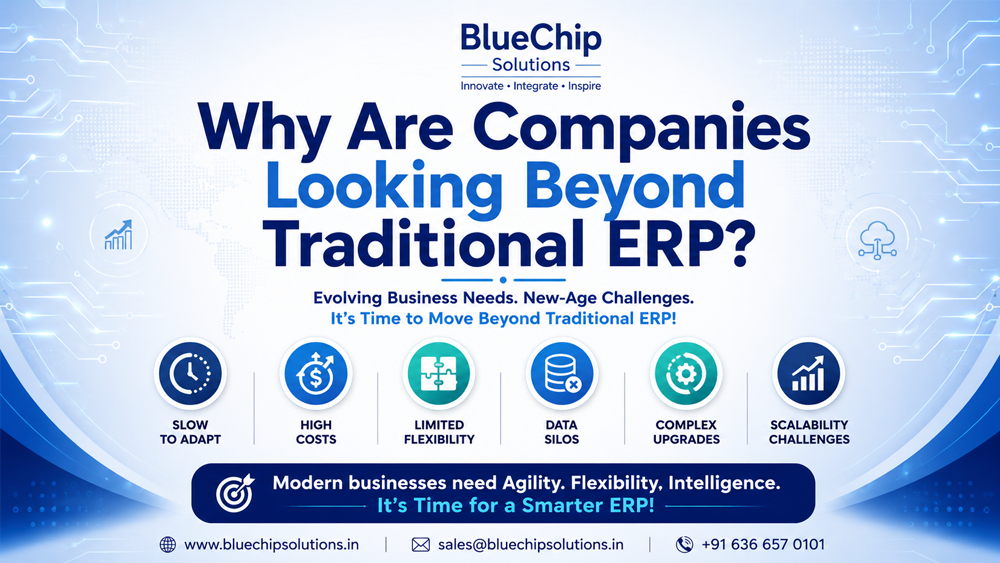
The biggest ERP problem is not necessarily functionality. It is adaptability.
A company may initially implement an ERP successfully. However, after two or three years, its processes may change significantly. New branches may be added, product lines may expand, regulatory requirements may change and management may request new reports.
Unfortunately, the ERP may remain structured around the original implementation. As a result, companies frequently create spreadsheets, emails, manual approvals and disconnected applications around the ERP. This creates another problem: data fragmentation.
One team works in ERP. Another works in Excel. A third uses a separate application. Management then has to combine information manually before making decisions. A no-code ERP addresses this gap by allowing organisations to modify and extend processes while keeping them connected to the central enterprise system.
How No-Code ERP Solves Common Business Pain Points
ERP Customization Takes Too Long
Traditional customization can involve requirement analysis, development, testing, deployment and ongoing maintenance. For a business waiting to launch a new product or workflow, this delay directly affects operations. With no-code ERP, many configuration changes can be handled through visual tools and reusable components. Therefore, businesses can reduce their dependency on lengthy development cycles for routine process changes.
Businesses Depend Too Much on IT Teams
IT teams are often responsible for infrastructure, cybersecurity, integrations, applications, support and multiple business requests simultaneously. Consequently, even a small ERP modification can enter a long development queue. A governed no-code environment allows authorised business users and functional teams to participate in application configuration while developers remain available for complex integrations and advanced requirements.
This does not mean developers become unnecessary. Instead, their time can be redirected toward higher-value technical work.
ERP Software Does Not Match the Real Business Process
This is one of the most expensive problems. If employees have to create workarounds because the ERP does not reflect their actual process, the company gradually develops a shadow system around its ERP. No-code ERP helps close this gap by allowing workflows and forms to be configured around actual operational requirements.
For example, a manufacturer can design approval workflows around procurement limits, quality requirements, production stages and inventory rules instead of forcing every department into the same rigid process.
Management Cannot Get Real-Time Business Visibility
When information is scattered across spreadsheets and applications, management reports can become outdated before they are even reviewed. A connected ERP can centralise operational information and provide dashboards based on current transactional data. As a result, management can move from asking, “What happened last week?” toward asking, “What is happening now, and what should we do next?”
That shift becomes even more valuable when ERP data is combined with analytics and AI.
No-Code ERP vs Traditional ERP
Traditional ERP remains powerful and appropriate for many organisations. However, its customization model can be more development-intensive. No-code ERP focuses on configurability and adaptability. With traditional ERP, a change may require technical development.
No-code ERP, many changes can be handled through visual configuration. With traditional ERP, business users may depend heavily on IT for application modifications. No-code ERP, authorised users can participate directly in configuring approved processes. Traditional customization, every change can increase development and maintenance complexity.
With a well-designed no-code architecture, reusable components and modular configuration can make future changes easier to manage. Therefore, the real question is not whether no-code ERP completely replaces traditional ERP. Instead, the better question is whether the ERP can evolve as quickly as the business.
What Features Should a No-Code ERP Platform Have?
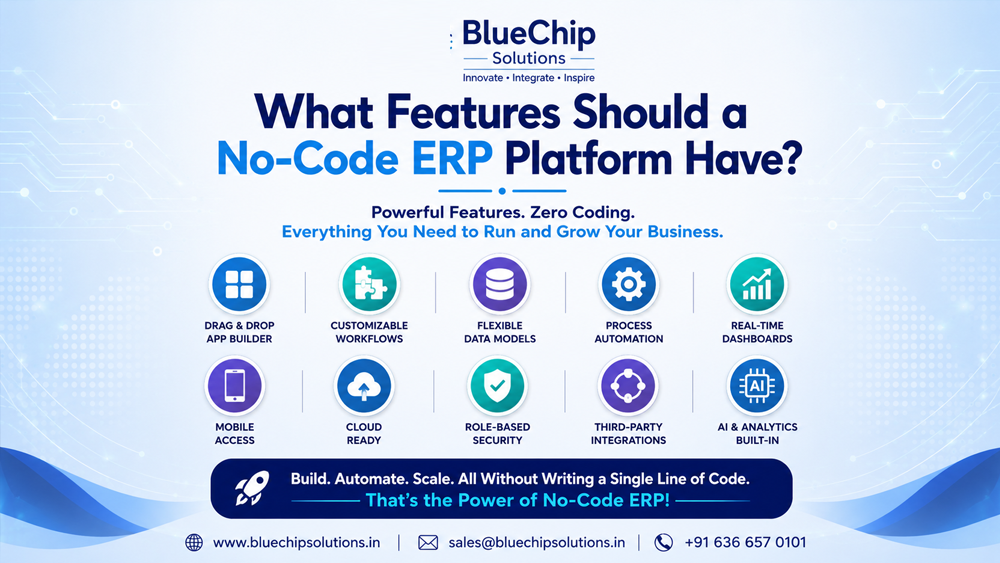
A serious enterprise no-code ERP should offer much more than drag-and-drop screens. First, it should provide a visual workflow designer for approvals, notifications and process automation. Next, it should provide configurable forms and business rules so organisations can capture and validate information according to their processes.
Furthermore, integration capabilities are essential. An enterprise ERP should be able to connect with APIs, databases, CRM systems, communication platforms, analytics tools and other enterprise applications. Security is equally important. Role-based access, audit trails, authentication, data protection and permission controls should be part of the platform architecture.
Finally, scalability matters. A no-code platform may start with a single department, but it should be capable of supporting larger transaction volumes, more users and additional business applications as the company grows. For example, Bluechip Solutions’ Auvit platform describes capabilities including visual interfaces, workflow design, reusable components, API and database integration, role-based access control, audit logs, mobile applications and AI/ML-enabled enterprise applications.
Can No-Code ERP Use AI?
Yes. In fact, AI is becoming an important part of the next generation of enterprise software. However, AI should not simply be added as a chatbot. The real value comes when AI can work with trusted business data and operational workflows. For example, AI can help identify unusual inventory movements, analyse sales trends, assist with demand forecasting, summarise operational information or provide decision-support insights.
Furthermore, AI-powered ERP can potentially move from simply reporting what happened to helping employees understand why it happened and what action may be appropriate. Recent research into AI-native and agentic ERP architectures is exploring this transition from systems that primarily record transactions toward systems capable of assisting with cross-functional operational decisions.
However, businesses should still maintain human oversight, access controls and governance for important decisions.
Is No-Code ERP Suitable for Manufacturing and Growing Businesses?
Yes, particularly when business processes are changing frequently. Manufacturing organisations often require customised production workflows, quality checks, procurement approvals, inventory controls, maintenance processes and management dashboards. Similarly, construction companies may need project-specific workflows, approvals, procurement controls and cost monitoring.
Distribution businesses may require flexible pricing, warehouse workflows, sales processes and inventory visibility. Therefore, an adaptable ERP can be valuable when a company’s processes cannot be effectively managed through a rigid standard configuration. This is also why no-code ERP should be evaluated according to business fit, rather than simply the number of features displayed in a product brochure.
How to Choose the Right No-Code ERP
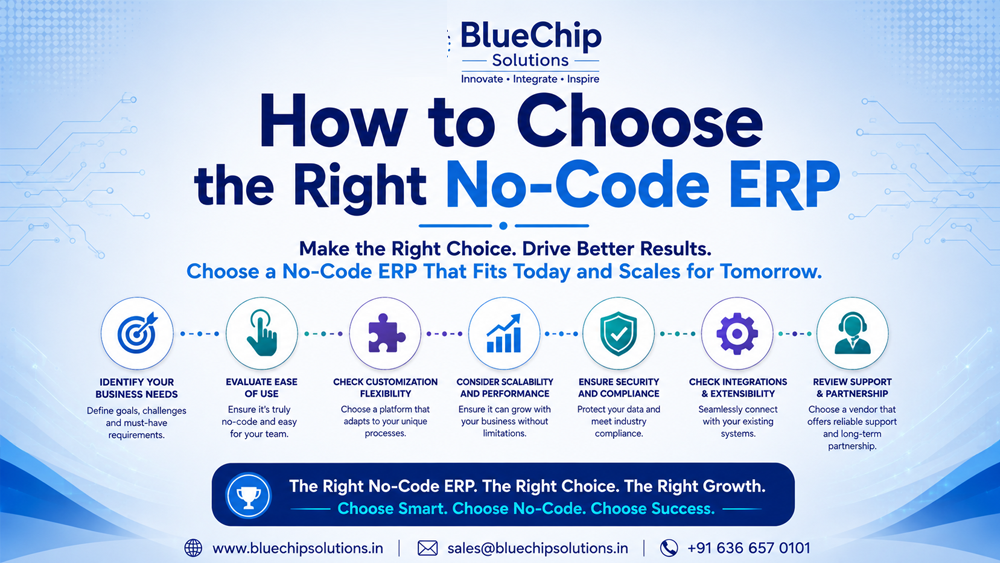
Choosing a no-code ERP should begin with the business process, not the software demonstration. First, identify the processes causing the most delays, duplication and manual work. Next, determine which departments need shared information. Then, examine how easily the platform can configure workflows, forms, approvals, reports and integrations.
After that, evaluate security, scalability, deployment options, support and future customization. Most importantly, ask the ERP vendor to demonstrate your actual business scenario. Do not simply ask, “Can your ERP manage inventory?” Instead, ask, “Can you demonstrate our purchase-to-quality-to-inventory process using our approval rules?” That single question can reveal the difference between a generic ERP and an ERP that genuinely fits the organisation.
What Is the Future of No-Code ERP?
The future of no-code ERP is moving toward AI-assisted, adaptable and process-driven enterprise applications. As businesses demand faster digital transformation, ERP systems will increasingly need to connect data, workflows, mobile applications, analytics and AI.
Consequently, the ERP of the future will not simply be a database for recording transactions. It will increasingly become a business operating platform that helps employees execute processes, understand data and respond to changing business conditions. Gartner’s current research reflects this broader movement, with low-code platforms increasingly connected to AI-assisted development and enterprise AI implementation.
Frequently Asked Questions About No-Code ERP
What is a no-code ERP?
A no-code ERP is an enterprise resource planning system that allows businesses to configure applications, workflows, forms and business processes with minimal traditional programming.
Is no-code ERP suitable for small and medium-sized businesses?
Yes. It can be particularly useful for growing businesses that need ERP functionality but also need flexibility as their processes evolve.
Is no-code ERP secure?
A business should evaluate the platform’s security architecture, including role-based access, authentication, encryption, audit trails, permissions and compliance controls. No-code itself does not automatically guarantee security.
Can no-code ERP be customized?
Yes. Customization is one of its major advantages. However, businesses should verify exactly what can be configured without code and which advanced requirements still require development.
Can no-code ERP integrate with existing software?
Yes, provided the platform offers suitable integration mechanisms such as APIs, databases and connectors. Integration capability should be evaluated during the ERP selection process.
Does no-code ERP replace developers?
Not necessarily. Instead, it reduces the amount of traditional coding required for many business applications and allows developers to focus on complex integrations, architecture and advanced requirements.
Is no-code ERP better than traditional ERP?
There is no universal answer. The better solution depends on business complexity, customization requirements, integrations, budget, governance and scalability. For organisations where adaptability is critical, no-code ERP can offer a significant advantage.
Turn Your ERP Into a System That Can Grow With Your Business
If your employees are constantly moving between ERP screens, Excel files, emails and manual approvals, the problem may not be a lack of software. The problem may be that your ERP is not flexible enough for the way your business operates. A modern no-code ERP approach can help connect processes, automate repetitive work, improve visibility and make future changes easier to implement.
Bluechip Solutions provides no-code ERP and enterprise application capabilities through its Auvit framework, with solutions designed around areas including finance, HR, manufacturing, supply chain, mobile applications, data and AI/ML.
Your business should not have to change its process just because your ERP cannot change.
Book a Free ERP Consultation and discuss your current workflow, customization requirements and automation challenges with an ERP specialist.
Lead Magnet CTA: Download the No-Code ERP Readiness Checklist to evaluate your current ERP’s flexibility, customization, automation, integration and scalability before investing in a new system.
Final Takeaway
No-code ERP is not simply about eliminating programming. It is about making enterprise software more adaptable. When business processes change, the ERP should be capable of evolving with them and departments need new workflows, the system should support them. When management needs better visibility, data should already be connected.
Therefore, the strongest no-code ERP strategy combines ERP functionality, visual configuration, workflow automation, integrations, security, analytics and increasingly AI. For businesses that are outgrowing rigid systems, that flexibility can become more than a technology advantage. It can become a practical foundation for continuous digital transformation.