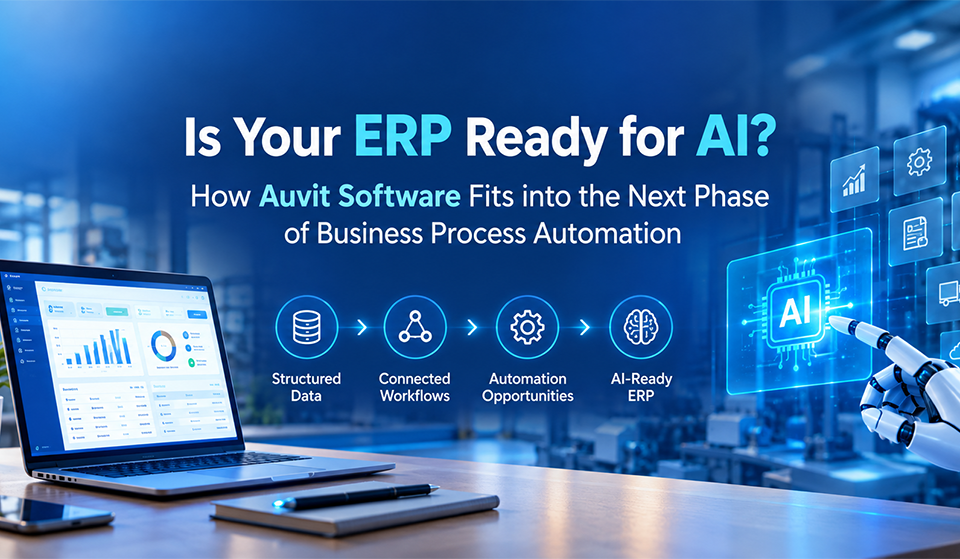
Is Your ERP Ready for AI? How Auvit Software Fits into the Next Phase of Business Process Automation

Artificial intelligence is creating new opportunities for businesses to automate decisions, identify operational risks and improve productivity. However, many companies face a problem before they even begin implementing AI: their business data is scattered across spreadsheets, accounting tools, disconnected applications and manual workflows. Auvit Software helps businesses explore a more connected approach to ERP and business process automation, creating a structured foundation for smarter operations and future AI adoption.
For example, a manufacturing company may record production in one system, maintain inventory in another and manage purchase approvals through email. Although each department has information, management still struggles to understand why production costs are increasing, where delays originate or which orders require immediate attention.
This is where ERP systems become essential to practical AI adoption. Before AI can deliver meaningful business value, companies need reliable data, connected processes and consistent operational records.
Auvit Software from Bluechip Solutions offers a No-Code ERP and business process automation approach that can help businesses establish these foundations. By connecting business functions, standardising workflows and improving operational visibility, an organisation can build a more structured environment for future AI initiatives.
The important question is not simply whether a company uses AI. Instead, it is whether its existing ERP system is ready to support useful, reliable and measurable automation.
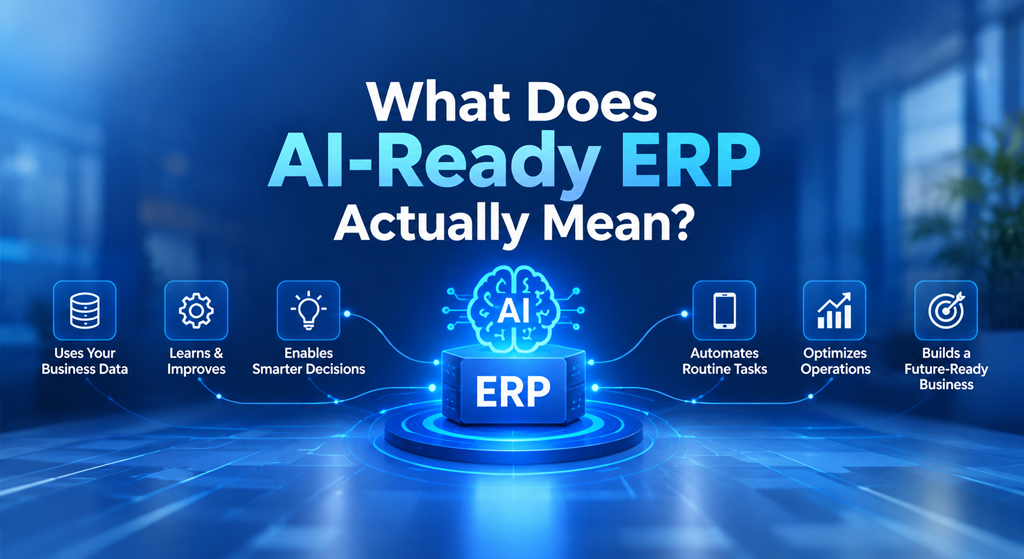
What Does AI-Ready ERP Actually Mean?
An AI-ready ERP is not merely an ERP system with an AI feature added to its dashboard. Rather, it is a business management environment where data is organised, operational processes are connected, and information can be accessed consistently for analysis and automation.
For instance, consider a distributor experiencing frequent stock shortages despite having sufficient inventory records. The problem may arise because sales orders, warehouse transactions, purchase orders and supplier lead times are not connected properly. In this situation, adding an AI assistant will not automatically solve the underlying issue. The business must first ensure that inventory movements are recorded correctly and that the relevant departments share consistent information.
Consequently, AI readiness depends on the quality of the business processes supporting the technology.
Why disconnected business data limits AI adoption
When departments maintain separate records, the same business transaction may appear differently across systems. Sales may report an order as confirmed while the warehouse has not received the corresponding fulfilment request. Similarly, finance may discover that an invoice remains unpaid only after a customer complains about a delayed reconciliation.
These inconsistencies reduce the reliability of automated analysis. If an AI model receives incomplete, outdated or conflicting information, its recommendations may also be unreliable. Therefore, companies should first establish consistent master data, connected transactions, clear ownership of records and dependable reporting. An integrated ERP environment helps bring these elements together, creating a stronger foundation for future AI applications.
The difference between traditional automation and AI-driven automation
Traditional automation follows predefined business rules. For example, an ERP workflow can send a purchase request to a manager whenever an order exceeds an approved spending limit. AI-driven automation can potentially go further by analysing historical purchasing patterns, identifying unusual spending or estimating future demand. However, these capabilities depend on the availability of suitable data, appropriate models, system integrations and human oversight.
As a result, businesses should not treat every automated workflow as artificial intelligence. Instead, they should use rule-based automation for predictable processes and evaluate AI for situations where pattern recognition, forecasting or language-based assistance offers additional value.
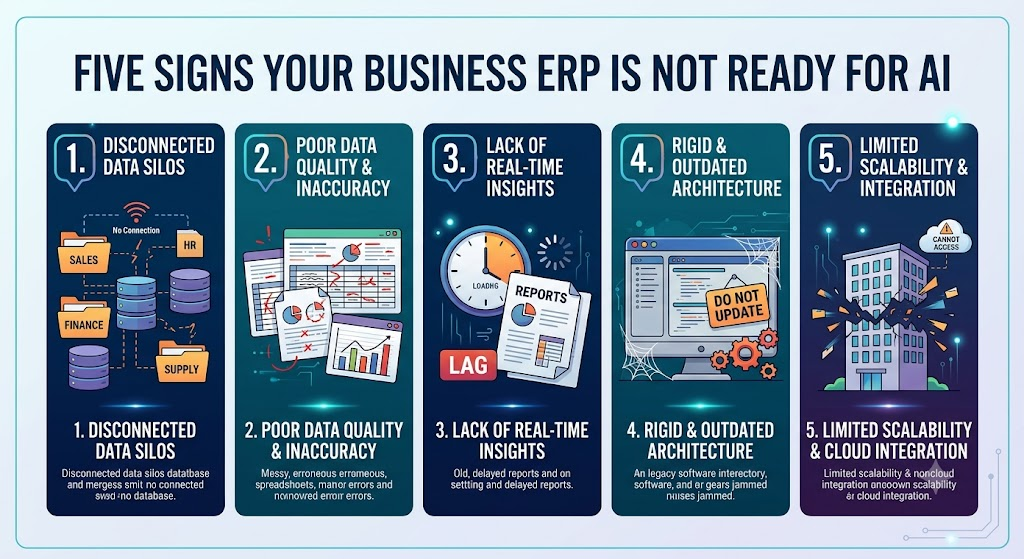
Five Signs Your Business ERP Is Not Ready for AI
Many organisations believe they are digitally mature because they use accounting software, dashboards and cloud applications. Nevertheless, several operational warning signs can reveal that their systems are not ready for more advanced automation.
1. Employees still reconcile data manually
If finance teams regularly compare spreadsheets with ERP reports, or warehouse staff manually correct inventory discrepancies, the business may lack consistent transaction controls. This creates additional work and delays management decisions. Before introducing AI, organisations should investigate why records differ, standardise data entry and connect the transactions responsible for those discrepancies.
Auvit Software’s ERP and business process automation approach can be evaluated for connecting relevant business activities and reducing avoidable manual handoffs.
2. Approvals depend on emails and personal follow-ups
Purchase approvals, expense claims and production requests often remain dependent on individual employees remembering to respond. As a result, work gets delayed whenever a manager is unavailable or a request disappears in an inbox. A structured ERP workflow can route requests according to business rules, record approval status and trigger reminders or escalations where configured. This improves process visibility while creating a clearer record of business activity.
Moreover, these structured workflow records can help organisations assess where delays occur before considering more advanced predictive automation.
3. Management receives reports after problems have already occurred
A monthly financial report may explain why costs increased, but it might arrive too late to prevent the same problem from recurring. Likewise, an inventory report generated after a stockout cannot recover the lost sales opportunity.
Connected ERP reporting can improve visibility into current transactions and operational exceptions. Once the data is sufficiently reliable, businesses can evaluate forecasting and anomaly-detection applications to identify potential issues earlier. However, real-time intelligence requires appropriate transaction updates, integrations and reporting configurations; it should not be assumed simply because an ERP has dashboards.
4. Every process change requires extensive development
Business requirements change as companies introduce new products, expand into new markets or modify approval policies. When every adjustment requires significant custom coding, automation projects can become expensive and difficult to maintain.
A No-Code ERP approach can help authorised business teams configure supported forms, workflows and process rules with less dependence on conventional development. Nevertheless, the exact flexibility depends on the platform’s capabilities, governance controls and the complexity of the requested change.
5. Nobody can clearly explain where the business data comes from
AI-generated recommendations become difficult to trust when users cannot identify the source of a figure, the transaction behind a result or the person responsible for correcting an error. Businesses should establish data ownership, access permissions, validation rules and traceable transaction records. These controls improve accountability and make it easier to review automated recommendations before acting on them.
How Auvit Software Supports the Foundations of AI-Ready Business Process Automation
Auvit Software is relevant to organisations that want to bring operational processes into a more connected ERP environment before expanding into advanced automation. Rather than treating AI as an isolated technology project, businesses can begin by improving the information and workflows that support everyday decisions.
Connected business processes create a consistent operating picture
When sales, procurement, inventory, production and finance operate independently, employees spend considerable time transferring information between departments. In contrast, a connected ERP environment can help teams work with shared transaction records and coordinated processes.
For example, when a sales order triggers inventory checks, procurement requirements and subsequent financial transactions through configured workflows, employees have a clearer view of how one decision affects another. This connected structure can also help management identify process bottlenecks and determine which workflows are suitable for further automation.
Structured data improves the quality of business decisions
Reliable business data involves more than storing information in a central database. Companies must also maintain consistent product codes, customer records, supplier details, units of measurement and transaction statuses. Auvit-based ERP implementation should therefore be assessed against the organisation’s actual data requirements, including validation, integration, reporting and access controls.
Once these foundations are established, businesses can investigate AI applications such as demand forecasting, exception detection and assisted reporting, subject to the availability of appropriate integrations and capabilities.
No-Code ERP can make process improvement more adaptable
Rigid business systems often struggle to keep pace with changing operational requirements. A configurable No-Code ERP approach can help businesses adapt supported forms, workflows and approval rules without treating every adjustment as a separate conventional coding project.
For growing SMEs, this flexibility can be valuable when processes evolve across multiple departments. However, flexibility must be balanced with governance. Changes should follow approval procedures, testing and access restrictions so that faster configuration does not create inconsistent business rules.
Business process automation establishes measurable operational controls
A workflow should do more than move a request from one employee to another. It should make the process easier to monitor, measure and improve. For example, an organisation can define approval responsibilities, establish escalation rules and track how long each stage takes. Management can then identify recurring delays, compare performance and determine where process redesign would deliver the greatest benefit.
These records can later support suitable analytical or AI initiatives, provided the data is sufficiently complete and the use case is technically feasible.
Real-World Example: Preparing a Manufacturing Business for AI
Consider a mid-sized manufacturer that experiences recurring production delays, inconsistent raw-material availability and unexpected cost variations. Initially, the company assumes that it needs AI-based production planning. However, a process review reveals that purchase requests are frequently delayed, material consumption is recorded inconsistently and production updates reach finance several days late.
Introducing a predictive model at this stage would not resolve the underlying process weaknesses. The company should first connect its procurement, inventory, production and finance processes through an appropriately configured ERP system. Material masters should be standardised, consumption transactions should be recorded consistently, and purchase approvals should follow clear rules.
Next, management should monitor measurable indicators such as material shortages, production schedule adherence, purchase approval time and actual-versus-planned material consumption. After sufficient reliable historical data has accumulated, the company can evaluate whether demand forecasting, production risk alerts or unusual consumption detection would provide additional value.
Auvit Software can be assessed as part of this ERP foundation, based on the company’s functional requirements and the platform’s verified capabilities. Any proposed AI functionality should be validated separately rather than assumed to be available automatically.
The key lesson is straightforward: connect the process first, establish trustworthy data next, and introduce AI where it can solve a clearly defined business problem.
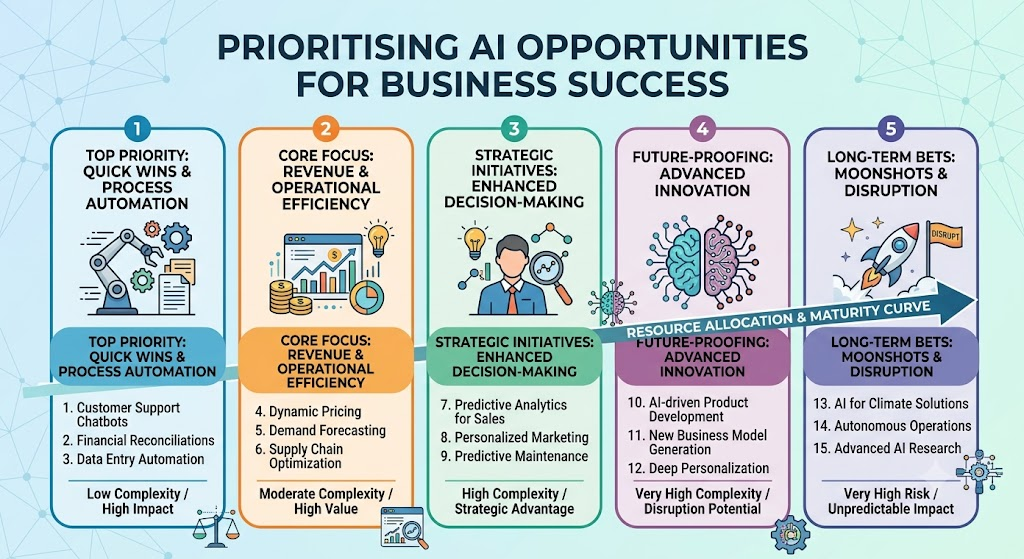
Which AI Opportunities Should Businesses Prioritise First?
Not every process needs artificial intelligence. In many cases, well-designed workflow automation provides faster and more predictable value. For example, routing purchase approvals, sending overdue-payment reminders and escalating delayed tasks can often be handled through predefined rules. AI may be more appropriate when the organisation needs to estimate future demand, identify unusual transaction patterns or extract useful information from large volumes of business documents.
The best starting point is a specific operational problem with measurable consequences. A manufacturer might investigate whether better forecasting could reduce stockouts. A distributor might assess whether automated exception detection could identify unusual inventory movements. A finance team might explore whether AI-assisted document processing could reduce manual data entry.
In each case, management should define a baseline, measure the current cost of the problem and establish a clear success criterion. The proposed solution should then be tested against real business data, with suitable human review and access controls. This approach reduces the risk of investing in impressive technology that fails to improve actual business performance.
A Practical Roadmap for Making Your ERP AI-Ready
The transition should begin with an assessment of existing systems rather than an immediate investment in AI tools. First, document the most important business processes and identify where spreadsheets, duplicate records or manual approvals create delays. Next, review data quality, system integrations, reporting requirements and user access permissions.
After that, prioritise the processes that affect revenue, operating costs, customer service or compliance. Configure and test the relevant ERP workflows, establish ownership of business records and measure whether the changes improve operational performance. Once the underlying processes are stable, select one AI use case with a clear business objective. Test it using representative data, compare its results against existing methods and involve experienced employees in reviewing important recommendations.
Finally, expand only when the initial use case demonstrates measurable value. This staged approach gives management a clearer understanding of implementation costs, operational risks and expected benefits. For organisations considering Auvit Software, a structured product demonstration should examine real workflows, configuration options, integration requirements, reporting capabilities and the practical steps needed to support future AI initiatives.
Frequently Asked Questions About Auvit Software and AI-Ready ERP
What is Auvit Software?
Auvit is a No-Code ERP and business process automation platform offered by Bluechip Solutions. It is intended to help businesses manage connected operational processes. Companies should assess its modules, configuration options and integrations against their specific requirements before implementation.
Can Auvit Software help prepare a business for AI?
Auvit Software can be evaluated as part of an AI-readiness strategy by examining how it supports structured business data, connected workflows, process automation and operational reporting. Actual AI capabilities depend on the available functionality, integrations, data quality and implementation design.
Does a company need AI before implementing ERP automation?
No. Many businesses can improve efficiency through conventional ERP workflows, approval automation, standardised records and better reporting. These improvements can also create a stronger foundation for future AI projects.
What data is required for AI-ready ERP?
The requirements depend on the use case. Generally, businesses need accurate transaction records, consistent master data, suitable historical information, clear data ownership and appropriate access controls. Forecasting and anomaly detection may require additional historical depth and validation.
How should an SME choose an AI-ready ERP system?
An SME should assess business process coverage, configuration flexibility, integration options, reporting, security, scalability, implementation effort and total cost of ownership. It should also distinguish between existing platform capabilities and AI features that require separate development or third-party services.
Conclusion: Build the Right ERP Foundation Before Investing in AI
AI adoption is not just a technology decision. It is also a business process and data management decision. When information remains scattered, approvals depend on personal follow-ups and reports arrive too late, advanced automation can reproduce existing problems rather than solve them. By contrast, connected processes, reliable records and measurable workflows give businesses a more practical starting point.
Auvit Software offers a No-Code ERP and business process automation approach that businesses can assess as part of this transition. The right implementation should address today’s operational challenges while creating a structured foundation for future analytical and AI applications.
Before investing in another AI tool, evaluate whether your ERP can provide the connected data and controlled workflows that meaningful automation requires.
Ready to Assess Your ERP’s AI Readiness?
Bluechip Solutions can help your team explore how ERP and business process automation align with your operational requirements.
Request an Auvit ERP Demo: https://bluechipsolutions.in/
Discuss your current workflows, integration challenges, reporting gaps and automation priorities to identify the next practical step towards an AI-ready business environment.
Get the AI-Ready ERP Checklist for SMEs: 15 Questions to Ask Before Investing in AI.
Use the checklist to evaluate data quality, workflow maturity, integration readiness, governance and potential AI use cases before committing to a larger technology investment.