
A delayed purchase order, an unexpected inventory shortage or a financial report that arrives after a management meeting can cost a business more than a few hours of productivity. For growing companies, these problems often arise because departments work with disconnected software, spreadsheets and manual approval processes. Consequently, business leaders struggle to understand what is happening across their operations until the damage has already occurred.
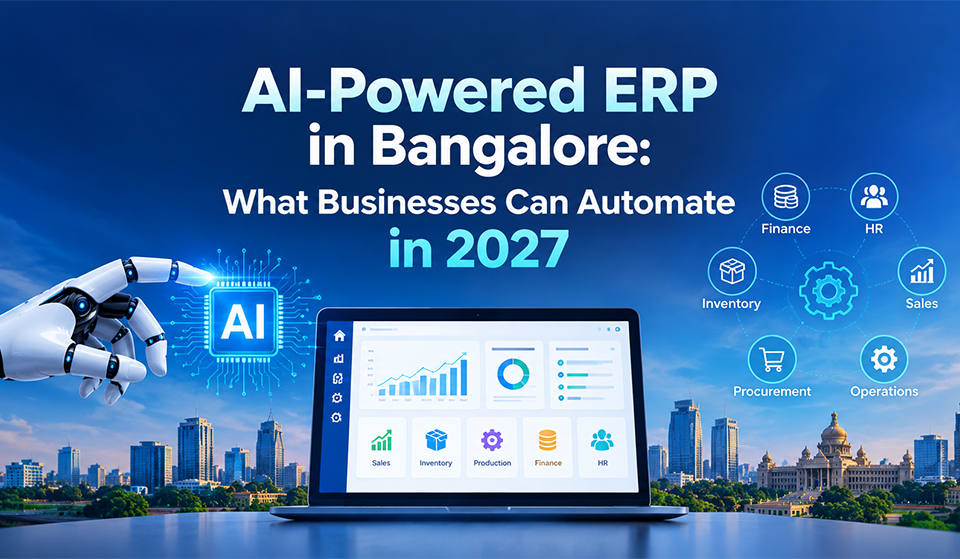
This is where AI-powered ERP in Bangalore is becoming an important consideration for businesses planning their next stage of digital transformation. Instead of simply recording transactions, modern ERP systems can help companies analyse operational data, identify unusual patterns, automate repetitive workflows and support faster decisions.
However, adopting artificial intelligence does not automatically make an ERP system intelligent. Businesses first need reliable data, connected departments, clear business rules and appropriate controls. Therefore, the real opportunity for 2027 is to combine ERP, artificial intelligence and business process automation to solve everyday operational problems rather than invest in technology simply because it is trending.
Why AI-Powered ERP Will Matter for Bangalore Businesses in 2027
Bangalore has businesses operating across manufacturing, distribution, construction, retail, technology and professional services. Although their operations differ, many face similar challenges: rising operating costs, growing transaction volumes, limited visibility into performance and increasing pressure to respond quickly to customers.
According to McKinsey’s State of AI in 2025 survey, 88% of respondents reported regular AI use in at least one business function, yet nearly two-thirds said their organisations had not begun scaling AI across the enterprise. These findings highlight an important distinction between experimenting with AI and embedding it into business operations.
For Bangalore businesses, an AI-enabled ERP strategy should therefore focus on measurable operational improvements. For example, a manufacturer may want to identify production delays earlier, while a distributor may need to anticipate stock shortages. Similarly, a finance team may want to reduce repetitive data entry and identify overdue payments before they affect cash flow.
Rather than implementing every available AI feature, companies should identify the processes that consume the most time, create the most errors or delay important decisions.
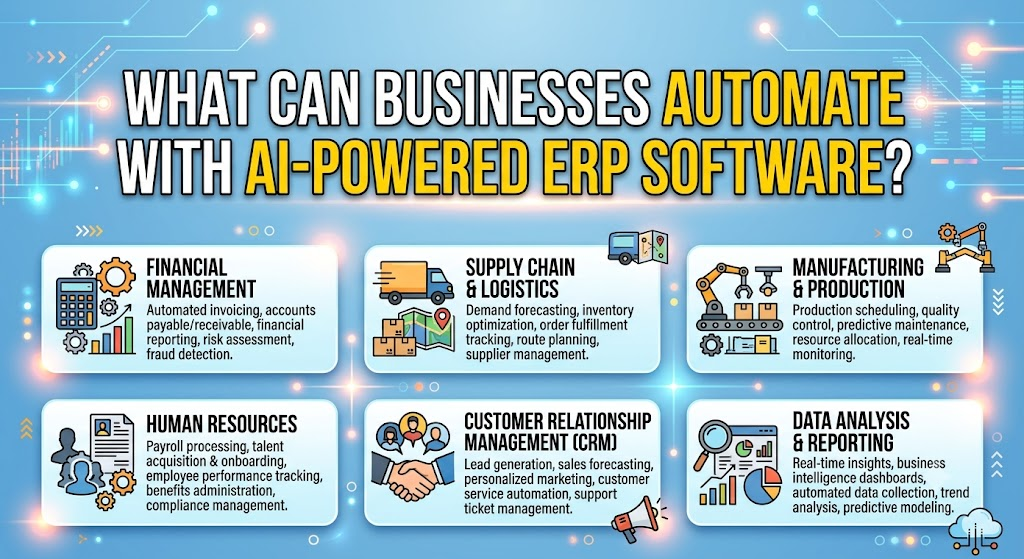
What Can Businesses Automate with AI-Powered ERP Software?
1. Financial Management and Cash Flow Forecasting
Financial teams frequently spend considerable time reconciling transactions, checking invoices, following up on outstanding payments and preparing reports from multiple systems. Consequently, decision-makers may receive an accurate financial picture only after the relevant opportunity to act has passed.
AI-powered ERP software can help streamline invoice processing, transaction classification, payment reminders and the identification of unusual financial entries. When sufficient historical and current data is available, forecasting models can also estimate future cash requirements based on payment patterns, outstanding receivables and planned expenses.
For example, if several customers regularly pay later than their agreed terms, the system can flag the resulting cash flow risk. Meanwhile, automated approval workflows can route invoices to the appropriate manager instead of leaving them in an unattended email inbox.
Financial teams should review forecasts carefully because predictions can change as new data becomes available. Finance teams must validate forecasts, investigate anomalies and retain appropriate approval controls. With these safeguards, businesses can move from retrospective reporting towards more proactive financial management.
2. Inventory Management and Demand Forecasting
Excess inventory ties up working capital, whereas insufficient stock can delay customer orders and interrupt production. Unfortunately, many businesses still rely on fixed reorder levels or manual stock checks that fail to reflect changing demand.
An AI-enabled ERP system can analyse historical sales, current stock levels, supplier lead times and seasonal patterns to support demand forecasting and replenishment planning. It can also highlight slow-moving materials, unusual consumption and items that may run out before the next scheduled delivery.
Consider a distributor handling hundreds of products. Instead of checking every item manually, the inventory team can review system-generated exceptions and prioritise the products that require immediate attention.
However, forecasting accuracy depends on clean transaction records and relevant business context. Promotions, supplier disruptions, sudden market changes and inaccurate stock entries can affect predictions. Therefore, companies should combine AI recommendations with inventory policies, supplier information and human review.
3. Manufacturing Planning and Real-Time Production Monitoring
For manufacturers, a delay in one production stage can affect labour utilisation, delivery commitments, material availability and profitability. Moreover, when employees update shop-floor information only at the end of a shift, managers may struggle to identify the actual cause of production delays.
AI-powered ERP solutions can support production planning by combining work orders, bills of materials, inventory availability, machine information and production schedules. Where connected equipment or shop-floor systems provide suitable data, analytics models can help identify recurring downtime patterns, unusual production variances and potential bottlenecks.
For instance, if a production line repeatedly falls behind when a particular material is unavailable, the system can highlight the relationship between material shortages and schedule performance. Planners can then investigate procurement timing, stock policies or production sequencing.
In addition, ERP-based workflow automation can alert supervisors when production teams miss a milestone or need to complete a quality inspection. Nevertheless, reliable monitoring requires appropriate integration with shop-floor systems; an ERP dashboard alone cannot automatically detect every machine-level issue.
For Bangalore manufacturers seeking greater operational control, the priority should be connecting engineering, procurement, production, quality, inventory and finance through a shared source of business information.
4. Procurement and Supplier Management
Procurement teams often manage multiple supplier quotations, purchase requisitions, delivery commitments and approval levels. As transaction volumes increase, manual comparisons and delayed approvals can create unnecessary purchasing costs.
An AI-enabled ERP can assist with identifying unusual purchase prices, highlighting supplier delivery variations, matching invoices against purchase orders and recommending replenishment actions based on approved business rules. Automated workflows can also route purchase requests according to value, department or approval authority.
or example, when a supplier significantly increases the price of a regularly purchased component, the system can flag the price difference before the company approves the purchase. The procurement manager can then verify the quotation, review the contractual terms and decide whether to negotiate further.
Importantly, AI should support supplier evaluation rather than make unsupported assumptions about supplier quality. Delivery history, quality records, commercial terms and verified performance indicators must remain central to procurement decisions.
5. Sales, Customer Service and Order Processing
Sales teams lose valuable time when they manually prepare quotations, check product availability, update customer records and follow up on pending orders. At the same time, customer service representatives may struggle to answer basic questions because information is scattered across departments.
AI-powered ERP software can help summarise customer interactions, assist with quotation preparation, identify follow-up opportunities and provide quicker access to relevant order information. When integrated with CRM and inventory modules, it can also help sales representatives check product availability and outstanding customer commitments.
For instance, a salesperson preparing a quotation can access customer-specific pricing rules, current stock information and previous order details within a connected workflow. This reduces the need to request the same information from several departments.
Furthermore, automated reminders can alert sales representatives when quotations remain unanswered or when important customer follow-ups are due. However, final pricing, contractual commitments and sensitive customer communications should remain subject to suitable permissions and review.
6. Document Processing, Approvals and Business Workflows
One of the most practical automation opportunities is often hidden in routine administrative work. Employees may repeatedly enter information from invoices, delivery notes, purchase orders, expense claims and internal forms into different systems.
Document-processing AI can extract relevant information from supported documents, while ERP workflows can validate fields, apply business rules and route records for approval. For example, an invoice can be checked against an existing purchase order before being forwarded to the accounts team.
Similarly, a purchase request can move through predefined approval stages, with reminders and escalations when a task remains pending. However, document extraction is not infallible. Poor scans, inconsistent formats and ambiguous information can lead to errors. Therefore, exceptions should be sent for human verification, and every important transaction should retain an appropriate audit trail.
When implemented carefully, workflow automation reduces repetitive administration while allowing employees to concentrate on exceptions, customer relationships and decisions that require judgement.
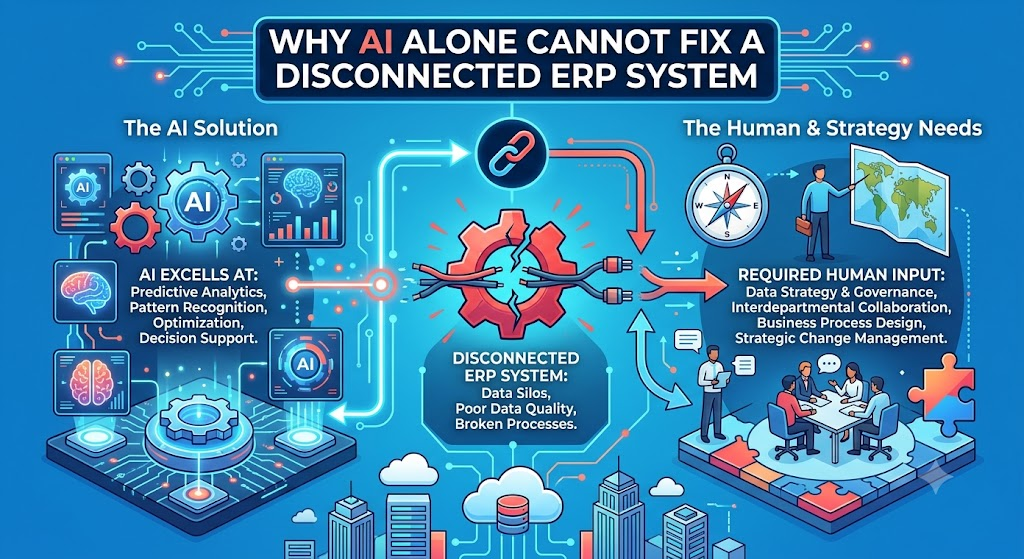
Why AI Alone Cannot Fix a Disconnected ERP System
Despite its potential, artificial intelligence cannot reliably compensate for fundamentally inconsistent business data. If inventory balances differ across departments, customer records contain duplicates or purchase orders are not updated promptly, AI-generated recommendations may be misleading.
NASSCOM and EY’s research on enterprise AI adoption in India identifies technology and data readiness, demonstrable return on investment, talent and trust as important challenges. The research reinforces the need to prepare business processes and data before attempting to scale AI.
Therefore, businesses should first establish consistent master data, integrate critical applications, define approval rules and assign responsibility for data quality. Next, they should select an automation use case with a clear business objective and measure its performance against an existing baseline.
For example, a company could measure invoice processing time, inventory stockout frequency, overdue receivables or production schedule adherence before introducing automation. After implementation, the same indicators can reveal whether the solution is producing meaningful improvements.
This approach is more dependable than adopting an AI feature without understanding the operational problem it is expected to solve.
How to Choose the Right AI-Powered ERP in Bangalore
Choosing an ERP solution requires more than comparing feature lists. Businesses should examine whether the platform can support their actual workflows, integrate with existing applications and accommodate future operational changes.
First, evaluate the availability and reliability of core modules such as finance, inventory, procurement, sales, production and reporting. Next, check whether the platform supports configurable workflows, role-based access, audit trails and integrations with the systems your employees already use.
Equally importantly, ask how its AI capabilities work. Can the system explain why an exception was flagged? Can authorised employees review recommendations before transactions are approved? Are sensitive records protected? Can the organisation measure automation performance and correct inaccurate outputs?
Businesses should also assess customisation costs and implementation timelines. A flexible, no-code business process automation platform may help organisations configure workflows without rebuilding the entire application for every change. However, the suitability of that approach depends on the complexity of the requirements and the platform’s actual capabilities.
Before signing a contract, request a demonstration based on your own business scenario rather than a generic presentation. A useful demonstration should show how information moves between departments, how exceptions are handled and how managers can measure results.
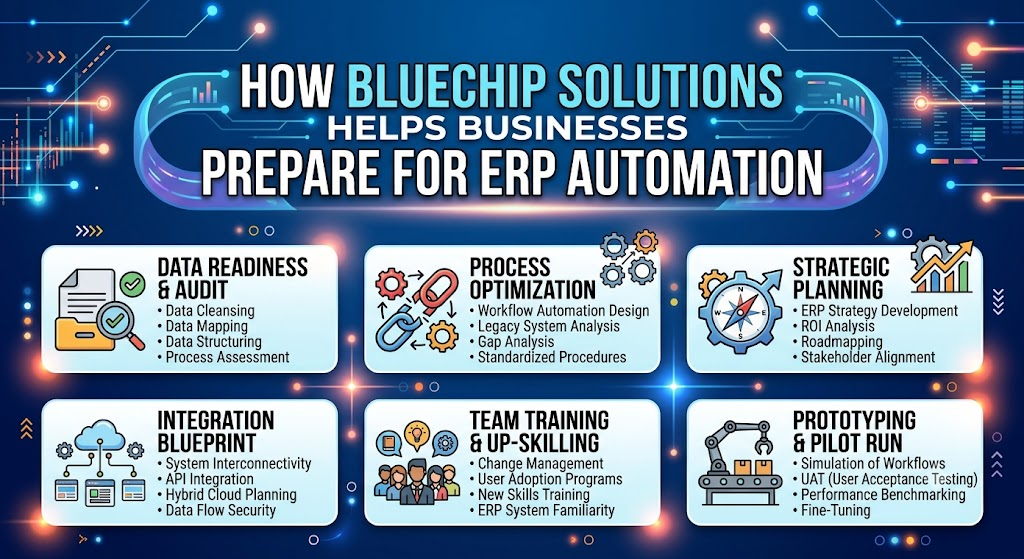
How Bluechip Solutions Can Help Businesses Prepare for ERP Automation
Bluechip Solutions offers ProfitPlus ERP and Auvit, its no-code ERP and business process automation platform, for businesses seeking connected operational processes and configurable workflows.
For organisations exploring AI-powered ERP in Bangalore, the starting point should be identifying where manual work, disconnected information and approval delays are affecting business performance. An ERP consultation can help map those issues to relevant modules, integration requirements, workflow opportunities and reporting needs.
Auvit’s no-code business process automation approach is designed to support configurable business processes. Depending on the selected configuration and integrations, businesses can explore workflow automation, approvals, reminders, reporting and connected departmental information.
However, AI functionality should be evaluated against the specific solution being proposed. Businesses should confirm which AI features are available, what data those features require and whether additional integration or configuration is necessary.
Rather than promising that technology will eliminate every operational problem, Bluechip Solutions can help businesses evaluate a practical ERP roadmap aligned with their existing processes, growth plans and automation priorities.
Planning to automate your business operations in 2027? Request a free ERP consultation from Bluechip Solutions to discuss your current challenges, required modules and potential automation opportunities.
Explore the Auvit No-Code ERP platform or visit Bluechip Solutions to learn more about its ERP offerings.
A Practical Roadmap for AI-Ready ERP in 2027
The most effective ERP transformation does not begin with the most advanced AI model. Instead, it begins with a clear understanding of how the business operates, where information becomes disconnected and which repetitive activities consume the most resources.
Businesses can start by establishing reliable data, integrating essential departments and automating straightforward workflows. Once those foundations are stable, they can introduce forecasting, anomaly detection and more advanced AI-assisted decision support where the business case justifies the investment.
Throughout this process, management should monitor measurable outcomes, review exceptions and strengthen data governance. Employees also need training so they understand when to trust system recommendations, when to investigate them and when to escalate an issue.
For Bangalore businesses preparing for 2027, the goal should not simply be to purchase AI-powered ERP software. Instead, it should be to build a connected, adaptable and measurable operating environment that helps people make better decisions and respond to problems earlier.
Take the next step: Get a practical ERP automation assessment checklist or book a free consultation with Bluechip Solutions to identify which business processes should be automated first.