
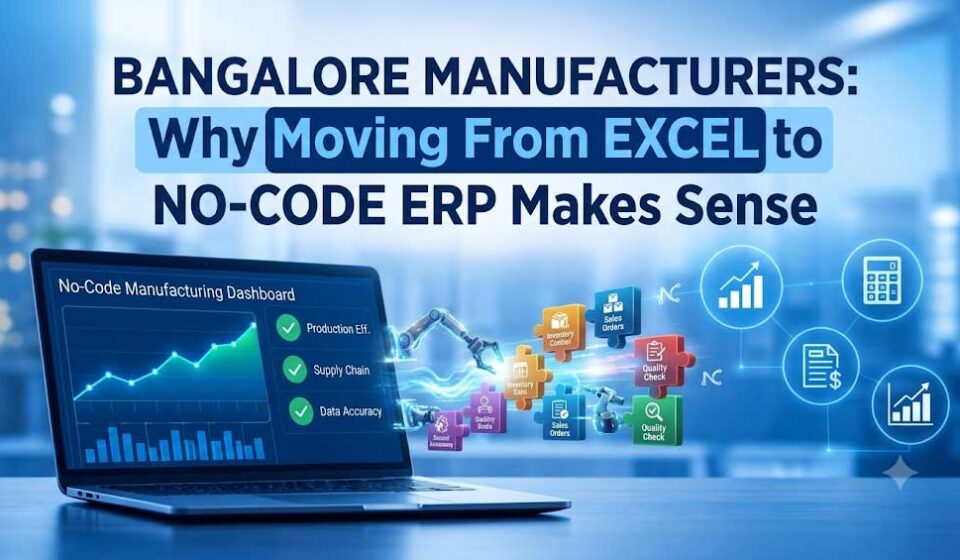
Why Bangalore Manufacturers Are Moving From Excel to No-Code ERP

A production order is delayed, but the inventory sheet still shows sufficient raw materials. Meanwhile, the purchase team has already raised another procurement request, the production supervisor is waiting for an updated schedule, and the finance department is calculating costs using a different spreadsheet. By the time management identifies the discrepancy, the factory has already lost valuable production time.
This is a common operational challenge for growing manufacturing businesses that depend on Excel to manage interconnected activities. Excel remains useful for calculations, reporting and quick data analysis. However, when manufacturers use multiple spreadsheets to coordinate procurement, inventory, production, quality, dispatch and finance, even a small data inconsistency can affect the entire operation.
Consequently, manufacturers across Bangalore’s industrial ecosystem are increasingly evaluating integrated ERP platforms that can adapt to their business processes without requiring extensive conventional software development.
This is where No-Code ERP for Manufacturers in Bangalore becomes particularly relevant. Instead of forcing every department to maintain separate records, a configurable ERP connects business operations, establishes workflow accountability and gives management a more consistent view of factory performance.
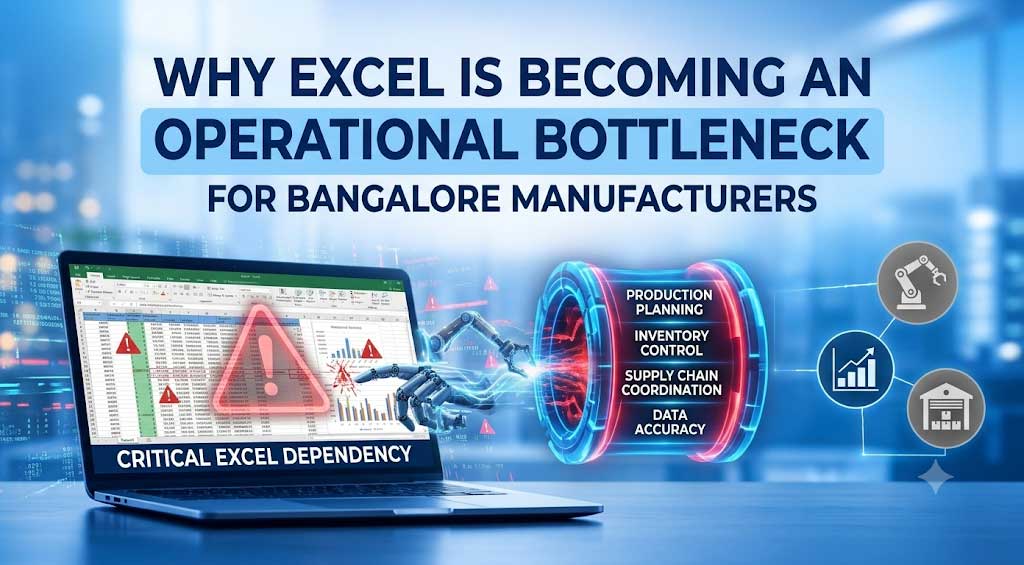
Why Excel Is Becoming an Operational Bottleneck for Bangalore Manufacturers
Bangalore’s manufacturing ecosystem includes automotive component suppliers, electronics manufacturers, engineering companies, machine builders, industrial equipment manufacturers and several growing MSMEs. As these businesses expand, their operational requirements become increasingly interconnected.
The Government of Karnataka’s Economic Survey 2025–26 estimates manufacturing growth at 7.2% at constant prices for the state. Manufacturing contributes approximately 11.33% to Karnataka’s GSDP. This expansion makes operational productivity, process visibility and technology adoption increasingly important for industrial businesses. However, business growth also exposes weaknesses in spreadsheet-based management.
Multiple Excel Files Create Multiple Versions of Business Reality
Consider a manufacturer operating with separate spreadsheets for raw material purchases, stock balances, production consumption and finished goods. The purchase department updates incoming quantities, while the warehouse team records material issues separately. Subsequently, production supervisors maintain their own consumption records.
Although every department believes its information is correct, management may receive three different stock figures for the same material. This creates a serious problem when the company accepts a new customer order or commits to a delivery date.
A connected manufacturing ERP addresses this issue by linking material receipts, stock movements, production consumption and finished goods transactions. Therefore, departments work with connected operational records instead of repeatedly reconciling independent spreadsheets.
Production Delays Remain Invisible Until Someone Reports Them
Excel can record a production schedule, but it cannot automatically establish a reliable operational feedback loop unless additional integrations and processes are developed. For example, a machine may remain idle because an operator is unavailable, a component has failed quality inspection or a required material has not arrived.
However, the production schedule may continue showing the original completion date. Consequently, plant managers discover problems through telephone calls, manual updates or end-of-shift reports.
With a properly implemented ERP, manufacturers can connect production orders, material availability, work progress, quality checks and approval workflows. This helps supervisors identify exceptions earlier and take corrective action before delays affect customer commitments.
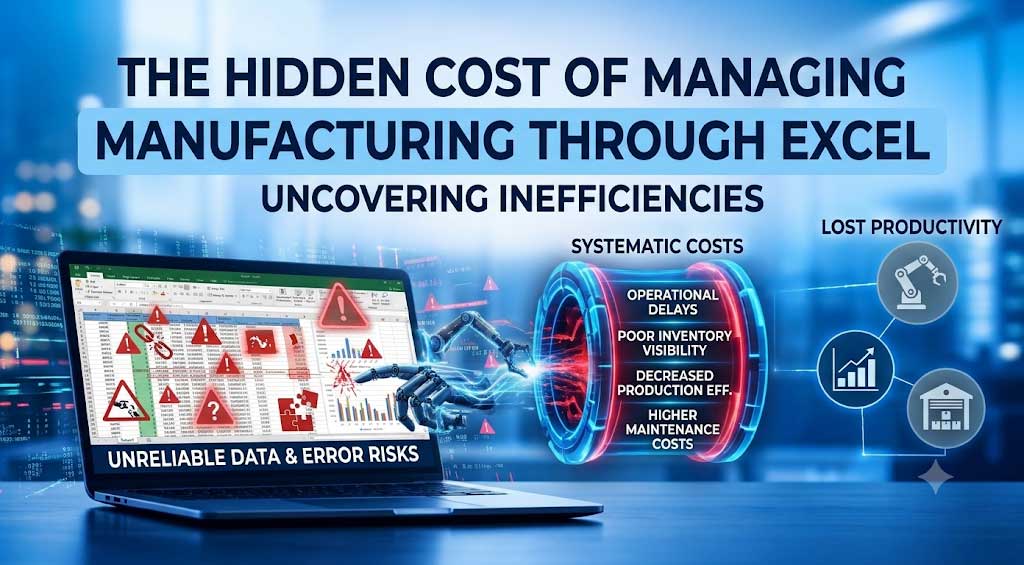
The Hidden Cost of Managing Manufacturing Through Excel
The biggest problem with Excel is not the software itself. It is the operational dependency created when critical business decisions rely on manually updated information.
Inventory Errors Increase Procurement Costs and Working Capital Pressure
Imagine a manufacturer holding sufficient quantities of a particular component according to its inventory spreadsheet. However, a portion of that stock has already been allocated to another production order. Without reliable allocation records, the purchasing team may either place unnecessary orders or discover a shortage after production begins.
Both situations affect profitability. Unnecessary purchases increase inventory holding costs, while material shortages interrupt production and delay dispatch. A Manufacturing ERP Software platform can connect purchase orders, goods receipts, stock allocation, material requirements and production consumption. As a result, procurement teams can make purchasing decisions using more consistent information.
Manual Costing Makes Product Profitability Difficult to Measure
Manufacturing costs extend beyond raw material purchases. Labour, machine expenses, subcontracting, overheads, wastage and rework can all influence the final product cost. When finance teams collect these figures from different Excel files, calculating actual production costs becomes time-consuming.
Furthermore, management may continue using estimated costs even when actual production expenses have changed. An integrated ERP can bring relevant material, production and financial transactions together, subject to the costing methods configured during implementation. This helps finance managers compare estimated and actual costs more effectively.
Customer Delivery Commitments Become Difficult to Manage
A sales executive may promise a delivery date based on an earlier production estimate. However, the production team may already be dealing with material shortages or machine downtime. Because sales, inventory and production operate separately, the company may discover the delivery risk too late.
An integrated ERP improves coordination by connecting sales orders with production planning, material availability and dispatch activities. Consequently, sales teams and management can make commitments using better operational information.
Why No-Code ERP Is Different From Traditional Manufacturing ERP
Traditional ERP systems bring business functions together, but manufacturers sometimes face another challenge after implementation: adapting the software when their processes change. For example, a factory may introduce a new quality approval, change its purchase authorisation hierarchy or introduce additional production inspection stages.
With conventional customisation, some changes may require development, testing and deployment. Therefore, even relatively small process improvements can become dependent on technical resources. A No-Code ERP approaches this challenge differently.
It uses visual configuration, reusable components and workflow designers to make supported business-process changes without requiring conventional programming for every modification. For manufacturers, this flexibility can be valuable when business requirements evolve frequently.
Configure Workflows Around Actual Factory Operations
Different manufacturers follow different operational procedures. An automobile component manufacturer may require stage-wise quality inspection, whereas an engineering company may need project-based material allocation and subcontracting approvals.
A rigid workflow may not accommodate these requirements without additional customisation. A configurable No-Code ERP can help businesses establish approval conditions, validations, forms, reminders, escalation rules and department-level workflows according to their requirements. Consequently, the software can better reflect how the factory actually operates.
Connect Departments Without Creating More Spreadsheets
No-Code ERP should not simply replace one spreadsheet with several digital forms. Its real value comes from connecting information across departments. For example, when procurement receives materials against an approved purchase order, the inventory records should reflect the receipt. Subsequently, production should be able to use the available material against authorised work orders.
Likewise, production completion should update relevant finished goods records and support subsequent dispatch and financial processes. This connected approach reduces repeated data entry and improves operational accountability.
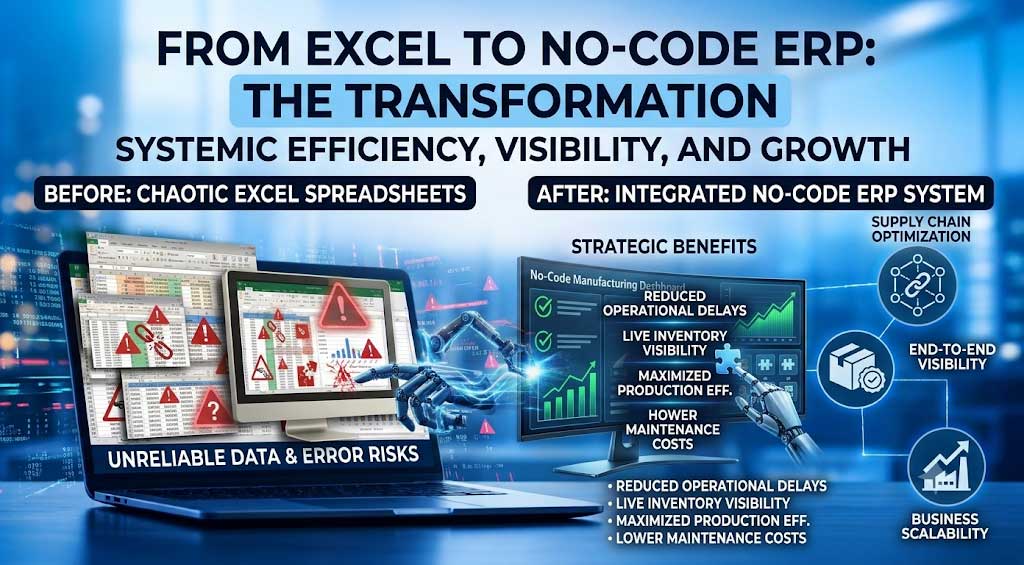
What Changes When a Manufacturer Moves From Excel to No-Code ERP?
The transition becomes meaningful when management can measure improvements in actual business processes.
From Manual Inventory Updates to Connected Stock Visibility
Instead of depending on separate stock registers, manufacturers can connect material receipts, issues, transfers, reservations and consumption. Therefore, warehouse teams can maintain more consistent inventory information while production planners gain better visibility into material availability.
From Production Follow-Ups to Workflow-Based Monitoring
Rather than repeatedly contacting supervisors for progress updates, management can use configured production records, status updates and dashboards. Furthermore, reminders and escalation workflows can help bring delayed activities to the attention of responsible employees.
From Disconnected Financial Records to Integrated Business Information
When purchasing, inventory, sales and manufacturing transactions connect with finance, accounting teams can work with more consistent operational and financial information. This also creates a stronger foundation for analysing material costs, production expenses, outstanding payments and business performance.
From Static Reports to Management Dashboards
Excel reports often require employees to collect, consolidate and update information before management can review it. An ERP with configured dashboards and reporting can present relevant business information in a more structured manner. Consequently, CEOs, CFOs and plant managers can spend less time chasing departmental updates and more time addressing operational exceptions.
Can No-Code ERP Support AI-Ready Manufacturing Operations?
Manufacturers are increasingly exploring AI for production analysis, demand planning, inventory optimisation and operational decision-making. However, AI cannot deliver dependable business insights when its underlying information is incomplete, inconsistent or scattered across disconnected spreadsheets.
The World Economic Forum’s August 2025 report, Transforming Small Businesses: An AI Playbook for India’s SMEs, identifies the lack of structured data systems, relevant solutions and workforce capabilities as important barriers to AI adoption. This highlights an important consideration for manufacturers: before investing in advanced AI applications, businesses need reliable operational data.
A connected ERP can establish that foundation by organising production transactions, inventory movements, procurement records, sales information and financial data. With suitable integrations and validated data, manufacturers can subsequently explore AI-assisted demand forecasting, inventory risk identification, production trend analysis and management reporting.
However, these outcomes depend on the AI capabilities implemented, data quality and integration architecture. An AI-ready ERP should therefore be evaluated on its actual technical capabilities rather than marketing claims alone.
How to Move From Excel to No-Code ERP Without Disrupting Production
Manufacturers do not need to replace every spreadsheet and operational process simultaneously. Instead, the transition should begin with the business activities creating the greatest operational risk. Start by identifying where employees repeatedly enter the same information, where stock figures differ between departments, where approvals remain pending and where production delays become visible too late.
Next, map the existing processes and identify which spreadsheets contain essential business information. Before migration, clean duplicate records, standardise material codes, validate opening stock and review customer and supplier information. Then, prioritise interconnected processes such as procurement, inventory and production rather than implementing isolated digital forms.
Once the initial workflows become stable, expand the implementation to quality management, costing, sales, dispatch and finance. Importantly, involve warehouse employees, production supervisors, accountants and department managers during implementation. Their practical knowledge helps ensure that the configured workflows reflect actual factory requirements.
Finally, measure the results using baseline indicators such as inventory discrepancies, purchase approval time, production delays, manual data-entry effort and order fulfilment performance.
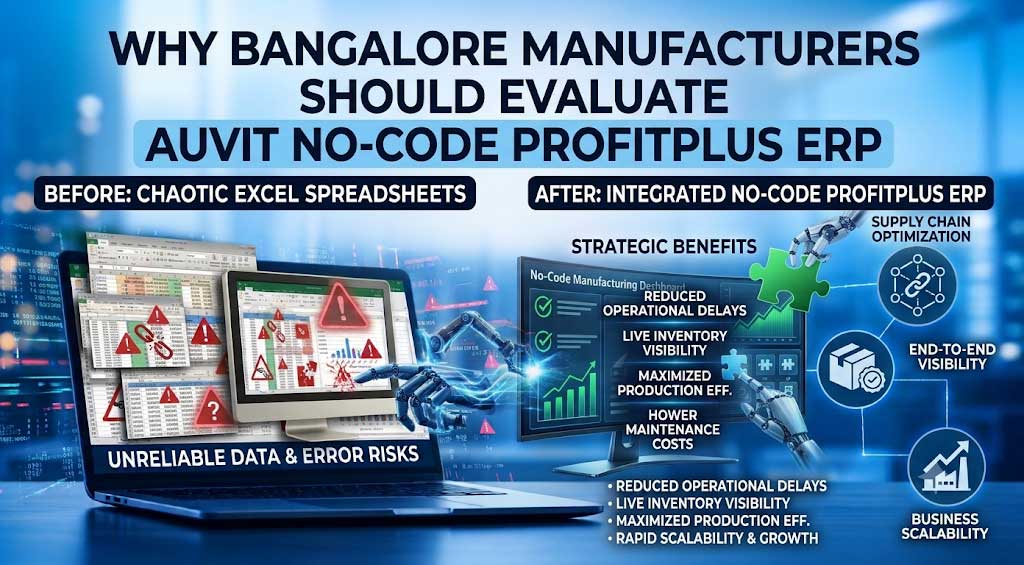
Why Bangalore Manufacturers Should Evaluate Auvit No-Code ProfitPlus ERP
For manufacturers looking to move beyond spreadsheet-dependent operations, Bluechip Solutions offers Auvit™ No-Code ProfitPlus ERP, built around its No-Code Business Process Automation platform. The approach focuses on connecting business operations while providing flexibility to configure workflows and business processes according to organisational requirements.
For manufacturing businesses, ProfitPlus ERP supports areas such as manufacturing, material planning, inventory, quality management and related business workflows. Auvit also provides workflow configuration, visual application development, integration capabilities and reporting options.
This becomes particularly relevant for growing manufacturers that want to connect purchasing, production, inventory, sales and finance without making every process change a separate conventional development project. Nevertheless, ERP suitability should always be evaluated against actual factory requirements. Manufacturers should validate their bills of materials, work orders, material allocation, production reporting, costing methods, security requirements and integrations during the demonstration.
Explore Bluechip Solutions’ Discrete Manufacturing ERP and Auvit No-Code ERP Platform to understand the available capabilities.
Frequently Asked Questions About No-Code ERP for Bangalore Manufacturers
Why are Bangalore manufacturers moving from Excel to ERP?
Manufacturers are evaluating ERP because multiple spreadsheets create data inconsistencies, manual reporting, inventory discrepancies and delayed operational decisions. An integrated ERP connects production, purchasing, inventory, finance and other business functions through centralised business processes.
Is No-Code ERP suitable for small and medium manufacturing companies?
Yes. No-Code ERP can suit growing manufacturers that need integrated business operations and frequently changing workflows. However, businesses should evaluate manufacturing functionality, scalability, security, integrations and implementation requirements before selecting a platform.
Can No-Code ERP replace Excel completely?
Not necessarily. Excel remains useful for individual calculations, specialised analysis and occasional reporting. However, manufacturers should avoid depending on separate spreadsheets as the primary systems for controlling critical inventory, production, purchasing and financial transactions.
How does No-Code ERP reduce manufacturing operational costs?
It can help reduce repetitive data entry, improve inventory visibility, streamline approvals and minimise manual coordination. Actual savings depend on implementation quality, process improvements, employee adoption and the company’s existing operational costs.
Can No-Code ERP integrate manufacturing, inventory and finance?
Yes, provided the selected platform supports the required modules, integrations and transaction workflows. A properly configured system can connect material purchases, inventory consumption, production transactions, sales and financial information.
Stop Managing Factory Growth Through Disconnected Spreadsheets
Your factory should not depend on multiple Excel files to understand its production status, inventory position or order commitments. As manufacturing operations expand, disconnected information creates additional work for employees and makes it harder for management to identify problems before they affect profitability.
Moving to No-Code ERP is not simply a technology upgrade. It is an opportunity to redesign how information moves across your factory, how employees execute processes and how management controls business performance.
Bluechip Solutions helps manufacturing businesses explore connected ERP operations through Auvit™ No-Code ProfitPlus ERP.
Ready to understand how your existing Excel-based processes can work within an integrated ERP environment?
Book a Free ERP Demo: https://bluechipsolutions.in/schedule-call-widget.php
Explore Manufacturing ERP: https://bluechipsolutions.in/discretemanufacturing.php
Contact: sales@bluechipsolutions.in