
Beyond Industry 4.0: A Practical Roadmap to Real-Time Production Intelligence in Discrete Manufacturing

A production line can have advanced machines, digital work instructions and automated inventory records, yet still struggle to meet delivery commitments. The reason is often not a lack of technology. Instead, engineering, procurement, production, quality and finance operate through disconnected systems that cannot provide a consistent view of what is happening across the factory.
Digital transformation in discrete manufacturing must therefore go beyond installing new software or connecting individual machines. Manufacturers need a connected operating model that links engineering changes, bills of materials (BOMs), production schedules, material availability, quality results and financial performance.
For manufacturing CEOs, COOs, Plant Heads and CTOs, the real objective is straightforward: understand production constraints earlier, respond to disruptions faster and make operational decisions using reliable data.
This guide explains how manufacturers can move from fragmented digital tools to real-time production intelligence through integrated ERP, smart factory integration and no-code business process automation.
Why Digital Transformation in Discrete Manufacturing Often Stalls
Many manufacturers have already invested in accounting software, inventory applications, machine monitoring tools and spreadsheets. However, these systems frequently operate independently. For example, a production supervisor may know that a machine has stopped, while procurement is unaware that the delay will affect a critical component. Meanwhile, the sales team continues communicating the original delivery date, and finance cannot accurately estimate the impact on order profitability.
Consequently, a small operational disruption becomes a wider business problem. Traditional reporting creates another challenge. When managers receive production reports at the end of a shift or the following morning, the information may explain yesterday’s losses but cannot prevent today’s delays.
The solution is not necessarily to replace every existing application. Instead, manufacturers should identify where information breaks down, connect critical business processes and establish a dependable flow of operational data.
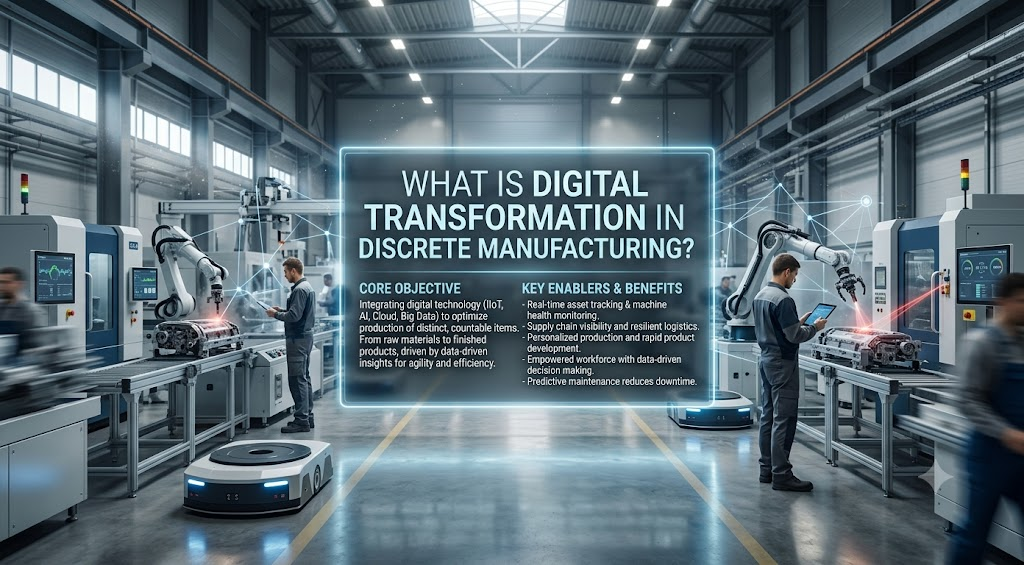
What Is Digital Transformation in Discrete Manufacturing?
Digital transformation in discrete manufacturing is the process of connecting engineering, production, supply chain, quality and financial operations through integrated digital systems, automated workflows and actionable data. Unlike isolated digitisation, which converts paper records into electronic formats, genuine transformation enables information from one business function to influence decisions in another.
For instance, when an engineering team revises a product design, the change should trigger an appropriate BOM review, material assessment, production instruction update and approval workflow. Similarly, when a machine breakdown threatens an order, production planning and procurement should receive the relevant information before the delay affects the customer.
Ultimately, production intelligence emerges when manufacturers can move from recording events to understanding their operational consequences and taking timely action.
Five Operational Gaps That Prevent Real-Time Production Intelligence
1. Engineering Changes Do Not Reach the Shop Floor Quickly Enough
In discrete manufacturing, even a minor design revision can affect component specifications, assembly sequences, material requirements and product costs. However, when engineering documents and production records are maintained separately, outdated instructions may remain in circulation.
An integrated ERP system should connect approved engineering changes with BOM versions, routing information and production orders. In addition, revision-controlled workflows should ensure that authorised changes reach the relevant teams before execution.
As a result, manufacturers can reduce avoidable rework, improve traceability and prevent production teams from relying on obsolete information.
2. Production Schedules Ignore Actual Material Availability
A production plan is only realistic when the required materials, machines and workforce are available. Nevertheless, many factories schedule orders using outdated inventory balances or assumptions about supplier delivery dates. Discrete Manufacturing ERP Software can connect production orders with inventory, purchase orders, material reservations and replenishment requirements. Therefore, planners can identify shortages before releasing work to the shop floor.
Moreover, when a supplier misses a delivery, planners can evaluate alternative sequences rather than allowing an entire schedule to become unreliable.
3. Shop-Floor Data Remains Separate from Business Decisions
Machine utilisation, downtime, cycle times and completed quantities are valuable indicators. However, these measurements provide limited value when supervisors must manually transfer information between machine interfaces, spreadsheets and ERP records.
Through shop-floor data integration, manufacturers can connect suitable machines, sensors, operator terminals and existing manufacturing systems with the central operational data environment.
Consequently, Real-Time Production Monitoring can help teams identify deviations sooner, investigate recurring downtime and compare planned production with actual output. The level of visibility depends on equipment connectivity, data quality and integration design.
4. Quality Issues Are Detected After Additional Costs Have Accumulated
When inspection results are recorded separately from production orders, a recurring defect may remain unnoticed until several batches or assemblies have been completed. An integrated quality workflow connects inspection plans, non-conformance records, affected lots, corrective actions and production history. Furthermore, automated alerts can notify responsible personnel when results exceed approved limits.
This approach helps manufacturers investigate root causes earlier, improve traceability and reduce the risk of repeated defects.
5. Production Performance Is Disconnected from Profitability
High production output does not automatically mean high profitability. Material price variations, overtime, scrap, rework, machine downtime and expedited procurement can reduce margins even when delivery targets appear healthy. By connecting production transactions with material consumption, labour costs and financial records, an ERP system can help managers compare expected costs with actual performance.
Therefore, production intelligence should answer two questions: how efficiently is the factory operating, and what is that performance doing to order-level profitability?
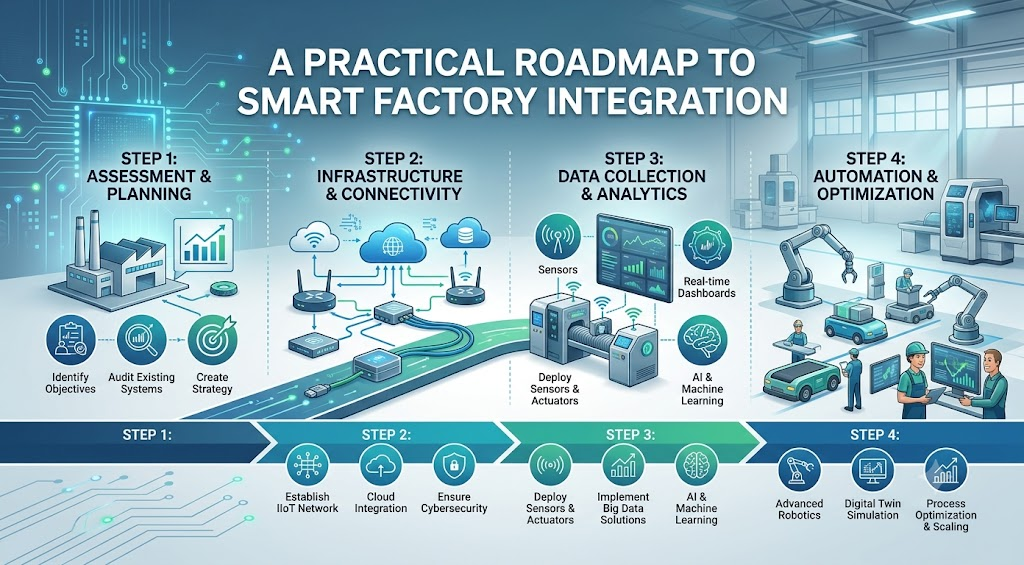
A Practical Roadmap to Smart Factory Integration
Phase 1: Establish a Reliable Operational Baseline
Before implementing new technology, manufacturers should document their existing production processes and identify where information is delayed, duplicated or manually reconciled. Start with measurable indicators such as schedule adherence, machine downtime, first-pass yield, inventory accuracy, order lead time and production cost variance. Then establish a baseline using a consistent measurement period.
Without this baseline, organisations may invest in dashboards that look impressive but cannot demonstrate operational improvement.
Phase 2: Connect Engineering, BOMs and Material Planning
Next, establish controlled information flows between engineering, product structures, inventory and procurement. Approved BOM revisions should connect with material requirements, while changes to production orders should follow defined authorisation rules.
This stage creates a dependable foundation for scheduling because planners can make decisions using current product specifications and material information.
Additionally, clear ownership of master data helps prevent duplicate part numbers, inconsistent units of measurement and inaccurate stock balances.
Phase 3: Integrate Shop-Floor Events with ERP Workflows
Once core data is reliable, connect production reporting with the systems that manage orders, materials and resources. Depending on the factory environment, integration may involve machine connectivity, manufacturing execution systems, operator terminals, APIs or scheduled data exchanges. However, not every machine needs to be connected simultaneously.
A phased approach allows manufacturers to begin with a critical production line, validate data accuracy and expand after the integration delivers useful operational insight. For example, a downtime event could create a maintenance notification, alert a supervisor and flag affected production orders. As a result, teams can respond through a defined workflow instead of relying entirely on phone calls and manual follow-ups.
Phase 4: Automate Decisions and Escalations
Manufacturing process automation becomes more valuable when workflows respond to actual business conditions. For instance, an inventory shortage can initiate a procurement review, a delayed production order can trigger an escalation, and an overdue quality approval can notify the responsible manager.
No-code business process automation can help organisations configure these rules without rebuilding the entire ERP application for every process change. Nevertheless, critical workflows still require appropriate testing, access controls, approval limits and audit trails.
Phase 5: Introduce AI-Ready Production Intelligence
Once reliable operational data is available, manufacturers can evaluate AI applications for demand forecasting, predictive maintenance, production scheduling and anomaly detection. However, AI is not a substitute for accurate data or sound operational processes. Incomplete machine readings, inconsistent downtime codes and outdated inventory records can weaken model performance.
An AI-Ready Manufacturing ERP environment should therefore support accessible, structured data, documented integrations and controlled access to business information. Start with a clearly defined use case, such as identifying recurring downtime patterns or forecasting component shortages. Compare model recommendations with actual outcomes before expanding to more complex decisions.
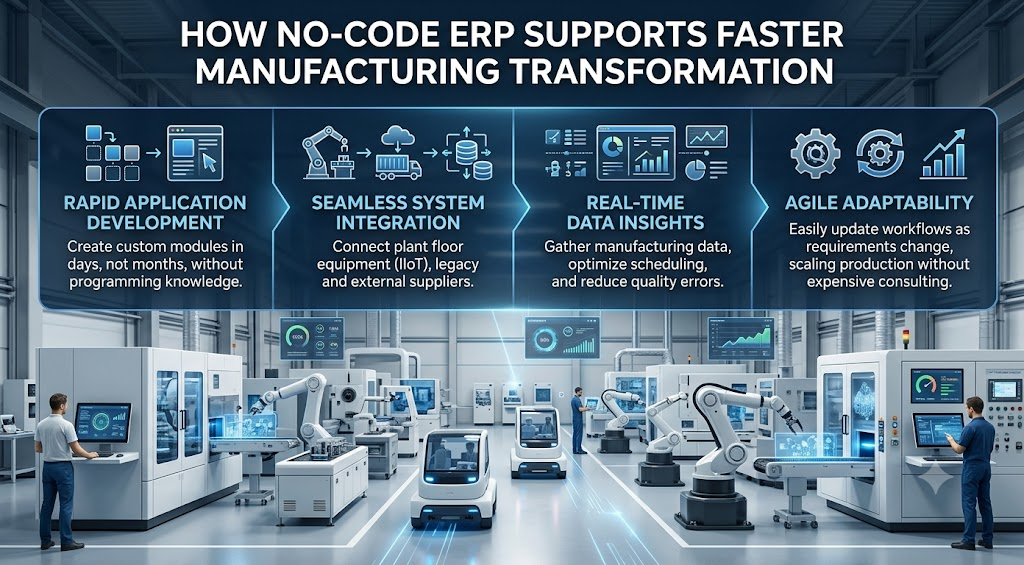
How No-Code ERP Supports Faster Manufacturing Transformation
Traditional customisation can make manufacturing software difficult to adapt when approval rules, production processes or reporting requirements change. Conversely, disconnected low-code tools can create additional data silos if they operate outside the core business system. An integrated no-code ERP approach aims to combine process flexibility with centralised business information.
For example, a manufacturer may need a customised subcontracting approval, a revised quality escalation or a new production dashboard. A configurable platform can help implement these requirements through defined workflows and application changes, subject to the platform’s capabilities and governance controls.
Bluechip Solutions positions Auvit™ No-Code ProfitPlus ERP and business process automation around connected business operations and configurable workflows. For manufacturers evaluating this approach, the priority should be to map actual process requirements, validate integration capabilities and demonstrate the proposed workflow using a realistic business scenario.
The objective is not to customise everything. Instead, it is to make necessary changes easier to manage while preserving data consistency, accountability and operational control.
Which KPIs Should Manufacturing Leaders Monitor?
Real-time production intelligence must translate into measurable business outcomes. Production leaders should monitor schedule adherence, throughput, downtime and overall equipment effectiveness where the necessary machine data is available. Quality teams should examine first-pass yield, defect rates and rework costs. Supply chain managers should track material shortages, inventory accuracy and supplier delivery performance.
Meanwhile, CEOs and finance leaders need visibility into order profitability, production cost variance, working capital and on-time delivery. The most useful dashboard connects these measures rather than displaying them as unrelated numbers. For example, a drop in throughput becomes more actionable when managers can examine its relationship with material shortages, downtime and the profitability of affected orders.
Manufacturers should establish their own baselines and improvement targets instead of assuming that a technology implementation will automatically deliver a particular percentage of savings.
Frequently Asked Questions
What is the biggest challenge in digital transformation in discrete manufacturing?
The biggest challenge is often connecting fragmented operational data and processes. When engineering, inventory, production, quality and finance rely on inconsistent information, managers struggle to respond quickly to disruptions.
How does Discrete Manufacturing ERP Software improve production visibility?
It connects production orders with BOMs, material availability, purchasing, inventory, quality and financial transactions. When integrated with suitable shop-floor systems, it can provide more timely visibility into actual production progress and emerging constraints.
Can smart factory integration work with existing manufacturing equipment?
Yes, in many cases. Depending on equipment capabilities, manufacturers can use industrial communication protocols, gateways, APIs, machine data platforms or manufacturing execution systems. A technical assessment is necessary to determine the most suitable integration method.
How can AI improve manufacturing operations?
AI can support demand forecasting, maintenance prediction, scheduling recommendations and anomaly detection. Its effectiveness depends on data quality, integration, model validation and appropriate human oversight.
How should manufacturers begin their digital transformation journey?
Begin with one measurable operational problem, establish a baseline, connect the necessary data and implement a controlled pilot. After validating the results, expand the approach to other production lines and business functions.
Build a Connected Manufacturing Operation with Bluechip Solutions
Disconnected systems, delayed production reporting and manual coordination can prevent manufacturers from responding effectively to operational changes. However, a phased digital transformation strategy can connect the information and workflows that matter most.
Bluechip Solutions helps businesses evaluate integrated ERP and no-code business process automation approaches for improving operational visibility and workflow coordination.
Ready to identify the gaps in your production operations? Request a manufacturing ERP consultation to discuss your current systems, shop-floor integration requirements, reporting needs and automation opportunities.
Get the Manufacturing Digital Transformation Readiness Checklist. Use it to assess ERP integration, BOM control, production monitoring, material planning, quality traceability, data governance and AI readiness before investing in your next manufacturing technology initiative.
Explore Auvit™ No-Code ERP. Visit Bluechip Solutions: https://bluechipsolutions.in/