
AI ERP for Finance: How to Detect Cash-Flow Risks Before They Become a Business Crisis

A profitable business can still struggle to pay salaries, suppliers and operating expenses when money does not arrive at the right time. For many growing companies, the problem is not necessarily a lack of sales. Instead, businesses face a gap between the cash they expect to receive from customers, the payments they must make to suppliers and the cash they actually have available in their bank accounts.
This is where AI ERP for finance becomes an important consideration for CFOs and Finance Managers. An integrated ERP connects financial and operational data, helping finance teams track cash flow, spot delayed payments and identify financial risks early.
However, identifying a cash-flow problem after it affects daily operations is already too late. Finance leaders need better visibility into upcoming obligations, outstanding invoices and changing payment patterns. Consequently, combining ERP financial management, business process automation and appropriately implemented AI capabilities can help businesses move from reactive financial management towards more informed decision-making.
Why Cash-Flow Problems Are Becoming a Serious Concern for Businesses
Cash-flow pressure affects more than just startups or financially unstable companies. Even established manufacturers, distributors and service organisations can face liquidity problems when customers delay payments or unexpected expenses increase.
The scale of delayed payments in India highlights this challenge. According to the Ministry of MSME’s Annual Report 2025–26, applications filed on the MSME Samadhaan portal since its inception involved ₹55,244.31 crore as of 31 December 2025. Furthermore, the Economic Survey 2025–26 reported that delayed payments to MSMEs had locked up approximately ₹8.1 lakh crore.
These figures demonstrate why businesses cannot depend entirely on historical financial statements or manually updated spreadsheets to manage working capital. For example, a manufacturing company may complete several customer orders and record strong monthly sales. Nevertheless, if customers delay payments by 45–60 days while suppliers demand payment within 15 days, the business can experience a working-capital shortage.
Meanwhile, salaries, electricity bills, transportation expenses and loan repayments continue according to their schedules. Therefore, revenue growth alone does not guarantee sufficient liquidity. An integrated financial management system helps address this visibility gap by bringing receivables, payables, expenses and financial information into a connected environment.
How AI ERP for Finance Helps Identify Cash-Flow Risks Earlier
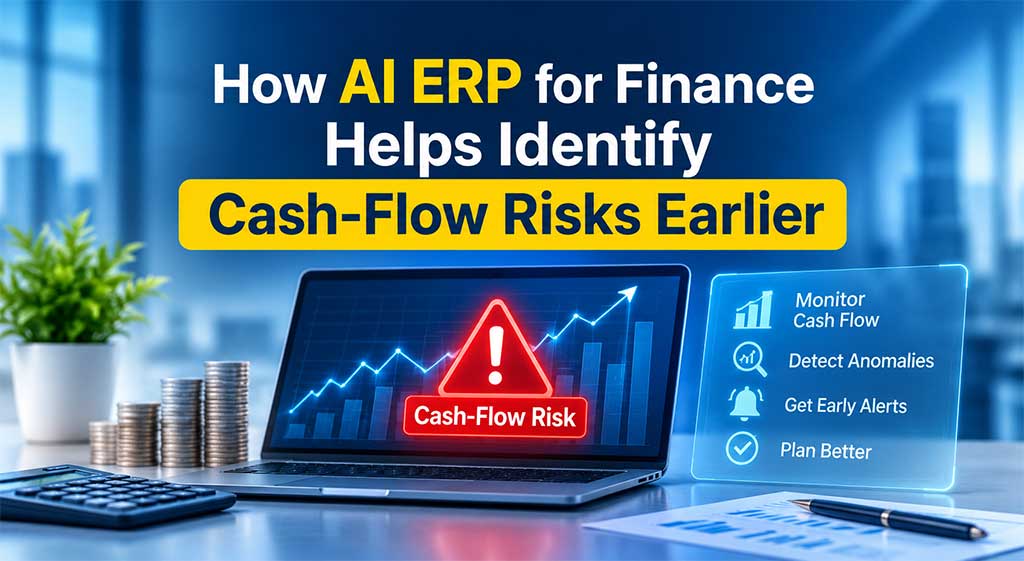
Traditional financial reporting generally explains what has already happened. However, CFOs also need to understand what could happen next. AI ERP for finance combines connected financial information, automation and, where implemented, analytical or machine-learning capabilities to help finance teams identify unusual patterns and evaluate potential cash-flow risks.
For instance, consider a company with ₹50 lakh in expected customer collections over the next 30 days. Although the accounts receivable report may show the entire amount as outstanding, some invoices could already be overdue, while others may be associated with customers who regularly pay late. Consequently, treating every outstanding invoice as immediately available cash can create an inaccurate financial forecast.
An integrated ERP system can provide invoice-level visibility, customer payment history, due dates and outstanding balances. With suitable AI-based analytical models, this information can also support payment-behaviour analysis and early identification of potential collection risks.
Rather than waiting for a liquidity shortage, finance managers can investigate potential problems earlier and take appropriate action.
1. Detect Delayed Customer Payments Before They Affect Working Capital
Delayed customer payments are among the most common reasons businesses experience cash-flow pressure. However, the challenge is not simply knowing how much money customers owe. Finance teams must also understand which invoices are overdue, how long payments have been pending and whether particular customers repeatedly miss their agreed payment terms.
Without connected accounts receivable information, finance employees may spend considerable time checking spreadsheets, reviewing emails and contacting different departments to confirm collection status. An ERP-based receivables management process brings customer invoices, payment terms, collection records and outstanding balances together.
Furthermore, configurable workflows can support payment reminders, follow-up scheduling and escalation to responsible employees. As a result, finance teams can prioritise overdue accounts instead of treating every customer follow-up equally. With properly implemented AI analytics, businesses can also examine historical payment behaviour and identify customers whose payment patterns are changing.
For example, if a customer who generally pays within 30 days starts taking 55 days, this change may indicate a collection risk. Although it does not automatically mean the customer will default, it gives the finance team an opportunity to investigate before the outstanding amount becomes more difficult to recover.
2. Monitor Accounts Payable to Prevent Unexpected Payment Pressure
Managing incoming payments is only one side of cash-flow control. Equally important is understanding when money must leave the business. Supplier invoices, purchase commitments, employee salaries, statutory payments, rent and loan instalments can create overlapping financial obligations.
When accounts payable information is maintained separately from purchasing and inventory records, finance managers may not have a complete picture of upcoming expenses. An integrated ERP system connects supplier information, purchase transactions, invoice records, payment terms and approval workflows. Consequently, finance teams can review upcoming payment obligations and plan available funds more effectively.
For example, a manufacturing company may have ₹18 lakh in supplier payments due over the next two weeks. At the same time, customer collections of ₹25 lakh may be expected during the same period. However, if a significant customer payment is delayed, the original payment plan could become difficult to maintain. With connected accounts payable and receivable information, the finance team can evaluate this mismatch earlier, review payment priorities and coordinate with management.
Additionally, AI-assisted anomaly detection can be considered for identifying unusual invoice amounts, duplicate records or unexpected changes in supplier payment patterns, provided these capabilities are specifically implemented and validated.
3. Improve Cash-Flow Forecasting Using Connected Financial Data
One of the biggest challenges for CFOs is estimating how much cash will actually be available in the coming weeks or months. Traditional forecasting methods often depend on historical averages and manually entered assumptions. Although these methods can be useful, they may not reflect sudden changes in customer collections, supplier commitments, inventory requirements or operating expenses.
A connected ERP environment provides a stronger foundation for financial forecasting because it brings together historical transactions and current business information. For example, finance teams can examine outstanding receivables, scheduled payables, recurring expenses, inventory purchasing requirements and available financial balances.
With appropriate forecasting models, this information can support different cash-flow scenarios. Consider a business expecting ₹40 lakh in customer collections next month. If ₹12 lakh is associated with overdue invoices and another ₹8 lakh depends on customers with inconsistent payment histories, the finance team should not automatically treat the entire ₹40 lakh as guaranteed cash inflow.
Instead, different collection scenarios can be evaluated to understand the possible impact on working capital. Furthermore, forecasting becomes more useful when finance managers can compare projected figures with actual transactions and revise assumptions as new information becomes available. Therefore, AI-assisted forecasting should be treated as a decision-support capability rather than a guarantee of future cash availability.
4. Identify Unusual Financial Transactions and Potential Exceptions
Small financial discrepancies can become significant problems when they remain unnoticed across multiple transactions. For instance, duplicate supplier invoices, incorrect payment amounts, unexpected expense increases and inconsistent transaction records can affect financial accuracy.
When transaction volumes increase, manual verification becomes increasingly difficult. Moreover, finance teams may discover discrepancies only during month-end closing or internal audits. An integrated ERP system helps establish structured financial records and configurable approval processes. Consequently, authorised employees can review transactions, verify supporting information and investigate exceptions.
Additionally, AI-based anomaly detection can be implemented to analyse transaction patterns and flag unusual activities for human review. For example, if a supplier invoice is significantly higher than its previous transactions, the system could flag it for verification, depending on the configured rules and analytical capabilities.
Importantly, an anomaly alert does not establish fraud or an accounting error. Instead, it identifies a transaction that deserves closer attention. This combination of structured ERP controls, workflow automation and human verification helps strengthen financial oversight.
5. Connect Inventory, Purchasing and Finance to Control Hidden Cash Blockages
Cash-flow problems do not always originate inside the finance department. In many manufacturing and distribution businesses, excess inventory and unplanned purchasing can lock up substantial amounts of working capital. For example, purchasing raw materials beyond actual production requirements may increase inventory holding costs without generating immediate revenue.
Similarly, slow-moving finished goods can occupy warehouse space while the business continues paying salaries, utilities and other operating expenses. When inventory, purchasing, production and finance operate independently, CFOs may struggle to understand how operational decisions affect available cash.
An integrated ERP platform connects these business activities and provides better visibility into stock movements, procurement transactions, inventory valuation and associated costs. As a result, finance and operations managers can evaluate purchasing requirements alongside inventory availability and production demand.
Furthermore, suitable analytical models can help identify unusual inventory accumulation or changes in material consumption. Therefore, connecting operational and financial information is essential for businesses that want to improve working-capital utilisation rather than focusing only on collections and payments.
6. Use Real-Time Financial Dashboards for Faster Management Decisions
Even when financial information is available, delayed reporting can prevent management from taking timely action. If a CFO receives an updated cash position only after several days of manual reconciliation, the business may already have missed an opportunity to address a payment shortfall.
Financial dashboards help address this challenge by bringing important business information into a central reporting environment. Depending on the ERP configuration, finance teams can monitor cash and bank balances, outstanding customer invoices, supplier liabilities, expense movements and financial performance indicators.
Moreover, management dashboards can help identify differences between expected and actual financial results. For example, if customer collections are below the planned amount while supplier obligations remain unchanged, management can review the situation and coordinate corrective action.
With appropriately implemented AI capabilities, dashboards can also incorporate predictive insights, risk indicators and exception alerts. However, the accuracy of these insights depends on the quality, completeness and timeliness of the underlying financial data. Consequently, connected information and reliable transaction processing must come before advanced analytics.
7. Why an AI-Ready ERP with Business Process Automation Matters
Implementing AI tools without connecting financial information can create another layer of disconnected systems. For example, a forecasting application may analyse receivables, but if purchasing commitments and supplier liabilities are maintained elsewhere, the resulting financial picture may remain incomplete.
This is why businesses should evaluate an integrated ERP platform that connects essential financial and operational processes. An AI-ready ERP with Business Process Automation (BPA) provides a structured foundation for managing transactions, configuring approval workflows, coordinating departments and generating management reports.
Furthermore, configurable workflows can reduce dependence on manual follow-ups by supporting automated reminders, approval routing, document management and escalation processes. For growing businesses, flexibility is equally important. Financial workflows, approval requirements and reporting structures can change as transaction volumes increase or operations expand.
Therefore, choosing an ERP platform that can adapt to business requirements is important for long-term financial process management. Bluechip Solutions’ Auvit™ No-Code ProfitPlus ERP combines ERP capabilities with a Business Process Automation platform to support configurable business processes and integrated information management.
Its suitability for specific financial forecasting or AI-based anomaly detection requirements should be evaluated against the actual implementation scope rather than assumed as an automatically available feature.
How CFOs Can Evaluate an ERP System for Better Cash-Flow Management
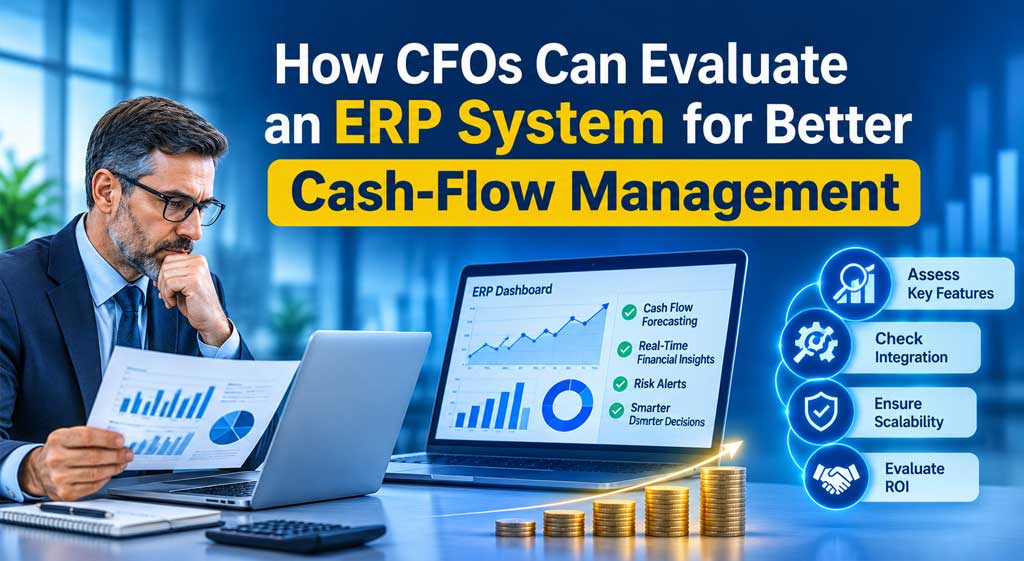
Before investing in an ERP solution, CFOs should examine whether the platform addresses the financial visibility problems affecting their organisation. The first consideration should be data integration. Accounts payable, accounts receivable, purchasing, inventory and financial reporting should work within a connected information environment.
Next, businesses should evaluate reporting flexibility. Finance managers need access to relevant financial information without depending entirely on manually consolidated spreadsheets. Additionally, approval controls, transaction traceability, access permissions and exception-handling workflows should be considered.
For organisations exploring AI, it is equally important to ask how analytical models use historical and current data, how alerts are validated and whether finance employees can review the reasoning behind flagged exceptions. Finally, businesses should assess implementation flexibility, scalability, security and integration requirements.
A successful ERP implementation is not simply about introducing new software. Instead, it should improve the way financial information is collected, processed, reviewed and used for business decisions.
Frequently Asked Questions About AI ERP for Finance
What is AI ERP for finance?
AI ERP for finance refers to an enterprise resource planning environment that combines integrated financial management with artificial intelligence and analytical capabilities. Depending on implementation, it can support financial analysis, cash-flow forecasting, transaction anomaly detection and automated financial workflows.
How can AI ERP help businesses detect cash-flow risks?
An integrated ERP system provides visibility into customer receivables, supplier payables, expenses and financial transactions. When appropriate AI models are implemented, this information can help identify delayed payment patterns, unusual transactions and potential differences between expected cash inflows and upcoming obligations.
Can ERP software predict future cash-flow shortages?
ERP software can provide the financial information required for forecasting. With suitable forecasting models, businesses can evaluate expected collections, scheduled payments and different financial scenarios. However, forecasts are estimates and depend on data quality, assumptions and changing business conditions.
Why should CFOs integrate accounts payable and accounts receivable?
Accounts payable represents money the business needs to pay, whereas accounts receivable represents money it expects to collect. Integrating both provides a more complete understanding of upcoming cash inflows and outflows, helping finance teams plan working capital more effectively.
Is an AI-ready ERP suitable for SMEs?
Yes. An appropriately configured ERP system can help SMEs connect financial transactions, automate workflows, improve reporting visibility and establish more structured financial controls. However, businesses should select capabilities according to their actual requirements, transaction volumes and implementation budgets.
Conclusion: Move from Reactive Financial Management to Early Risk Visibility
A cash-flow crisis rarely develops from a single transaction. Instead, it often emerges through a combination of delayed customer payments, increasing supplier obligations, excess inventory, rising operating expenses and insufficient financial visibility.
Therefore, CFOs need more than periodic financial statements to manage business liquidity effectively. They need connected financial data, timely reporting, exception monitoring and reliable insights that help identify potential risks before they affect business operations.
AI ERP for finance can support this shift by helping finance teams analyse transaction patterns, monitor outstanding receivables and payables, identify unusual financial activity and improve cash-flow forecasting, depending on the platform’s capabilities and implementation.
For growing businesses, the real advantage is not simply automating financial tasks. It is building a more proactive financial management approach where decision-makers can understand emerging risks, evaluate their impact and respond with greater confidence.
With Bluechip Solutions’ Auvit No-Code ProfitPlus ERP, businesses can bring financial and operational processes together through an integrated ERP platform designed to support better visibility, streamlined workflows and informed decision-making.
Ready to improve financial visibility and strengthen business control? Explore how Bluechip Solutions can help your organisation modernise financial management.
Schedule a Free ERP Demo: https://bluechipsolutions.in/schedule-call-widget.php