
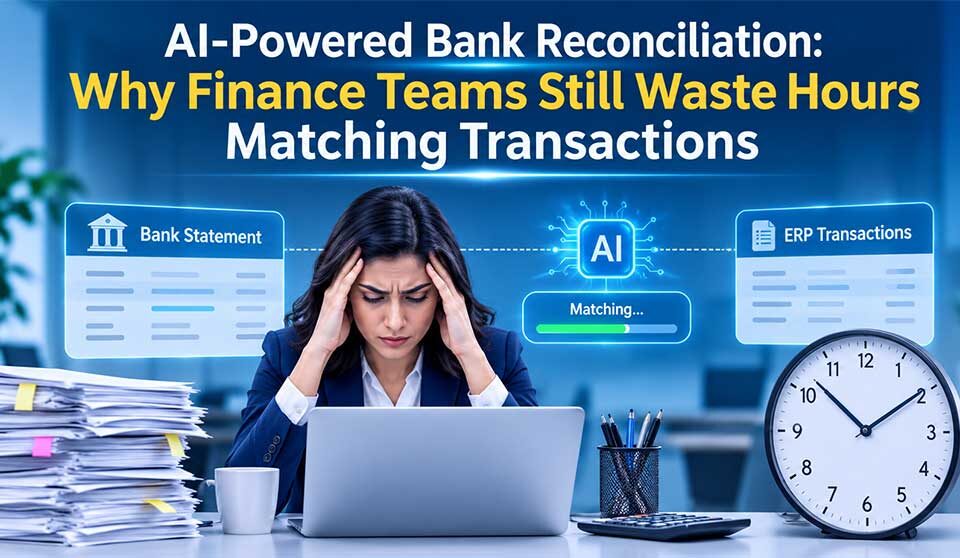
AI-Powered Bank Reconciliation: Why Finance Teams Still Waste Hours Matching Transactions

Bank reconciliation should not require finance professionals to spend hours investigating transactions that should have matched automatically. Yet, many businesses still depend on spreadsheets, bank statements, accounting exports and manual verification to confirm whether money received or paid has been correctly recorded.
The real problem is not simply the number of transactions. It is the growing complexity behind each transaction. A single customer payment may cover multiple invoices, a supplier may receive a consolidated payment, bank charges may reduce the credited amount, and payment references may differ between banking platforms and accounting records.
Consequently, even finance teams with well-maintained accounting systems can spend considerable time investigating discrepancies instead of analysing financial performance. AI-powered bank reconciliation introduces a more intelligent approach. By analysing transaction descriptions, amounts, dates, historical matching patterns and reference information, machine learning-based systems can help identify likely matches, prioritise exceptions and direct uncertain transactions to human reviewers.
However, automation alone is not the objective. Finance teams need accurate matching, explainable decisions, traceable corrections and complete control over financial records. This is where AI bank reconciliation software, when properly integrated into an ERP environment, can transform the reconciliation process.
Why Traditional Bank Reconciliation Still Creates Financial Bottlenecks
The traditional reconciliation process generally compares transactions recorded in an organisation’s accounting system against entries appearing in its bank statements. Although this process appears straightforward, the difficulty increases when businesses manage multiple bank accounts, payment gateways, branches, currencies and transaction channels.
Consider a manufacturing company receiving hundreds of customer payments every week. Its accounting department may receive bank credits containing short transaction descriptions, UTR numbers or payment gateway references. However, the corresponding sales invoices may contain different reference numbers.
As a result, the accountant must investigate each payment, identify the customer, locate the invoice and confirm the amount before closing the entry. Furthermore, partial payments, advance receipts, deductions and consolidated settlements introduce additional complexity.
The problem becomes more serious during month-end closing. Finance teams must resolve outstanding entries, investigate differences and prepare supporting documentation within strict reporting deadlines. The real bottleneck is not recording transactions; it is establishing reliable relationships between transactions, invoices, payments and financial records.
The Hidden Complexity Behind Modern Business Transactions
The volume and diversity of digital payments make reconciliation more demanding than many organisations anticipate. According to the Government of India’s Ministry of Finance, UPI processed approximately 24,161.69 crore transactions worth ₹314 lakh crore during FY 2025–26, representing 30% year-on-year growth in transaction volume. The same report recorded an average of approximately 66 crore transactions daily. Press Information Bureau
These figures demonstrate how extensively businesses and consumers now depend on digital payment infrastructure. However, receiving payments digitally does not automatically mean that accounting records will match those payments correctly. For example, a business may receive money through UPI, NEFT, RTGS, IMPS, payment gateways, credit cards and traditional bank transfers. Each channel can provide different transaction references, settlement timings and descriptions.
Consequently, finance departments face a reconciliation challenge involving multiple data formats and different transaction behaviours. An effective AI-powered reconciliation approach must therefore understand more than transaction amounts. It must establish the context behind every financial entry.
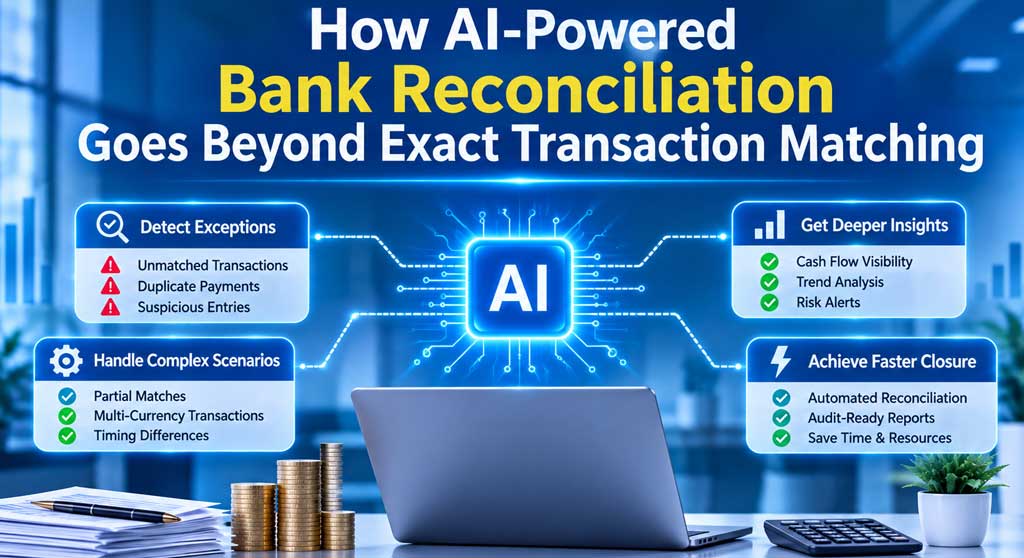
How AI-Powered Bank Reconciliation Goes Beyond Exact Transaction Matching
Traditional reconciliation often relies on exact comparisons between transaction amounts, dates and reference numbers. Although this approach works for straightforward transactions, it struggles when banking descriptions differ from accounting records. AI bank reconciliation software can introduce a more flexible matching process by analysing multiple transaction attributes simultaneously.
Multi-Attribute Transaction Matching Instead of Reference Number Matching
Consider a customer who pays ₹1,50,000 against three outstanding invoices. The bank statement may contain one consolidated credit, while the accounting system contains three separate receivables. An exact reference-number comparison cannot establish the complete relationship. A machine learning-based matching approach can evaluate transaction amounts, customer identifiers, payment descriptions, invoice balances, historical payment behaviour and transaction dates.
It can then identify potential relationships between the bank credit and multiple invoices. However, the system should distinguish between a mathematically possible match and a financially verified match. This distinction prevents incorrect automatic reconciliation.
Contextual Matching for Inconsistent Bank Descriptions
Another challenge occurs when banks display abbreviated or inconsistent transaction descriptions. For example, the accounting system may identify a customer as ABC Manufacturing Pvt Ltd, whereas the bank statement displays ABCMFG, an abbreviated UPI reference or a payment gateway identifier.
An intelligent matching engine can use historical relationships, reference patterns and available customer information to estimate whether these records belong together. Additionally, natural language processing (NLP) can help interpret unstructured transaction descriptions and identify meaningful reference information. Nevertheless, uncertain customer identities should remain subject to human verification rather than automatic acceptance.
How AI Algorithms Can Identify Unmatched Transactions and Reconciliation Exceptions
The most valuable improvement in AI-powered bank reconciliation is not simply matching more transactions. It is identifying why transactions remain unmatched. A sophisticated reconciliation architecture can combine several analytical techniques.
Machine Learning for Transaction Similarity Scoring
Instead of relying on a single matching condition, a machine learning model can evaluate multiple attributes and calculate a confidence score for each potential match. For example, the matching engine may evaluate the amount difference, date difference, reference similarity, customer identity and historical transaction relationships.
A conceptual scoring model could combine these attributes:
\[ S = w_1A+w_2D+w_3R+w_4C+w_5H \]
Here, \(A\) represents amount similarity, \(D\) represents date proximity, \(R\) represents reference similarity, \(C\) represents counterparty confidence and \(H\) represents historical relationship strength. The weights determine the relative importance of each attribute. The model can be calibrated using verified historical reconciliation decisions. However, a high similarity score should not automatically establish financial correctness. Duplicate candidates, unusual amounts and conflicting references require additional checks.
Anomaly Detection for Unusual Financial Entries
AI-based anomaly detection can identify transactions that differ from established financial patterns. For example, a finance team may regularly receive customer payments within a particular range. Suddenly, a transaction appears with an unexpected amount, an unfamiliar reference or a repeated payment identifier.
An anomaly detection model can flag this entry for investigation. Furthermore, businesses can use exception classification to distinguish between possible duplicate payments, bank charges, timing differences, unidentified credits and unexpected debits. This helps accountants investigate the underlying problem instead of manually reviewing every transaction.
Predictive Prioritisation of Reconciliation Exceptions
Not every unmatched transaction deserves the same level of attention. A small bank charge and a large unidentified customer receipt have different financial implications. An AI-assisted exception management process can prioritise transactions using factors such as outstanding value, transaction age, financial impact, recurrence and risk indicators.
Consequently, finance managers can focus on high-value discrepancies before they affect cash-flow visibility or month-end reporting.
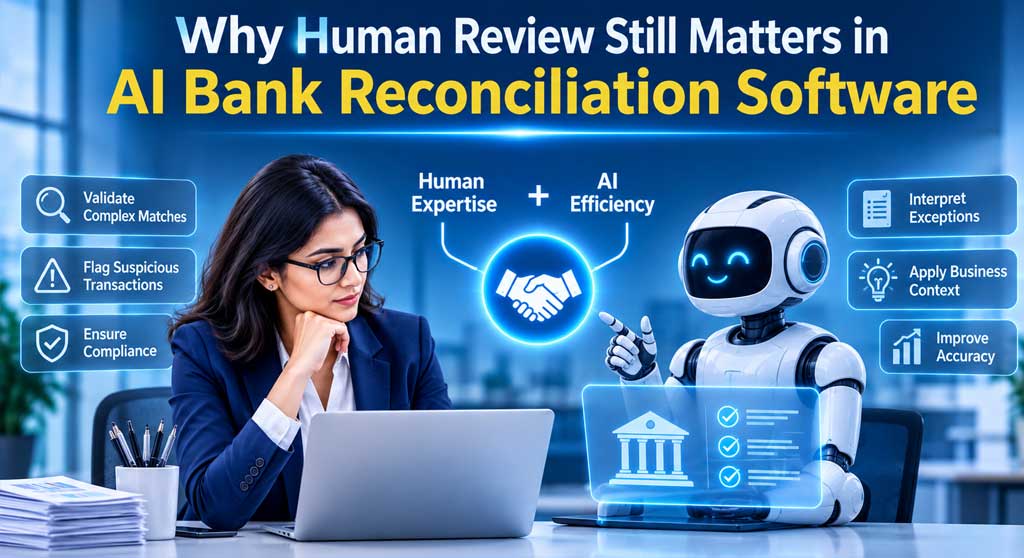
Why Human Review Still Matters in AI Bank Reconciliation Software
Complete automation is not always the right approach for financial reconciliation. Imagine a company receiving two customer payments of ₹75,000 on the same day. Both payments have similar descriptions and relate to outstanding invoices. A matching algorithm might identify both transactions as strong candidates. However, selecting the wrong customer account could create incorrect receivables, inaccurate customer balances and additional audit complications.
Therefore, a reliable reconciliation process should use confidence-based decision controls. High-confidence matches that satisfy predefined validation rules may qualify for automated processing. Medium-confidence matches should enter a review queue, while low-confidence or high-risk transactions should require investigation. Importantly, human reviewers should see why the system suggested a particular match, which attributes influenced its decision and what alternative matches were available.
This approach combines machine efficiency with professional financial judgement.
Audit Trails: The Missing Link Between Automation and Financial Accountability
Reconciliation does not end when two transactions match. Finance teams must also demonstrate how the match occurred and who approved any subsequent changes. For this reason, audit trails are essential when implementing AI bank reconciliation software. A well-designed reconciliation environment should retain the original bank transaction, corresponding accounting entry, matching rationale, confidence assessment, reviewer identity, approval timestamp and adjustment history.
Moreover, the system should preserve previous decisions instead of silently overwriting financial records. For example, if an accountant rejects an automatically suggested match, the system should record the rejection and its reason. Similarly, any manual adjustment should remain traceable to the person who authorised it.
These controls improve transparency during internal audits, statutory audits and financial closing activities. The objective is not merely faster reconciliation. It is faster reconciliation without sacrificing financial accountability.
Why ERP Integration Is Critical for Intelligent Bank Reconciliation
An AI reconciliation engine becomes considerably more useful when it operates within an integrated ERP environment rather than as an isolated financial application. For instance, a customer payment should connect with accounts receivable, sales invoices, customer ledgers and bank transactions. Similarly, supplier payments should connect with accounts payable, purchase invoices, payment approvals and cash balances.
Without these connections, finance teams may still need to transfer information between multiple applications. An integrated ERP environment can create a connected reconciliation workflow in which financial transactions, accounting entries, approvals and exception reports remain accessible through a common system. Furthermore, integration with bank statement imports, supported banking interfaces and payment gateways can reduce repetitive data entry.
For businesses managing multiple branches or bank accounts, this connected approach can improve financial visibility and make month-end reconciliation more manageable.
How CFOs Should Evaluate AI Bank Reconciliation Software
Choosing an AI bank reconciliation solution requires more than checking whether the software offers automatic matching. CFOs should evaluate whether the solution supports multiple bank accounts, different transaction formats, partial payments, consolidated settlements and configurable matching rules.
Equally important, they should examine how the system handles uncertain matches, duplicate detection, exception escalation and manual approvals. Another important consideration is explainability. Finance professionals must understand why the system suggested a match and whether they can independently verify its accuracy.
Finally, businesses should assess ERP integration, role-based access, audit history, reporting capabilities and data security before implementation. The right solution should reduce repetitive reconciliation work while preserving the controls required for accurate financial reporting.
Frequently Asked Questions About AI-Powered Bank Reconciliation
What is AI-powered bank reconciliation?
AI-powered bank reconciliation uses artificial intelligence and machine learning techniques to compare bank transactions with accounting records, identify potential matches, detect discrepancies and prioritise exceptions for review.
How does AI bank reconciliation software match transactions?
It can analyse transaction amounts, dates, descriptions, reference numbers, customer information and historical relationships. Based on these attributes, the matching engine can identify potential corresponding entries and assign confidence scores.
Can AI automatically resolve unmatched bank transactions?
AI can identify likely explanations and recommend matching entries. However, transactions involving ambiguous references, duplicate possibilities or financial inconsistencies should undergo human verification before reconciliation.
Does AI-powered bank reconciliation improve audit accuracy?
It can improve audit readiness by maintaining matching explanations, approval records, timestamps and adjustment histories. However, actual audit accuracy also depends on data quality, internal controls and proper implementation.
Can bank reconciliation be integrated with ERP software?
Yes. An integrated ERP environment can connect bank transactions with accounts payable, accounts receivable, general ledger, customer records and financial reporting. The available integration depends on the ERP platform and supported banking interfaces.
Turn Bank Reconciliation into a Financial Control Advantage
Unmatched transactions, inconsistent payment references and repetitive manual verification should not consume the time your finance professionals need for financial planning and business analysis. AI-powered bank reconciliation offers an opportunity to move beyond traditional transaction comparisons towards intelligent matching, exception prioritisation and explainable financial controls.
However, the real business value comes from combining automation with ERP integration, reliable audit trails and human oversight. Bluechip Solutions helps businesses streamline financial and operational processes through ProfitPlus ERP and Auvit™ No-Code ERP. By connecting business functions within an integrated ERP environment, organisations can improve information visibility, strengthen process coordination and reduce dependence on disconnected workflows.
Looking to improve your finance operations?
Get a Free ERP Demo: Explore how integrated ERP workflows can support your accounting, financial management and business processes.
Website: https://bluechipsolutions.in/
Schedule a Consultation: https://bluechipsolutions.in/schedule-call-widget.php
Email: sales@bluechipsolutions.in