
Where Is Your Cotton Going? How AI-Driven Spinning Mill ERP Can Detect Hidden Fibre Loss, Improve Yarn Realisation and Protect Production Margins

A spinning mill can process thousands of kilograms of cotton every day, yet how much of that valuable fibre actually becomes saleable yarn?Cotton input and finished yarn output do not always match because spinning mills lose valuable fibres during blowroom cleaning, carding, combing, spinning and material handling. Moreover, when departments maintain separate production records, managers struggle to identify exactly where these losses occur As cotton procurement costs continue to influence spinning mill profitability, even small variations in fibre recovery can affect production costs and profit margins. The real challenge goes beyond reducing cotton waste; spinning mills must track every kilogram, identify the causes of fibre loss and predict production inefficiencies before they reduce yarn realisation. By combining AI-driven production analytics with Spinning Mill ERP Software, manufacturers can move beyond traditional waste reporting towards stage-wise fibre tracking, intelligent process monitoring and data-driven production decisions.
Where Does Your Cotton Actually Disappear During Spinning?
A spinning mill purchases cotton by weight, processes it through multiple production stages and finally converts it into yarn. However, when finished yarn output falls below expectations, visible waste alone cannot explain the entire difference. Spinning mills lose cotton through blowroom droppings and remove additional fibres during carding and combing.. Meanwhile, short fibres, fly, machine deposits, contaminated material, handling losses and inaccurate stock records can create additional differences that are difficult to identify.
The bigger problem is that many spinning mills monitor total cotton consumption and finished yarn production without establishing exactly where every kilogram of fibre goes. Consequently, production teams may notice lower yarn realisation without knowing whether the underlying reason is raw cotton quality, machine settings, excessive extraction, material handling or inaccurate production reporting.
This is where stage-wise fibre accountability becomes essential. India’s Ministry of Textiles’ 2026 report estimates that spinning mills generate approximately 284.1 thousand tonnes of cotton waste annually from the 5,050 thousand tonnes of cotton fibre input covered by its assessment. This highlights the substantial material volume associated with spinning-stage waste. However, not all extracted waste is avoidable; some is necessary to achieve the required yarn quality.
For spinning mill owners, the real question goes beyond measuring cotton waste. They must identify what causes the waste, pinpoint where it originates and determine how to reduce it without compromising yarn quality.
Why Traditional Cotton Waste Monitoring Fails to Reveal the Real Problem
Many mills maintain production registers, shift reports and waste records. Although these records provide basic visibility, they often fail to establish a continuous connection between cotton input, machine-level processing, waste generation and finished yarn output. For example, consider a mill processing 20,000 kg of cotton in a production cycle. When the mill fails to achieve the expected yarn output, the production team may classify the difference as process waste or material loss.
However, this approach does not explain whether the loss originated in blowroom extraction, carding, comber settings, pneumatic cleaning or material movement. Furthermore, when different departments maintain separate records, identifying the actual source becomes even more difficult. By the time management receives consolidated production figures, the original machine conditions or operating parameters may already have changed.
The solution is to move from total waste reporting to process-level material reconciliation.
A connected spinning mill ERP system can bring procurement, inventory, production, waste recording, quality control and financial information into one operational environment. When the mill produces less yarn than expected, the production team may classify the shortfall as process waste or material loss.
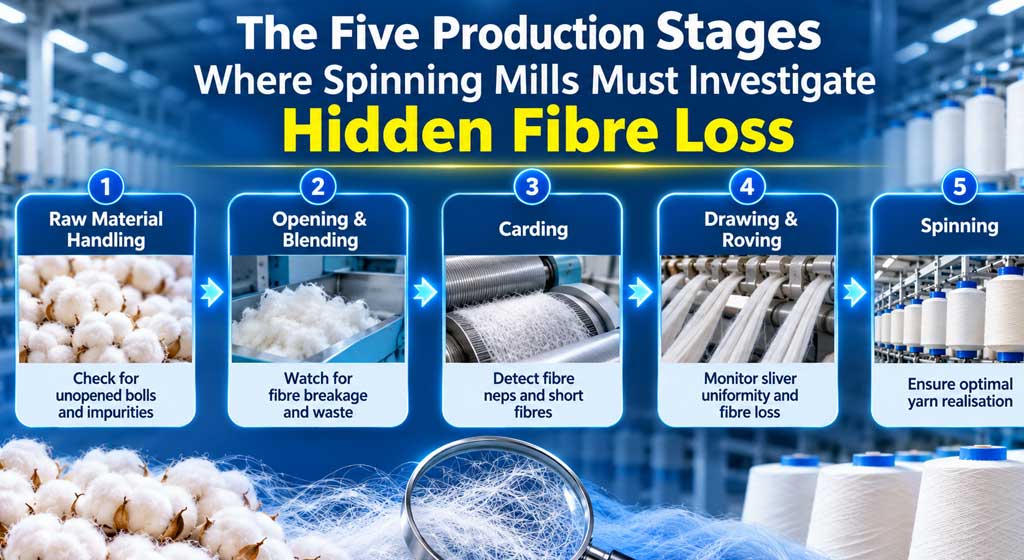
The Five Production Stages Where Spinning Mills Must Investigate Hidden Fibre Loss
1. Blowroom: Are Your Cleaning Settings Removing More Fibre Than Necessary?
Blowroom is the first major processing stage where cotton undergoes opening, cleaning and blending. Its purpose is to remove trash, dust, seed particles and other impurities before the material moves towards carding. Nevertheless, excessive cleaning intensity, unsuitable machine settings, inconsistent cotton mixing and variations in raw material quality can increase valuable fibre removal.
For instance, two cotton lots with different trash content may require different cleaning approaches. Applying identical machine settings without considering material characteristics can result in unnecessary fibre extraction or inadequate cleaning. The solution starts with recording cotton lot details, trash percentages, machine settings and blowroom waste quantities together. When production teams compare these parameters across shifts and cotton batches, they can determine whether specific material combinations or operating conditions cause higher fibre losses.
2. Carding: Is Fibre Separation Creating Unnecessary Waste?
Carding plays a critical role in individualising fibres, removing impurities and producing a more uniform sliver. However, excessive card waste can indicate problems with machine settings, clothing condition, raw material quality or operating practices. The challenge is that card waste cannot be evaluated independently of fibre quality. Reducing extraction indiscriminately may increase contamination and affect downstream yarn quality.
Therefore, mills must examine card waste alongside sliver quality, neps, short-fibre content and machine performance. A structured production monitoring system can help managers compare carding efficiency across machines, shifts and cotton lots. More importantly, historical production records can reveal recurring patterns that are difficult to identify through isolated shift reports.
3. Combing: Is Your Mill Losing More Fibre Than the Yarn Specification Requires?
Combing plays a crucial role in mills that manufacture finer-count and higher-quality yarn. During this process, mills remove short fibres and remaining impurities to improve fibre alignment and yarn characteristics. However, the comber removes a significant amount of material as noil. Production teams must evaluate the quantity of noil against the target yarn count, fibre characteristics and quality specifications.
If noil extraction increases without a corresponding improvement in yarn quality, production managers should investigate the operating conditions. For example, comparing noil percentages across machines, cotton lots and production orders can help identify unusual extraction patterns. The objective is not to eliminate necessary combing waste. Instead, it is to achieve the required yarn quality with controlled and technically justified fibre removal.
4. Ring Frame and Winding: Are Breakages and Rejections Increasing Your Hidden Losses?
After converting fibres into yarn, spinning mills may lose additional material through end breaks, damaged packages, yarn cuts, machine stoppages and quality rejections Although individual incidents may appear insignificant, their cumulative impact can become substantial across hundreds or thousands of spindles.
Furthermore, if breakage records are maintained separately from production output and maintenance records, identifying the root cause becomes difficult. By connecting machine-wise production, downtime, breakage frequency and rejection data, mills can investigate whether specific machines, shifts or operating conditions are contributing to lower yarn output.
5. Material Handling and Waste Accounting: Where Does the Unexplained Difference Go?
Not every loss occurs inside a production machine. Cotton movement between departments, floor sweepings, material transfers, waste storage, weighing errors and incorrect stock adjustments can create discrepancies between recorded and actual material quantities. For example, waste collected from multiple departments may be combined before weighing. Once that happens, identifying its original production stage becomes difficult.
A better approach is to assign waste categories and recording responsibilities at every production stage. Each waste transaction should be linked to its department, machine, production order, shift and material batch wherever practical. This creates a traceable record rather than leaving management with a single unexplained monthly difference.

How AI and Machine Learning Can Predict Fibre Loss Before It Affects Profitability
Traditional reporting explains what has already happened. AI-driven manufacturing analytics can potentially help identify conditions associated with abnormal fibre loss before the problem becomes a recurring production issue. The first requirement is reliable historical and real-time operational data. A machine-learning model can analyse relationships between cotton lot characteristics, moisture, trash content, machine settings, production speed, shift conditions, waste percentages and yarn quality.
For example, an anomaly-detection model can compare current carding waste against historical patterns for similar cotton types and yarn specifications. If the current waste percentage moves significantly outside the expected operating range, the system can flag the deviation for investigation. Similarly, predictive models can estimate expected waste under comparable production conditions. Managers can then compare actual results against the predicted range.
Another valuable application is root-cause analysis. Instead of simply highlighting an increase in waste, analytical models can identify which combinations of operating variables contribute to the deviation. However, textile process experts must validate AI recommendations. Cotton varieties, machine configurations and yarn specifications vary across mills, so teams should not assume that a model trained in one production environment will work effectively in another.
The most effective approach combines machine data, ERP records, quality measurements and production expertise.
The Role of Spinning Mill ERP Software in Achieving Complete Fibre Accountability
AI analytics alone cannot solve material visibility problems if the underlying production information is fragmented. A spinning mill needs a connected system that follows cotton from procurement through mixing, blowroom, carding, combing, spinning, winding and finished-yarn inventory. This is where Spinning Mill ERP Software becomes valuable.
An integrated ERP environment can connect raw cotton inventory, lot tracking, production planning, machine-wise reporting, waste transactions, quality records and finished-goods accounting. For example, when cotton is issued to a production batch, its material quantity and identification details can be recorded. As it moves through different departments, production teams can capture output and waste quantities against the relevant stage.
Consequently, management can compare input material, expected output, actual output and recorded waste without depending entirely on disconnected spreadsheets. Furthermore, dashboards can provide visibility into yarn production, material consumption, inventory movement, production costs and operational performance.
With a flexible No-Code ERP and Business Process Automation platform such as Auvit, businesses can also configure workflows and operational reporting around their specific production and approval requirements. This is particularly useful for mills where existing reporting processes differ across departments or where standard ERP workflows do not adequately reflect actual shop-floor operations.
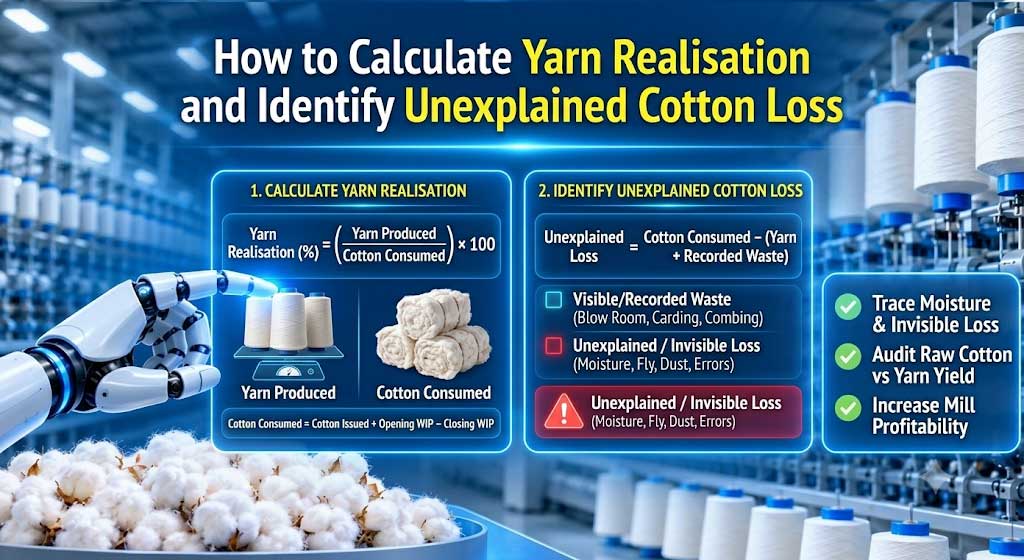
How to Calculate Yarn Realisation and Identify Unexplained Cotton Loss
Yarn realisation is one of the most important indicators of how effectively a spinning mill converts cotton input into finished yarn. The basic calculation is:
Yarn Realisation (%) = (Net Saleable Yarn Produced ÷ Total Cotton Input) × 100
For example, assume a spinning mill processes 10,000 kg of cotton and produces 8,200 kg of saleable yarn.
Its yarn realisation is:
(8,200 ÷ 10,000) × 100 = 82%
Production teams must account for the remaining 18% through process-wise waste records, recoverable material, expected extraction and other documented adjustments. Importantly, they should not automatically classify this percentage as avoidable waste. The correct expected realisation depends on cotton quality, yarn count, process route, extraction requirements and product specifications.
For meaningful analysis, managers should compare yarn realisation across similar production conditions rather than applying one universal benchmark to every yarn variety. A well-configured ERP system can help automate these calculations and generate comparisons across production batches, machines, departments and reporting periods.
Why Fibre Loss Visibility Is Becoming a Competitive Advantage for Indian Spinning Mills
Cotton procurement costs, raw material availability and yarn market conditions directly influence spinning mill profitability. India’s Ministry of Textiles reported provisional cotton production of 290.91 lakh bales for the 2025–26 cotton season, while the government also highlighted the importance of improving cotton productivity and quality through its Mission for Cotton Productivity. These developments underline the importance of using available raw material efficiently. [Source: Ministry of Textiles, Government of India, July 2026.]
Meanwhile, buyers increasingly expect consistent yarn quality, reliable delivery and competitive pricing. Therefore, mills that understand their material conversion performance have a stronger foundation for production planning and cost control. The competitive advantage does not come from reducing every waste percentage. It comes from knowing which losses are necessary, which are recoverable, which are caused by process inefficiencies and which result from poor material accounting.
That distinction can transform fibre waste management from a routine production report into a meaningful business improvement strategy.
Is Your Spinning Mill Ready to Move From Waste Reporting to Intelligent Production Monitoring?
If your production team can tell you how much cotton was consumed but cannot explain exactly where the material went, your mill may have a visibility gap. Disconnected production records, delayed waste reporting, inconsistent inventory entries and limited machine-level analysis can prevent management from identifying the real reasons behind lower yarn realisation.
Bluechip Solutions’ Auvit No-Code ProfitPlus ERP provides an integrated ERP and Business Process Automation platform designed to connect business operations, production information, inventory and reporting. With configurable workflows, operational dashboards and integrated business information, spinning mills can work towards better material traceability, improved production visibility and more informed operational decisions.
Rather than relying on assumptions at the end of each month, start building a measurable approach to cotton consumption and production accountability.
Your cotton has a cost at every stage. Make sure every kilogram has an explanation.
Explore Spinning Mill ERP Software: https://bluechipsolutions.in/spinningmill.php
Discover Auvit No-Code ERP: https://auvit.io/no-code-erp#Manufacturing
Ready to improve production visibility?
Request a Free ERP Demo and discover how an integrated ERP solution can support your spinning mill’s production and material management requirements.
Contact: sales@bluechipsolutions.in
Frequently Asked Questions About Cotton Fibre Loss in Spinning Mills
What causes cotton fibre loss in spinning mills?
Cotton fibre loss can occur during blowroom cleaning, carding, combing, spinning, winding and material handling. Raw cotton quality, machine settings, fibre characteristics, process requirements and inaccurate waste accounting can all influence total material loss.
How can spinning mills reduce cotton waste without affecting yarn quality?
Mills should first classify necessary process waste separately from avoidable losses. They can then analyse cotton quality, machine settings, waste percentages, yarn specifications and production conditions to identify opportunities for improvement without compromising quality.
What is yarn realisation in a spinning mill?
Yarn realisation is the percentage of cotton input converted into net saleable yarn. It is calculated by dividing net saleable yarn production by total cotton input and multiplying the result by 100.
How can AI help spinning mills identify hidden fibre losses?
AI and machine-learning models can analyse historical production data, cotton quality, machine parameters, waste quantities and yarn quality measurements to detect unusual patterns, predict potential deviations and support root-cause investigations.
Why do spinning mills need ERP software for waste management?
Spinning Mill ERP Software connects material consumption, production output, waste records, inventory and quality information. This helps management track material movement across production stages, investigate discrepancies and improve operational visibility.
Can an ERP system track cotton consumption across different spinning stages?
Yes. A suitably configured ERP system can record material issues, production quantities, transfers and waste transactions against relevant departments, machines, batches and production orders. The level of traceability depends on the system configuration and the accuracy of operational data.
Take Control of Every Kilogram of Cotton. Improve Production Visibility With Bluechip Solutions.
Explore: https://bluechipsolutions.in/spinningmill.php
Email: sales@bluechipsolutions.in