

A customer confirms a large order on Monday. By Wednesday, the required delivery date moves forward. Meanwhile, a critical supplier delays raw materials, one machine goes down, and another customer reduces its order. For many manufacturing companies, this does not simply mean changing one production schedule. It means recalculating materials, machine capacity, labour availability, purchase orders, inventory, delivery commitments, and sometimes even profitability.
That is where Manufacturing ERP for production planning becomes valuable.
Instead of treating production planning as a fixed monthly exercise, a modern ERP connects customer demand with inventory, procurement, material requirements, production capacity, shop-floor execution, and finance. Consequently, planners can respond to changes using current operational data rather than relying on spreadsheets and outdated reports.
This shift is becoming increasingly important. Recent manufacturing research shows that AI is moving from isolated experiments toward production, planning, and enterprise workflows. NTT DATA reports that 93.2% of manufacturing AI leaders embed AI directly into operational workflows, while 83.8% are increasing AI investment. At the same time, NIST’s 2026 smart-manufacturing roadmap highlights AI/ML, industrial data, supply-chain optimization, digital twins, and trustworthy AI as important areas for modern manufacturing.
Why Changing Customer Demand Makes Production Planning Difficult
The biggest problem is not demand fluctuation itself. Instead, the problem is how quickly that fluctuation travels through the factory. Suppose a manufacturer normally produces 10,000 units every month. Suddenly, a major customer requests 30% more units. The production planner cannot simply increase the work order by 30%. The company must first determine whether sufficient raw materials are available, whether suppliers can deliver on time, whether machines have enough capacity, whether operators are available, and whether existing orders will be delayed.
Furthermore, increasing production for one customer can create shortages for another.
Traditional spreadsheets often make this worse because sales, inventory, purchasing, production, and finance may maintain different versions of the same information. Consequently, planners spend valuable time collecting and validating data instead of making decisions. A Manufacturing ERP addresses this problem by creating a connected planning environment where demand, materials, capacity, production, inventory, and customer commitments can be viewed together.
How Manufacturing ERP Converts Customer Demand Into a Production Plan
A modern Manufacturing ERP starts with demand signals such as confirmed sales orders, forecasts, historical sales, minimum stock requirements, and customer delivery commitments. The system then connects those requirements to Bills of Materials, inventory availability, open purchase orders, work orders, production capacity, and lead times.
For example, when a customer order increases, the ERP can determine the additional finished goods required and then calculate the associated component requirements through Material Requirements Planning. Bluechip’s discrete manufacturing ERP, for example, supports BOM management, work-order scheduling, MRP-driven planning, production-status tracking, inventory visibility, and real-time KPI monitoring.
As a result, production planning becomes a connected process rather than a manual calculation. More importantly, the planner can see the consequences of a demand change before committing to a new schedule.
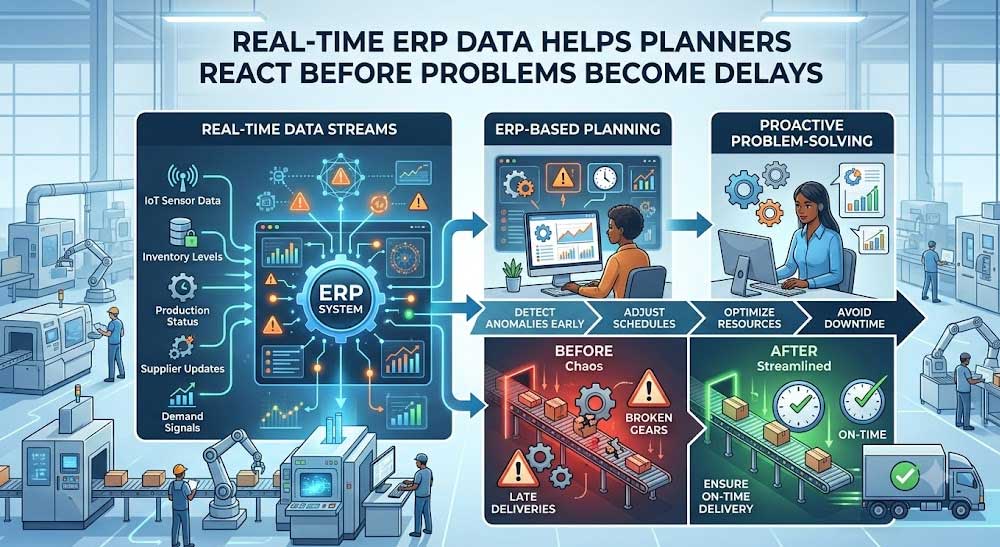
Real-Time ERP Data Helps Planners React Before Problems Become Delays
A production plan is only as reliable as the information behind it. If inventory data is three days old, machine availability is maintained in a spreadsheet, and purchase orders are updated manually, even an advanced planning method can produce the wrong answer.
Therefore, real-time ERP visibility is becoming a critical requirement. Modern manufacturing ERP systems can connect sales, inventory, procurement, production, quality, maintenance, and finance so that planners work from the same operational picture. This matters because a sudden customer requirement can immediately affect material availability, production capacity, procurement priorities, and delivery commitments.
For instance, if a production order requires a component that is currently unavailable, the ERP can expose that shortage while the order is being planned. Consequently, the purchasing team can act earlier instead of discovering the problem after production has already stopped.
This approach also improves management visibility. Instead of asking several departments for separate updates, management can review production KPIs, inventory positions, order status, and exceptions through integrated dashboards. Industry research supports this direction. TCS reports that 67% of manufacturers in its Future-Ready Manufacturing Study reported improved supply-chain visibility through AI-enabled insights.
AI-Powered Demand Forecasting Makes Production Planning More Responsive
Historical forecasting alone becomes difficult when customer behaviour changes rapidly. An AI-enabled ERP can evaluate multiple demand signals instead of depending only on last year’s sales. Depending on the data available, an AI model can analyse historical orders, seasonality, sales trends, customer behaviour, product-level demand, order cancellations, lead times, inventory movement, and other relevant operational signals.
The important point, however, is that AI should not simply generate a forecast and leave the planner to work manually. The real value comes when forecasting is connected to planning. A simplified AI-assisted planning model can work like this:
Demand signals → Forecast → Inventory position → Material requirements → Capacity check → Production schedule → Exception alerts → Planner approval
Consequently, a change in expected demand can influence the downstream planning process much faster. Recent research published in August 2026 identifies AI-driven demand forecasting as a major opportunity for improving forecasting accuracy, production planning, inventory optimization, and demand-supply synchronization in manufacturing supply chains.
However, manufacturers should avoid treating AI predictions as unquestionable decisions. AI works best when planners can review recommendations, understand exceptions, and approve important changes. This human-in-the-loop approach is especially important in manufacturing environments where operational constraints and business priorities cannot always be captured perfectly by historical data.
ERP Helps Recalculate Material Requirements When Orders Change
One of the most expensive consequences of demand volatility is material imbalance. A manufacturer may have enough finished goods for one product but insufficient components for another. Alternatively, excess raw material may sit in inventory while urgently required components are unavailable.
MRP within Manufacturing ERP helps connect production requirements to material requirements. When demand changes, the system can evaluate the BOM and calculate what materials are required, what is already available, what is committed to existing orders, and what needs to be purchased or produced.
Therefore, purchasing decisions become more closely aligned with actual production requirements. This is particularly useful for manufacturers operating with multiple product variants, complex BOMs, subcontracting operations, or long supplier lead times.
Capacity Planning Prevents the Factory From Promising What It Cannot Produce
A sales team may secure a major order, but the factory still needs to determine whether it can manufacture that order within the promised timeframe. Capacity planning brings machine availability, labour, working hours, production routes, existing work orders, and maintenance constraints into the planning conversation.
For example, if one critical machine is already operating at full capacity, the ERP can help planners identify the impact of adding another order. The planner may then reschedule another job, use an alternative machine, outsource a process, adjust the production sequence, or negotiate a revised delivery date.
AI-assisted sequencing can make this process even more responsive. Current ERP/MES developments increasingly use AI-supported sequencing to evaluate different order sequences and their effects on workload, deadlines, and production stability. Thus, production planning becomes less about creating a perfect schedule once and more about continuously choosing the best feasible schedule.
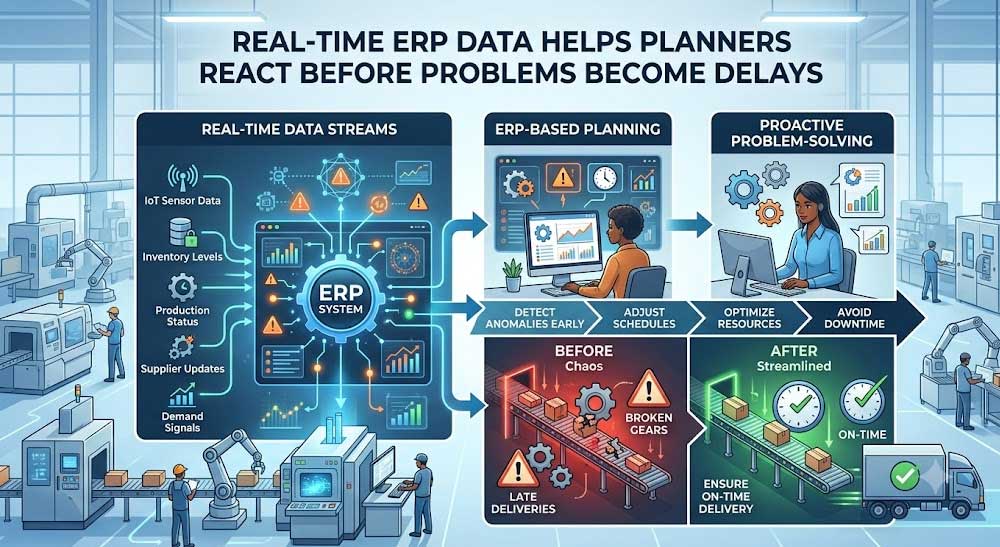
What Happens When a Machine Breaks Down or a Supplier Is Delayed?
This is where the difference between static planning and responsive planning becomes obvious. Imagine that a machine required for an urgent customer order suddenly becomes unavailable. In a spreadsheet-driven environment, the planner may need to contact maintenance, production supervisors, stores, procurement, and sales before understanding the complete impact.
With integrated ERP data, the disruption can be evaluated against open production orders, machine schedules, material availability, and customer commitments. Similarly, if a supplier delays a critical component, the system can identify affected production requirements and help planners prioritize available material for the most important orders.
The objective is not to eliminate every disruption. That is unrealistic. Instead, the objective is to reduce the time required to understand the disruption and respond intelligently.
Manufacturing ERP Reduces the Cost of Overproduction and Stockouts
Changing demand creates a difficult balance. Produce too much, and working capital becomes locked in inventory. Produce too little, and the business risks stockouts, expedited purchases, missed deliveries, and dissatisfied customers. Consequently, production planning must balance customer service against inventory and capacity costs. An integrated ERP helps because planners can view demand, stock, open orders, production requirements, and procurement information together.
AI can add another layer by identifying patterns that may indicate rising or falling demand and by recommending adjustments to inventory or production parameters. Nevertheless, the best result comes from combining AI recommendations with business rules. For example, a company may deliberately maintain higher safety stock for a strategically important component even when an algorithm suggests a lower level.
That is why AI-powered Manufacturing ERP should support business decisions, not blindly replace them.
Why Spreadsheets Become a Bottleneck as Manufacturing Complexity Increases
Spreadsheets are useful tools. However, they become increasingly difficult to manage when multiple planners, products, factories, warehouses, suppliers, and customer commitments are involved. A spreadsheet can show a production schedule. It cannot, by itself, guarantee that every department is working from the same real-time information.
Moreover, manual planning creates version-control problems. One person may update demand while another updates inventory. Meanwhile, purchasing may use a different file and production may follow an older schedule. Therefore, the real issue is not that spreadsheets are bad. The issue is that they are often being used as the central planning system when manufacturing complexity has already outgrown them.
A Manufacturing ERP provides a shared operational foundation where planning decisions can flow into procurement, inventory, production, quality, dispatch, and finance.
How to Choose a Manufacturing ERP for Demand-Driven Production Planning
Manufacturers should look beyond a long feature list. The right system should connect demand planning with MRP, BOMs, inventory, procurement, capacity, shop-floor execution, quality, maintenance, and financial information. Furthermore, it should provide real-time dashboards, configurable workflows, API integration, auditability, role-based access, and the flexibility to adapt as manufacturing processes change.
AI capabilities should also be evaluated carefully. Ask whether the platform can use your operational data, whether forecasts can be measured against actual results, whether planners can review AI recommendations, and whether the AI is embedded into workflows rather than existing only as a separate dashboard.
Data quality must also be considered. KPMG’s 2026 industrial manufacturing research found that 76% of surveyed executives still identify unreliable data as a top AI risk. Therefore, implementing AI on top of poor master data will not automatically produce better planning.
How Bluechip Solutions Approaches Manufacturing ERP and Production Planning
Bluechip Solutions combines manufacturing ERP capabilities with its Auvit No-Code and AI/ML approach, with the objective of adapting enterprise applications to changing business requirements. Its manufacturing offering covers production planning, MRP, inventory, procurement, quality, plant maintenance, subcontracting, finance, and real-time KPI monitoring.
This integrated approach is particularly relevant for manufacturers whose processes do not fit neatly into rigid standard ERP workflows. The company states that its discrete manufacturing ERP can be deployed in cloud or on-premises environments and supports REST API integration, mobile KPI monitoring, audit trails, data validation, and drill-down reporting.
Bluechip Solutions also brings more than 26 years of ERP and enterprise-software experience, according to its company profile. For a manufacturer evaluating ERP, the practical question is therefore not simply, “Does this ERP have production planning?”
The better question is, “Can this ERP continuously connect changing customer demand with the decisions required to fulfil it profitably?”
Frequently Asked Questions About Manufacturing ERP and Production Planning
How does Manufacturing ERP improve production planning?
Manufacturing ERP connects customer orders, demand forecasts, inventory, BOMs, MRP, procurement, capacity, work orders, and shop-floor information. Therefore, planners can create more informed production schedules and respond faster when demand or operational conditions change.
Can ERP handle sudden changes in customer demand?
Yes. A modern ERP can recalculate material requirements, inventory needs, production priorities, and procurement requirements when demand changes. AI-enabled systems can additionally provide forecasts, recommendations, and exception alerts based on historical and current operational data.
How does AI help production planning?
AI can analyse demand patterns and operational data to forecast requirements, identify anomalies, support inventory decisions, and recommend production or sequencing adjustments. However, human approval remains important for decisions involving business priorities, unusual customer requirements, and operational constraints.
Can Manufacturing ERP reduce excess inventory?
It can help reduce unnecessary inventory by connecting demand, production requirements, purchasing, and stock levels. AI-based forecasting can further improve demand sensing, although actual results depend heavily on data quality, planning policies, lead times, and business conditions.
Is Manufacturing ERP suitable for SMEs?
Yes. Modern cloud and configurable ERP platforms can scale according to business requirements. The key is selecting a system that supports current processes without creating unnecessary complexity while still allowing future expansion.
The Future of Production Planning Is Responsive, Connected, and Data-Driven
Customer demand will continue to change. Suppliers will experience delays. Machines will require maintenance. Product mixes will evolve. Consequently, production planning cannot remain a process that is created once and followed regardless of what happens on the shop floor.
Manufacturers need planning systems that continuously connect demand with supply, capacity, materials, inventory, and execution. That is the real value of Manufacturing ERP.
AI makes the opportunity even greater by helping manufacturers move from simply recording what happened to predicting what may happen and recommending what should happen next. However, the strongest results come when AI, real-time ERP data, manufacturing expertise, and human decision-making work together.
For manufacturers struggling with changing orders, excess inventory, material shortages, production delays, or unreliable planning spreadsheets, the next step is not necessarily buying more software.
It is building a connected production-planning environment where every important decision is based on the most relevant information available.
Ready to see how this can work for your manufacturing operation? Explore Bluechip Solutions’ Manufacturing ERP capabilities or book a free ERP consultation to discuss your production-planning challenges.
Lead Magnet: Download a Manufacturing ERP Production Planning Checklist covering demand forecasting, MRP, inventory, capacity planning, AI readiness, real-time dashboards, ERP integration, and implementation requirements before choosing your next ERP platform.
Sources and 2026 Evidence
This article incorporates current 2026 research from NIST, NTT DATA, KPMG, TCS, BCG, and recent peer-reviewed research on AI-based manufacturing demand forecasting. NIST specifically highlights trustworthy AI, industrial data, supply-chain optimization, and AI/ML as important areas for smart manufacturing. BCG’s 2026 supply-chain planning research also cautions that many organizations are still experimenting with AI rather than scaling it, reinforcing the importance of embedding AI into practical planning workflows.



A well-explained overview of how Manufacturing ERP and AI can make production planning more responsive, efficient, and data-driven. The connection between real-time data, demand forecasting, MRP, and capacity planning is especially insightful.