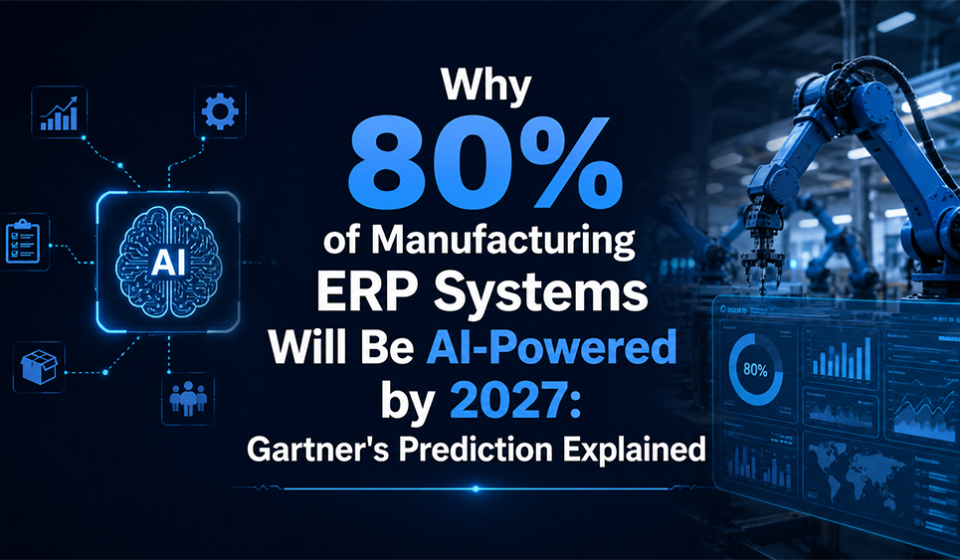
Why 80% of Manufacturing ERP Systems Will Be AI-Powered by 2027: Gartner’s Prediction Explained

Manufacturing is experiencing one of the biggest technological transformations in its history, and AI Powered Manufacturing ERP is driving this evolution. Companies are no longer competing only through production capacity or product quality. Instead, they are competing through speed, intelligence, automation, and data-driven decision-making. As manufacturers embrace AI-powered technologies, modern ERP systems are becoming the foundation for smarter operations, enabling businesses to improve efficiency, optimize resources, and make faster, data-driven decisions that support sustainable growth.
Manufacturers across industries are facing increasing pressure from rising raw material costs, labor shortages, supply chain disruptions, stricter compliance requirements, and growing customer expectations. At the same time, digital transformation is no longer a long-term strategy. It has become a business necessity for organizations that want to remain profitable and competitive.
Against this backdrop, Gartner predicts that by 2027, more than 80% of manufacturing ERP platforms will include AI-assisted automation. This prediction reflects a significant shift in how enterprise software is evolving. Artificial Intelligence is moving beyond experimental projects and becoming a core capability within modern ERP systems, helping manufacturers automate operations, predict risks, improve efficiency, and make faster business decisions.
This transition is not simply about adopting another technology trend. Rather, it represents a fundamental change in how manufacturers manage production, inventory, procurement, maintenance, finance, quality assurance, and customer service. Organizations that embrace AI-powered ERP solutions early are expected to gain measurable advantages in productivity, cost optimization, operational visibility, and customer satisfaction.
This article explains why Gartner expects AI to become a standard feature in manufacturing ERP systems by 2027, the business challenges driving this transformation, and how intelligent ERP solutions are helping manufacturers build more resilient and future-ready operations.
Understanding Gartner’s Prediction About AI-Powered Manufacturing ERP
Gartner’s prediction is not based on speculation. Instead, it reflects the direction in which enterprise technology, manufacturing operations, and business investments are already moving. Over the past several years, manufacturers have significantly increased investments in digital transformation initiatives. Cloud computing, Industrial IoT, machine learning, advanced analytics, robotic process automation, and artificial intelligence have become key priorities for organizations seeking operational excellence.
Traditional ERP systems primarily served as centralized databases for managing business transactions. While they successfully integrated departments such as production, finance, procurement, inventory, human resources, and sales, they largely depended on manual data entry, predefined workflows, and human decision-making. Modern ERP systems, however, are becoming intelligent business platforms.
Instead of simply storing information, AI-powered ERP platforms continuously analyze operational data, identify hidden patterns, predict future outcomes, recommend actions, and automate repetitive processes. Consequently, ERP evolves from being a record-keeping system into a proactive decision-support engine. This transformation enables manufacturers to anticipate problems before they occur rather than reacting after they happen.
For example, instead of discovering inventory shortages after production stops, AI can forecast shortages weeks in advance. Similarly, instead of repairing machines only after failures occur, predictive algorithms identify equipment likely to fail, allowing maintenance teams to intervene before costly downtime happens. As manufacturers increasingly recognize these advantages, AI capabilities are becoming expected features rather than optional add-ons.
Why Traditional Manufacturing ERP Systems Are No Longer Enough
Many manufacturing companies still operate with ERP platforms designed more than a decade ago. Although these systems continue to manage transactions effectively, they struggle to support today’s rapidly changing business environment. Manufacturing operations have become significantly more complex. Customer expectations are changing faster than ever. Supply chains are increasingly unpredictable. Global competition continues to intensify. Production cycles are becoming shorter.
Product customization is growing rapidly. Meanwhile, decision-making has become increasingly data-intensive. Unfortunately, conventional ERP systems cannot keep pace with these changes because they were designed to process historical information rather than predict future events. As a result, managers often spend countless hours analyzing reports manually before making operational decisions.
By the time reports are generated, the information may already be outdated. Consequently, businesses frequently experience delayed responses to market changes. Production planners struggle to balance fluctuating demand. Inventory managers either overstock warehouses or face shortages. Procurement teams react too late to supplier disruptions. Maintenance departments continue relying on preventive schedules instead of actual equipment conditions. Executives often lack real-time visibility across multiple manufacturing locations.
These operational challenges directly affect profitability. Production delays increase manufacturing costs. Inventory carrying costs continue rising. Machine breakdowns interrupt customer deliveries. Quality issues create waste and customer dissatisfaction. Furthermore, employees spend valuable time performing repetitive administrative work instead of focusing on strategic improvements. Artificial Intelligence addresses these limitations by transforming ERP into an intelligent operational assistant capable of learning from data and continuously improving business processes.
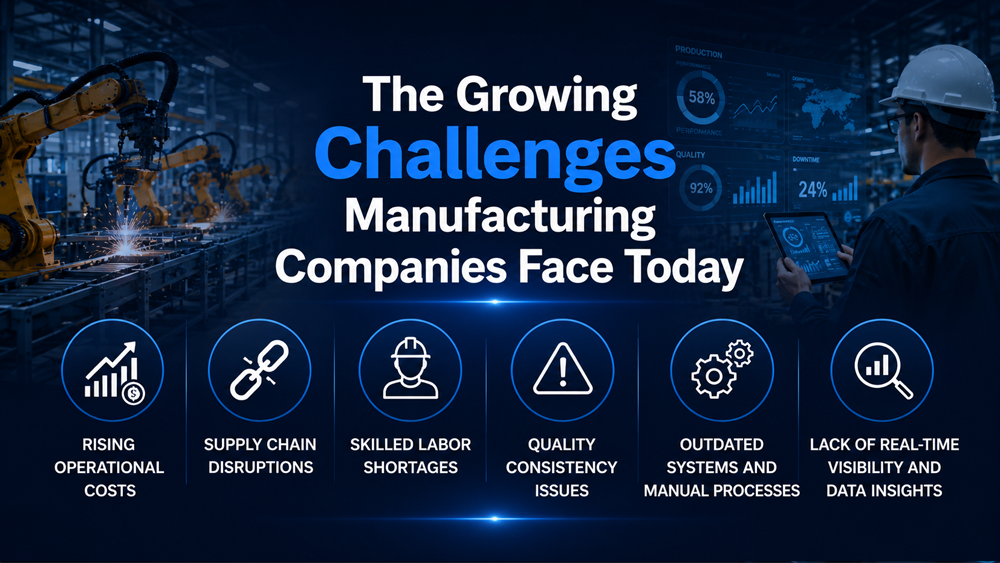
The Growing Challenges Manufacturing Companies Face Today
Manufacturing leaders are operating in an environment where uncertainty has become the norm rather than the exception. Supply chains remain vulnerable to geopolitical events, transportation disruptions, changing regulations, and fluctuating supplier performance. Meanwhile, customers expect shorter lead times, personalized products, consistent quality, and competitive pricing.
Meeting all these expectations simultaneously has become increasingly difficult. Labor shortages add another layer of complexity. Experienced production planners, maintenance engineers, machine operators, and quality specialists are becoming harder to recruit and retain. As skilled employees retire, manufacturers risk losing decades of operational knowledge.
Additionally, production facilities now generate enormous volumes of operational data through ERP systems, sensors, Industrial IoT devices, quality inspection systems, warehouse management software, and customer applications. Ironically, many organizations possess more data than ever before while struggling to convert it into actionable business intelligence.
Large amounts of valuable information remain unused because traditional ERP systems cannot interpret complex relationships across multiple business functions. At the same time, increasing regulatory requirements require manufacturers to maintain complete traceability, improve sustainability reporting, enhance cybersecurity, and ensure strict compliance across operations.
Managing these responsibilities manually creates additional administrative burden while increasing the likelihood of costly errors. Therefore, manufacturers require ERP systems capable of processing millions of data points automatically while delivering meaningful recommendations in real time. Artificial Intelligence makes this possible.
What Makes an AI-Powered Manufacturing ERP Different?
An AI-powered ERP system does much more than automate workflows. It continuously learns from historical data, operational behavior, market trends, supplier performance, machine conditions, customer purchasing patterns, and financial information. Instead of waiting for users to ask questions, intelligent ERP systems proactively identify opportunities and potential risks.
For instance, if customer demand begins increasing unexpectedly, the ERP can recommend production schedule adjustments before inventory shortages occur. Likewise, if supplier performance declines, the system can suggest alternative sourcing strategies before procurement delays impact manufacturing. Similarly, if production efficiency decreases gradually over several weeks, AI can identify contributing factors that may otherwise remain unnoticed.
These recommendations help decision-makers respond faster while reducing uncertainty. Furthermore, AI-powered ERP systems improve continuously. Machine learning algorithms analyze business outcomes and refine predictions over time. Consequently, forecasting accuracy improves as more operational data becomes available. Unlike static software, intelligent ERP platforms become increasingly valuable as organizations continue using them. This continuous learning capability represents one of the biggest reasons Gartner expects AI adoption to accelerate rapidly across manufacturing ERP solutions.
The Shift from Reactive Manufacturing to Predictive Manufacturing
Historically, manufacturers solved problems after they occurred. Machines failed. Production stopped. Customers complained. Inventory ran out. Suppliers delayed shipments. Quality defects increased. Managers investigated the issue. Teams worked overtime. Costs increased. Although this reactive approach kept operations running, it rarely optimized business performance.
Predictive manufacturing changes this model completely. Instead of reacting to operational failures, AI continuously monitors business conditions and identifies early warning signals. As a result, manufacturers can prevent disruptions before they impact production. For example, predictive analytics may identify that demand for a specific product will increase by twenty percent next month. Production schedules can therefore be adjusted proactively. Raw materials can be ordered earlier. Warehouse space can be optimized. Delivery commitments remain on schedule. Similarly, predictive maintenance algorithms may detect unusual vibration patterns within production equipment.
Maintenance teams receive alerts days or even weeks before mechanical failure occurs. Consequently, repairs become planned maintenance activities instead of costly emergency shutdowns. This transition from reactive operations to predictive decision-making represents one of the most valuable outcomes of AI-powered ERP systems.
How Artificial Intelligence Is Transforming Every Module of Manufacturing ERP
Artificial Intelligence is no longer confined to a single department within manufacturing. Instead, it is becoming the intelligence layer that connects every function of the business. Unlike traditional ERP systems that merely record transactions, AI-powered ERP continuously analyzes operational data, recognizes patterns, predicts future events, and recommends the best course of action.
As a result, every department benefits from faster decision-making, reduced manual effort, higher operational efficiency, and improved profitability. Furthermore, because every module shares real-time information, manufacturers gain complete visibility across the entire organization. Let’s explore how AI is reshaping every major ERP module.
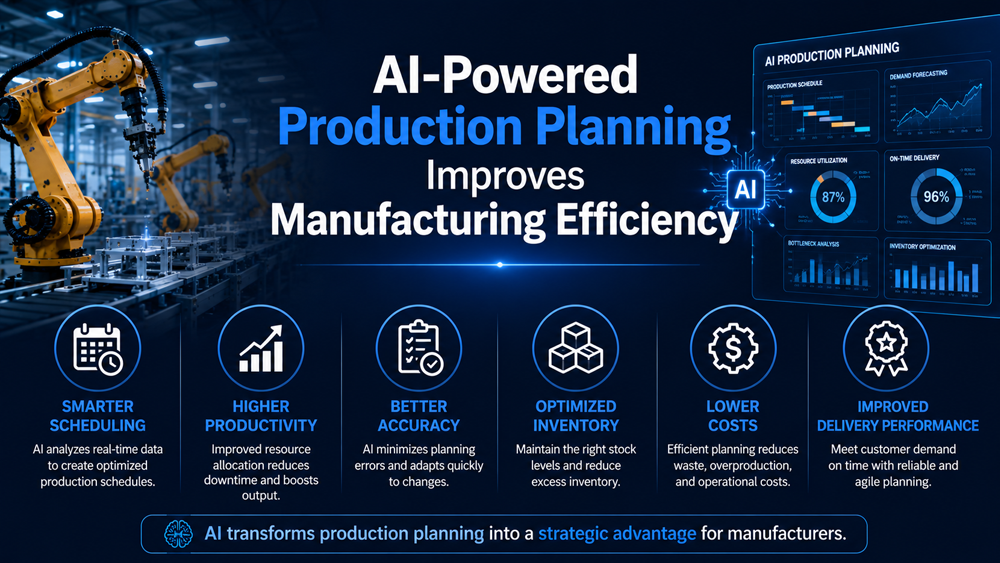
AI-Powered Production Planning Improves Manufacturing Efficiency
Production planning has always been one of the most complex responsibilities within manufacturing. Demand constantly changes, customer priorities shift, raw material availability fluctuates, and machine capacity varies from day to day. Consequently, production planners often spend hours adjusting schedules manually.
Traditional ERP systems rely heavily on historical reports and predefined planning rules. While these methods were effective in relatively stable environments, they struggle to handle today’s rapidly changing manufacturing landscape. Artificial Intelligence completely changes this process.
Instead of relying only on historical production data, AI continuously evaluates customer orders, inventory availability, supplier lead times, machine utilization, workforce availability, seasonal demand, and production constraints simultaneously. Therefore, production schedules become dynamic rather than static. Whenever unexpected changes occur, such as delayed raw material deliveries or urgent customer orders, the AI engine automatically recommends optimized production schedules that minimize disruption.
Moreover, intelligent scheduling significantly reduces production bottlenecks. Rather than allowing certain workstations to become overloaded while others remain underutilized, AI balances workloads across production lines to maximize overall efficiency. As a result, manufacturers experience shorter production cycles, improved on-time delivery rates, and higher equipment utilization. Perhaps even more importantly, production managers spend less time creating schedules and more time improving manufacturing performance.
AI Makes Inventory Management Predictive Instead of Reactive
Inventory management directly affects profitability. Holding excessive inventory increases storage costs, ties up working capital, and creates the risk of obsolete stock. Conversely, maintaining insufficient inventory causes production delays, missed customer commitments, and emergency purchasing expenses. Finding the perfect balance has always been challenging. Traditional ERP systems generate reorder reports based on predefined minimum and maximum stock levels. However, these rules rarely account for changing customer demand, supplier performance, market conditions, or seasonal trends.
Artificial Intelligence transforms inventory management from rule-based automation into predictive optimization. Instead of simply monitoring stock levels, AI continuously forecasts future demand using historical sales patterns, current customer orders, seasonal fluctuations, promotional activities, economic indicators, supplier reliability, and production schedules. Consequently, procurement teams receive highly accurate inventory recommendations long before shortages occur.
Furthermore, AI identifies slow-moving inventory that may become obsolete. Rather than allowing excess stock to accumulate unnoticed, the ERP recommends corrective actions such as production adjustments, supplier negotiations, promotional campaigns, or inventory redistribution between warehouses. This proactive approach significantly reduces carrying costs while improving inventory turnover. Manufacturers therefore maintain optimal stock levels without compromising production continuity.
Intelligent Procurement Creates Smarter Supplier Management
Supplier performance plays a critical role in manufacturing success. Unfortunately, many organizations still evaluate suppliers using basic metrics such as purchase price or delivery history. Although these measurements remain important, they provide only a partial view of supplier reliability. Artificial Intelligence evaluates suppliers from multiple perspectives simultaneously.
For example, AI analyzes delivery consistency, quality performance, pricing trends, contract compliance, financial stability, transportation delays, geopolitical risks, and historical purchasing behavior. As a result, procurement managers receive comprehensive supplier performance scores rather than isolated reports. When supplier risks begin increasing, AI immediately alerts procurement teams before disruptions affect production. Moreover, intelligent ERP systems recommend alternative suppliers capable of meeting production requirements.
This proactive approach minimizes supply chain interruptions while improving purchasing decisions. Additionally, AI predicts future material price fluctuations based on market trends, historical pricing patterns, and global economic conditions. Consequently, procurement departments can negotiate contracts at the most favorable time. Over time, these improvements reduce procurement costs while strengthening supplier relationships.
AI-Powered Predictive Maintenance Reduces Costly Downtime
Machine downtime remains one of the most expensive challenges facing manufacturers. Unexpected equipment failures interrupt production schedules, delay customer deliveries, increase overtime expenses, and reduce overall profitability. Traditional preventive maintenance schedules are based primarily on calendar intervals or operating hours. Although preventive maintenance reduces certain risks, it often results in unnecessary servicing or fails to detect hidden equipment problems.
Artificial Intelligence introduces predictive maintenance. Rather than relying solely on maintenance schedules, AI continuously analyzes sensor readings, vibration patterns, temperature fluctuations, machine utilization, maintenance history, production output, and operational anomalies. Whenever unusual equipment behavior appears, AI predicts the probability of future failure.
Maintenance teams receive early warnings before serious breakdowns occur. Therefore, repairs become planned maintenance activities instead of emergency shutdowns. This capability provides several important business benefits. Production interruptions decrease significantly.
Maintenance costs become more predictable. Equipment lifespan increases. Spare parts inventory becomes easier to manage. Customer commitments remain on schedule. Most importantly, manufacturers avoid millions of dollars in unexpected downtime costs over the lifetime of their facilities.
AI Enhances Manufacturing Quality Management
Maintaining consistent product quality becomes increasingly difficult as production complexity grows. Manual inspections consume valuable resources while still allowing certain defects to reach customers. Traditional ERP systems record quality inspection results after production has already occurred. Unfortunately, discovering defects after production often leads to expensive rework or product recalls.
Artificial Intelligence shifts quality management toward prevention instead of correction. By analyzing production parameters, machine conditions, environmental factors, raw material characteristics, operator performance, and historical quality data, AI identifies conditions most likely to produce defects. Consequently, quality teams receive recommendations before quality issues develop.
Furthermore, AI-powered computer vision systems inspect products automatically during production. Unlike manual inspections, computer vision operates continuously without fatigue. Even microscopic defects can be detected with remarkable accuracy. As inspection results flow directly into the ERP system, manufacturers gain complete traceability throughout the production process.
This integrated approach reduces scrap, minimizes rework, improves customer satisfaction, and strengthens regulatory compliance.
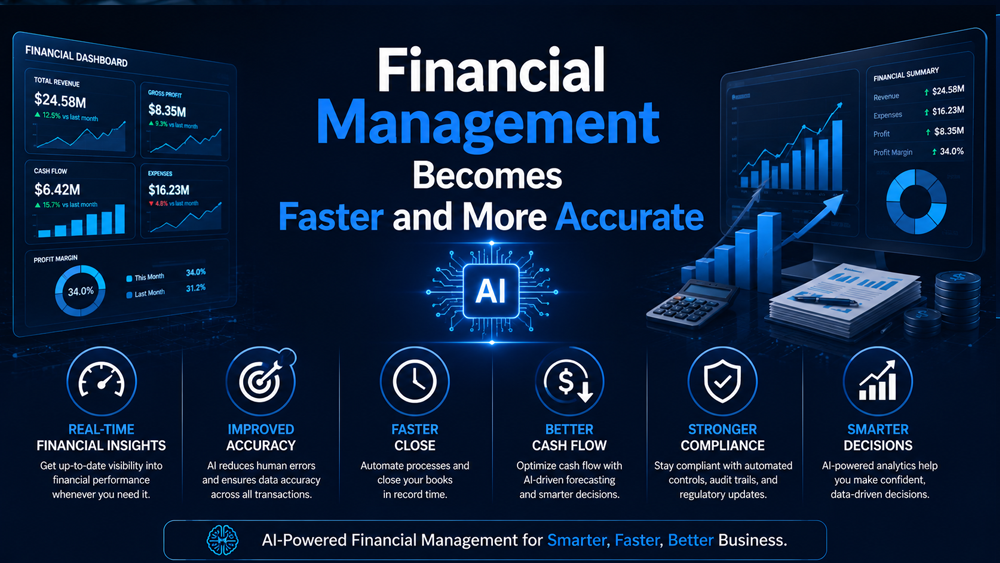
Financial Management Becomes Faster and More Accurate
Finance departments process enormous volumes of transactions every day. Invoice matching, payment approvals, expense validation, budgeting, forecasting, tax calculations, and financial reporting consume considerable administrative effort. Artificial Intelligence significantly reduces these manual activities.
Instead of relying entirely on finance professionals to review every transaction, AI automatically identifies duplicate invoices, unusual spending patterns, suspicious transactions, delayed customer payments, and accounting inconsistencies. Additionally, AI improves financial forecasting by analyzing historical revenue, seasonal demand, production costs, procurement expenses, and broader market conditions.
Consequently, executives gain more accurate profit projections and cash flow forecasts. Financial reporting also becomes faster. Rather than spending several days preparing month-end reports, intelligent ERP systems automatically generate dashboards containing real-time financial insights. This allows leadership teams to make strategic decisions using current information instead of outdated reports.
AI Revolutionizes Demand Forecasting
Demand forecasting has traditionally relied on historical sales data and planner experience. However, today’s markets change too quickly for historical trends alone to provide accurate predictions. Artificial Intelligence evaluates hundreds of influencing variables simultaneously. Customer purchasing behavior, seasonal trends, competitor activity, weather conditions, promotional campaigns, economic indicators, regional demand, online search behavior, and social media trends all contribute to more accurate forecasts.
As forecasting accuracy improves, manufacturers reduce both stock shortages and excess inventory. Production schedules align more closely with actual market demand. Procurement planning becomes more reliable. Warehouse utilization improves. Customer satisfaction increases because products remain consistently available. Ultimately, accurate forecasting strengthens profitability throughout the entire manufacturing value chain.
AI Strengthens Customer Relationship Management (CRM)
Customer expectations continue rising across every manufacturing industry. Business buyers increasingly expect personalized service, faster quotations, accurate delivery commitments, and proactive communication. Artificial Intelligence helps manufacturers meet these expectations more effectively. AI analyzes customer purchasing history, buying frequency, product preferences, service requests, contract performance, payment behavior, and engagement patterns.
Sales representatives therefore receive intelligent recommendations regarding upselling opportunities, renewal timing, pricing strategies, and customer retention activities. Additionally, AI-powered chatbots provide instant responses to routine customer inquiries. Sales teams spend less time answering repetitive questions and more time building strategic customer relationships.
Because customer information integrates directly with production and inventory data, delivery commitments become significantly more accurate. This improves customer confidence while strengthening long-term business relationships.
Human Resources Benefits from Intelligent Workforce Planning
Manufacturing success depends heavily on workforce availability and productivity. Unfortunately, labor shortages continue affecting manufacturers worldwide. Artificial Intelligence helps HR departments optimize workforce planning by analyzing employee skills, certifications, shift availability, overtime trends, absenteeism, production requirements, and future hiring needs.
Consequently, manufacturers assign the right employees to the right production activities at the right time. AI also identifies future skill gaps, allowing organizations to invest in employee training before shortages become critical. Furthermore, intelligent recruitment tools help identify qualified candidates more efficiently. Employee productivity improves while recruitment costs decrease.
At the same time, workforce satisfaction increases because scheduling becomes more balanced and workloads become more predictable.
AI Delivers Real-Time Executive Decision Intelligence
Executives often struggle to obtain a complete picture of business performance. Traditional ERP reports frequently present yesterday’s information rather than today’s operational reality. Artificial Intelligence transforms executive reporting into continuous decision intelligence. Instead of reviewing dozens of disconnected reports, leadership teams access interactive dashboards that highlight business opportunities, operational risks, financial performance, production efficiency, customer trends, and future forecasts in real time.
Even more importantly, AI explains why changes are occurring. Rather than simply showing declining production efficiency, the system identifies contributing factors such as supplier delays, machine utilization issues, workforce shortages, or inventory constraints. Executives therefore make faster, more informed decisions with greater confidence. This represents one of the most significant advantages of intelligent manufacturing ERP systems.
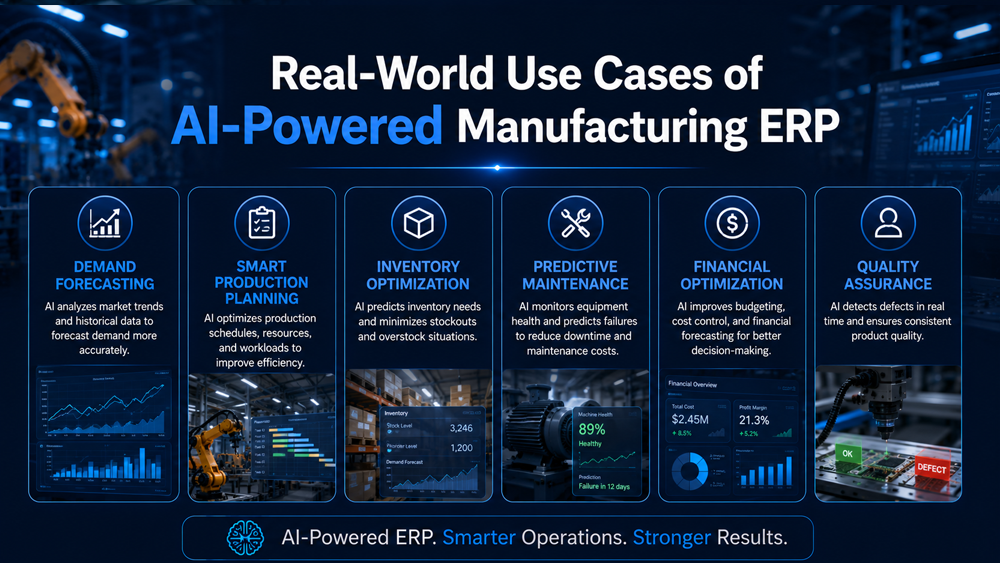
Real-World Use Cases of AI-Powered Manufacturing ERP
Artificial Intelligence is already delivering measurable business value across manufacturing industries. Organizations that integrate AI into their ERP platforms are improving operational efficiency, reducing costs, increasing productivity, and making better decisions using real-time insights.
The following examples demonstrate how AI-powered ERP systems solve practical manufacturing challenges while creating long-term competitive advantages.
AI Optimizes Production Scheduling
A manufacturer producing multiple product lines often faces unexpected order changes, machine availability issues, and fluctuating workforce capacity. In a conventional ERP environment, planners manually adjust production schedules, which consumes valuable time and often results in production delays.
With AI-powered ERP, production schedules are automatically optimized based on customer priorities, available inventory, machine capacity, employee shifts, maintenance schedules, and delivery deadlines. When an urgent customer order arrives, the ERP immediately recalculates the production sequence and recommends the most efficient schedule without disrupting ongoing operations. Consequently, manufacturers reduce idle machine time, improve resource utilization, and consistently deliver products on schedule.
AI Improves Supply Chain Visibility
Supply chain disruptions have become increasingly common due to transportation delays, supplier shortages, geopolitical events, and changing market conditions. Traditional ERP systems typically notify procurement teams only after a shipment has already been delayed. An AI-powered ERP continuously monitors supplier performance, shipment tracking, lead times, market trends, and historical procurement data.
If the system predicts that a supplier may fail to deliver materials on time, procurement managers receive proactive alerts along with recommendations for alternative suppliers or adjusted purchasing schedules. As a result, production continues without costly interruptions.
AI Detects Quality Issues Before Products Reach Customers
Product defects can significantly impact customer trust and manufacturing profitability. Rather than identifying defects during final inspections, AI analyzes production parameters throughout the manufacturing process. Machine settings, production speed, environmental conditions, raw material quality, and historical defect patterns are continuously evaluated.
Whenever production conditions indicate an increased probability of quality problems, the ERP immediately notifies quality teams. Production adjustments can therefore be made before defective products are manufactured. This proactive approach reduces scrap, minimizes rework, and improves customer satisfaction.
AI Predicts Equipment Failure
Manufacturing equipment generates enormous amounts of operational data every second. Temperature fluctuations, vibration patterns, motor performance, pressure readings, and operational cycles all provide valuable insights into equipment health. Artificial Intelligence continuously analyzes this information to detect early signs of mechanical failure.
Instead of waiting for equipment to break down, maintenance teams receive predictive alerts days or weeks in advance. Maintenance activities become planned events rather than emergency repairs. Consequently, manufacturers reduce downtime, increase equipment lifespan, and improve overall production efficiency.
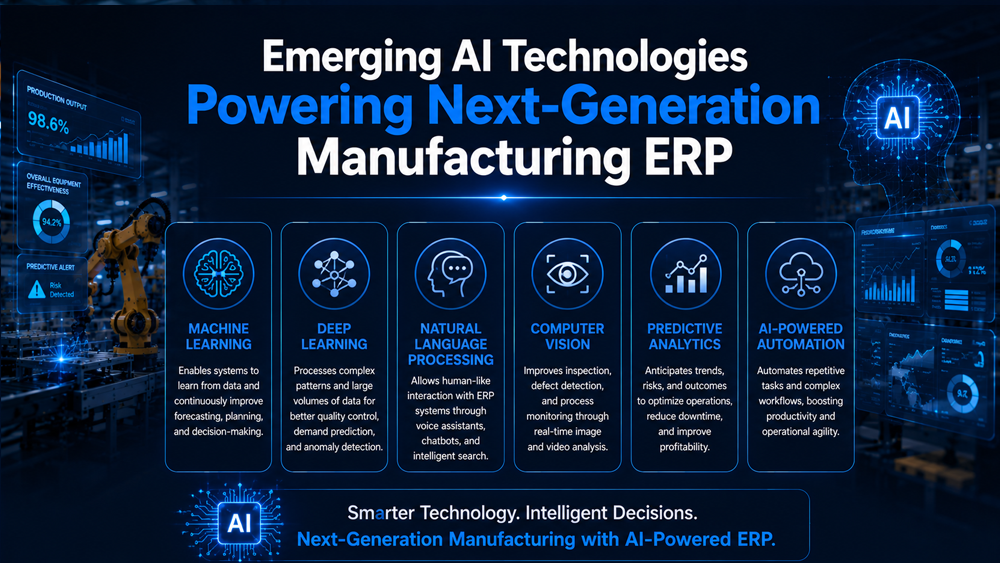
Emerging AI Technologies Powering Next-Generation Manufacturing ERP
Artificial Intelligence is not a single technology. Instead, modern ERP systems combine several advanced AI capabilities to create intelligent business operations. Understanding these technologies helps manufacturers appreciate why ERP platforms are becoming significantly more powerful than traditional business software.
Machine Learning Enables Continuous Business Improvement
Machine Learning allows ERP systems to learn from historical business data without requiring manual programming for every scenario. As new operational information becomes available, prediction accuracy continuously improves. For example, forecasting models become more accurate after each production cycle because the system learns from previous planning decisions and business outcomes. This continuous learning enables ERP software to evolve alongside the organization.
Generative AI Enhances Employee Productivity
Generative AI is transforming how employees interact with ERP systems. Instead of navigating multiple screens to retrieve information, users simply ask questions using natural language. For example, a production manager might ask:
“Which production orders are most likely to miss their delivery deadlines this week?”
Within seconds, the ERP generates a detailed explanation supported by real-time operational data. Similarly, finance teams can request automated financial summaries. Procurement managers can generate supplier performance reports instantly. Sales representatives can prepare customer proposals much faster. Generative AI significantly reduces administrative work while making ERP systems easier to use.
Natural Language Processing Simplifies ERP Usage
Natural Language Processing enables users to communicate with ERP software using everyday language. Rather than remembering complex report structures or database queries, employees simply ask questions. Examples include:
- Show today’s delayed purchase orders.
- Which machines require maintenance this month?
- Compare production efficiency between Plant A and Plant B.
- Display inventory items likely to become obsolete.
This conversational interface improves user adoption while making business intelligence accessible to employees across all departments.
Computer Vision Strengthens Manufacturing Quality
Computer Vision combines cameras with Artificial Intelligence to inspect products automatically during production. Unlike manual inspection, computer vision operates continuously and consistently. Surface defects, dimensional inaccuracies, assembly errors, packaging issues, and labeling mistakes can all be detected in real time.
Inspection results automatically update the ERP system, providing complete traceability across the manufacturing process. Manufacturers therefore improve quality while reducing inspection costs.
Digital Twins Improve Manufacturing Simulation
Digital Twin technology creates virtual replicas of physical manufacturing operations. Production managers can simulate operational changes before implementing them on the factory floor. For example, organizations can evaluate:
- Production capacity increases
- Factory layout modifications
- New equipment installations
- Workforce scheduling changes
- Material flow optimization
Because these simulations occur virtually, manufacturers reduce implementation risks while improving investment decisions.
Agentic AI Represents the Next Evolution of ERP
The next generation of ERP systems is moving toward Agentic AI. Unlike conventional AI that simply provides recommendations, Agentic AI performs complete business processes autonomously while remaining under human supervision. For example, an intelligent procurement agent could:
Monitor inventory continuously. Predict material shortages. Evaluate supplier performance. Request quotations. Compare pricing. Recommend suppliers. Generate purchase orders. Route approvals. Track deliveries. Notify stakeholders. All these activities occur automatically while employees focus on higher-value strategic decisions. This evolution explains why analysts expect AI adoption within ERP systems to accelerate dramatically over the next several years.
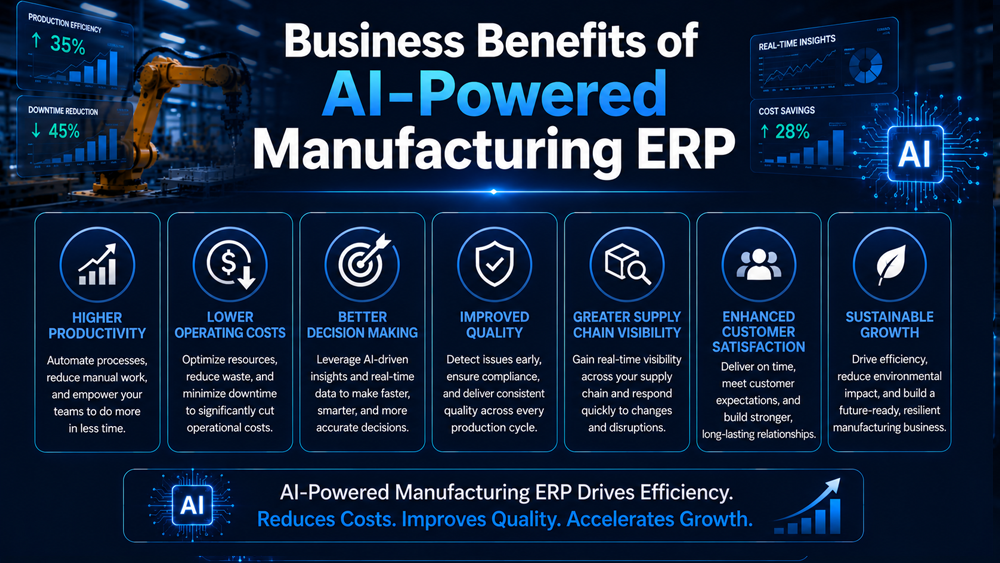
Business Benefits of AI-Powered Manufacturing ERP
Organizations implementing intelligent ERP solutions consistently experience measurable operational improvements across multiple business functions. Production efficiency improves because AI continuously optimizes scheduling and resource allocation. Inventory costs decrease through accurate demand forecasting and intelligent replenishment planning. Maintenance expenses decline as predictive maintenance replaces emergency repairs.
Procurement decisions become more strategic through supplier intelligence and market forecasting. Quality improves because defects are identified before products leave the production line. Financial reporting becomes faster through automated reconciliation and real-time analytics. Customer satisfaction increases because manufacturers consistently deliver products on time while maintaining higher quality standards.
Executives also gain greater confidence in business decisions because recommendations are supported by real-time operational intelligence rather than historical reports alone. Perhaps most importantly, AI allows employees to spend less time performing repetitive administrative work and more time solving complex business problems. This shift significantly improves organizational productivity.
Return on Investment (ROI) of AI-Powered ERP
One of the most common questions manufacturers ask is whether Artificial Intelligence delivers measurable financial value. The answer increasingly appears to be yes. Organizations implementing AI-enabled ERP platforms typically realize value across several key areas. Operational costs decline through automation of repetitive tasks. Inventory carrying costs decrease due to improved forecasting accuracy.
Production downtime is reduced through predictive maintenance. Equipment utilization increases because production schedules become more efficient. Waste decreases as AI identifies quality issues earlier in the manufacturing process. Administrative productivity improves because employees spend less time creating reports and performing manual data entry. Decision-making becomes faster because executives receive intelligent recommendations supported by real-time analytics. Over time, these improvements compound into significant competitive advantages.
Although implementation timelines vary depending on business size and operational complexity, many manufacturers begin realizing measurable operational improvements within the first year of deployment.
Common Challenges During AI ERP Implementation
Despite its significant benefits, successful AI adoption requires careful planning. Many organizations mistakenly assume that implementing AI simply involves installing new software. In reality, successful transformation requires improvements across technology, business processes, and organizational culture. Poor data quality remains one of the biggest implementation challenges. Artificial Intelligence depends on accurate, consistent, and complete operational data.
If ERP data contains duplicate records, missing information, or inconsistent processes, AI predictions become less reliable. Employee resistance also represents a common obstacle. Many employees initially worry that Artificial Intelligence may replace their jobs. However, successful organizations position AI as a productivity tool that assists employees rather than replacing them.
Training therefore becomes an essential component of implementation. Additionally, manufacturers should avoid attempting to automate every business process simultaneously. Instead, organizations achieve better results by beginning with high-value use cases such as demand forecasting, predictive maintenance, inventory optimization, or production planning before expanding AI across additional ERP modules.
By following a phased implementation strategy, manufacturers reduce project risks while maximizing long-term business value.
Why 2027 Is a Defining Year for Manufacturing ERP
Gartner’s prediction that more than 80% of manufacturing ERP platforms will incorporate AI-assisted automation by 2027 is more than an industry forecast—it reflects the direction in which manufacturing is rapidly evolving. Artificial Intelligence is transitioning from a competitive advantage to a standard capability within enterprise software.
Several factors are accelerating this shift. Cloud-based ERP adoption continues to grow because organizations require scalable, secure, and continuously updated platforms. At the same time, manufacturers are generating unprecedented volumes of operational data through Industrial IoT sensors, connected production equipment, warehouse systems, quality inspection tools, and customer applications. Without AI, extracting meaningful insights from this data becomes increasingly difficult.
Customer expectations are also changing. Businesses expect shorter lead times, higher product quality, personalized products, and complete order visibility. Meanwhile, executives must respond quickly to supply chain disruptions, changing regulations, and volatile market conditions. Consequently, ERP systems must evolve from passive transaction systems into intelligent decision-making platforms.
Organizations that embrace AI-powered ERP before it becomes an industry standard will have more time to optimize business processes, train employees, improve data quality, and build a sustainable competitive advantage. Conversely, businesses that delay adoption risk falling behind competitors already benefiting from predictive analytics, intelligent automation, and AI-driven operational insights.
Therefore, 2027 should not be viewed as a deadline but as a milestone that highlights the urgency of digital transformation.
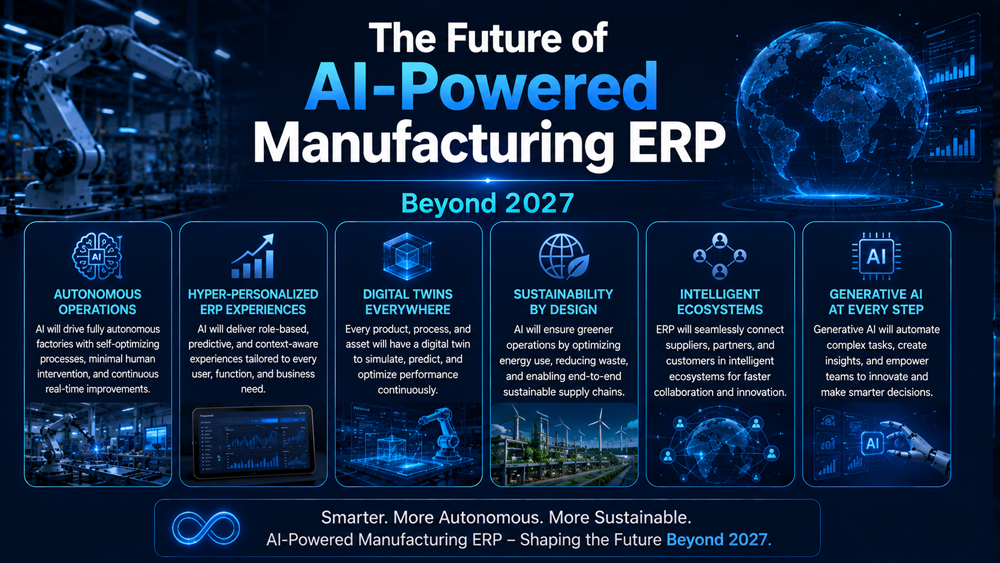
The Future of AI-Powered Manufacturing ERP Beyond 2027
The evolution of manufacturing ERP will not stop with AI-assisted automation. Instead, ERP platforms will continue becoming increasingly intelligent, autonomous, and interconnected.
Future ERP systems will move beyond providing recommendations to executing routine business processes automatically. Intelligent AI agents will monitor production schedules, evaluate supplier performance, negotiate procurement decisions, optimize inventory levels, and recommend strategic actions with minimal human intervention.
Hyperautomation will become a defining characteristic of next-generation ERP systems. Artificial Intelligence, Robotic Process Automation (RPA), Machine Learning, and workflow automation will work together to eliminate repetitive manual tasks across finance, procurement, production, warehousing, customer service, and human resources.
Digital Twin technology will also play a larger role in manufacturing. Organizations will simulate production scenarios, evaluate operational changes, and predict business outcomes before implementing decisions in real-world environments. This capability will significantly reduce operational risks while improving strategic planning.
Generative AI will transform how employees interact with ERP software. Instead of navigating multiple dashboards, users will communicate naturally with AI assistants capable of generating reports, answering operational questions, creating forecasts, summarizing performance, and recommending business improvements in seconds.
Sustainability will become another major driver of ERP innovation. AI-powered ERP systems will help manufacturers monitor carbon emissions, energy consumption, waste generation, water usage, and ESG compliance while identifying opportunities to improve environmental performance and reduce operational costs.
Cybersecurity will also become more intelligent. AI will continuously detect unusual system activity, identify potential security threats, and respond to risks before business operations are affected.
Ultimately, ERP systems will evolve into intelligent business ecosystems capable of supporting every operational decision across the manufacturing enterprise.
How Manufacturers Can Successfully Begin Their AI ERP Journey
Successfully adopting AI-powered ERP requires a clear strategy rather than a technology-first approach.
The first step is evaluating existing business processes. Organizations should identify repetitive tasks, operational bottlenecks, reporting delays, inventory inefficiencies, maintenance challenges, and forecasting inaccuracies that AI can improve.
The second step involves improving data quality. Artificial Intelligence performs best when operational data is accurate, complete, and standardized. Cleaning master data, eliminating duplicate records, and establishing consistent business processes create a strong foundation for AI implementation.
Next, manufacturers should prioritize high-impact use cases. Instead of attempting a complete transformation immediately, organizations often achieve faster results by focusing on production planning, predictive maintenance, inventory optimization, procurement intelligence, or quality management before expanding AI capabilities across additional departments.
Employee training is equally important. Successful digital transformation depends on employee adoption. When users understand how AI supports their daily responsibilities rather than replacing them, implementation becomes significantly smoother.
Choosing the right ERP partner is another critical decision. Manufacturers should select a solution that offers industry-specific functionality, scalability, cloud readiness, AI integration, strong security, and ongoing support. An experienced implementation partner can also help organizations align technology with business objectives, reducing project risks and accelerating return on investment.
Finally, AI adoption should be viewed as a continuous improvement journey. As business requirements evolve and new AI capabilities emerge, organizations can gradually expand automation, analytics, and intelligent decision-making across the enterprise.
Why Bluechip Solutions Is the Right Partner for AI-Powered Manufacturing ERP
Digital transformation is not only about implementing software—it is about enabling smarter business operations. At Bluechip Solutions, we help manufacturers modernize their operations with intelligent ERP solutions designed to address real-world manufacturing challenges.
Our AI-enabled Manufacturing ERP platform empowers businesses to optimize production planning, automate inventory management, improve procurement, strengthen quality control, predict equipment failures, and gain real-time operational visibility. Built on our flexible Auvit™ platform, the solution supports rapid customization, seamless integration, and scalable deployment, allowing manufacturers to adapt quickly to changing business requirements.
Whether your organization is beginning its digital transformation journey or upgrading an existing ERP system, our team works closely with you to understand your business processes, identify improvement opportunities, and deliver a solution aligned with your operational goals.
With deep expertise in manufacturing, automation, business intelligence, and AI-driven process optimization, Bluechip Solutions helps manufacturers improve efficiency, reduce costs, and prepare for the future of intelligent manufacturing.
Download Your Free AI Manufacturing ERP Readiness Checklist
Preparing for AI adoption begins with understanding your organization’s current digital maturity. To help manufacturers assess their readiness, Bluechip Solutions offers a free AI Manufacturing ERP Readiness Checklist.
This practical guide helps you evaluate your production planning, inventory management, procurement processes, maintenance strategy, reporting capabilities, data quality, and automation opportunities. It also highlights the key areas that should be addressed before implementing an AI-powered ERP solution.
Download the checklist today and take the first step toward building a smarter, more efficient manufacturing operation.
Conclusion
Manufacturing is entering a new era where intelligence, automation, and real-time decision-making are becoming essential business capabilities rather than optional innovations. Gartner’s prediction that over 80% of manufacturing ERP systems will incorporate AI-assisted automation by 2027 reflects a broader transformation already underway across the industry.
Traditional ERP systems have successfully centralized business information for many years. However, modern manufacturing demands more than transaction processing. Organizations need ERP platforms capable of predicting disruptions, optimizing production, improving quality, enhancing supply chain resilience, reducing operational costs, and supporting faster strategic decisions.
Artificial Intelligence enables these capabilities by transforming ERP into an intelligent business partner that continuously learns, analyzes, and recommends the best course of action. From predictive maintenance and demand forecasting to procurement intelligence and financial analytics, AI-powered ERP creates measurable value across every department.
Manufacturers that invest in intelligent ERP today will be better positioned to navigate future uncertainties, respond to changing customer expectations, and maintain a sustainable competitive advantage. Those who postpone digital transformation may find it increasingly difficult to compete in an industry where data-driven decision-making becomes the standard.
The future of manufacturing is not simply automated—it is intelligent. Organizations that embrace AI-powered ERP today will lead the next generation of industrial innovation.
Frequently Asked Questions (FAQs)
What is an AI-powered Manufacturing ERP?
An AI-powered Manufacturing ERP is an enterprise resource planning system that uses Artificial Intelligence, Machine Learning, and predictive analytics to automate processes, improve decision-making, optimize production, forecast demand, and enhance operational efficiency.
Why is AI becoming essential in Manufacturing ERP?
AI enables manufacturers to predict problems before they occur, automate repetitive tasks, optimize inventory, improve production planning, reduce downtime, strengthen quality control, and make faster business decisions using real-time insights.
Is AI ERP suitable for small and medium-sized manufacturers?
Yes. Modern cloud-based AI ERP solutions are scalable and can be implemented by small, medium, and large manufacturing companies. Organizations can begin with selected modules and expand as their business grows.
How does AI improve production planning?
AI analyzes customer demand, inventory levels, machine availability, workforce capacity, supplier lead times, and production constraints to create optimized production schedules that improve efficiency and reduce delays.
Can AI reduce manufacturing costs?
Yes. AI reduces costs by minimizing downtime, optimizing inventory, improving procurement decisions, reducing waste, automating manual tasks, and increasing production efficiency.
What industries benefit most from AI Manufacturing ERP?
Food processing, pharmaceuticals, automotive, engineering, plastics, chemicals, electronics, textiles, consumer goods, packaging, and industrial manufacturing all benefit significantly from AI-enabled ERP solutions.
How long does AI ERP implementation take?
Implementation timelines depend on company size, process complexity, customization requirements, and data readiness. Many organizations begin realizing measurable improvements within the first year after deployment.
Is AI replacing manufacturing employees?
No. AI is designed to assist employees by automating repetitive tasks and providing intelligent recommendations. Human expertise remains essential for strategic decision-making, innovation, and operational leadership.
What should manufacturers consider before implementing AI ERP?
Organizations should evaluate business processes, improve data quality, define implementation objectives, train employees, and select an experienced ERP implementation partner with manufacturing expertise.
Why is Gartner’s 2027 prediction important?
It highlights the rapid adoption of AI within manufacturing ERP systems and signals that intelligent automation is becoming the new industry standard. Businesses that prepare early will be better positioned to remain competitive.
Ready to Future-Proof Your Manufacturing Business?
The manufacturing leaders of tomorrow are making AI-driven decisions today. Don’t wait until intelligent ERP becomes a necessity—start building a smarter, more agile, and more profitable operation now.
Book a free AI ERP consultation with Bluechip Solutions today to discover how our AI-powered Manufacturing ERP can streamline your operations, reduce costs, and accelerate business growth.
Contact Us Today
- 🌐 https://bluechipsolutions.in
- 📧 sales@bluechipsolutions.in
- 📞 Schedule your personalized ERP demo and discover how AI can transform your manufacturing operations.