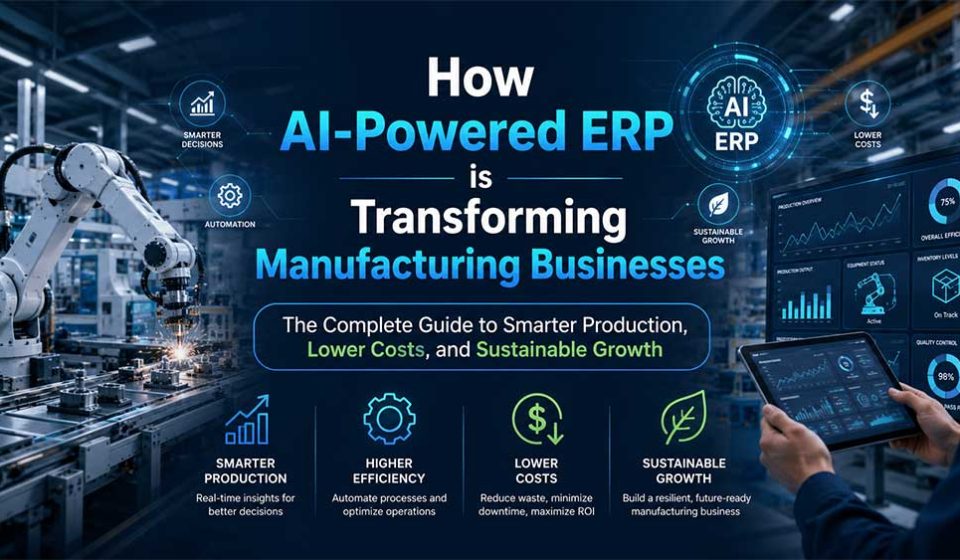
How AI-Powered ERP is Transforming Manufacturing Businesses: The Complete Guide to Smarter Production, Lower Costs, and Sustainable Growth

Manufacturing companies are facing increasing pressure to produce more with fewer resources while maintaining quality, reducing costs, and meeting customer expectations. Rising raw material prices, supply chain disruptions, labor shortages, unpredictable demand, and increasing competition have made traditional manufacturing management methods less effective. Many manufacturers continue to rely on disconnected software, spreadsheets, manual reporting, and delayed decision-making, which often results in production delays, inventory inaccuracies, poor forecasting, and shrinking profit margins.
AI-powered ERP is changing this reality. By combining Enterprise Resource Planning (ERP) with Artificial Intelligence (AI), manufacturers gain a centralized, intelligent platform capable of learning from business data, automating repetitive operations, predicting future trends, and helping leaders make faster, data-driven decisions.
Instead of simply recording business transactions, AI-powered ERP actively analyzes production, inventory, procurement, finance, quality control, customer orders, and machine performance to recommend the best course of action before problems become costly.
This guide explains how AI-powered ERP is transforming manufacturing businesses, the challenges it solves, the technologies behind it, and why manufacturers adopting intelligent ERP solutions are building a competitive advantage for the future.
Why Manufacturing Businesses Need AI-Powered ERP More Than Ever
Manufacturing has become significantly more complex over the past few years. Customer expectations have shifted toward shorter delivery times, personalized products, and complete order visibility. Meanwhile, businesses must deal with volatile supply chains, rising operational costs, compliance requirements, and workforce shortages.
Many manufacturers still struggle because critical information is spread across multiple departments. Production teams, procurement departments, finance, warehouses, quality control, and sales often work with different systems that don’t communicate effectively. As a result, decision-makers spend valuable time collecting reports instead of solving problems.
AI-powered ERP removes these silos by integrating every department into one intelligent ecosystem. More importantly, Artificial Intelligence continuously studies operational patterns, identifies risks, predicts future outcomes, and recommends actions before disruptions occur.
Industry analysts continue to report rapid investment growth in AI-enabled enterprise software, with manufacturers increasingly prioritizing predictive analytics, intelligent automation, and machine learning as part of their digital transformation strategies. Organizations adopting AI-driven business applications are experiencing measurable improvements in operational efficiency, forecasting accuracy, and productivity.
What Is AI-Powered ERP?
AI-powered ERP is an advanced Enterprise Resource Planning system enhanced with Artificial Intelligence technologies such as Machine Learning, Predictive Analytics, Natural Language Processing (NLP), Intelligent Automation, and Data Analytics.
Unlike conventional ERP software that records transactions after they occur, AI-powered ERP continuously learns from business operations and provides proactive recommendations.
For example, instead of notifying managers that inventory has already become unavailable, AI predicts future shortages weeks in advance based on historical demand, supplier lead times, seasonal fluctuations, production schedules, and customer purchasing behavior.
This shift from reactive management to predictive decision-making creates significant operational advantages for manufacturing organizations.
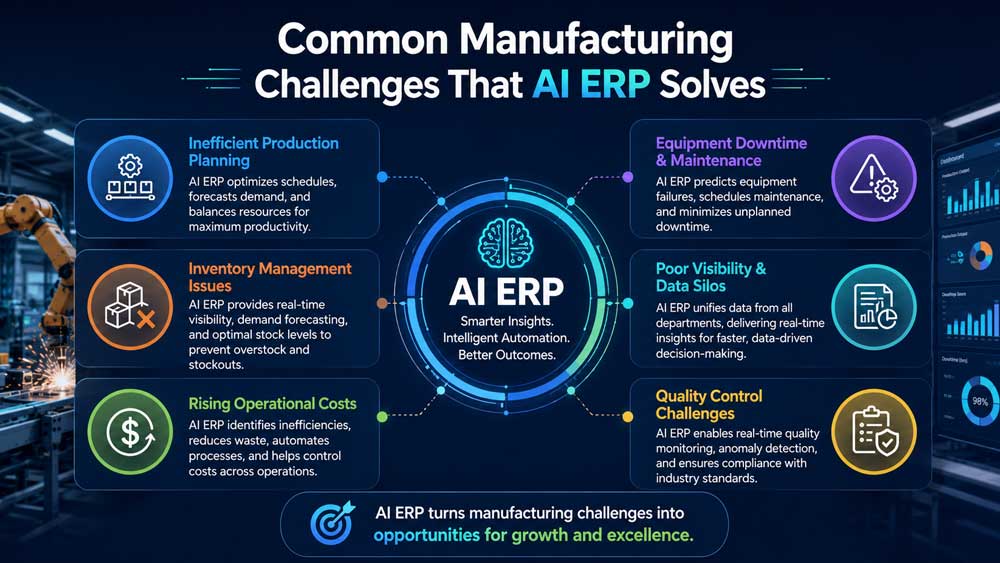
Common Manufacturing Challenges That AI ERP Solves
Many manufacturing businesses experience similar operational bottlenecks regardless of their size or industry.
Production planning frequently becomes inaccurate because forecasting depends on historical spreadsheets rather than real-time demand signals. Consequently, manufacturers either overproduce products that remain unsold or underproduce items customers urgently need.
Inventory management also presents a major challenge. Excess inventory locks valuable working capital, while inventory shortages interrupt production and delay deliveries. Quality control often relies on manual inspections that identify defects only after production is complete, increasing waste and rework costs. Maintenance departments typically follow fixed maintenance schedules rather than actual equipment conditions. This approach results in unexpected machine breakdowns or unnecessary maintenance expenses.
Customer service suffers when sales teams cannot accurately predict production status, shipment schedules, or delivery commitments. AI-powered ERP addresses each of these problems by transforming raw operational data into actionable intelligence that supports faster and more accurate decision-making.
AI-Driven Demand Forecasting Improves Production Planning
Accurate demand forecasting remains one of the most valuable capabilities of AI-powered ERP. Traditional forecasting methods usually rely on previous sales reports or manual assumptions. Unfortunately, market conditions change rapidly, making historical data alone insufficient.
AI forecasting models analyze multiple variables simultaneously, including customer purchasing behavior, seasonal trends, promotions, regional demand, supplier availability, economic indicators, historical production performance, and real-time sales activity.
As the system continuously learns from new information, forecast accuracy improves over time. Manufacturers can therefore produce the right products at the right time while minimizing inventory costs and reducing excess production. Improved forecasting also enhances procurement planning, warehouse utilization, labor scheduling, and cash flow management.
Predictive Maintenance Reduces Machine Downtime
Unexpected equipment failures remain one of the most expensive operational risks in manufacturing. Traditional maintenance schedules often replace components too early or too late because they depend on fixed intervals rather than equipment condition.
AI-powered ERP integrates with IoT sensors and machine monitoring systems to evaluate vibration, temperature, pressure, operating hours, energy consumption, and equipment performance. Machine learning algorithms detect abnormal patterns that may indicate future failures. Instead of reacting after equipment breaks down, maintenance teams receive early alerts, allowing repairs during planned maintenance windows.
Consequently, manufacturers reduce downtime, extend equipment life, improve production reliability, and lower maintenance costs.
Smart Inventory Management Eliminates Waste
Inventory optimization directly impacts profitability. Holding excessive inventory increases storage costs, insurance expenses, and working capital requirements. However, insufficient inventory creates production interruptions and dissatisfied customers. AI-powered ERP continuously evaluates inventory movement, supplier reliability, production schedules, seasonal demand, and purchase trends.
The system recommends optimal reorder quantities while identifying slow-moving materials, obsolete inventory, and purchasing opportunities. As a result, manufacturers maintain healthier inventory levels without sacrificing production efficiency.
Intelligent Production Scheduling Maximizes Capacity
Production scheduling becomes increasingly difficult when customer priorities, raw material availability, labor resources, and machine capacity change daily. Manual scheduling often creates production bottlenecks that reduce overall equipment effectiveness. AI algorithms automatically evaluate thousands of scheduling possibilities within seconds.
The ERP system recommends production sequences that maximize machine utilization, reduce setup time, minimize idle resources, and improve delivery performance. When unexpected disruptions occur, AI recalculates production schedules almost instantly, allowing operations to continue with minimal delays.
AI Improves Manufacturing Quality Control
Quality problems can significantly damage profitability and customer trust. Instead of identifying defects after production finishes, AI-powered ERP enables manufacturers to detect quality issues much earlier. Artificial Intelligence analyzes production parameters, supplier quality history, machine performance, inspection records, and defect patterns.
Whenever the system detects abnormal manufacturing conditions, it immediately alerts quality teams before defects spread across production batches. This proactive approach reduces scrap, minimizes rework, improves customer satisfaction, and strengthens regulatory compliance.
Supply Chain Intelligence Strengthens Business Resilience
Global supply chains have become increasingly unpredictable. Supplier delays, transportation disruptions, geopolitical events, and raw material shortages can quickly affect production schedules. AI-powered ERP continuously monitors supplier performance, delivery history, procurement cycles, inventory availability, logistics data, and purchasing risks.
The system predicts potential supply disruptions while recommending alternative suppliers or procurement strategies before production is affected. Consequently, manufacturers become more resilient and better prepared for unexpected market changes.
Financial Intelligence Enables Better Business Decisions
Manufacturing executives require accurate financial visibility to make strategic decisions. AI-powered ERP continuously analyzes production costs, procurement spending, inventory valuation, labor efficiency, operational expenses, and profitability. Instead of waiting for month-end reports, finance leaders receive real-time dashboards showing cash flow, production profitability, margin analysis, budget variances, and cost optimization opportunities. This visibility enables faster business decisions while improving financial planning.
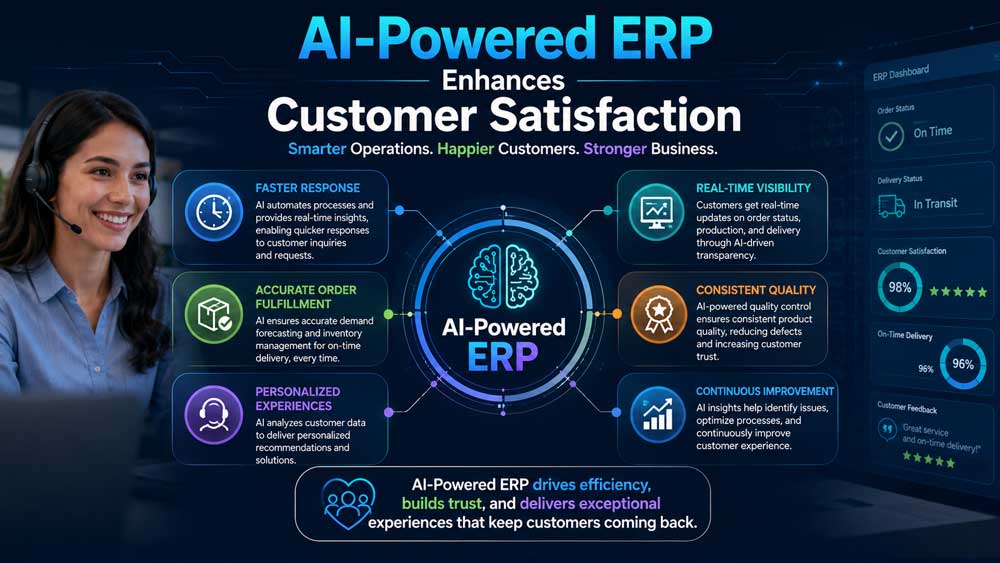
AI-Powered ERP Enhances Customer Satisfaction
Customers expect faster deliveries, accurate order tracking, and consistent product quality. AI-powered ERP improves customer experience by synchronizing production, inventory, logistics, procurement, and sales operations. Sales teams receive accurate delivery estimates based on real-time production schedules.
Customers benefit from improved communication, shorter lead times, fewer shipment delays, and greater confidence in delivery commitments. Higher customer satisfaction ultimately increases retention and long-term revenue growth.
AI Technologies Behind Modern Manufacturing ERP
Modern AI-powered ERP platforms combine multiple intelligent technologies rather than relying on a single AI capability. Machine Learning continuously improves forecasting accuracy by learning from operational data. Predictive Analytics identifies future risks before they affect production. Natural Language Processing allows users to search reports and ask business questions using everyday language.
Robotic Process Automation eliminates repetitive administrative tasks, reducing manual work. Business Intelligence dashboards convert complex manufacturing data into clear visual insights. Computer Vision supports automated quality inspection by identifying manufacturing defects more accurately than manual inspections. Together, these technologies create an intelligent manufacturing ecosystem capable of continuous improvement.
Measuring ROI After Implementing AI-Powered ERP
One of the biggest concerns among manufacturing companies is whether ERP implementation delivers measurable returns. The answer depends on selecting the right ERP platform and aligning implementation with business objectives. Manufacturers typically evaluate success by measuring production efficiency, inventory turnover, order fulfillment speed, machine utilization, downtime reduction, forecasting accuracy, operating margins, customer satisfaction, and employee productivity.
Organizations implementing AI-powered ERP often experience faster decision-making, lower operational costs, improved inventory accuracy, reduced production waste, and stronger financial performance within the first year of optimization, although actual results vary depending on implementation quality and business processes.
How to Choose the Right AI ERP for Manufacturing
Selecting an ERP solution should extend beyond feature comparisons. Manufacturers should prioritize platforms that support industry-specific manufacturing workflows, intelligent automation, cloud deployment, mobile accessibility, advanced analytics, seamless third-party integration, role-based security, compliance management, scalability, and continuous AI innovation.
Equally important is choosing an implementation partner with deep manufacturing expertise who understands production planning, inventory management, finance, procurement, quality control, and supply chain operations. An ERP platform should evolve alongside business growth instead of requiring expensive replacements every few years.
Future Trends in AI-Powered Manufacturing ERP
The next generation of manufacturing ERP will become increasingly autonomous. Generative AI will help managers generate production plans, procurement recommendations, financial summaries, and operational reports within seconds. Digital twins will simulate manufacturing environments before production changes are implemented.
Autonomous scheduling engines will optimize production continuously without manual intervention. Conversational AI assistants will enable executives to retrieve complex business insights through simple voice or text queries. Edge AI integrated with industrial IoT will process machine data instantly, enabling even faster predictive maintenance and quality control. Manufacturers adopting these innovations early will be better positioned to compete in increasingly dynamic markets.
Why Forward-Thinking Manufacturers Are Investing in AI ERP
Manufacturing success no longer depends solely on machinery or production capacity. Competitive advantage increasingly comes from how effectively organizations use data.AI-powered ERP transforms disconnected information into actionable intelligence, allowing manufacturers to reduce costs, improve operational visibility, strengthen customer relationships, increase profitability, and make faster strategic decisions.
Businesses that continue relying on spreadsheets, manual reporting, and disconnected systems risk falling behind competitors embracing intelligent automation. Organizations investing in AI-driven ERP today are building more agile, efficient, and resilient manufacturing operations capable of adapting to future market changes with confidence.
Frequently Asked Questions About AI-Powered ERP for Manufacturing
Can small and medium-sized manufacturers benefit from AI-powered ERP?
Yes. Modern cloud-based AI ERP solutions are designed for businesses of all sizes. SMEs can automate operations, improve forecasting, optimize inventory, and reduce costs without investing in complex IT infrastructure.
Does AI replace employees in manufacturing?
No. AI enhances employee productivity by automating repetitive tasks and providing intelligent recommendations. Employees remain essential for strategic decision-making, innovation, quality assurance, and customer relationships.
How long does AI ERP implementation take?
Implementation timelines vary depending on business size, customization requirements, and data migration complexity. Cloud-based ERP platforms generally deploy faster than traditional on-premise systems.
Is AI-powered ERP secure?
Leading ERP providers implement advanced security measures, including role-based access control, encryption, audit trails, multi-factor authentication, and continuous monitoring to protect sensitive manufacturing data.
Transform Your Manufacturing Business with AI-Powered ERP
Manufacturing leaders who embrace intelligent ERP are not simply adopting new software—they are investing in long-term operational excellence. AI-powered ERP helps reduce costs, improve production efficiency, strengthen supply chain resilience, enhance quality control, and deliver exceptional customer experiences through data-driven decision-making.
If your manufacturing business is struggling with production delays, inaccurate forecasting, inventory challenges, rising operational costs, or disconnected systems, now is the right time to modernize your operations.
Ready to accelerate your digital transformation? Explore Bluechip Solutions’ AUVIT No-Code AI-Powered ERP to automate manufacturing processes, gain real-time business intelligence, and scale your business with confidence. Request a personalized demo today and discover how intelligent ERP can transform your manufacturing operations into a smarter, faster, and more profitable enterprise.