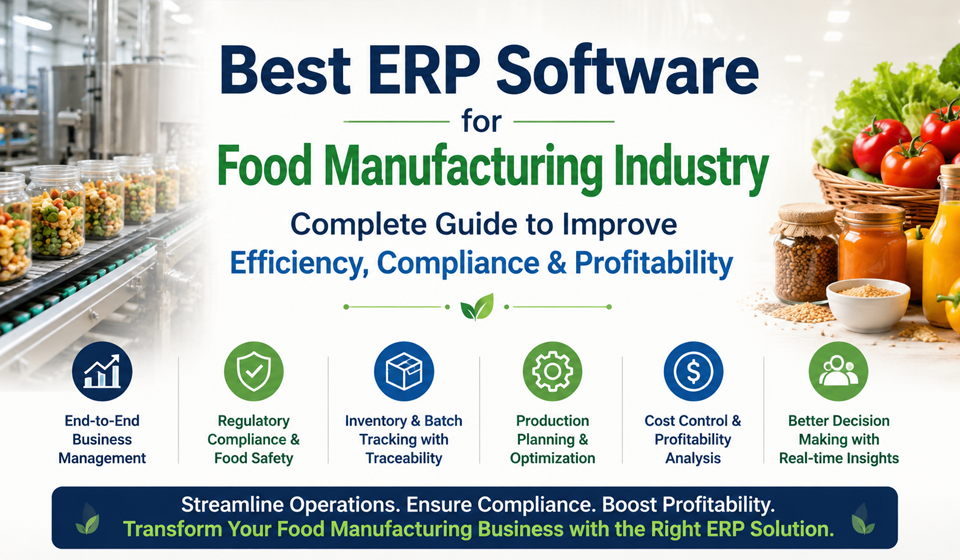
Best ERP Software for Food Manufacturing Industry: Complete Guide to Improve Efficiency, Compliance & Profitability

Food manufacturers operate in one of the most demanding industries. Every day, businesses must balance production efficiency, strict food safety regulations, inventory control, fluctuating raw material prices, changing customer demands, and supply chain disruptions. A single mistake in production planning, quality management, or traceability can lead to product recalls, financial losses, and damage to brand reputation.
Many food manufacturing companies still rely on spreadsheets or disconnected software applications that create information silos. As businesses grow, these systems struggle to handle increasing operational complexity, making it difficult to maintain visibility across departments.
An intelligent ERP (Enterprise Resource Planning) system eliminates these challenges by connecting every business function into a single platform. From procurement and production to quality assurance, inventory management, finance, sales, and distribution, ERP provides real-time visibility, automation, and data-driven decision-making.
Organizations adopting AI-powered ERP solutions are experiencing improved production planning, reduced operational costs, enhanced product quality, better regulatory compliance, and stronger customer satisfaction.
This comprehensive guide explains why modern food manufacturers need ERP software, the challenges it solves, the essential features to consider, and how AI is transforming the future of food manufacturing.
Why Food Manufacturing Companies Need ERP Software
The food manufacturing industry is unique because every product has a limited shelf life, requires complete traceability, and must comply with stringent regulations. Unlike traditional manufacturing, food production involves variable raw materials, multiple recipes, batch processing, quality inspections, expiration management, and complex distribution networks.
Managing these operations manually increases the likelihood of errors that directly impact profitability.
ERP software integrates every operational process into a centralized platform, ensuring that all departments access the same real-time information. This improves collaboration, reduces manual work, minimizes errors, and enables faster business decisions.
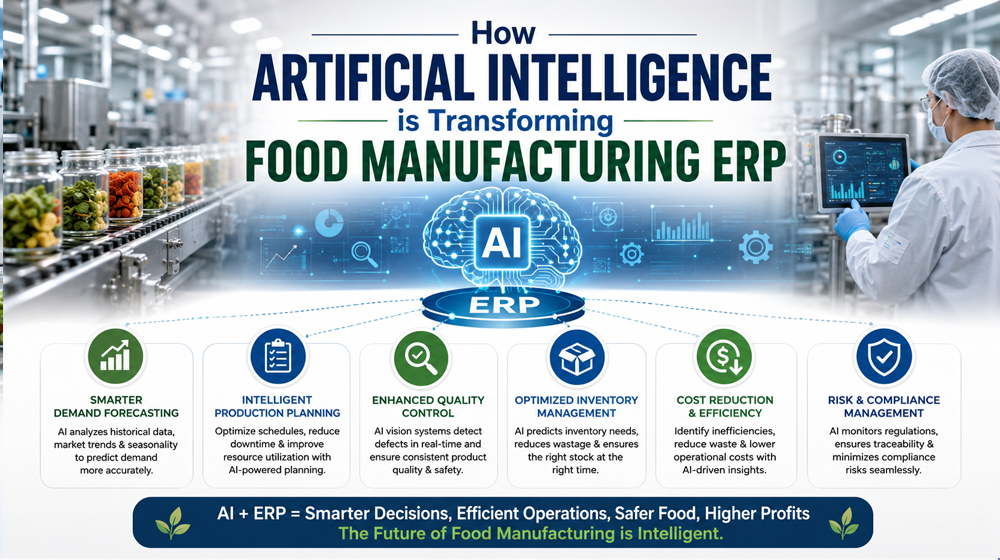
More importantly, AI-enabled ERP systems analyze historical and live operational data to forecast demand, optimize production schedules, predict inventory requirements, and improve supply chain efficiency.
Common Challenges Faced by Food Manufacturing Companies
Lack of Real-Time Inventory Visibility
One of the biggest challenges in food manufacturing is maintaining optimal inventory levels. Excess inventory increases storage costs and product wastage, while insufficient stock results in production delays and lost sales.
Many manufacturers still depend on manual inventory updates, making it difficult to know the exact stock available across multiple warehouses.
Modern ERP software provides live inventory tracking, enabling businesses to monitor raw materials, work-in-progress inventory, finished goods, packaging materials, and warehouse movements in real time.
AI algorithms further enhance inventory management by forecasting future demand based on seasonal trends, historical sales, and customer purchasing behavior.
Consequently, businesses reduce waste while maintaining sufficient inventory to meet customer demand.
Difficulty Maintaining Product Traceability
Food recalls can be extremely expensive and damaging to customer trust.
Without complete traceability, identifying affected products becomes a time-consuming process that increases regulatory risks.
ERP software automatically tracks every batch from supplier procurement through production, packaging, warehousing, and customer delivery.
If a quality issue occurs, manufacturers can instantly identify the affected batches and isolate them before they reach consumers.
This not only protects public safety but also minimizes recall costs and preserves brand reputation.
Managing Short Shelf-Life Products
Unlike other manufacturing sectors, food products have limited shelf lives.
Businesses that cannot effectively monitor expiry dates often experience significant product losses.
ERP systems manage expiry tracking automatically using First Expired First Out (FEFO) inventory methods.
The software alerts warehouse managers before products expire, helping organizations prioritize stock movement and reduce wastage.
AI additionally predicts products likely to expire soon, enabling proactive sales promotions or redistribution.
Production Planning Challenges
Production planning becomes increasingly difficult when customer demand changes frequently.
Manual scheduling often results in underproduction, overproduction, equipment downtime, and labor inefficiencies.
AI-powered ERP software continuously analyzes customer orders, historical demand patterns, machine availability, raw material inventory, and workforce capacity.
The system then recommends optimized production schedules that maximize efficiency while reducing operational costs.
Manufacturers gain better resource utilization and consistently meet customer delivery commitments.
How ERP Software Solves Food Manufacturing Challenges
Centralized Business Management
ERP connects procurement, manufacturing, finance, quality assurance, inventory, sales, maintenance, HR, and customer service into one unified platform.
Instead of multiple disconnected systems, decision-makers gain complete visibility across the organization.
Every department works with accurate, real-time information, reducing communication gaps and operational delays.
This centralized approach improves productivity while enabling faster strategic decisions.
Intelligent Production Planning
Modern ERP software uses Artificial Intelligence and Machine Learning algorithms to analyze multiple operational variables simultaneously.
Rather than relying solely on historical production schedules, AI evaluates customer demand fluctuations, seasonal trends, supplier lead times, equipment utilization, labor availability, and raw material consumption.
As a result, production becomes more efficient, reducing idle time while increasing manufacturing output.
Manufacturers can also simulate different production scenarios before making operational decisions.
Advanced Inventory Optimization
Inventory represents one of the largest operational expenses in food manufacturing.
ERP software continuously monitors stock levels across warehouses while calculating reorder points automatically.
AI predicts future inventory requirements using demand forecasting models.
This prevents excessive purchasing while ensuring sufficient stock availability during peak demand periods.
Businesses experience reduced inventory carrying costs without compromising production continuity.
Complete Quality Control Management
Food quality cannot be compromised.
ERP systems automate quality inspections throughout the manufacturing lifecycle.
Quality checkpoints can be configured during raw material receiving, production processing, packaging, and final shipment.
Any deviations automatically generate alerts, enabling immediate corrective actions.
Furthermore, digital quality records simplify compliance audits while improving overall product consistency.
Regulatory Compliance Made Easy
Food manufacturers must comply with strict food safety standards.
Managing compliance manually consumes valuable time and increases documentation errors.
ERP software stores every production record digitally, including supplier certifications, quality inspections, ingredient traceability, laboratory reports, sanitation records, and production logs.
This simplifies regulatory audits while reducing compliance risks.
Companies remain prepared for inspections without scrambling to collect paperwork.
Essential Features Every Food Manufacturing ERP Should Include
Recipe and Formula Management
Food production depends on maintaining consistent recipes.
ERP software stores standardized formulations while automatically calculating ingredient quantities based on production volume.
When production quantities change, ingredient calculations update instantly without manual intervention.
This maintains consistency across every production batch.
Batch and Lot Tracking
Every ingredient and finished product receives unique batch identification.
Manufacturers can instantly identify production history, supplier information, quality inspections, warehouse locations, and customer deliveries.
Complete traceability improves both compliance and customer confidence.
Expiry Date Management
ERP automatically monitors expiration dates for raw materials and finished goods.
Alerts notify warehouse teams before products approach expiry, reducing waste significantly.
Demand Forecasting Using AI
Machine learning models continuously analyze customer purchasing behavior, market trends, seasonal demand, promotional campaigns, and historical sales.
Demand forecasts become increasingly accurate over time, allowing businesses to optimize procurement and production planning.
Procurement Automation
ERP automates supplier selection, purchase order creation, approval workflows, and vendor performance monitoring.
AI recommends preferred suppliers based on pricing, quality history, delivery performance, and lead times.
This improves procurement efficiency while lowering purchasing costs.
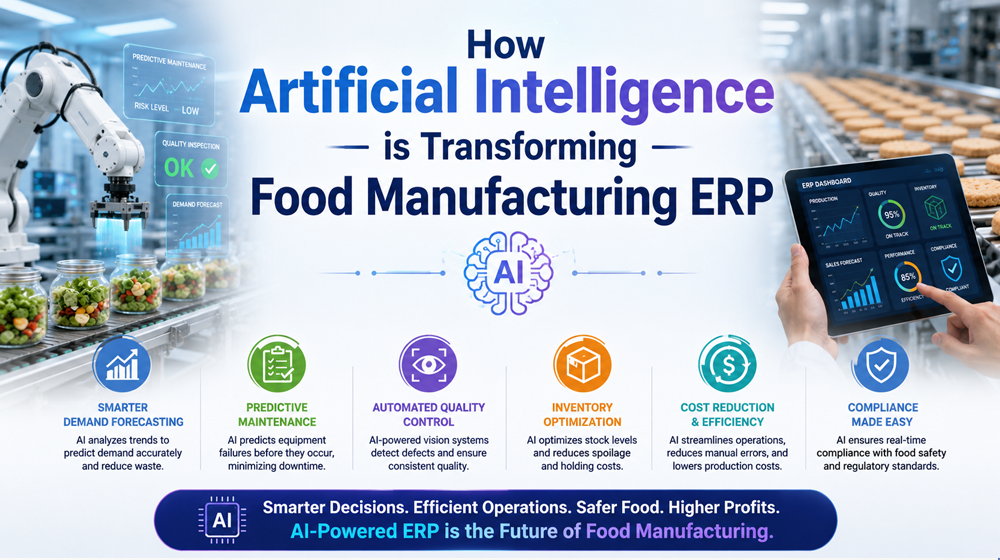
How Artificial Intelligence is Transforming Food Manufacturing ERP
Artificial Intelligence is no longer an optional feature.
It has become the driving force behind intelligent manufacturing operations.
Modern ERP systems leverage AI to automate repetitive tasks, identify hidden operational patterns, and provide predictive recommendations.
Instead of simply displaying reports, AI explains why performance changed and recommends corrective actions.
For example, if raw material consumption suddenly increases beyond expected levels, AI can identify the production line responsible, analyze possible causes, and recommend immediate corrective measures.
Similarly, predictive maintenance algorithms monitor machine performance and detect early signs of equipment failure.
Maintenance teams receive alerts before breakdowns occur, reducing costly downtime.
Natural language reporting also enables managers to ask questions such as:
“Which products generated the highest profit this month?”
“Which suppliers caused the most production delays?”
“What inventory will expire within the next 30 days?”
The ERP instantly generates meaningful answers using live business data.
Choosing the Best ERP Software for Food Manufacturing Industry
Selecting the right ERP software is not simply about replacing existing systems. Instead, it is about investing in a platform that can support your business growth for the next decade. The ideal ERP should adapt to evolving market demands, changing regulations, and increasing production complexity without requiring expensive system replacements.
Many food manufacturers choose software based only on price. However, the lowest-cost solution often results in higher long-term expenses due to customization, maintenance, and limited scalability. Therefore, decision-makers should evaluate the overall business value rather than the initial investment.
An ERP platform should seamlessly integrate procurement, production, inventory, quality control, finance, warehouse management, customer relationship management, and reporting into a unified ecosystem. Furthermore, it should provide mobile accessibility, cloud deployment options, AI-driven analytics, and role-based security to ensure operational flexibility and data protection.
Scalability is equally important. As production volumes increase, the ERP should continue delivering consistent performance without requiring extensive infrastructure upgrades. Consequently, businesses can expand into new markets, launch additional product lines, and manage multiple manufacturing plants from a single centralized platform.
Another critical factor is ease of use. Employees should be able to navigate the system without extensive technical knowledge. An intuitive interface reduces training time, improves user adoption, and minimizes operational errors. Therefore, organizations should prioritize ERP platforms that offer a modern, user-friendly experience alongside advanced functionality.
Cloud ERP vs On-Premise ERP for Food Manufacturers
The deployment model significantly impacts operational flexibility, maintenance costs, and long-term scalability.
Cloud ERP has become the preferred choice for modern food manufacturers because it offers remote accessibility, automatic updates, enhanced cybersecurity, and reduced infrastructure costs. Teams can access real-time production data from any location, enabling faster decision-making across multiple facilities.
Additionally, cloud ERP simplifies disaster recovery by securely storing business data in professionally managed data centers. This approach minimizes downtime while ensuring business continuity during unexpected disruptions.
On-premise ERP, on the other hand, provides greater control over infrastructure and may suit organizations with strict internal IT policies. However, it often requires higher upfront investments, dedicated IT resources, and ongoing maintenance.
As artificial intelligence, predictive analytics, and IoT technologies continue evolving, cloud ERP platforms receive these innovations more rapidly through continuous updates. Consequently, businesses remain technologically competitive without undertaking major software upgrades.
The Role of AI and Machine Learning in Modern Food Manufacturing
Artificial Intelligence has transformed ERP from a transactional system into an intelligent business advisor. Rather than simply recording historical data, AI continuously analyzes operational activities to recommend improvements before problems occur.
Machine learning algorithms study production trends, supplier performance, customer purchasing behavior, seasonal demand, and machine utilization. Over time, these algorithms become increasingly accurate because they continuously learn from new business data.
For example, an AI-powered ERP can predict that a specific raw material supplier may experience delivery delays based on historical patterns and current logistics conditions. As a result, procurement teams receive early warnings and can secure alternative suppliers before production is affected.
Similarly, predictive quality analytics identifies production variables that may lead to quality deviations. Instead of discovering defects after manufacturing, production managers receive alerts during the manufacturing process, allowing immediate corrective action.
Furthermore, AI-powered scheduling continuously optimizes production sequences based on available machinery, workforce capacity, maintenance schedules, and customer priorities. This significantly improves production efficiency while reducing operational costs.
Food Safety Compliance Becomes Simpler with ERP
Food safety regulations continue becoming more stringent across global markets. Manufacturers must maintain detailed records demonstrating compliance throughout every stage of production.
Manual documentation creates unnecessary risks because missing records, inconsistent data, or delayed reporting can result in regulatory penalties.
ERP software automatically captures production activities, quality inspections, sanitation procedures, supplier certifications, laboratory test results, employee training records, and equipment maintenance logs. Therefore, organizations maintain complete digital documentation without increasing administrative workload.
When regulatory audits occur, businesses can instantly retrieve historical records, reducing preparation time while improving auditor confidence.
Complete traceability also strengthens customer trust because manufacturers can verify ingredient origins, production batches, storage conditions, and distribution history within seconds.
Real-Time Business Intelligence for Better Decision-Making
Data has become one of the most valuable business assets. However, information scattered across spreadsheets, disconnected software, and manual reports often delays important decisions.
Modern ERP platforms consolidate operational data into interactive dashboards that provide real-time insights across every department.
Executives can monitor production efficiency, inventory turnover, profit margins, sales performance, procurement costs, customer demand, and financial health through a single dashboard.
Moreover, AI-generated insights highlight anomalies that traditional reporting may overlook. For instance, if production waste increases unexpectedly, the ERP identifies the specific production line, machine, shift, or raw material contributing to the issue.
As a result, managers spend less time analyzing reports and more time implementing improvements that increase profitability.
How ERP Improves Customer Satisfaction
Customer expectations continue rising across the food industry. Buyers expect consistent product quality, on-time deliveries, transparent communication, and rapid issue resolution.
ERP software enables manufacturers to meet these expectations through improved operational visibility and automation.
Sales teams receive real-time inventory availability before confirming customer orders. Production managers can prioritize urgent orders without disrupting overall manufacturing schedules. Logistics teams receive optimized delivery plans that improve transportation efficiency.
If customers request product traceability information, businesses can immediately provide complete production histories, reinforcing confidence in product quality and food safety.
Consequently, organizations build stronger customer relationships while increasing repeat business and long-term loyalty.
Latest Market Trends Driving ERP Adoption in Food Manufacturing
The global ERP market continues expanding rapidly as manufacturers invest in digital transformation initiatives. Industry analysts project the ERP software market to surpass USD 100 billion within the next few years, driven by cloud adoption, AI integration, and increasing automation across manufacturing industries.
Similarly, food manufacturers are prioritizing digital technologies to address labor shortages, supply chain disruptions, inflationary pressures, and stricter compliance requirements.
Artificial Intelligence has become one of the most influential ERP innovations because it enables predictive planning rather than reactive decision-making.
Additionally, Internet of Things (IoT) integration allows ERP systems to collect live data directly from production equipment. Sensors continuously monitor temperature, humidity, machine health, production speed, and energy consumption, enabling manufacturers to improve operational efficiency while reducing waste.
Sustainability has also become a strategic priority. ERP software helps organizations monitor energy usage, optimize resource consumption, reduce food waste, and generate sustainability reports that support environmental initiatives and regulatory compliance.
Why Bluechip Solutions ERP is the Right Choice for Food Manufacturing
Food manufacturing businesses require more than generic ERP software. They need an intelligent platform specifically designed to address industry-specific operational challenges.
Bluechip Solutions delivers a comprehensive ERP solution that integrates procurement, production planning, inventory management, warehouse operations, finance, quality assurance, sales, customer management, reporting, and AI-powered analytics into a unified ecosystem.
Built on the Auvit™ No-Code Digital Transformation Platform, the solution enables rapid customization without lengthy development cycles. As business requirements evolve, workflows, approvals, dashboards, reports, and automation can be modified quickly without complex programming.
The platform also supports cloud deployment, mobile accessibility, role-based security, workflow automation, document management, barcode integration, AI-powered dashboards, predictive analytics, and business intelligence reporting.
Whether your organization operates a single manufacturing facility or multiple production plants, Bluechip Solutions ERP scales alongside your business while maintaining operational efficiency.
Frequently Asked Questions
Which ERP software is best for the food manufacturing industry?
The best ERP software should include inventory management, batch tracking, recipe management, quality control, compliance management, AI-powered forecasting, production planning, warehouse management, finance, and supply chain integration. It should also support future business growth through cloud scalability and workflow automation.
Why do food manufacturers need ERP software?
ERP software centralizes business operations, improves inventory accuracy, enhances production planning, ensures regulatory compliance, reduces waste, increases traceability, and enables better business decisions using real-time analytics.
Can ERP reduce food wastage?
Yes. ERP systems monitor inventory levels, expiry dates, production schedules, and demand forecasts. AI algorithms further optimize procurement and production planning, significantly reducing excess inventory and expired products.
How does AI improve ERP software?
Artificial Intelligence enhances ERP by providing predictive analytics, demand forecasting, automated production scheduling, predictive maintenance, anomaly detection, intelligent reporting, and decision support based on live operational data.
Is cloud ERP better than traditional ERP?
For most food manufacturers, cloud ERP offers greater flexibility, lower infrastructure costs, automatic software updates, remote accessibility, enhanced cybersecurity, and faster innovation compared to traditional on-premise systems.
Download Your Free ERP Evaluation Checklist
Selecting ERP software is a critical business decision. Before investing, evaluate whether your existing system supports:
- Complete batch traceability
- AI-powered demand forecasting
- Inventory optimization
- Production scheduling
- Food safety compliance
- Warehouse automation
- Mobile accessibility
- Business intelligence dashboards
- Predictive analytics
- Workflow automation
If your current solution lacks these capabilities, it may be time to modernize your operations with an intelligent ERP platform.
Transform Your Food Manufacturing Business with Intelligent ERP
Food manufacturing continues becoming more competitive, regulated, and customer-driven. Companies that rely on disconnected systems, manual processes, and outdated software will increasingly struggle to maintain profitability and operational efficiency.
An AI-powered ERP platform empowers businesses to optimize production, improve inventory accuracy, strengthen quality management, simplify regulatory compliance, reduce waste, and deliver exceptional customer experiences.
Organizations that embrace digital transformation today will be better positioned to respond to market changes, manage growth, and outperform competitors in the years ahead.
Ready to modernize your food manufacturing operations?
Book a free ERP consultation with Bluechip Solutions today and discover how our AI-powered ERP built on the Auvit™ No-Code Platform can streamline your entire manufacturing process, improve profitability, and accelerate business growth.
Contact us today for a personalized demo and digital transformation roadmap.