How a Manufacturing Company Reduced Costs by 32%: A Real-World Guide to Smart Manufacturing Transformation in 2026

Introduction: Why Manufacturing Cost Reduction Has Become a Survival Strategy
The manufacturing industry is facing unprecedented challenges in 2026. Rising raw material prices, increasing labor costs, ongoing supply chain disruptions, fluctuating energy expenses, and growing customer expectations are putting significant pressure on profit margins. As a result, manufacturing cost reduction has become a top priority for organizations striving to remain competitive and profitable. However, companies that continue relying on traditional processes, manual operations, and disconnected systems are finding it increasingly difficult to control costs and maintain operational efficiency. Therefore, manufacturers are turning to advanced technologies such as ERP software, artificial intelligence, automation, and data analytics to achieve sustainable manufacturing cost reduction while improving productivity and business performance.
At the same time, forward-thinking manufacturers are leveraging digital transformation, ERP software, artificial intelligence, predictive analytics, and automation to gain a competitive advantage. As a result, many organizations are not only surviving but also significantly improving their margins.
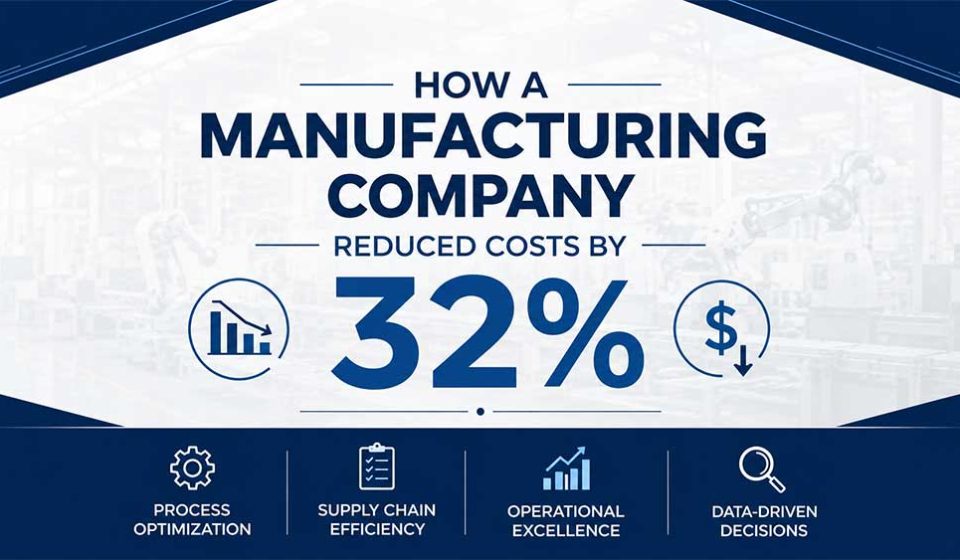
One manufacturing company recently achieved something remarkable. By implementing a data-driven operational strategy supported by AI-powered analytics and an integrated ERP platform, the company successfully reduced operational costs by 32% within eighteen months while simultaneously increasing productivity, improving product quality, and enhancing customer satisfaction.
This case-study-style article explains exactly how that transformation happened, the challenges the company faced, the solutions implemented, and the measurable results achieved. More importantly, it provides practical insights that manufacturers can apply immediately to reduce costs and improve operational efficiency.
The Manufacturing Cost Crisis Facing Companies Today
Before understanding how costs were reduced, it is important to understand the challenges many manufacturers currently face.
Manufacturing organizations often struggle with hidden inefficiencies that quietly drain profits every day. Although these issues may appear small individually, together they create substantial financial losses.
For instance, excessive inventory holding costs frequently tie up working capital. Meanwhile, production delays create bottlenecks that increase operational expenses. Furthermore, machine downtime reduces productivity and causes missed delivery commitments.
Additionally, manual data entry often results in errors that affect procurement, inventory management, and production planning. Consequently, management teams lack accurate real-time information needed for effective decision-making.
According to recent industry reports published by leading manufacturing analysts, organizations lose between 15% and 30% of operational efficiency due to disconnected systems, manual processes, and poor visibility across departments.
Therefore, reducing manufacturing costs requires more than simply cutting expenses. Instead, it demands a comprehensive strategy focused on eliminating inefficiencies and improving productivity.
Company Background: The Challenge That Triggered Transformation
The company featured in this case study is a mid-sized manufacturing organization specializing in industrial components supplied to automotive and engineering industries. Despite strong market demand, the company faced several critical challenges. Production costs had increased by nearly 22% over three years. Simultaneously, inventory carrying costs continued rising due to inaccurate demand forecasting.
Management also discovered that production planning relied heavily on spreadsheets maintained by multiple departments. As a result, different teams worked with inconsistent information. Moreover, machine breakdowns occurred frequently, causing unplanned downtime and delayed customer deliveries.
The leadership team realized that unless significant changes were implemented, profitability would continue declining despite revenue growth. Therefore, the company initiated a comprehensive operational improvement program focused on three primary objectives:
Improve visibility across operations.
Reduce operational costs.
Increase productivity without expanding workforce size.
Initial Assessment: Identifying the Hidden Cost Drivers
Before implementing solutions, the company conducted a detailed operational assessment. This analysis revealed several major cost drivers.
Excess Inventory and Poor Demand Forecasting
Inventory levels exceeded actual business requirements by approximately 38%. Because forecasting relied largely on historical assumptions rather than predictive analytics, procurement teams frequently ordered materials that were not immediately required.
Consequently, warehouse costs increased significantly while cash flow suffered. Furthermore, slow-moving inventory occupied valuable storage space and increased inventory obsolescence risks.
Production Scheduling Inefficiencies
Production planning was largely manual. As a result, production managers often struggled to balance workloads across machines and shifts. Some machines operated below capacity while others became overloaded. Consequently, production delays became common, leading to overtime expenses and increased operational costs.
Unplanned Equipment Downtime
Equipment maintenance followed a reactive approach rather than a predictive strategy. Machines were repaired only after failures occurred. Therefore, production interruptions became frequent and costly. Moreover, emergency maintenance expenses were considerably higher than preventive maintenance costs.
Lack of Real-Time Visibility
Management reports were generated manually using spreadsheets. Because data collection took several days, decision-makers often worked with outdated information. As a result, corrective actions were delayed and opportunities for cost savings were missed.
The Digital Transformation Strategy That Changed Everything
After identifying key challenges, the company developed a transformation roadmap based on modern manufacturing best practices. Instead of implementing isolated solutions, management adopted an integrated approach combining:
ERP software
Artificial Intelligence
Predictive Analytics
Industrial IoT Monitoring
Automated Workflow Management
Business Intelligence Dashboards
This holistic strategy ensured that every department worked from a single source of truth. Consequently, data became more accurate, processes became more efficient, and decision-making improved significantly.
Phase One: Implementing an Integrated Manufacturing ERP System
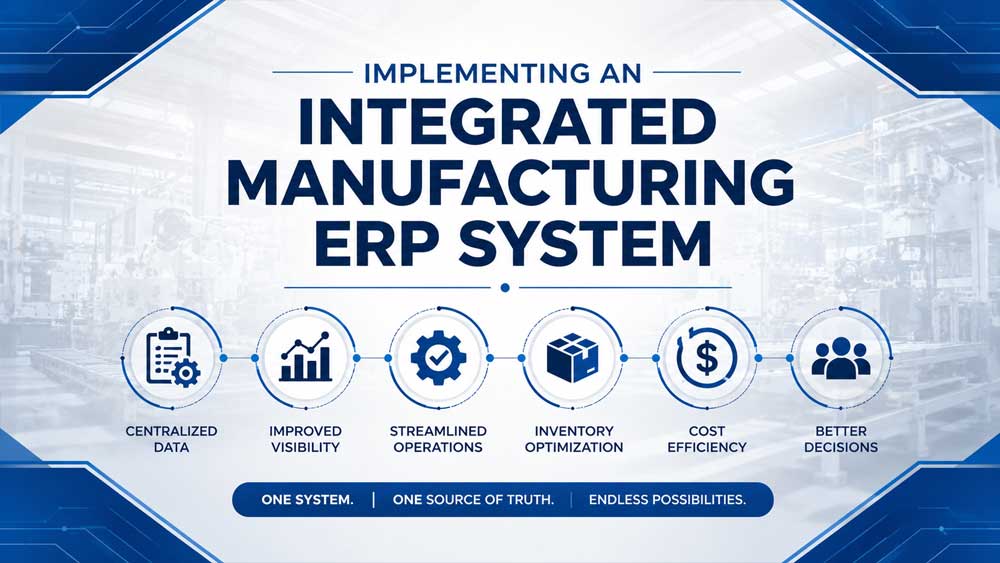
The first major initiative involved deploying an advanced manufacturing ERP platform. This ERP system integrated procurement, inventory management, production planning, quality control, maintenance management, sales, and finance. As a result, data flowed seamlessly across departments.
Previously, employees spent hours manually transferring information between systems. However, after ERP implementation, information became available instantly across the organization.
How ERP Reduced Operational Costs
The ERP platform delivered immediate benefits. Inventory visibility improved dramatically. Procurement teams could now monitor stock levels in real time. Consequently, unnecessary purchases were eliminated. Production planners gained access to accurate material availability information.
Therefore, production schedules became more reliable. Additionally, automated approval workflows reduced administrative overhead. Within six months, inventory carrying costs decreased by 18%. At the same time, procurement efficiency improved substantially.
Phase Two: Leveraging AI-Powered Demand Forecasting
One of the company’s biggest challenges involved inaccurate forecasting. Therefore, management implemented AI-driven demand forecasting models. Unlike traditional forecasting methods, AI algorithms analyze multiple variables simultaneously.
These variables included:
Historical sales trends
Seasonal demand patterns
Customer buying behavior
Economic indicators
Market fluctuations
Supplier performance data
Because AI continuously learns from new data, forecast accuracy improved significantly.
The Business Impact of AI Forecasting
Forecast accuracy increased from 68% to 92%. Consequently, inventory levels became more aligned with actual demand. Stock shortages decreased dramatically. Meanwhile, excess inventory reduced substantially. As a result, working capital requirements dropped while service levels improved. This single initiative contributed nearly 8% of the total cost reduction achieved.
Phase Three: Predictive Maintenance Using AI and IoT
Equipment downtime represented another major cost center. To address this issue, the company implemented predictive maintenance technology. Sensors were installed across critical production equipment. These sensors continuously monitored machine performance indicators such as:
Temperature
Vibration
Pressure
Energy consumption
Operating cycles
The collected data was analyzed using machine learning algorithms. Whenever the system detected unusual patterns, maintenance teams received automated alerts. Therefore, potential failures could be addressed before breakdowns occurred.
Results of Predictive Maintenance
The results exceeded expectations. Unplanned downtime decreased by 41%. Maintenance costs dropped significantly. Equipment lifespan increased. Production schedules became more reliable. Furthermore, customer deliveries improved because production interruptions became less frequent. Consequently, operational efficiency improved across the entire manufacturing facility.
Phase Four: Data Analytics for Smarter Decision-Making
Data alone does not create value. Instead, actionable insights drive business improvement. Therefore, the company implemented advanced business intelligence dashboards. Executives gained real-time visibility into critical performance metrics. Production managers could monitor efficiency indicators instantly.
Procurement teams tracked supplier performance continuously. Quality teams identified process deviations more quickly. Because decisions were now based on real-time data rather than assumptions, operational performance improved consistently. Management could identify issues before they escalated into costly problems. As a result, continuous improvement became part of the organization’s culture.
Conclusion
Reducing manufacturing costs is no longer just about cutting expenses; it is about improving efficiency through smarter operations. As demonstrated in this case study, the combination of ERP software, AI-powered analytics, predictive maintenance, and data-driven decision-making helped a manufacturing company reduce operational costs by 32% while increasing productivity and operational visibility.
Moreover, by eliminating inefficiencies, optimizing inventory, reducing downtime, and automating critical processes, the company achieved sustainable cost savings and improved profitability. As manufacturing challenges continue to evolve, organizations that embrace digital transformation will be better positioned to stay competitive and drive long-term growth.
Ultimately, investing in smart manufacturing technologies is not just a strategy for cost reduction—it is a pathway to greater efficiency, higher profitability, and future-ready business success.