ERP Implementation Cost in India in 2026: Complete Pricing Guide, Hidden Costs, ROI Analysis, and Smart Budget Planning for Growing Businesses

Introduction
Digital transformation is no longer a luxury for Indian businesses. Instead, it has become a necessity for organizations that want to remain competitive, improve operational efficiency, and deliver superior customer experiences. As businesses expand across multiple locations, departments, and channels, managing operations through spreadsheets and disconnected software systems becomes increasingly difficult.
Consequently, many organizations begin exploring Enterprise Resource Planning (ERP) software as a long-term solution. However, before making this strategic investment, one critical question arises:
What is the actual ERP implementation cost in India?
Unfortunately, many companies underestimate ERP implementation expenses. While software licensing often receives the most attention, the actual cost of ERP implementation includes several other components such as customization, deployment, data migration, integrations, training, infrastructure, and post-implementation support.
As a result, businesses frequently experience budget overruns, project delays, and implementation challenges.
Therefore, understanding the complete ERP cost structure before starting a project is essential.
In this comprehensive guide, we will explore ERP implementation costs in India for 2026, hidden expenses organizations often overlook, AI-driven cost optimization strategies, ROI forecasting models, and practical recommendations to maximize ERP investment value.
Understanding ERP Implementation Cost in India
When business leaders search for ERP pricing, they often expect a straightforward answer. However, ERP implementation costs vary significantly because every business has unique operational requirements, workflows, industry regulations, and scalability needs.
Consequently, ERP implementation pricing depends on multiple factors rather than a single software subscription fee.
For example, a small manufacturing company with fifty employees will have entirely different ERP requirements compared to a multi-location enterprise managing thousands of users.
Therefore, ERP implementation costs must be evaluated from both a technology perspective and a business transformation perspective.
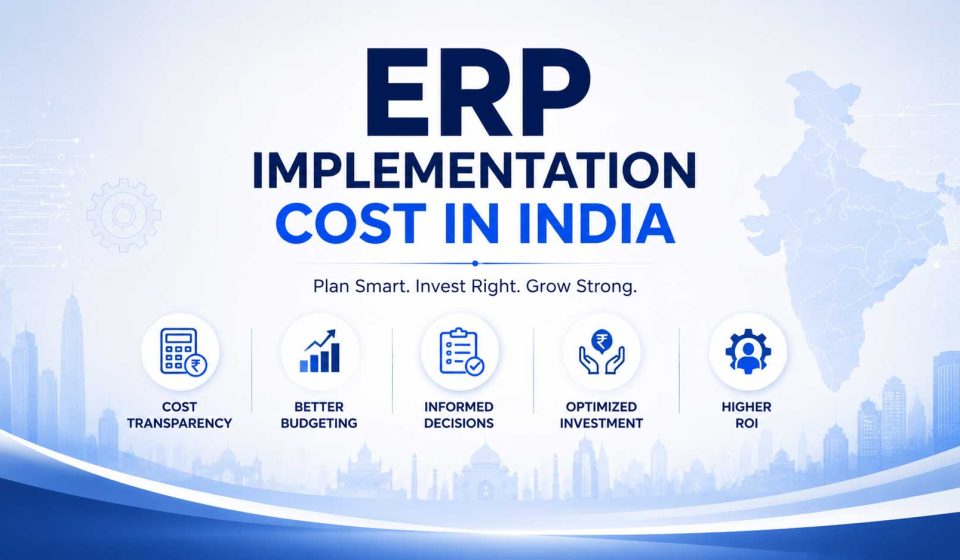
In India, ERP implementation costs typically range from ₹2 lakh for small businesses to more than ₹2 crore for large enterprises depending on complexity, customization requirements, and deployment architecture.
Why Indian Businesses Are Investing More in ERP Systems
The Indian business landscape is changing rapidly.
Today, organizations face increasing competition, rising operational costs, complex compliance requirements, supply chain disruptions, and growing customer expectations.
At the same time, businesses generate massive amounts of operational data every day.
Unfortunately, many organizations struggle to convert this data into actionable insights.
As a result, management teams often make decisions based on assumptions rather than real-time information.
ERP software addresses this challenge by integrating finance, inventory, procurement, manufacturing, HR, CRM, sales, and operations into a unified platform.
Consequently, businesses gain complete visibility across departments while improving decision-making speed and accuracy.
Major Factors Affecting ERP Implementation Cost in India
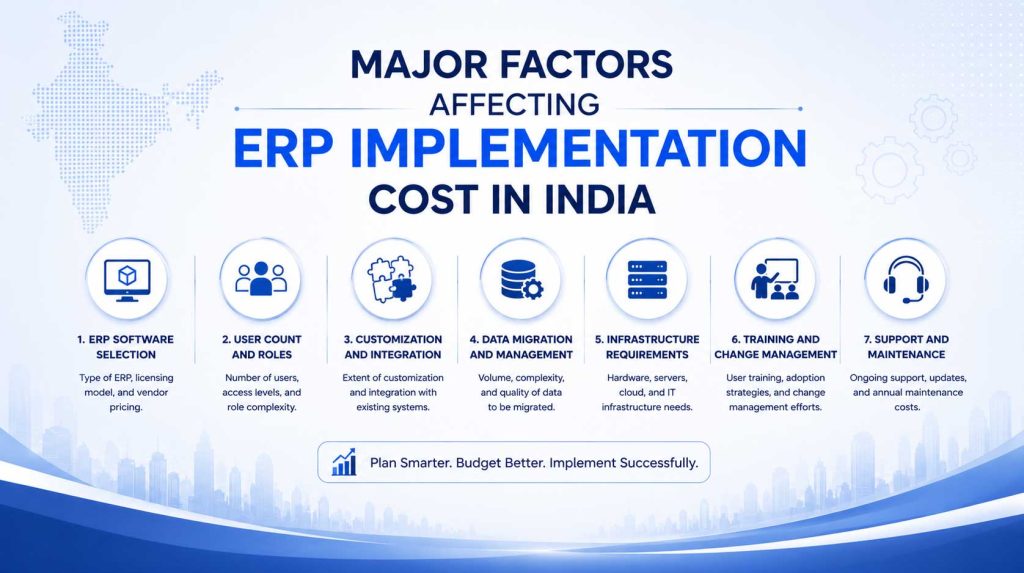
Business Size and Organizational Complexity
One of the biggest factors influencing ERP implementation cost is organizational size.
A small business generally requires fewer modules, limited customization, and fewer user licenses.
However, as organizations grow, business processes become more complex.
Multiple departments, branches, approval workflows, compliance requirements, and reporting structures increase implementation complexity significantly.
Therefore, larger organizations naturally require higher implementation budgets.
Number of Users
ERP vendors often calculate pricing based on user licenses.
As the number of employees accessing the system increases, licensing expenses also rise.
Moreover, different user categories such as administrators, managers, supervisors, and operational staff may require different access levels.
Consequently, user-based pricing directly impacts overall ERP implementation costs.
Industry-Specific Requirements
Different industries require different ERP capabilities.
For example, manufacturing organizations need production planning, quality management, machine monitoring, and inventory control.
Construction companies require project costing, subcontractor management, and resource allocation.
Healthcare organizations require patient management and regulatory compliance.
Therefore, industry-specific functionality significantly influences ERP costs.
Customization Requirements
Many businesses initially assume they can adopt standard ERP software without modifications.
However, during implementation, organizations often discover unique workflows that require customization.
Although customization improves operational alignment, it also increases development time and project costs.
Therefore, businesses should carefully evaluate customization requirements before implementation begins.
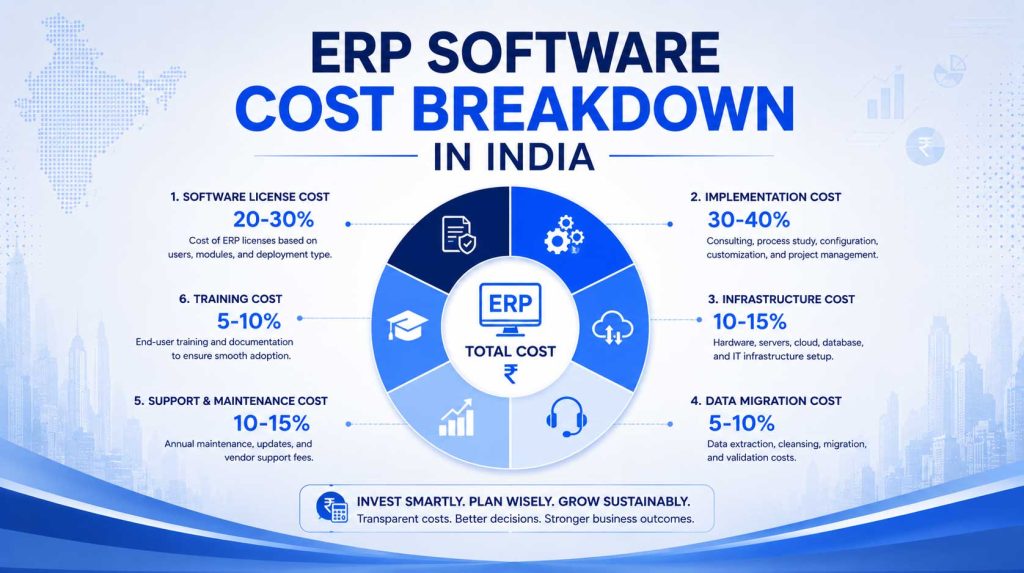
ERP Software Cost Breakdown in India
Software Licensing Costs
Software licensing remains one of the primary ERP expenses.
Cloud-based ERP solutions generally operate on subscription models.
Meanwhile, on-premise ERP systems often require upfront licensing investments.
For small businesses, licensing costs may range from ₹50,000 to ₹5 lakh annually.
For medium-sized enterprises, costs often range between ₹5 lakh and ₹50 lakh.
Large enterprises may invest several crores depending on deployment scale.
Implementation and Consulting Costs
Implementation services typically include business analysis, solution design, workflow configuration, testing, deployment, and project management.
In many ERP projects, implementation costs exceed software licensing expenses.
Therefore, organizations should carefully assess implementation partner expertise rather than focusing solely on software pricing.
Data Migration Costs
Migrating data from legacy systems is often more challenging than expected.
Historical records frequently contain inconsistencies, duplicate entries, and incomplete information.
Consequently, businesses must invest in data cleansing and migration processes.
Without proper planning, poor data quality can negatively impact ERP performance.
Integration Costs
Modern organizations rely on multiple software platforms including CRM systems, payroll solutions, e-commerce applications, accounting software, and business intelligence tools.
Therefore, ERP systems often require integrations with existing applications.
These integrations contribute significantly to implementation budgets.
Training and Change Management Costs
Technology alone does not guarantee ERP success.
Employee adoption plays a crucial role in achieving implementation objectives.
Therefore, organizations must invest in comprehensive training and change management initiatives.
Although many companies attempt to reduce training expenses, insufficient training often results in lower productivity and delayed ROI.
Hidden ERP Costs Most Businesses Ignore
One of the most common mistakes organizations make is focusing only on visible ERP expenses.
However, hidden costs frequently account for a significant portion of total project expenditure.
For example, productivity losses during implementation are rarely included in budget estimates.
Similarly, process redesign, additional reporting requirements, infrastructure upgrades, and extended support services often emerge during project execution.
As a result, actual ERP costs may exceed original projections by twenty to forty percent.
Therefore, proactive planning is essential.
Cloud ERP vs On-Premise ERP Cost Comparison
Cloud ERP solutions continue gaining popularity across India because they reduce infrastructure investment requirements.
Instead of purchasing servers and maintaining internal IT infrastructure, organizations pay subscription-based fees.
Consequently, initial implementation costs are generally lower.
Meanwhile, on-premise ERP systems require substantial upfront investments in hardware, networking, security, and maintenance.
However, some organizations prefer on-premise deployments due to compliance requirements or specific operational considerations.
Therefore, deployment decisions should align with long-term business goals rather than short-term cost savings alone.
AI-Based ERP Cost Estimation Model
Artificial Intelligence is transforming ERP budgeting and implementation planning.
Traditional ERP budgeting relies heavily on assumptions.
However, AI-powered models analyze historical implementation data, business complexity indicators, user requirements, and operational patterns to generate accurate cost forecasts.
Data Collection Phase
The AI model gathers information from organizational systems including finance, inventory, HR, procurement, and operational databases.
This comprehensive dataset provides visibility into current business complexity.
Machine Learning Analysis
Advanced machine learning algorithms evaluate implementation patterns from similar organizations.
Consequently, businesses receive realistic cost projections based on actual implementation outcomes rather than theoretical estimates.
Predictive Budget Forecasting
The AI engine predicts:
Expected implementation costs.
Potential budget overruns.
Training requirements.
Customization efforts.
Future scalability investments.
Therefore, organizations gain significantly better financial planning capabilities.
ERP ROI Analysis: Is ERP Worth the Investment?
Many organizations focus exclusively on implementation costs.
However, ERP should be evaluated based on long-term value generation rather than short-term expenditure.
For example, ERP systems often reduce inventory carrying costs, improve workforce productivity, eliminate duplicate data entry, accelerate financial reporting, and enhance customer service.
Consequently, businesses achieve measurable operational improvements.
A properly implemented ERP solution can generate ROI within twelve to thirty-six months depending on industry, scale, and adoption effectiveness.
Common Challenges Indian Businesses Face During ERP Implementation
Many organizations struggle with ERP implementation because they underestimate organizational change requirements.
Employees may resist new workflows.
Management teams may delay decisions.
Legacy data may contain quality issues.
Project scopes may expand unexpectedly.
Therefore, successful ERP implementation requires strong leadership, realistic planning, stakeholder engagement, and continuous communication.
Organizations that address these challenges proactively typically achieve faster implementation success and higher ROI.
How to Reduce ERP Implementation Costs Without Compromising Quality
Cost reduction should never come at the expense of implementation quality.
Instead, businesses should focus on strategic optimization.
Clearly defining project scope from the beginning prevents expensive mid-project changes.
Similarly, selecting scalable ERP platforms eliminates future migration expenses.
Investing in employee training improves adoption rates and accelerates ROI realization.
Furthermore, choosing experienced implementation partners reduces project risks and prevents costly mistakes.
Consequently, organizations achieve better outcomes while maintaining budget control.
Choosing the Right ERP Partner in India
Selecting the right ERP implementation partner is often more important than selecting the software itself.
An experienced partner understands industry-specific requirements, implementation best practices, integration challenges, and change management strategies.
Therefore, businesses should evaluate implementation expertise, customer references, support capabilities, and long-term partnership potential.
The cheapest implementation partner may not always provide the best value.
Instead, organizations should focus on total business outcomes and long-term success.
The Future of ERP Implementation in India
As artificial intelligence, machine learning, predictive analytics, and automation technologies continue evolving, ERP systems are becoming more intelligent and proactive.
Future ERP platforms will not only manage business processes but also recommend actions, predict operational risks, optimize resource allocation, and automate decision-making.
Consequently, ERP investments will generate significantly higher strategic value than traditional operational benefits.
Organizations that embrace AI-powered ERP solutions today will be better positioned for future growth, scalability, and competitiveness.
Conclusion
ERP implementation is one of the most important technology investments a business can make. However, understanding the true ERP implementation cost in India requires evaluating software licensing, consulting, customization, training, integration, infrastructure, and long-term support expenses.
While costs vary significantly across industries and business sizes, organizations that plan strategically, leverage AI-powered forecasting models, and focus on long-term value creation consistently achieve stronger returns on investment.
Ultimately, ERP should not be viewed merely as a software purchase. Instead, it should be viewed as a business transformation initiative capable of improving efficiency, increasing profitability, enhancing decision-making, and supporting sustainable growth for years to come.
As India’s digital economy continues expanding in 2026 and beyond, businesses that invest in the right ERP strategy today will be better prepared to lead tomorrow.