
Choosing an ERP system is no longer simply a technology purchase. For a growing business, it can determine how efficiently finance, sales, inventory, production, procurement, and management work together. That is why companies searching for the top ERP companies in Bangalore should focus on more than software features, pricing, or brand recognition.
Bangalore has a highly competitive ERP ecosystem, with global ERP vendors, Indian software companies, industry-specific ERP providers, and implementation partners serving businesses of different sizes. Consequently, the real challenge is not finding an ERP company. The challenge is finding an ERP partner that understands your business problems and can turn the software into measurable business improvements.
For SMEs and growing enterprises, this distinction matters. A technically powerful ERP can still fail if implementation is poorly planned, employees are not trained, business processes are misunderstood, or the software cannot adapt as the organization grows.
Therefore, this guide explains what businesses should look for when comparing ERP companies in Bangalore in 2026, the common problems companies face during ERP selection, and how to choose a partner capable of supporting long-term digital transformation.
Why Are Bangalore Businesses Looking for ERP Solutions in 2026?
Business growth often creates operational complexity faster than companies expect. Initially, spreadsheets, accounting software, emails, and individual applications may appear sufficient. However, as transaction volumes increase, these disconnected systems start creating operational bottlenecks.
For example, the sales team may maintain customer information in one application while inventory is updated somewhere else. Meanwhile, finance may receive information through emails, and management may depend on manually prepared Excel reports.
As a result, decision-makers can spend more time collecting information than actually using it. This creates several practical problems, including delayed reporting, duplicate data entry, inventory discrepancies, poor production visibility, approval delays, and difficulty tracking profitability.
An integrated ERP addresses this problem by connecting business processes through a centralized system. Consequently, employees can work with more consistent information while management gains better visibility into operational performance.
What Makes a Good ERP Company Different From an ERP Software Vendor?
This is one of the most important questions businesses should answer before making an ERP investment. An ERP software vendor primarily provides the technology. However, an ERP partner should understand how that technology needs to be configured, customized, implemented, integrated, and adopted within the customer’s business.
That difference becomes especially important when the organization has industry-specific processes. For instance, a manufacturing company may need production planning, BOM management, material requirements, work orders, inventory control, costing, quality processes, and shop-floor visibility. Therefore, an ERP provider that only demonstrates generic accounting and sales features may not be the right fit.
Similarly, a construction company may require project costing, procurement, contracts, billing, resource management, and project-level financial visibility. Consequently, businesses should evaluate business understanding and implementation expertise alongside ERP functionality.
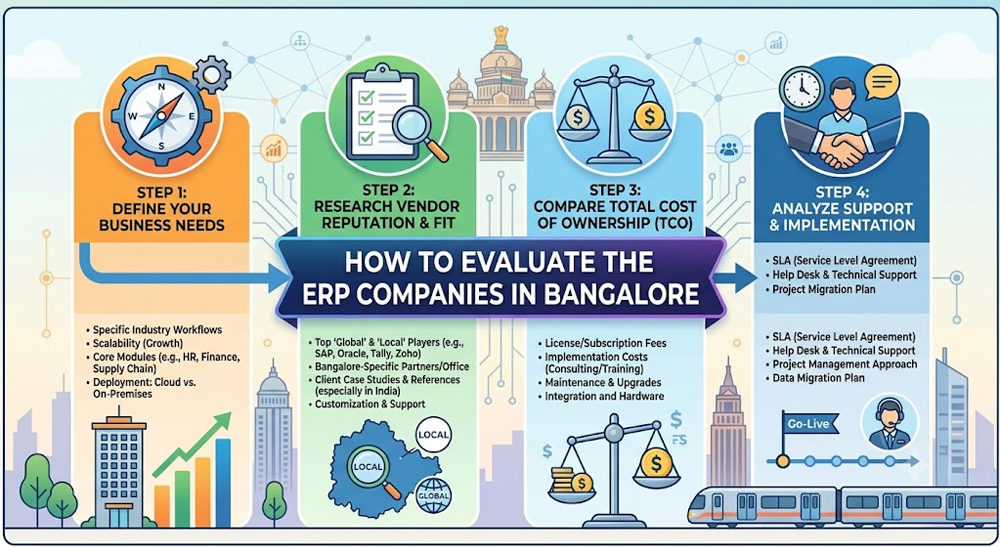
How to Evaluate the Top ERP Companies in Bangalore
Industry Experience Should Come Before Feature Count
One common ERP selection mistake is comparing vendors based on the number of features they offer. More features do not necessarily mean a better ERP. Instead, companies should ask whether the provider understands their specific operational environment. An ERP partner with relevant industry experience can identify process gaps faster, recommend appropriate workflows, reduce unnecessary customization, and help employees adopt the system more effectively.
Therefore, before shortlisting an ERP company, businesses should examine its experience with similar industries, business models, implementation scenarios, and operational challenges.
ERP Customization Determines Long-Term Flexibility
Every business has processes that are different from its competitors. Consequently, forcing every department to follow a rigid ERP workflow can create resistance and operational inefficiency. This is particularly challenging for growing companies because business processes evolve. A flexible ERP should allow organizations to adapt workflows, approvals, reports, dashboards, integrations, and business rules when legitimate requirements arise.
However, customization should also be controlled. Excessive customization can increase implementation complexity and future maintenance costs. Therefore, the right ERP partner should first understand the requirement, determine whether standard functionality can solve it, and customize only where it creates genuine business value.
Why ERP Implementation Experience Matters
Selecting ERP software is only the beginning. The implementation phase determines whether the organization actually receives the expected value from its investment. Poor implementation can result in incorrect data migration, employee resistance, delayed deployment, process confusion, and low utilization.
Therefore, businesses should carefully evaluate the implementation methodology of every ERP company they consider. A strong implementation approach generally begins with understanding business requirements and existing processes. Subsequently, the ERP partner should perform process and gap analysis before configuring the solution.
The project should then move through configuration, customization where necessary, data migration, testing, user training, deployment, and post-go-live support. This structured approach reduces implementation risks because problems can be identified before they affect the entire organization.
Cloud, Mobile and AI: What Should Businesses Expect From ERP in 2026?
ERP expectations have changed significantly. Businesses increasingly want systems that provide information beyond traditional transaction processing. loud accessibility allows authorized users to access business information without being restricted to a particular physical location. Similarly, mobile capabilities can help managers monitor important KPIs while away from their desks.
Meanwhile, AI and advanced analytics are creating opportunities for businesses to identify patterns in sales, inventory, finance, customer activity, and operational performance. However, businesses should be careful about choosing an ERP simply because a vendor uses the word “AI” in its marketing.
Instead, ask practical questions. Can the system turn business data into useful insights? it automate repetitive processes? Can management identify exceptions more quickly? Can the platform support future AI-driven applications? These questions offer a more realistic way to evaluate whether an ERP platform can support the next stage of business automation.
The Hidden ERP Problem: Integration Between Departments
Many businesses do not realize how much productivity is lost because departments operate in isolation. Consider a typical order. A customer places an order. Sales records it. Inventory checks availability. Procurement may purchase missing material. Production may manufacture the product. Logistics then handles dispatch, while finance generates the invoice.
If every department uses separate systems, information must travel between people and applications. Consequently, delays and errors become more likely. An integrated ERP connects these processes and creates a common flow of information. For management, this can also improve visibility. Instead of waiting for separate departmental reports, decision-makers can access information from connected business processes.
Therefore, when comparing ERP companies in Bangalore, businesses should ask vendors to demonstrate an end-to-end business process, rather than showing isolated modules.
How Much Does ERP Software Cost in Bangalore?
ERP pricing varies considerably because the final investment depends on business size, number of users, modules, customization, integrations, implementation complexity, deployment model, and support requirements. Therefore, there is no single ERP price that is suitable for every company.
Instead of comparing only the initial quotation, businesses should evaluate total cost of ownership. Implementation, customization, data migration, training, integrations, support, upgrades, and future expansion can all affect the actual cost. A cheaper ERP may become expensive if it requires extensive customization or cannot scale with the organization.
Conversely, a flexible ERP with a well-planned implementation can potentially deliver better long-term value even when the initial investment is higher.
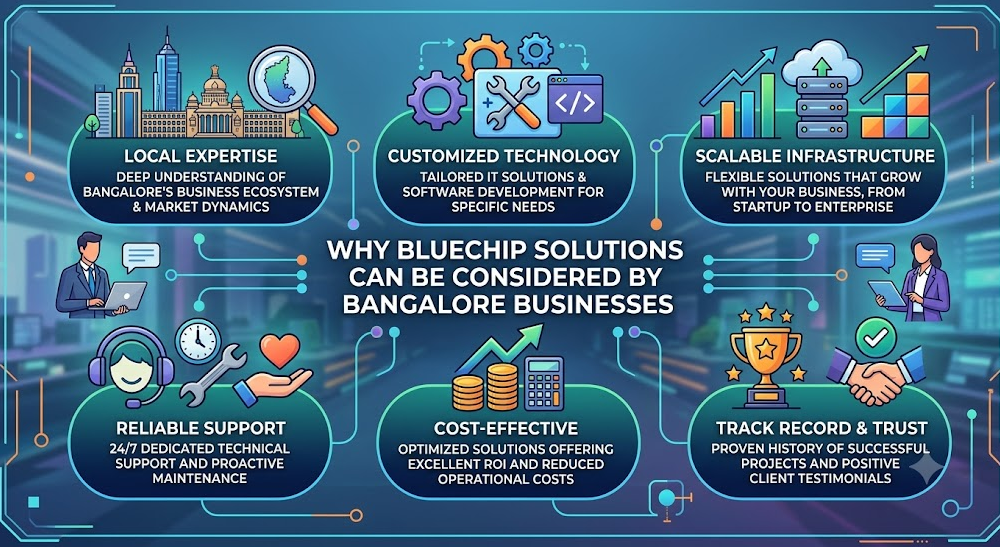
Why Bluechip Solutions Can Be Considered by Bangalore Businesses
Bluechip Solutions PPLUS Pvt. Ltd. is a Bangalore-based technology company providing ERP and enterprise application solutions for businesses. Its technology portfolio includes Auvit™, a no-code business application platform, along with ProfitPlus and ProfitEazy solutions designed for different business requirements.
The company’s solutions cover areas including discrete manufacturing, accounting, distribution, workshop management, microfinance, construction, and other business processes. For organizations that require industry-specific workflows, this approach can be valuable because ERP requirements often extend beyond basic finance and inventory management.
Bluechip Solutions also focuses on no-code and enterprise application capabilities, providing businesses with greater flexibility when their requirements evolve. For a growing company, this is particularly relevant because ERP requirements rarely remain static for five or ten years.
How Bluechip Solutions Addresses Common ERP Pain Points
Problem: Departments Work in Silos
When finance, sales, inventory, purchasing, and operations use disconnected systems, management visibility suffers. Bluechip’s ERP approach focuses on connecting business functions so information can move through integrated processes rather than relying heavily on manual data exchange.
Problem: Standard ERP Does Not Match the Business
Rigid software can force businesses to change processes simply to accommodate the ERP. Bluechip’s no-code approach provides greater flexibility for adapting applications and workflows to business requirements.
Problem: Management Lacks Real-Time Visibility
When reports depend on manually consolidated spreadsheets, decision-making can become slow. Integrated ERP systems can provide centralized operational information and dashboards, helping management monitor business performance more efficiently.
Problem: Business Growth Creates New Requirements
A system that works for a small organization may become restrictive when the company adds branches, users, products, warehouses, or new business processes. Therefore, scalability should be considered from the beginning. Bluechip Solutions’ enterprise application approach is designed to support evolving business requirements rather than treating ERP as a one-time software installation.
What Questions Should You Ask an ERP Company Before Signing the Contract?
Before selecting an ERP partner, ask the vendor to demonstrate your actual business scenario. For example, if you are a manufacturer, ask them to demonstrate the complete flow from sales order to material planning, production, inventory, dispatch, invoicing, and accounting.
Furthermore, ask who will manage implementation, how data migration will be handled, what training employees will receive, how customization requests will be managed, and what support will be available after go-live. Most importantly, ask the ERP provider to explain what happens if your business changes after implementation.
The answer can reveal how flexible the technology and partnership really are.
What Is the Best ERP Company in Bangalore for Your Business?
There is no universal answer to the question, “Which is the best ERP company in Bangalore?” The right choice depends on your industry, business size, processes, budget, technology requirements, implementation expectations, and growth plans. However, the strongest ERP partner should combine industry understanding, flexible technology, implementation expertise, scalability, integration capabilities, employee training, and long-term support.
Therefore, instead of searching only for the “best ERP software,” businesses should search for the best ERP fit for their organization.
Frequently Asked Questions About ERP Companies in Bangalore
Which are the top ERP companies in Bangalore?
Bangalore has ERP providers ranging from global enterprise software companies to Indian ERP developers and industry-specific implementation partners. The best option depends on the organization’s industry, size, requirements, budget, customization needs, and implementation expectations.
How do I choose an ERP company in Bangalore?
Start by identifying your operational problems and documenting your ERP requirements. Then compare providers based on industry experience, functionality, customization, implementation methodology, scalability, integration, support, security, and total cost of ownership. Finally, request a business-specific demonstration before making a decision.
Is ERP suitable for small and medium-sized businesses?
Yes. Modern ERP solutions can be designed for growing businesses as well as larger organizations. For SMEs, the most important consideration is selecting a scalable solution that provides the required functionality without creating unnecessary implementation complexity.
What should I look for in a manufacturing ERP?
A manufacturing ERP should ideally address areas such as production planning, BOM, inventory, procurement, costing, work orders, quality, sales, purchasing, and financial integration. However, the exact requirements depend on the manufacturing process and business model.
Why is ERP implementation important?
ERP implementation determines how effectively the software is configured, integrated, adopted, and used by employees. A structured implementation can reduce operational disruption and improve the likelihood of achieving the expected business outcomes.
Ready to Find the Right ERP Partner in Bangalore?
Choosing an ERP is a major business decision. However, the right selection process does not need to be complicated.
Start with your business problems. Then identify the processes that need improvement. After that, compare ERP companies based on their ability to solve those problems rather than simply comparing feature lists.
If you are evaluating ERP software in Bangalore, Bluechip Solutions can help you assess your requirements, understand suitable ERP options, and explore how an integrated and flexible ERP environment can support your business growth.
Get a free ERP consultation from Bluechip Solutions and discuss your current processes, operational challenges, and future technology requirements with an ERP specialist.
CTA: Book Your Free ERP Consultation → Connect with us
Lead Magnet: Download the ERP Selection Checklist for Growing Businesses in 2026 and use it to compare ERP vendors, implementation costs, customization requirements, integrations, scalability, and post-go-live support before making your final decision.