ERP Software in Bangalore: Can No-Code ERP Adapt to Your Business Without Expensive Custom Development?

ERP software in Bangalore helps businesses connect finance, inventory, sales, purchasing, and operations in one integrated system. However, as companies grow, changing workflows, new approval rules, and evolving reporting requirements can make traditional ERP customization expensive and time-consuming. Auvit No-Code ERP from Bluechip Solutions offers an approach to adapting supported business processes with less dependence on custom programming. Discover how no-code ERP can help CEOs, CTOs, and IT Heads improve operational flexibility, manage development costs, and prepare their businesses for future growth without compromising control or scalability.
Why Does ERP Software Become Expensive When Your Business Changes?
Your business may have selected an ERP system to connect finance, inventory, sales, purchasing and operations. However, as the company grows, the way these departments work rarely remains the same. New approval levels emerge, customer requirements change, reporting needs become more complex, and management expects faster access to business information.
This is where the real challenge begins. An ERP system that worked well during implementation may require additional development whenever an existing process changes. Even a small modification, such as introducing a new purchase approval rule or changing a sales quotation workflow, can involve technical analysis, development, testing and deployment.
For CEOs, CTOs and IT Heads, the question is no longer simply whether an ERP system has enough features. Instead, the important question is whether the system can adapt when the business changes without repeatedly increasing IT expenditure.
ERP software in Bangalore should help businesses manage change, not make every change a costly development project. This is why no-code ERP platforms, such as Auvit No-Code ERP from Bluechip Solutions, deserve consideration when evaluating long-term ERP flexibility and business process automation.
The Hidden Cost of Traditional ERP Customization
Traditional ERP systems often provide standard modules and configuration options. Nevertheless, when a business requirement falls outside those capabilities, the company may need custom code, external development support or additional integrations.
Why Small Business Changes Can Create Large IT Expenses
Consider a manufacturing company that initially requires approval from one purchase manager. As procurement volumes increase, management introduces separate approval limits for department heads, finance managers and directors. The company may also need emergency purchase approvals for production-critical materials.
If the existing ERP cannot support these changes through configuration, developers may need to modify the workflow, validate permissions, test exceptions and ensure that existing transactions continue working correctly. Consequently, the cost extends beyond the initial development effort. Future upgrades, maintenance, documentation and testing can also become more demanding, particularly when custom modifications are closely tied to the underlying software.
The Business Impact Goes Beyond Development Costs
The larger problem is operational delay. When employees must wait for an ERP modification, they may temporarily depend on spreadsheets, email approvals or manual tracking. Consequently, fragmented information, unclear approval histories, and outdated transaction statuses make business tracking and decision-making more difficult.
For a CEO, this creates uncertainty around performance and accountability. And a CTO, it increases the burden of maintaining custom code. For an IT Head, it means balancing business requests against limited development resources. Therefore, an effective ERP strategy evaluates implementation, customization, maintenance, upgrades, integrations, and ongoing change management costs.
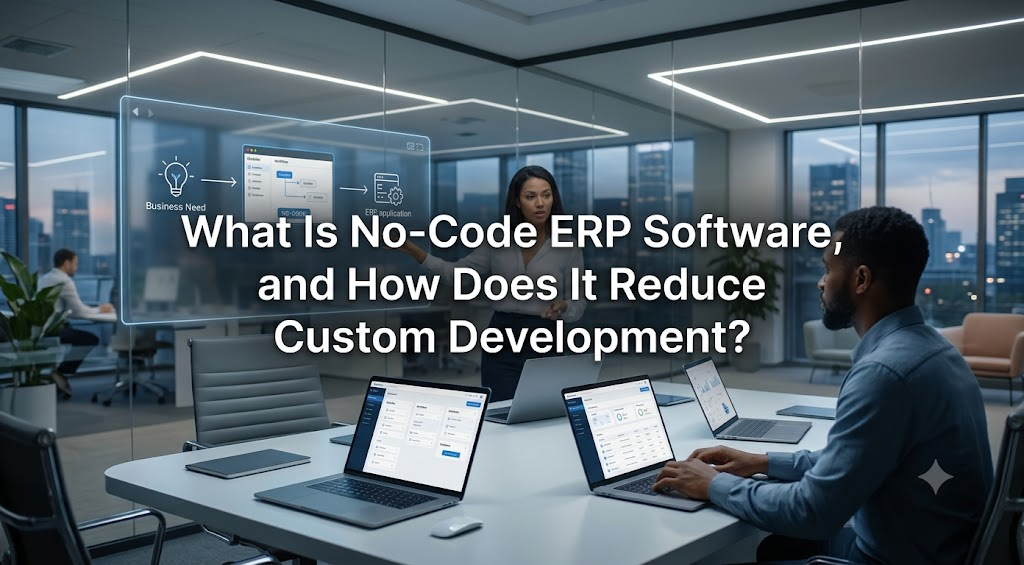
What Is No-Code ERP Software, and How Does It Reduce Custom Development?
No-code ERP software helps teams configure business processes using visual tools, reducing the need for custom programming for supported changes. Depending on the platform, these capabilities may include workflow design, approval rules, forms, notifications, dashboards and business logic configuration. A no-code approach simplifies supported process changes, reducing reliance on separate software development projects and improving business flexibility.
However, no-code does not mean that every requirement can be implemented without technical expertise. Complex integrations, advanced security requirements, unusual calculations and specialized business logic may still require IT involvement. The practical advantage is that businesses can reduce their dependence on custom programming for requirements that the platform already supports.
How No-Code ERP Helps Businesses Adapt Faster
Suppose a distributor wants to introduce a credit approval step before confirming orders for customers who exceed their payment limits. A configurable workflow lets teams define triggers, assign approvers, and automate the next steps based on business rules.
Similarly, if management changes the reporting structure, the team may be able to update dashboard views or reporting parameters without rebuilding the entire application. As a result, routine process improvements can become easier to implement, validate and maintain. The actual time and cost savings, however, depend on the ERP platform, the complexity of the requirement and the quality of the initial implementation.
How Auvit No-Code ERP Can Support Changing Business Requirements
Auvit No-Code ERP from Bluechip Solutions is positioned around no-code ERP customization and business process automation. For organizations evaluating ERP software in Bangalore, the relevant consideration is how these capabilities can support changing operational requirements while keeping business data and processes connected.
Adapt Approval Workflows Without Rebuilding Every Process
Approval rules frequently change as companies expand. For example, a growing organization may introduce different approval limits for purchasing, expenses, discounts and customer credit. A configurable ERP workflow can help align these rules with the company’s current authorization structure. When supported by the platform, the workflow can route requests to the appropriate approver, maintain process continuity and trigger notifications for pending actions. This helps management establish clearer accountability while reducing dependence on informal email-based approvals.
Connect Business Processes Across Departments
A change in one department often affects several others. A revised sales order may influence inventory availability, procurement planning, production scheduling and delivery commitments. If these activities operate in disconnected systems, employees may need to update the same information repeatedly.
An integrated ERP approach helps connect relevant transactions and information across departments. Therefore, teams can work with a more consistent view of business activity instead of relying on multiple spreadsheets and isolated applications. For manufacturers, distributors and service organizations, this connected view can support better coordination between operational teams and management.
Improve Reporting as Management Needs Evolve
Business leaders rarely use the same reports forever. Initially, management may focus on sales and revenue. Later, it may need to understand order delays, inventory exposure, departmental expenditure, pending approvals or customer payment patterns. Where the ERP supports configurable reports and dashboards, reporting requirements can be adapted to reflect these changing priorities. Consequently, decision-makers can focus on the indicators that matter to their current business objectives.
However, dashboard flexibility alone does not guarantee accurate decisions. Reliable reporting also depends on consistent master data, correct transaction entry, appropriate access controls and clearly defined business metrics.
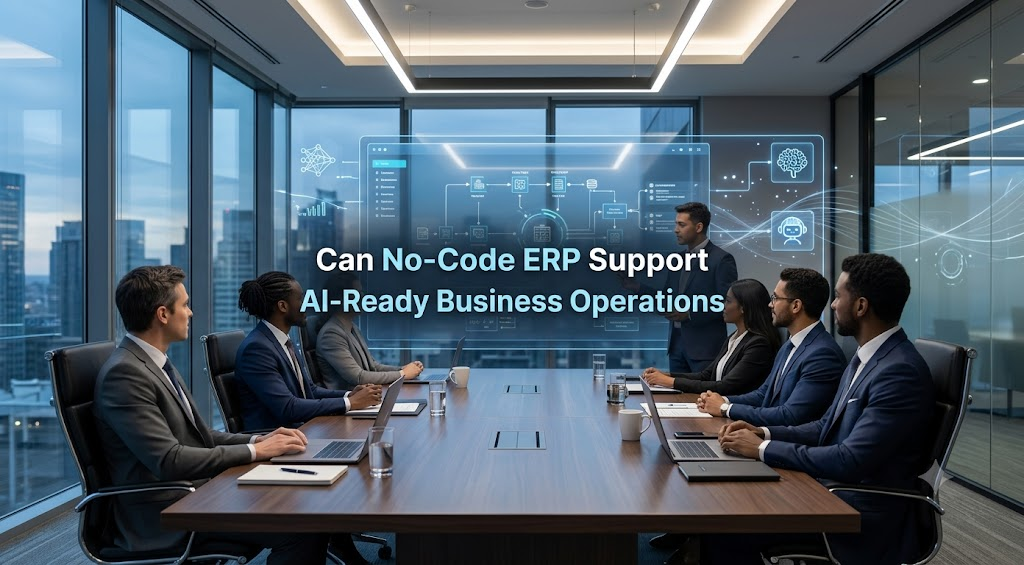
Can No-Code ERP Support AI-Ready Business Operations?
ERP flexibility is becoming increasingly relevant as businesses explore AI-assisted reporting, automation and decision support. The Confederation of Indian Industry’s 2026 publication, AI Meets ERP: A Market Survey on the Future of Enterprise Technology, examines the movement toward AI-powered enterprise systems while highlighting challenges involving data readiness, governance and implementation maturity.
Why Flexible Workflows Matter for AI Adoption
AI-enabled business processes need dependable data, defined actions and suitable controls. For example, a business may want to identify overdue invoices, flag unusual purchasing activity or notify managers about recurring order delays. An ERP system can provide the underlying transaction data and business context needed for these use cases. Configurable workflows can then help define how employees respond to an alert, who reviews it and what action follows.
Nevertheless, a no-code ERP is not automatically an AI-powered ERP. Actual AI capabilities depend on available integrations, supported functionality, data quality and governance arrangements. For this reason, CTOs should evaluate whether an ERP platform can accommodate future integrations and evolving workflows without compromising security, auditability or system performance.

How CEOs and CTOs Should Evaluate ERP Customization Costs
Choosing ERP software based only on its initial licence or implementation price can lead to an incomplete investment decision. A more reliable approach is to examine the expected cost of operating and adapting the system over several years.
Assess the Total Cost of Ownership
Compare the initial implementation cost with the likely expenditure on custom development, support, upgrades, integrations, training and ongoing process changes. Also consider the business impact of delays when a required change cannot be delivered quickly.
A platform with a lower initial price may become more expensive if routine modifications require repeated specialist intervention. Conversely, a flexible platform may offer better long-term value when its configuration capabilities match the organization’s actual needs.
Check Security, Governance and Technical Limitations
Flexibility should not come at the expense of control. Before selecting an ERP, confirm whether role-based access, approval permissions, audit trails, backup procedures, data protection and change management meet your requirements. IT leaders should also ask how configuration changes are tested, how they are promoted to production, how integrations are maintained and which changes still require developers. These questions help distinguish a genuinely manageable ERP environment from a system that simply moves complexity into another layer.
Validate the Platform With Real Business Scenarios
A product demonstration becomes more valuable when it uses your actual business requirements. Ask the ERP provider to demonstrate a changing purchase approval, a revised sales workflow, a new management report and a process involving multiple departments.
Where possible, document the effort required, the roles involved, the testing process and any additional costs. This gives decision-makers a more practical basis for comparison than relying on general claims about flexibility.
Who Should Consider No-Code ERP Software in Bangalore?
No-code ERP can be particularly relevant for growing SMEs, manufacturers, distributors and service businesses whose processes evolve faster than their existing software can accommodate. It may also suit organizations that frequently change approval hierarchies, introduce new reporting requirements or want to reduce repetitive development requests. For these businesses, ERP flexibility can support operational consistency while allowing workflows to evolve.
However, companies with highly specialized requirements should assess the platform’s boundaries before committing. A detailed fit-gap analysis is essential to identify which processes can be configured, which require integrations and which may still need custom development.
Frequently Asked Questions About ERP Software in Bangalore
Can no-code ERP eliminate ERP customization costs?
No-code ERP can reduce the need for custom programming when the required changes fall within the platform’s configuration capabilities. However, implementation, integration, testing, training and specialized development may still involve costs.
Is no-code ERP suitable for manufacturing companies?
Yes, it can be suitable when the platform supports the company’s requirements for production, inventory, purchasing, quality processes, approvals and reporting. Manufacturers should validate critical workflows against their actual operational requirements before selecting a system.
Is Auvit No-Code ERP suitable for growing businesses?
Auvit No-Code ERP is an option for businesses evaluating configurable ERP processes and business process automation. Suitability depends on the company’s industry, required modules, integrations, security expectations and implementation scope.
How can a company estimate the ROI of no-code ERP?
Compare the current cost of change requests, developer effort, maintenance and process delays against the projected costs under the proposed ERP system. Include measurable operational outcomes, and validate estimated savings through a pilot or documented demonstration rather than assuming a fixed percentage of improvement.
How quickly can a no-code ERP be implemented?
Implementation time depends on the number of modules, data migration, integrations, process complexity, user readiness and testing requirements. No-code configuration may simplify certain changes, but it does not eliminate the need for careful planning and validation.
Conclusion: Choose ERP Software That Can Evolve With Your Business
The real cost of ERP is not limited to implementation. It also includes how easily the system can accommodate new approval rules, changing workflows, management reporting and future technology requirements. For CEOs, CTOs and IT Heads, no-code ERP offers a practical approach to reducing dependence on custom development for supported business changes. By evaluating workflow flexibility, integration capabilities, governance and total cost of ownership, businesses can make a more informed ERP investment.
Auvit No-Code ERP from Bluechip Solutions is worth evaluating if your organization wants to connect business processes and adapt supported workflows more efficiently.
Ready to evaluate whether your current ERP can keep pace with your business? Request a discussion with Bluechip Solutions to explore your workflow requirements, customization challenges and potential fit for Auvit No-Code ERP.
Explore Auvit No-Code ERP: Bluechipsolutions.in
Visit Bluechip Solutions: https://bluechipsolutions.in/
Recommended next step: Request an ERP consultation and demonstrate one real business process that currently requires repeated manual work or custom development.