
AI ERP for Finance: How to Detect Cash-Flow Risks Before They Become a Business Crisis

What if your ERP could flag a cash shortage before your bank balance reveals it?
A business can report strong sales, maintain a healthy order book, and still struggle to pay suppliers on time. The reason is often not a lack of revenue, but a gap between when money is expected to arrive and when it must leave the business. An overdue customer invoice, an unexpected supplier payment, or a delayed approval can quickly turn a manageable cash position into a serious operational problem.
For finance teams, the challenge is to identify these risks early enough to act. Traditional spreadsheets and month-end reports often show what has already happened. However, AI ERP for finance can help businesses connect accounts receivable, accounts payable, payment schedules, and financial data to identify potential cash shortages before they disrupt operations.
For small and medium-sized enterprises (SMEs), this early visibility can make a practical difference. Instead of reacting when the bank balance falls below a safe level, finance managers can prepare for upcoming obligations, follow up with customers, and make better-informed payment decisions.
Why Cash-Flow Problems Often Appear Before Finance Teams Expect Them
Cash-flow problems rarely begin with a single dramatic event. More often, several small financial warning signs develop at the same time. For example, a manufacturer may dispatch products worth ₹25 lakh during a month, but customers may take 45 to 60 days to settle their invoices. Meanwhile, employee salaries, raw-material purchases, transport charges, and statutory payments continue according to their own schedules. Although the business has generated revenue, the cash required to meet its immediate commitments may not be available.
The situation becomes more difficult when finance teams depend on separate spreadsheets, accounting records, emails, and manual payment trackers. Each source may contain useful information, but combining them takes time. Consequently, an important warning can remain hidden until a supplier delays a shipment or a payment fails.
This is where an integrated ERP system becomes valuable. When financial transactions and operational commitments are connected, finance teams can examine expected inflows and outflows together rather than treating each transaction independently.
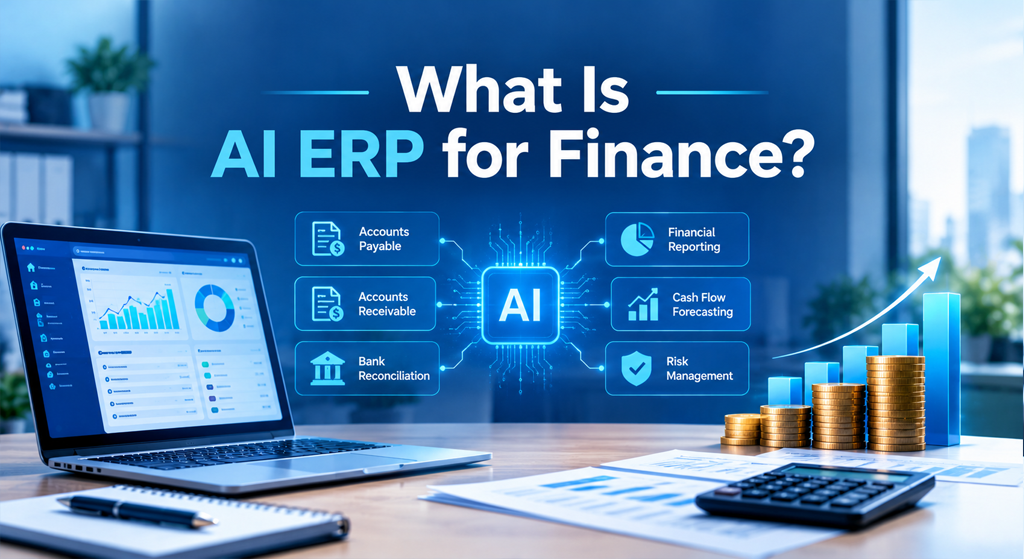
What Is AI ERP for Finance?
AI ERP for finance is an enterprise resource planning approach that combines connected financial records, automated workflows, analytical tools, and artificial intelligence to support financial monitoring and decision-making. Instead of simply recording invoices and payments, an AI-enabled finance system can analyse transaction histories, payment patterns, outstanding receivables, upcoming liabilities, and changes in business activity to help identify potential financial risks.
For example, a conventional report might show that a customer owes ₹8 lakh. An intelligent forecasting workflow could also consider the invoice due date, the customer’s previous payment behaviour, the outstanding amount, and the company’s upcoming obligations to highlight a possible timing gap.
However, the quality of any prediction depends on the data available, the forecasting method, and how well the system reflects actual business conditions. AI supports financial judgement; it does not guarantee that a customer will pay on time or that a forecast will be correct.
How AI ERP Detects Cash-Flow Risks Before They Become Critical
1. Identifying Delayed Customer Payments Before They Affect Working Capital
Late customer payments are one of the most common sources of cash-flow pressure. Even a reliable customer can delay payment because of an internal approval issue, a disputed invoice, or a temporary budget constraint. When receivables are managed manually, finance teams may discover the delay only after the invoice becomes overdue. By then, the expected cash may already have been allocated to supplier payments or production requirements.
An integrated ERP system can track invoice dates, payment terms, outstanding balances, and collection history. Where suitable AI capabilities are available, the system can analyse historical payment patterns and identify invoices that may require earlier attention.
For instance, if a customer regularly pays 15 days after the contractual due date, the forecast can reflect that pattern instead of assuming payment will arrive on the due date. Finance teams can then prioritise collection calls, clarify invoice disputes, and update their short-term cash forecast. The result is a more realistic view of expected collections and fewer decisions based on optimistic assumptions.
2. Predicting Supplier Payment Pressure Through Accounts Payable Analysis
Cash-flow forecasting is incomplete when it focuses only on incoming money. Businesses must also understand exactly when their financial obligations are likely to fall due. Supplier invoices, payroll, rent, loan repayments, taxes, logistics costs, and planned purchases can create overlapping cash requirements. If several large payments fall within the same week, a business may experience a temporary shortage even when its overall monthly forecast appears healthy.
AI ERP for finance can bring accounts payable data, payment terms, purchase commitments, and scheduled outflows into a consolidated view. Forecasting methods can then help identify periods when expected outflows may exceed available funds and probable inflows.
For example, a manufacturing SME may expect ₹18 lakh in customer collections over the next two weeks but have ₹22 lakh in supplier and operating payments due during the same period. The resulting ₹4 lakh gap is a warning that deserves investigation. This example is illustrative rather than a prediction for a specific business. Actual exposure would also depend on opening cash, payment timing, other receipts, credit facilities, and the reliability of the underlying records.
With earlier visibility, the finance manager can review collection priorities, discuss appropriate payment terms with suppliers, and assess whether purchases should be rescheduled. Such decisions are easier to make before a payment becomes urgent.
3. Using Predictive Cash-Flow Forecasting Instead of Static Spreadsheets
A spreadsheet prepared at the beginning of the month can become unreliable as soon as a customer delays payment, an urgent purchase arises, or a supplier changes a delivery schedule. Predictive forecasting addresses this limitation by incorporating updated transactional information and applying suitable forecasting methods to estimate future cash positions. Depending on the ERP platform, these methods may include historical time-series analysis, transaction-based forecasting, or driver-based models.
A transaction-based model uses information such as invoice due dates, expected receipts, supplier payment dates, and recorded cash balances. A statistical model may also identify recurring patterns, including seasonal sales fluctuations or regular changes in expenses.
For finance teams, the practical advantage is the ability to compare the expected cash position across different time horizons. A daily or weekly forecast can help manage immediate obligations, while a longer-term forecast supports purchasing, hiring, expansion, and financing decisions.
For example, if a forecast indicates that available cash could fall below a company’s internal safety threshold in ten days, the finance team can investigate the transactions driving that result. The warning becomes actionable when it identifies the expected shortfall, the relevant dates, and the transactions that need attention.
Importantly, forecasts should be refreshed as new information becomes available. A prediction based on outdated invoices or incomplete bank records may create false confidence rather than reduce risk.
4. Detecting Unusual Transactions and Unexpected Financial Changes
Not every cash-flow risk comes from a late payment or a large expense. Sometimes, the warning lies in an unusual transaction, an unexpected increase in spending, or a mismatch between financial records. AI-based anomaly detection can compare transactions against historical patterns, business rules, or expected ranges. Depending on the system and available data, it may flag duplicate invoices, unusual payment amounts, unexpected vendor changes, or expenses that differ significantly from established patterns.
For example, if a department’s purchase expenses rise sharply without a corresponding increase in production or sales activity, the system could flag the variance for review. Similarly, an unusually large payment scheduled just before a forecasted cash shortage may require verification. The purpose is not to assume fraud or automatically reject a transaction, but to direct attention toward exceptions that could otherwise go unnoticed.
Human review remains essential, particularly for high-value transactions, supplier bank-detail changes, and payments requiring additional authorisation.
5. Connecting Financial Dashboards With Real-Time Business Operations
A finance dashboard is useful only when its information helps decision-makers understand what is happening and what needs to happen next. When financial data is connected with purchasing, inventory, sales, production, and order management, finance teams gain a broader understanding of the factors influencing cash flow.
For instance, a manufacturing business may have sufficient funds to cover current expenses, but a major production order could require additional raw-material purchases before the customer makes an advance payment. A finance dashboard connected to operational commitments can help reveal this potential gap earlier.
An effective dashboard can display the current cash position, overdue receivables, upcoming payables, expected collections, forecast balances, and significant variances. Where supported, predictive alerts can highlight changes that deserve immediate attention.
The key is to move beyond displaying financial figures. The system should help finance managers understand the reason behind a warning, trace it to the underlying transactions, and coordinate a response with the relevant department.
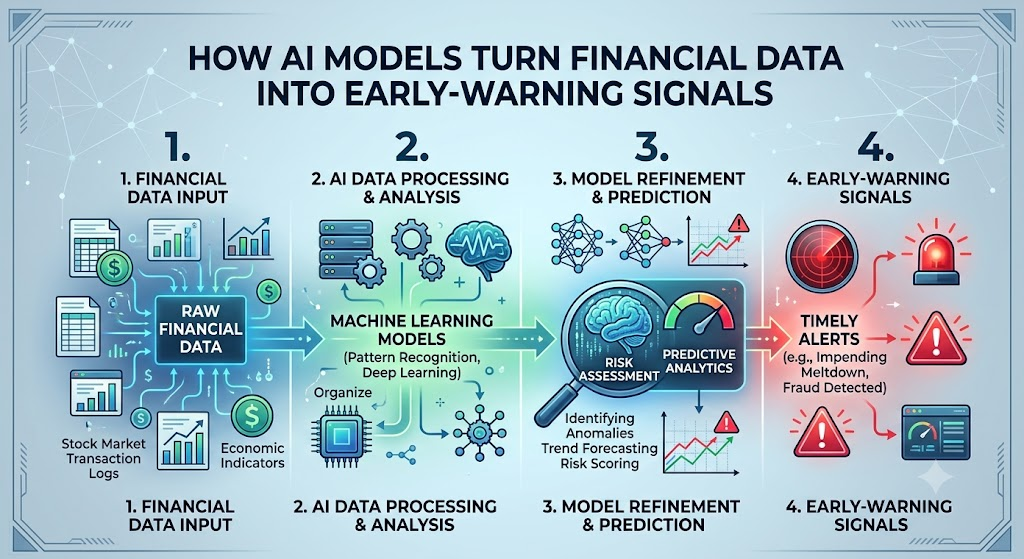
How AI Models Turn Financial Data Into Early-Warning Signals
The effectiveness of AI ERP for finance depends on how the system interprets financial data, identifies patterns, and communicates potential risks. A practical forecasting workflow can combine several analytical methods. Historical analysis helps identify recurring payment delays and seasonal cash requirements. Predictive models estimate likely collection dates or future balances using available transaction data. Rule-based alerts flag conditions such as overdue invoices, unusually high payments, or projected cash balances below an approved threshold.
More advanced implementations may combine these methods to produce a rolling cash-flow forecast. For example, the system may estimate expected customer receipts, incorporate scheduled supplier payments, and compare the projected balance against a minimum liquidity requirement.
However, businesses should not treat every AI-generated warning as a confirmed outcome. Finance teams need to understand the assumptions behind each forecast, verify significant exceptions, and compare previous predictions with actual results. This feedback helps identify where the forecasting process needs improvement.
What Should CFOs Monitor in an AI-Powered Finance Dashboard?
A useful cash-flow dashboard should connect financial warnings with measurable business indicators.The most important starting point is the projected cash balance over the coming days and weeks. Finance managers should compare this forecast with expected customer collections, overdue receivables, scheduled payments, and committed expenses. A projected negative balance or a breach of the company’s minimum cash threshold should trigger investigation.
Days Sales Outstanding (DSO) is another valuable measure because it indicates how long, on average, a business takes to collect payment after making a sale. Rising DSO can indicate slower collections and increasing pressure on working capital, although the result should be interpreted alongside payment terms, sales patterns, and customer mix.
Finance teams should also monitor forecast accuracy by comparing expected receipts and payments with actual outcomes. If the forecast repeatedly overestimates collections, management may need to revise its assumptions or improve customer payment tracking. Together, these indicators help decision-makers distinguish between a temporary timing difference and a more persistent financial problem.
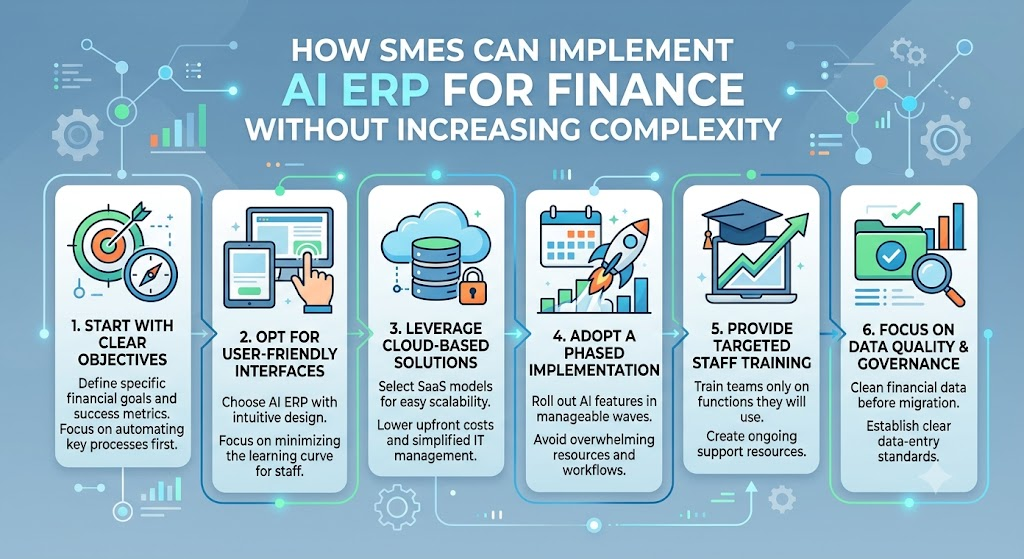
How SMEs Can Implement AI ERP for Finance Without Increasing Complexity
Implementing predictive finance capabilities does not require every SME to automate its entire finance department at once. A focused approach is often more practical. Start by consolidating the financial information that influences cash flow. Customer invoices, supplier bills, payment terms, bank balances, and scheduled expenses should be accurate and accessible through connected systems. If teams maintain conflicting records, even a sophisticated model may generate misleading forecasts.
Next, establish a baseline forecast using existing financial data. This gives the business a reference point against which to assess whether predictive analytics and automation improve visibility. Identify the recurring problems that create the greatest pressure, such as delayed collections, unpredictable purchasing, or payment approval bottlenecks.
Then introduce alerts and forecasting workflows for those specific risks. Assign responsibility for reviewing each warning, define escalation rules, and record whether the recommended action improved the outcome. Over time, compare forecast accuracy, collection performance, and the frequency of unexpected cash shortages.
Finally, review integration, access controls, data protection, and approval requirements before allowing automated workflows to influence financial transactions. High-value payments and sensitive changes should retain appropriate authorisation. The goal is not to replace finance professionals. It is to reduce the time spent assembling information so they can focus on financial analysis, risk management, and better business decisions.
Why Connected ERP Matters for Preventing Cash-Flow Crises
Predictive analytics cannot deliver dependable results when financial information is fragmented across disconnected applications and spreadsheets. An integrated ERP environment provides a common operational view of receivables, payables, purchasing, sales, and other relevant transactions. This connection helps finance teams understand not only the current cash position but also the operational commitments that may change it.
For growing SMEs, this is particularly important when transaction volumes increase, multiple departments approve expenses, or management needs consolidated financial visibility across locations.
Bluechip Solutions provides ERP software and business process automation capabilities designed to help businesses connect processes, manage workflows, and improve access to business information. Explore Bluechip Solutions to understand how integrated ERP can support more connected business operations.
The right solution should be evaluated against your specific requirements for financial reporting, forecasting, workflow automation, integrations, security, and approval controls. Predictive cash-flow forecasting and AI-based anomaly detection should be confirmed as available capabilities rather than assumed features of every ERP implementation.
Frequently Asked Questions About AI ERP for Finance
How does AI ERP for finance help prevent cash-flow problems?
AI ERP for finance can analyse connected receivables, payables, payment schedules, and historical transactions to estimate future cash positions. By identifying possible shortfalls and unusual financial patterns earlier, it gives finance teams more time to investigate risks and take corrective action.
Can AI predict a cash shortage before it happens?
AI can estimate the likelihood of a cash shortage by analysing expected receipts, scheduled payments, historical patterns, and available balances. However, the reliability of that estimate depends on data quality, model performance, and changing business conditions. It is an early-warning tool, not a guarantee.
Is AI-powered cash-flow forecasting suitable for SMEs?
Yes. SMEs can benefit from improved visibility into customer collections, supplier obligations, and upcoming expenses. A practical implementation can begin with accurate financial records, connected ERP modules, and short-term forecasting before expanding into more advanced predictive analytics.
What is the difference between traditional cash-flow forecasting and AI-based forecasting?
Traditional forecasting often relies on manually prepared spreadsheets, fixed assumptions, and historical figures. AI-based forecasting can analyse transaction-level data, detect patterns, and update estimates as new information becomes available. Both approaches still require financial oversight and regular accuracy checks.
Which financial data is needed for AI cash-flow forecasting?
Useful data includes opening cash balances, customer invoices, payment due dates, collection history, supplier bills, scheduled payments, recurring expenses, and relevant bank transactions. Businesses should also account for committed purchases, credit facilities, and other material cash movements when these affect liquidity.
Conclusion: Detect Cash-Flow Risks Before They Disrupt Business Growth
A business should not have to wait for a failed payment or an urgent supplier call to discover that its cash position is under pressure.
With connected financial data, reliable forecasting, and carefully implemented AI capabilities, finance teams can identify potential collection delays, anticipate payment pressure, and investigate unusual transactions before they become operational problems.
For SME CEOs and CFOs, the real value of AI ERP for finance is not simply faster reporting. It is the opportunity to make better-informed decisions while there is still time to act.
Want better visibility into your business finances? Explore ERP solutions from Bluechip Solutions and discuss how connected financial workflows, reporting, and automation can support your business requirements.
Get started: Visit Bluechip Solutions to explore ERP solutions or request a consultation through your preferred contact channel.